Connected Trailers Move to Centre Stage in Europe’s Digital Freight Economy
Europe’s freight and logistics sector is in the middle of a structural shift, driven less by new vehicles and more by the data that flows through them. As regulatory pressure tightens, margins remain thin and supply chains grow more complex, trailer intelligence has become just as critical as engine performance. Against that backdrop, the integration of OEM-grade trailer data into fleet management platforms is no longer a nice-to-have. It is becoming foundational infrastructure.
A new partnership between Cartrack, a global mobility solutions provider, and Schmitz Cargobull, Europe’s largest semi-trailer manufacturer, signals a meaningful step in that direction. By enabling the seamless flow of TrailerConnect® telematics data directly into Cartrack’s fleet platform, the collaboration brings trailer assets fully into the digital operational picture, without additional hardware, manual integration or fragmented systems.
The significance lies not in the announcement itself, but in what it unlocks. For transport operators managing mixed fleets across borders, the ability to access OEM-grade trailer data alongside vehicle, driver and route intelligence fundamentally changes how fleets are monitored, optimised and governed.
Why Trailer Data Has Become Strategic Infrastructure
For years, trailers were the blind spot of fleet operations. Vehicles generated data, drivers were monitored and routes optimised, yet the trailer often remained digitally silent unless retrofitted with aftermarket sensors. That gap is no longer sustainable, particularly in temperature-controlled logistics, high-value freight and regulated supply chains.
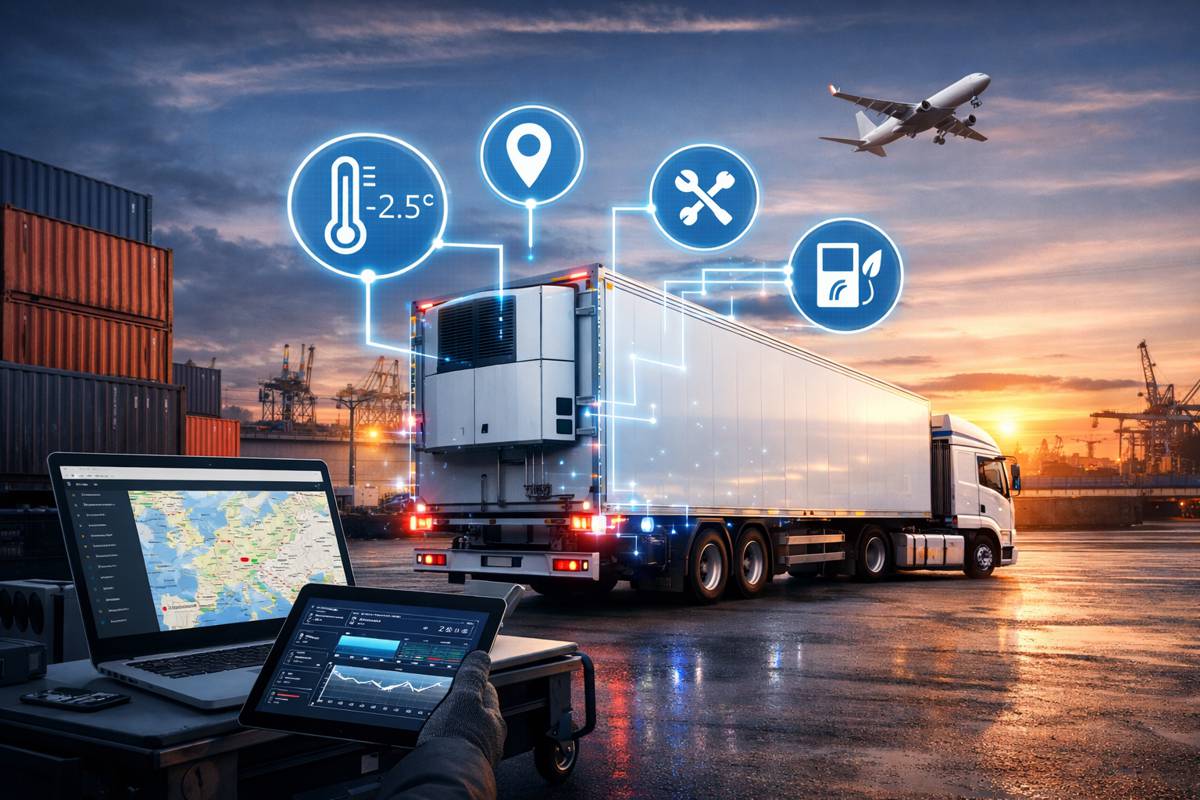
TrailerConnect® telematics, fitted at the factory by Schmitz Cargobull, already captures a wide range of operational parameters. What has changed is how that data is made accessible. Through this integration, opted-in customers see trailer location, temperature, route progression and load condition directly within Cartrack’s platform, alongside their existing fleet data.
This matters because operational risk increasingly sits at trailer level. Cold chain compliance failures, unplanned downtime, cargo damage and security breaches rarely stem from the tractor unit alone. Without real-time trailer visibility, operators are left reacting after the fact. Integrated telematics turns that model on its head, shifting fleets from incident response to operational foresight.
Data Control and Trust at the Core of the Integration
One of the defining features of the partnership is the emphasis on data governance. Rather than forcing operators into opaque data-sharing arrangements, the integration respects trailer owners’ control over their information.
As Soeren Danielsen, Manager of Strategy and Business Development at Schmitz Cargobull, explains: “The TrailerConnect® Data Management Center gives transport companies full control over their data and allows them to selectively share it with third parties – hauliers stay in control of their data and decide exactly what to share and with whom. By intelligently linking vehicle, route, and order information, users can go beyond just position and temperature data – selecting, processing, and transmitting a wide range of information to external systems at the push of a button. TrailerConnect® stands for connectivity, secure data consolidation and transparency, delivering real value to all stakeholders in the supply chain.”
In an era shaped by GDPR enforcement and increasing scrutiny over data ownership, that approach is commercially significant. It allows fleet operators to benefit from ecosystem integration without relinquishing strategic control, a balance many digital platforms still struggle to achieve.
Hardware-Free Integration and the Economics of Scale
From an operational standpoint, the absence of additional hardware requirements is a quiet but critical detail. Retrofitting trailers across large fleets is expensive, time-consuming and often disruptive. By relying on OEM-fitted TrailerConnect® units, Cartrack removes friction from onboarding and accelerates time to value.
This model aligns with broader industry trends. According to research by the European Commission, logistics operators consistently cite integration complexity and upfront investment as barriers to digital adoption. Hardware-free integration lowers both, making advanced telematics accessible not only to large fleets but also to mid-sized operators under cost pressure.
Once connected, trailer data is visualised through Cartrack’s dashboards and driver application, allowing operational teams to work from a single interface rather than juggling multiple systems. In practice, that consolidation reduces training requirements, minimises data silos and improves decision speed across dispatch, compliance and maintenance teams.
From Compliance Tool to Operational Intelligence
While temperature monitoring and location tracking are often framed as compliance tools, their real value lies in operational intelligence. Continuous access to trailer temperature data, for example, enables proactive intervention before thresholds are breached, reducing spoilage risk and insurance exposure in cold chain logistics.
Location and route data, when combined with vehicle and driver information, supports more accurate ETA forecasting and dynamic route optimisation. That capability is increasingly important as congestion, border controls and urban delivery restrictions introduce volatility into European freight movements.
Maintenance is another area where integrated trailer data shifts the equation. Predictive insights allow operators to schedule servicing based on actual usage and condition rather than fixed intervals, reducing unplanned downtime and extending asset life. In a market where trailer availability directly impacts revenue, that efficiency translates quickly into commercial advantage.
Mixed Fleets and the Reality of European Transport
Few European operators run homogenous fleets. Mergers, subcontracting and cross-border operations result in mixed assets sourced from multiple manufacturers. Cartrack’s ability to present Schmitz Cargobull trailer data alongside other vehicles and equipment addresses that reality head-on.
The platform supports visibility across multi-brand fleets, allowing operators to apply consistent performance metrics and compliance standards regardless of asset origin. That consistency is particularly valuable for logistics providers serving multinational clients who expect uniform reporting and service levels across regions.
By automating inspections and reducing paperwork, the integration also helps address one of the industry’s quieter pain points: administrative overload. Digital inspection records and automated reporting reduce manual effort while improving audit readiness, a growing concern as enforcement becomes more data-driven.
Sustainability Reporting Moves from Aspirational to Measurable
Sustainability commitments are increasingly contractual rather than voluntary. Shippers are demanding evidence, not promises, and transport providers must back up claims with data. Through fuel and emissions tracking, Cartrack’s platform supports more accurate environmental reporting, linking trailer utilisation to broader fleet performance.
While trailers themselves are not fuel-burning assets, their condition, routing and utilisation directly influence vehicle efficiency. Integrated data allows operators to identify inefficiencies such as under-utilised trailers, suboptimal routing or avoidable idling linked to loading delays. Incremental improvements across large fleets quickly add up to measurable emissions reductions.
This capability aligns with EU policy direction, where digital monitoring is expected to underpin future transport sustainability frameworks. Platforms that already embed this intelligence are better positioned as reporting requirements evolve.
Commercial Scale and Global Context
Cartrack’s scale lends weight to the partnership. As a subsidiary of Karooooo Limited, listed on NASDAQ, Cartrack supports more than 125,000 commercial customers and over 2.6 million active subscribers across more than 20 countries. That footprint spans logistics, construction, agriculture and industrial transport, sectors where trailer visibility directly affects operational risk.
Schmitz Cargobull brings comparable industrial heft. Founded in 1892 and still family-owned, the company produces around 60,000 vehicles annually and operates ten production sites across Europe and Australia. Its €2.4 billion turnover in the 2023/24 financial year underscores the scale at which digital trailer connectivity is now being deployed.
The partnership therefore sits at the intersection of industrial manufacturing and cloud-based operations, reflecting a broader convergence shaping the transport sector.
Platform Strategy Over Point Solutions
A recurring challenge in fleet digitisation has been the proliferation of point solutions. Operators adopt tools for specific problems, only to find themselves managing fragmented systems that do not talk to one another. By integrating OEM trailer data directly into an existing fleet platform, Cartrack reinforces a platform-first strategy.
As Richard Schubert, Group COO at Cartrack, notes: “This partnership with Schmitz Cargobull brings unparalleled value to transport businesses looking to digitally transform their trailer operations. Together, we offer complete transparency, smarter insights, and secure, scalable data solutions to simplify complex logistics workflows.”
The emphasis on simplification is telling. As fleets scale, complexity becomes the enemy of resilience. Platforms that absorb complexity rather than amplify it are likely to define the next phase of digital transport management.
A Signal of Where the Market Is Heading
Viewed in isolation, the integration could be read as a technical enhancement. In reality, it signals a deeper shift in how trailers are positioned within the digital freight ecosystem. Trailers are no longer passive assets. They are data-generating nodes, contributing directly to operational intelligence, compliance assurance and commercial performance.
As OEMs, platform providers and operators align around open, secure data exchange, the industry moves closer to a genuinely connected transport network. The Cartrack and Schmitz Cargobull partnership does not claim to solve every challenge facing European logistics. What it does do is remove a long-standing blind spot, bringing trailer intelligence into the operational mainstream.
For fleets navigating regulatory pressure, sustainability demands and margin constraints, that visibility is not incremental improvement. It is a structural advantage.