Building Coherence into Metro Manila’s Mass Transit
Metro Manila’s rail network is once again at the centre of a policy debate that could reshape how urban transport concessions are structured across Southeast Asia. The Philippines’ Department of Transportation is reviewing an unsolicited proposal from a private rail operator to consolidate and manage the operations of Metro Rail Transit Line 3 and Light Rail Transit Line 1 under a single concession. On the surface, the idea appears operational. Dig a little deeper, though, and it speaks to broader questions around investor confidence, fare regulation, network resilience, and the long-term viability of public transport systems in fast-growing megacities.
For a capital region grappling with chronic congestion, productivity losses, and mounting environmental pressures, rail integration is not just about smoother commutes. It is about whether public infrastructure can keep pace with economic growth while remaining attractive to private capital. The current review offers a window into how the Philippines is recalibrating that balance.
Why Integration Matters for Metro Manila and Beyond
Metro Manila’s rail system has long been criticised for fragmentation. Different operators, concession structures, and regulatory approaches have resulted in operational silos that passengers feel daily, from ticketing inconsistencies to service disruptions that ripple unevenly across the network. Integrating the operations of the two busiest lines could, in theory, address some of those long-standing inefficiencies.
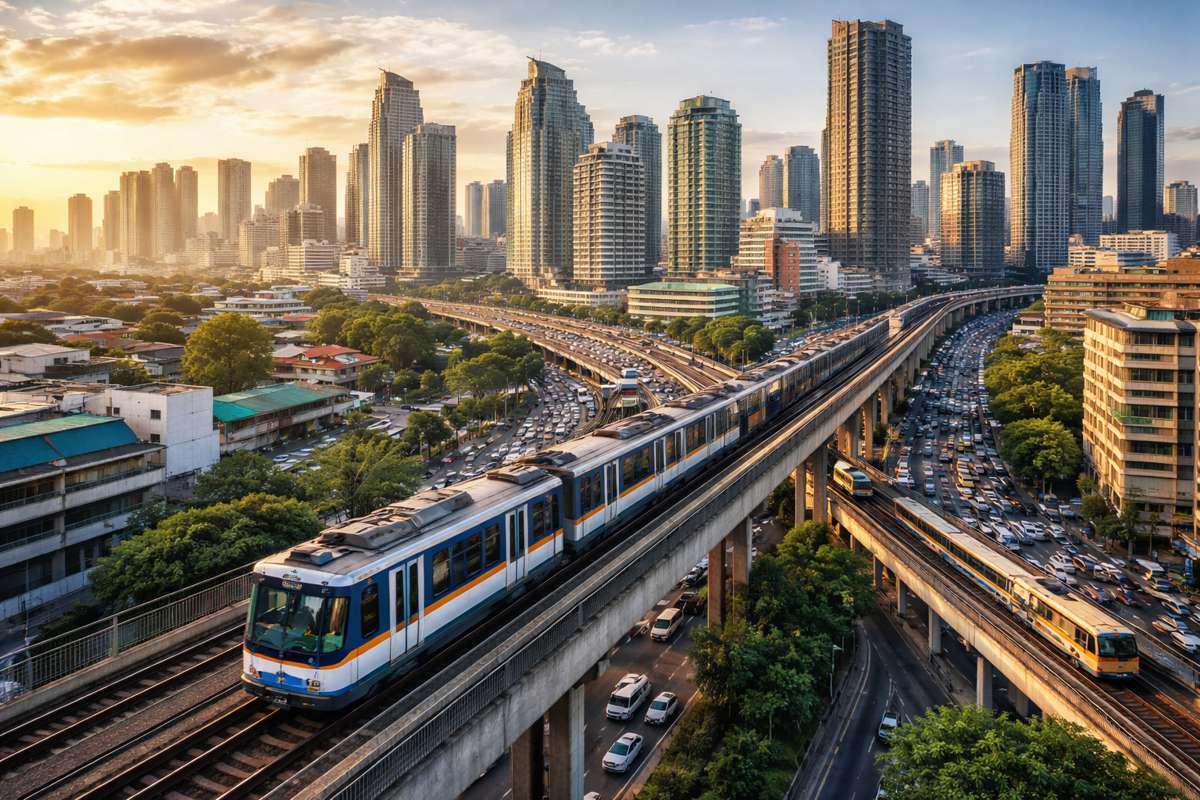
The logic is straightforward. MRT-3 and LRT-1 run along interconnected corridors, with MRT-3 tracing the heavily trafficked EDSA artery and LRT-1 forming a north to south spine that serves dense residential and commercial districts. According to government figures, MRT-3 carried around 388,000 passengers per day in 2025, while LRT-1 handled nearly 324,000 daily in 2024. Together, they represent the backbone of Metro Manila’s mass transit system.
From an infrastructure perspective, consolidation could unlock economies of scale. Shared maintenance regimes, unified operational control centres, and harmonised staffing structures can reduce duplication and improve reliability. International experience supports this view. Integrated urban rail operators in cities such as Singapore and Hong Kong consistently outperform fragmented systems in terms of punctuality, asset lifecycle management, and passenger satisfaction, according to data from the International Association of Public Transport.
Commercial Viability and the Role of Network Effects
The Acting Transport Secretary has indicated that a combined concession could be commercially viable, particularly given the planned Unified Grand Central Station, which is scheduled to open by 2027. This interchange is expected to physically and operationally link MRT-3, LRT-1, and other rail lines, creating a true multimodal hub.
Network effects matter in rail economics. As lines become more interconnected, the value of the system increases disproportionately, not just linearly. A single operator overseeing both MRT-3 and LRT-1 could optimise timetables, manage rolling stock deployment more flexibly, and coordinate service recovery during incidents. Over time, these efficiencies translate into lower operating costs per passenger kilometre, a metric closely watched by both regulators and investors.
However, commercial viability is not determined by ridership alone. Fare structures, subsidy mechanisms, and regulatory predictability play decisive roles. Without clarity on how fares are adjusted and how revenue risks are shared, even high-demand lines can struggle financially.
Lessons from LRT-1’s Financial Pressures
The review comes at a sensitive moment for Light Rail Manila Corp., the private operator of LRT-1. The company has faced persistent financial strain, driven largely by postponed fare increases and delays in the Cavite Extension due to right-of-way issues. These challenges are not unique to the Philippines. Across emerging markets, rail concessions often falter when contractual assumptions collide with political realities.
Delayed fare adjustments erode revenue predictability. Right-of-way disputes inflate capital costs and delay ridership growth. Together, they undermine the internal rates of return that underpin private investment decisions. Analysts at the World Bank have repeatedly noted that uncertainty around these factors increases the cost of capital for transport projects, ultimately raising the burden on public finances.
In this context, consolidation could offer a partial remedy. A larger, integrated concession may be better positioned to absorb short-term shocks, cross-subsidise operations, and negotiate more balanced risk-sharing arrangements with government. That said, scale alone does not solve structural issues.
Regulatory Certainty as the Real Differentiator
Transport economists and infrastructure investors consistently point to regulatory certainty as the single most important determinant of private sector participation in rail projects. Experts commenting on the Philippine market have emphasised the need for stronger regulatory implementation, predictable fare frameworks, and faster resolution of right-of-way disputes.
These factors directly influence investor confidence. According to the Asian Development Bank, projects with clear tariff adjustment mechanisms and enforceable concession agreements are significantly more likely to reach financial close and maintain operational stability over their lifecycle. Conversely, ad hoc policy interventions, even when politically popular, can deter future investment and increase reliance on public funding.
For Metro Manila, the stakes are high. The region’s population continues to grow, and traffic congestion is estimated to cost the Philippine economy billions of dollars annually in lost productivity. Rail expansion and optimisation are not optional. They are economic necessities.
Implications for Public Private Partnerships in the Philippines
The proposal to consolidate MRT-3 and LRT-1 under a single concession also raises broader questions about the evolution of public private partnerships in the country. Historically, the Philippines has oscillated between state-led operation and private concessions, often in response to performance issues or political shifts.
A unified concession could signal a more mature phase in the PPP framework, one that recognises the importance of integrated systems rather than isolated assets. For policymakers, it is an opportunity to reset expectations, clarify regulatory commitments, and demonstrate that lessons have been learned from past projects.
For investors, the review will be closely watched as an indicator of how future rail concessions might be structured. Will risks be allocated more realistically. Will fare policies be insulated from short-term political pressures. Will right-of-way acquisition be addressed earlier in the project lifecycle. The answers will shape capital flows not just into rail, but into other infrastructure sectors as well.
A Regional Signal to Other Megacities
Metro Manila is not alone in facing these challenges. Cities across Southeast Asia are racing to expand urban rail networks amid rapid urbanisation. Jakarta, Bangkok, and Ho Chi Minh City are all experimenting with different concession models and integration strategies.
If the Philippines succeeds in creating a commercially viable, operationally efficient unified rail concession, it could provide a template for other emerging megacities. Conversely, if structural issues remain unresolved, consolidation risks becoming a cosmetic fix rather than a substantive reform.
The review process itself is therefore as important as the eventual decision. Transparent evaluation criteria, stakeholder engagement, and clear communication will be critical to building trust across the ecosystem.
Towards a More Coherent Urban Rail Future
At its core, the proposal to consolidate MRT-3 and LRT-1 is about coherence. Coherence in operations, in regulation, and in long-term planning. For passengers, it promises a more seamless travel experience. For government, it offers a chance to optimise public assets. For investors, it tests whether the Philippines is ready to offer the stability that large-scale infrastructure demands.
Whether the proposal proceeds or not, the discussion marks a shift in how urban rail is being framed. No longer as standalone lines, but as interconnected systems that underpin economic competitiveness and social mobility. In that sense, the review is less about two rail lines and more about the future of infrastructure governance in one of Asia’s most dynamic regions.