Crete Emerging as Europe’s Next Space Technology Frontier
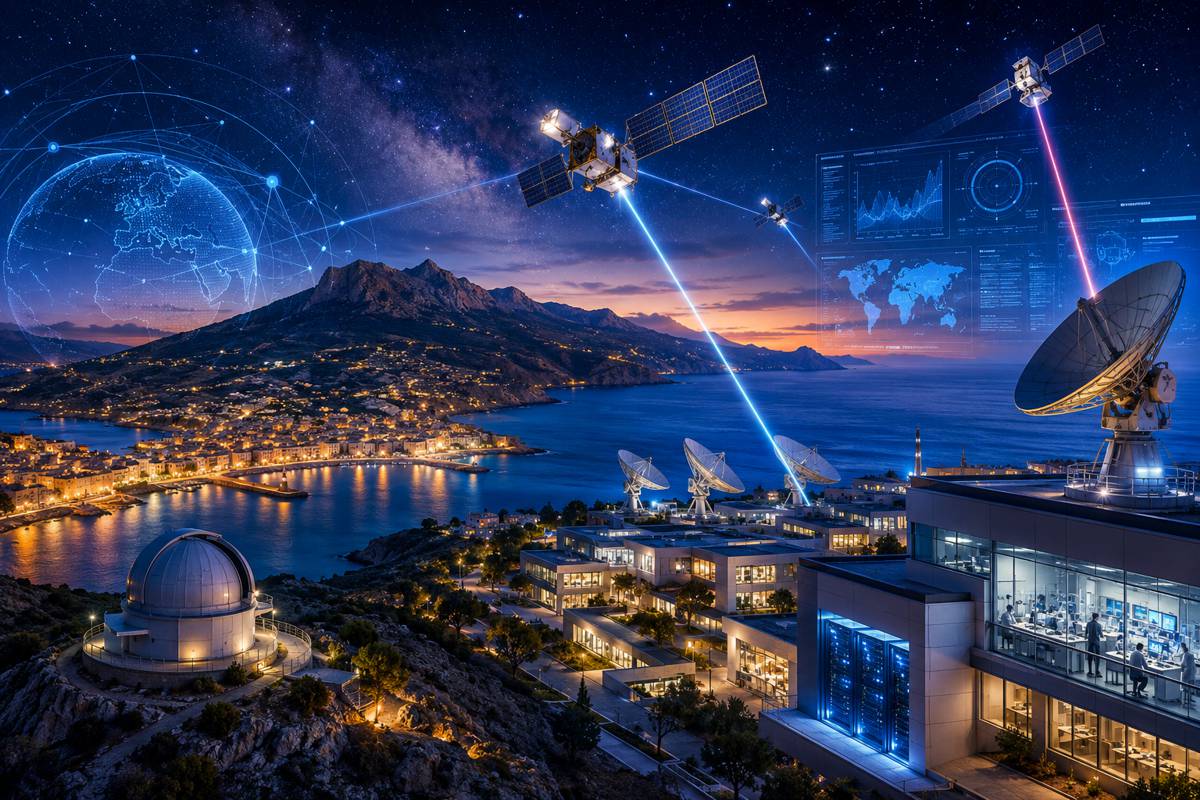
For decades, Crete has been known globally for tourism, archaeology and Mediterranean culture. Now, however, the Greek island is quietly positioning itself for an entirely different future — one built around satellites, quantum technologies, artificial intelligence and Europe’s rapidly expanding space economy.
Backed by a €35 million European funding programme known as SPACE-Crete, the island is now moving decisively into the aerospace and deep-tech sectors, with ambitions that stretch far beyond academic research. The initiative aims to transform Greece from a consumer of space technologies into an active producer of advanced systems, applications and specialised expertise.
What makes the project particularly significant is the level of international support already secured. Major aerospace and defence companies including Airbus, OHB, Safran Electronics & Defense and Planetek Italia have all signed cooperation agreements or formal letters of intent to participate in the programme.
At the same time, some of Europe’s leading scientific institutions, including Germany’s DLR aerospace centre and France’s CEA research organisation, are joining the effort. Together, they are helping establish Crete as a regional anchor for next-generation space technologies in southeastern Europe.
The initiative comes as Europe accelerates investment into strategic technologies linked to digital sovereignty, secure communications, artificial intelligence and advanced sensing systems. Increasing geopolitical tensions, cybersecurity concerns and growing competition with the United States and China have pushed Brussels to prioritise independent European capabilities in both civilian and dual-use space infrastructure.
SPACE-Crete HAS arrived at exactly the right moment.
Briefing
- €35 million SPACE-Crete initiative ranks second among 61 Horizon Europe proposals
- Crete Center of Excellence in Emerging Space Technologies (CCEST) to be established
- Programme focuses on quantum communications, smart space systems and quantum sensors
- Major aerospace firms including Airbus, OHB and Safran joining the initiative
- More than 120 specialised jobs expected alongside startup incubation and testing infrastructure
A European Vote of Confidence
The SPACE-Crete initiative is coordinated by the Foundation for Research and Technology Hellas, widely known as FORTH or ITE, through its Institute of Computer Science.
Its success in the highly competitive Horizon Europe “Teaming for Excellence” programme immediately drew attention across both scientific and industrial circles. Ranking second among 61 proposals from across Europe is no minor achievement. Horizon Europe evaluations are considered among the most demanding research assessments globally, with proposals judged not only on scientific excellence but also long-term economic viability and strategic relevance.
The result effectively signals that European institutions view Crete as a credible location for long-term investment into advanced space technologies.
The project will lead to the creation of the Crete Center of Excellence in Emerging Space Technologies, known as CCEST, which will serve as the programme’s central research and innovation hub.
Professor Panagiotis Tsakalides, Director of the Institute of Computer Science and coordinator of SPACE-Crete, has emphasised that the initiative is designed as a genuine industrial ecosystem rather than a purely academic exercise. International companies are expected to collaborate directly with researchers, support doctoral programmes and host Greek scientists at their own facilities to encourage knowledge transfer and long-term industrial integration.
That approach reflects a broader shift taking place across Europe’s space economy, where partnerships between academia, startups and major aerospace firms are becoming increasingly essential.
Quantum Communications
One of the most strategically important areas within SPACE-Crete involves quantum and optical communications technologies.
As global reliance on satellite systems grows, so do concerns over cybersecurity vulnerabilities and data interception risks. Future satellite communications networks will require far stronger encryption and significantly greater bandwidth capacity than today’s systems can provide. Quantum communications offer a potential solution.
Using quantum key distribution technologies, next-generation networks could theoretically achieve ultra-secure encrypted communications resistant to conventional hacking methods. This has enormous implications for governments, defence systems, critical infrastructure operators and financial institutions.
The involvement of Swiss quantum technology specialist ID Quantique highlights the seriousness of these ambitions. The company is internationally recognised as one of the leaders in quantum-safe encryption and secure communication technologies.
Optical communications are equally important. Traditional radio-frequency satellite communications are increasingly struggling to handle rising global data volumes. Laser-based optical systems can dramatically increase transmission speeds while reducing latency and improving security.
These technologies are expected to underpin future:
- secure government communications
- autonomous transport systems
- AI-enabled infrastructure
- satellite internet services
- defence networks
- future 6G connectivity
For Europe, developing independent expertise in these fields is becoming strategically critical.
AI and Smart Space Systems
Another major focus area for SPACE-Crete involves smart space systems and onboard artificial intelligence.
Modern satellites generate extraordinary volumes of data from Earth observation, climate monitoring, maritime tracking and infrastructure surveillance systems. Historically, much of this data needed to be transmitted back to Earth for processing, creating delays and requiring enormous bandwidth capacity. That model is rapidly changing.
New generations of satellites increasingly process data directly in orbit using embedded AI systems. Known as edge computing in space, this approach allows satellites to analyse information in real time before transmitting only essential outputs to ground stations. The implications are substantial.
AI-enabled satellites are expected to play growing roles in:
- wildfire detection
- disaster response
- border monitoring
- shipping and logistics
- smart agriculture
- environmental analysis
- infrastructure resilience
- urban planning
For industries such as construction and infrastructure management, these systems may eventually become essential operational tools.
Future smart infrastructure networks could increasingly depend on integrated satellite intelligence capable of monitoring transport corridors, utilities, flood risks and structural stability continuously from orbit.
Quantum Sensors and the Hidden Infrastructure Economy
Perhaps the most commercially disruptive area of the programme involves quantum sensing technologies.
Quantum sensors are capable of detecting incredibly small variations in gravity, magnetic fields and motion. While still emerging commercially, the technology is expected to have enormous industrial applications across multiple sectors.
Potential uses include:
- underground mapping
- tunnel detection
- mineral exploration
- precision navigation
- earthquake monitoring
- subsea infrastructure analysis
- structural monitoring
- defence applications
For sectors such as mining, tunnelling, infrastructure and energy, the commercial value could be transformative.
Many of these technologies also align closely with Europe’s growing interest in resilient critical infrastructure and digital twins — virtual models capable of monitoring and predicting the condition of real-world assets.
In that sense, SPACE-Crete is not simply about space exploration. It is increasingly tied to the future of intelligent infrastructure systems operating on Earth.
Building a Southern European Innovation Cluster
At first glance, Crete may appear an unusual location for a space technology hub. Yet strategically, the island offers several important advantages.
Crete already possesses strong scientific infrastructure through the University of Crete and FORTH, both internationally respected research institutions. The island also hosts the Skinakas Observatory, which celebrates its 40th anniversary in 2026 and provides valuable astronomical and optical observation capabilities.
Geographically, Crete occupies a highly strategic position between Europe, the Middle East and North Africa. Combined with lower operating costs than many northern European technology centres, the island presents an attractive environment for long-term research investment.
The programme also aligns with wider efforts to diversify the Greek economy beyond tourism and seasonal industries.
Officials behind the initiative have made clear that SPACE-Crete is intended to create a sustainable high-value technology ecosystem capable of generating skilled employment, attracting international investment and encouraging Greek scientific talent to return from abroad.
Reversing Greece’s Brain Drain
One of the programme’s most important objectives involves reversing the long-running scientific brain drain that accelerated during Greece’s financial crisis.
Over the past decade, thousands of highly skilled Greek engineers, software developers and scientists relocated to northern Europe and North America in search of opportunities unavailable domestically. SPACE-Crete aims to change that trajectory.
More than 120 highly specialised positions are expected to be created through the initiative, supported by competitive salaries, doctoral programmes and relocation incentives designed to attract Greek researchers currently working overseas.
The University of Crete is also developing new postgraduate and doctoral programmes linked directly to the initiative, helping establish a long-term talent pipeline connected to the emerging European space economy. Importantly, the programme goes beyond research alone.
Plans are already underway for the creation of SPACE-Crib, a dedicated startup incubator focused on space technologies and advanced digital systems. Testing and certification infrastructure — currently absent in Greece — will also be developed as part of the initiative.
That infrastructure could eventually allow Greek companies to participate more consistently in European space programmes not merely as observers, but as suppliers, subcontractors and technology developers.
A Long-Term Economic Transformation
The broader significance of SPACE-Crete may ultimately extend far beyond aerospace.
Historically, advanced technology clusters often create ripple effects across wider regional economies. Aerospace ecosystems have previously transformed cities including Toulouse, Bremen and Turin into major innovation centres supporting manufacturing, AI, software engineering and advanced research. Crete could now be attempting a similar transition.
The development of advanced digital infrastructure, cybersecurity expertise, AI research capabilities and international scientific partnerships may accelerate wider economic diversification across the island. For Europe, meanwhile, projects like SPACE-Crete represent part of a much larger strategic transition.
The global space economy is evolving rapidly from a government-led industry into a highly competitive commercial ecosystem increasingly intertwined with artificial intelligence, cybersecurity, infrastructure resilience and advanced communications.
Crete’s emergence within that landscape signals that Europe’s next generation of innovation hubs may not necessarily emerge from traditional industrial capitals alone.
Increasingly, they may arise in places willing to combine research excellence, strategic investment and long-term technological ambition into entirely new economic identities.