Virtual Twins Replacing Spreadsheets and Aging IT in Manufacturing
Manufacturing’s growing dependence on spreadsheets and ageing IT systems is creating a hidden bottleneck across global industry. As product complexity increases and supply chains become more interconnected, many manufacturers are discovering that traditional tools struggle to provide the visibility and coordination needed for modern production environments.
Drawing on insights from Adrian Wood, Director of Strategic Business Development at DELMIA, the discussion highlights how model-based manufacturing, virtual twin technology and AI-assisted decision-making are helping manufacturers replace fragmented processes with connected digital operations.
The shift extends far beyond software modernisation. Across sectors including automotive, aerospace, electronics and industrial equipment, manufacturers are rethinking how information flows between engineering, planning, production and suppliers. Organisations that establish a unified digital foundation are increasingly able to respond faster to change, improve quality control and reduce operational risk, while those relying on disconnected systems often find themselves spending valuable time reconciling data rather than improving performance.
Briefing
- Manufacturers are increasingly replacing spreadsheet-driven processes with model-based digital operations.
- Unified data platforms help eliminate costly information silos between engineering, planning and production teams.
- Virtual twin technology allows manufacturers to simulate and validate changes before implementation.
- AI-assisted planning improves scheduling, resource allocation and decision-making under real-world constraints.
- Digital transformation initiatives are delivering measurable improvements in productivity, quality, traceability and operational resilience.
Manufacturing Complexity Has Outgrown Legacy Systems
For decades, spreadsheets served as the universal language of manufacturing operations. They provided flexibility, familiarity and relatively low implementation costs. Legacy enterprise applications similarly offered structure and control within specific business functions.
The problem is not that these tools are inherently ineffective. Rather, they were created during a period when manufacturing systems were less interconnected, product lifecycles were longer and global supply networks were considerably simpler. Modern production environments generate enormous volumes of engineering, operational and supplier data that must remain synchronised across multiple functions and locations.
Research from the World Economic Forum and consulting firms including McKinsey consistently highlights that data fragmentation remains one of the most significant barriers to industrial productivity. In many organisations, engineering, manufacturing, procurement, quality and maintenance departments still operate using separate information systems, each maintaining its own version of reality.
This fragmentation creates delays whenever change occurs. Engineering modifications must be manually interpreted and transferred between departments. Production schedules require constant adjustment. Quality investigations often involve searching through multiple databases, emails and spreadsheets to reconstruct events. Valuable time disappears into administrative work rather than productive manufacturing activity.
The Rise of the Digital Thread
Leading manufacturers increasingly recognise that competitive advantage depends upon creating a continuous digital thread connecting product design, production planning, factory operations and lifecycle management.
A digital thread enables information to flow seamlessly throughout an organisation while maintaining traceability and version control. Instead of multiple disconnected files and databases, stakeholders access a shared and continuously updated model of products, processes, resources and operational constraints.
This approach transforms how decisions are made. When engineering changes occur, their impact can be assessed across manufacturing lines, tooling requirements, supplier relationships, work instructions and production schedules almost immediately. Rather than relying on manual interpretation, organisations gain visibility into potential consequences before costly mistakes occur.
The concept aligns closely with broader Industry 4.0 initiatives that seek to connect digital and physical operations through data-driven decision-making. According to the International Data Corporation (IDC), global spending on digital transformation technologies continues to rise as manufacturers prioritise resilience, agility and operational efficiency in increasingly volatile markets.
Virtual Twins Become the New Testing Ground
One of the most significant developments within modern manufacturing is the emergence of virtual twin technology.
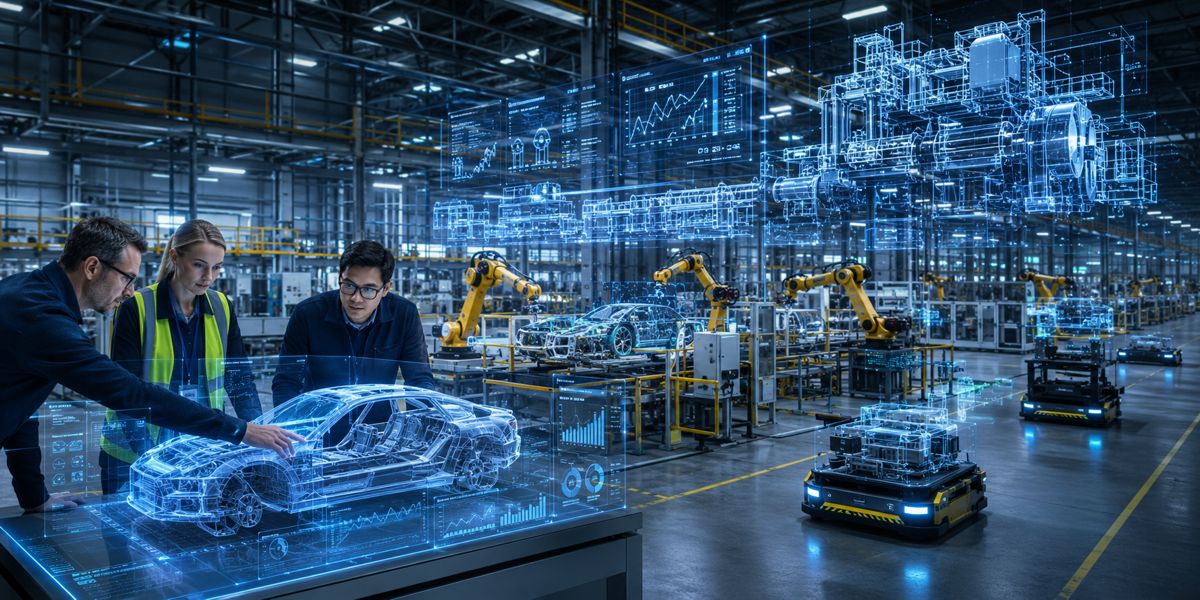
Unlike traditional simulations, virtual twins combine real-world operational data with sophisticated digital models to create dynamic representations of products, factories and production systems. These models evolve continuously as conditions change, enabling organisations to test scenarios before making real-world commitments.
The value becomes particularly evident during product introductions and engineering modifications. Rather than discovering problems during pilot builds or production ramp-up, manufacturers can validate processes virtually, identifying bottlenecks, ergonomic concerns, equipment limitations and quality risks long before physical implementation.
Virtual twins also support collaboration across departments. Engineers, planners, operators and management teams can evaluate alternatives using the same model, reducing misunderstandings and improving alignment around strategic decisions.
As computational capabilities continue expanding and industrial data becomes more accessible, virtual twins are moving from specialised engineering tools to central components of enterprise-wide manufacturing governance.
Artificial Intelligence Moves from Analytics to Decision Support
Artificial intelligence is becoming another critical component of manufacturing transformation.
Industrial environments generate vast quantities of information from machinery, sensors, enterprise systems, supply chains and customer demand signals. Analysing these datasets manually is increasingly impractical. AI technologies provide a mechanism for identifying patterns, evaluating options and supporting operational decisions at a scale beyond human capability.
The most effective implementations focus on augmentation rather than replacement. Planners, engineers and supervisors retain responsibility for final decisions while AI systems perform complex calculations, evaluate constraints and identify optimal alternatives.
Scheduling provides a useful example. Traditional planning approaches often struggle when demand fluctuates, supply disruptions occur or production priorities change unexpectedly. AI-enabled systems can rapidly assess thousands of variables simultaneously, generating feasible schedules while considering material availability, workforce capacity, equipment constraints and delivery commitments.
The result is not autonomous manufacturing management but more informed and confident decision-making supported by data-driven recommendations.
From Reactive Operations to Predictive Manufacturing
The operational improvements associated with digital transformation extend across multiple dimensions of manufacturing performance.
Historically, many factories operated reactively. Problems were identified after they emerged, investigations occurred after quality failures, and corrective actions followed production disruptions. This approach remains common where disconnected systems limit visibility and delay information flow.
Model-based operations shift the focus towards prediction and prevention. Impact analysis can be performed before engineering changes are approved. Feasibility assessments occur during product development rather than production launch. Scheduling decisions incorporate real-world constraints before disruptions materialise.
Quality management similarly benefits from improved traceability. Rather than reconstructing events through emails and manual records, organisations can trace specific revisions, materials, operations and production conditions directly through integrated digital systems.
These capabilities contribute to improved schedule adherence, reduced scrap rates, lower inventory requirements and faster product introductions. While results vary by organisation and implementation scope, the cumulative effect often extends across multiple operational performance indicators simultaneously.
Building a Practical Transformation Strategy
Despite the promise of advanced technologies, successful transformation rarely begins with enterprise-wide implementation.
Manufacturers achieving sustainable results typically start with targeted business challenges that provide clear objectives and measurable outcomes. New product introduction programmes, engineering change management processes and recurring quality issues frequently provide effective starting points.
A focused approach allows organisations to establish governance structures, validate technology choices and demonstrate value before expanding adoption. Early successes also help build confidence among stakeholders who may be unfamiliar with model-based methodologies.
Equally important is the creation of a reliable digital foundation. Unified data models require accurate information regarding products, processes, resources and operational constraints. Without trustworthy data, even sophisticated simulations and AI systems will produce unreliable results.
Once foundational models are established, organisations can progressively expand integration between engineering, manufacturing and operational functions. Over time, the virtual environment evolves into a collaborative workspace where innovation, optimisation and continuous improvement become embedded within everyday operations.
Digital Transformation and the Human Workforce
Concerns about automation replacing workers frequently accompany discussions surrounding digital transformation. Manufacturing is no exception.
However, industry experience suggests that transformation initiatives often address workforce shortages and skills gaps rather than eliminating large numbers of positions. Many manufacturers face challenges recruiting experienced personnel while simultaneously managing knowledge transfer from retiring employees.
Digital platforms help capture expertise, standardise best practices and improve workforce consistency. Visual work instructions, guided workflows and collaborative knowledge systems make complex processes easier to execute while reducing dependence on tribal knowledge.
Employees also benefit from spending less time performing repetitive administrative tasks. Rather than manually reconciling spreadsheets or searching for information, workers can focus on problem-solving, process improvement and value-adding activities.
The result is frequently a more productive workforce supported by better information and stronger decision-making tools rather than a workforce replaced by technology.
Panasonic Connect Illustrates the Potential
A practical example of this transformation can be seen through Panasonic Connect’s adoption of DELMIA technologies.
The company sought to address challenges associated with fragmented information management, limited real-time collaboration and inconsistencies between engineering and production environments. By implementing a unified digital platform and establishing a single source of truth, Panasonic Connect improved visibility across factory operations while enabling more accurate progress tracking and coordination.
According to the company: “We could centralize and manage our unorganized data and analog info. and because of that we could track in real-time the overall factory line operations.”
The example highlights a broader industry trend. Manufacturers increasingly recognise that digital transformation succeeds when it connects people, processes and information within a common operational framework rather than introducing isolated technology solutions.
The Factory of the Future Is Built on Connected Intelligence
Manufacturing competitiveness increasingly depends upon how effectively organisations manage information rather than simply how efficiently they operate machinery.
Spreadsheets and legacy systems still have roles within industrial environments, but they struggle to provide the transparency, traceability and coordination demanded by modern manufacturing ecosystems. As product complexity rises and market pressures intensify, disconnected tools become obstacles to agility rather than enablers of productivity.
Model-based governance, virtual twins, unified data foundations and AI-assisted planning offer manufacturers a path towards faster decision-making, improved quality and greater operational resilience. The transition requires investment, organisational commitment and disciplined execution, yet the direction of travel across the industry is becoming increasingly clear.
Manufacturers that establish connected digital foundations today will be better positioned to manage future complexity, accelerate innovation and compete in a global industrial landscape where speed, visibility and adaptability have become decisive advantages.