Architect Equity Bets on Circular Warehousing with Latest Acquisition
A Los Angeles buyout firm has just bought one of the quieter cogs in the machine that keeps online retail moving. Architect Equity has acquired Material Handling Exchange, an Indiana storage specialist that designs, builds, buys back and reinstalls the steel racking that holds up the world’s warehouses. It’s hardly the sort of deal that lights up a headline, yet it lands squarely on a part of the logistics chain that investors have spent the past few years learning to take seriously.
Distribution centres don’t run on conveyor belts and robots alone. They run on shelving, and somebody has to make it, move it and put it where it needs to go.
The acquisition matters less for the cheque written and more for what it signals. Storage hardware, long treated as a commodity afterthought, is being folded into the same buy-and-build strategies that have reshaped components manufacturing and industrial services.
For construction professionals fitting out fulfilment space, for the funds backing them and for policymakers watching warehouse construction reshape the edges of their cities, the deal is a small marker of a larger shift: the boring backbone of the supply chain has become an asset class.
Briefing
- Architect Equity has acquired Material Handling Exchange, marking the firm’s tenth platform acquisition across North America.
- Founded in 1989, MHE offers a single-source racking service spanning permitting, layout and design, large-scale teardown and removal, fabrication of customised racking and shipping and installation.
- MHE describes itself as the only rack manufacturer in the United States that also runs large-scale buying, selling and refurbishment of used racking, a circular model that sets it apart from pure manufacturers.
- The global pallet racking market sits at roughly USD 10.6 billion in 2025 and is forecast to climb towards USD 18.8 billion by 2035, with e-commerce, automation and high-density storage cited as the engines.
- MHE will keep operating from its existing Indiana facilities, serving customers across North America.
A Storage Specialist Changes Hands
Architect Equity is a lower middle market private equity firm based in the Los Angeles area, the sort of investor that hunts for established companies with room to grow rather than headline-grabbing start-ups.
The firm typically targets businesses with revenues between USD 50 million and USD 750 million across diversified industrials, business services and consumer staples, and it closed its first institutional fund last year at USD 285 million, comfortably ahead of its USD 200 million target. The MHE deal is its tenth platform acquisition, slotting in alongside earlier purchases that include a die-casting manufacturer and an outsourced procurement business.
Buy MHE and you’re not buying a single product line. You’re buying a position in the flow of goods, the kind of mission-critical, unglamorous service that keeps earning through a downturn because warehouses still need shelving whether the economy is roaring or wheezing. That defensive quality is precisely what lower middle market funds prize.
MHE will carry on from its existing operations in Indiana, just south of Indianapolis, which means customers across North America shouldn’t notice much beyond, in theory, a deeper bench of capital and operational support standing behind the company.
The Second Life Of Steel
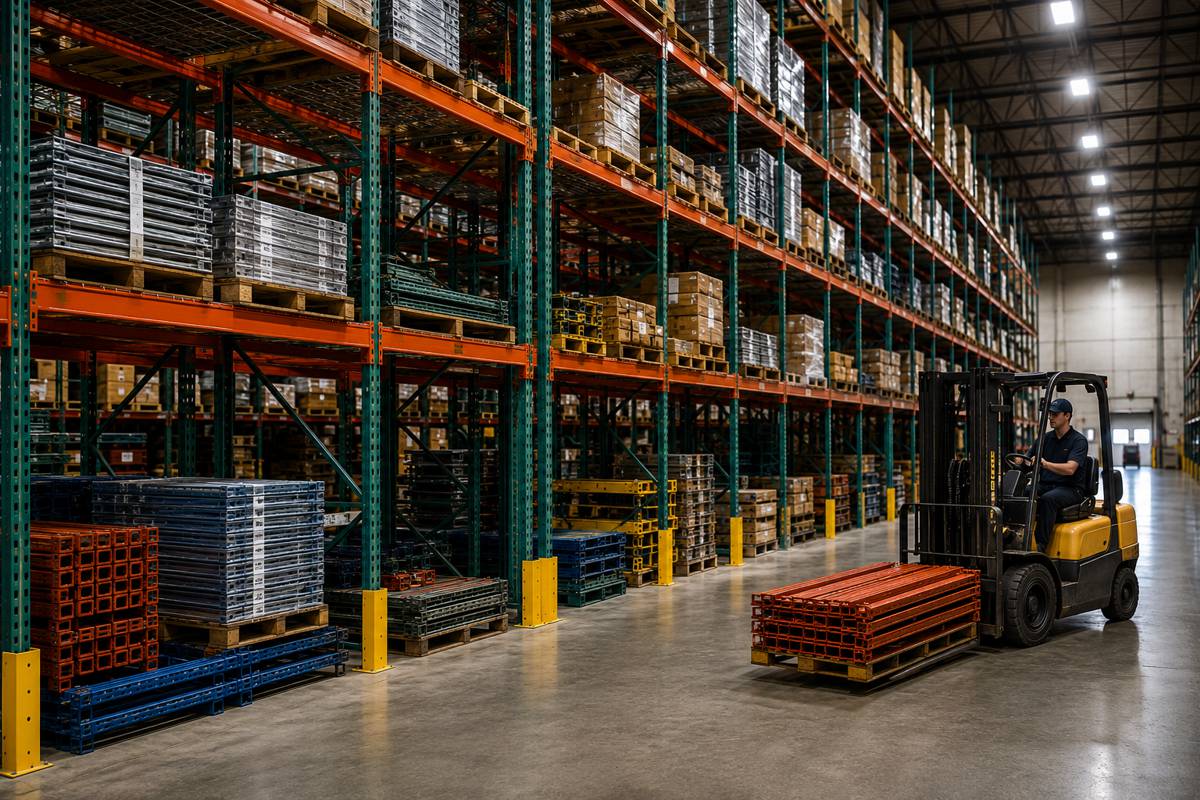
Here’s where MHE gets interesting, and where it parts company with most of its rivals. The firm doesn’t just make new racking. It buys used racking at scale, refurbishes it and sells it on, and by its own account it’s the only rack manufacturer in the United States doing both under one roof.
That circular model is more than a marketing line. Racking is heavy, galvanised and built to last decades, so a teardown from one closing facility can become the fit-out for another at a fraction of the cost and lead time of new steel. Reuse turns what would otherwise be scrap into inventory.
For a buyer weighing up a warehouse fit-out, that flexibility cuts both ways. Need a system fast and don’t want to wait on a manufacturing queue? Refurbished stock can ship in days. Want something bespoke that no second-hand lot can cover? The same company can fabricate it new, mixing and matching used uprights with new beams where the maths works.
The sustainability angle writes itself, too. Steel carries a hefty embodied-carbon load, and keeping it in service rather than melting it down chimes with the tightening environmental expectations now bearing down on construction and logistics procurement alike.
What’s Pushing Warehouses To Build Up
The timing isn’t an accident. Warehouse storage has been riding a structural wave, and the numbers behind it are substantial. Analysts at Future Market Insights peg the global pallet racking market at around USD 10.6 billion in 2025, rising towards USD 18.8 billion by 2035 at a compound annual growth rate near 5.8 per cent. Other forecasters draw the curve slightly differently, but they all point the same way: up and to the right, fuelled by e-commerce, the spread of third-party logistics and a relentless push for denser, smarter storage.
North America sits near the centre of that story. The rise of online retail and the scramble for fulfilment space have left distribution operators upgrading storage systems to wring more out of every square foot, with selective pallet racking still the workhorse and high-density formats like push-back and drive-in gaining ground in tighter buildings. Automation layers on top rather than replacing the steel, since automated storage and retrieval systems still need racking to climb. For a company that can supply, design and install across that whole spectrum, the demand backdrop looks about as supportive as it gets.
One Roof From Permit To Pallet
MHE’s pitch rests on doing the lot, and in a fragmented trade that’s no small thing. Fitting out a warehouse usually means juggling separate firms for permitting, for layout and design, for tearing out old systems, for fabricating new ones and for shipping and bolting everything into place. MHE folds those steps into a single relationship, which trims the coordination headaches that tend to blow out timelines and budgets on industrial projects.
Permitting alone can stall a fit-out for weeks, so having it handled in-house is the sort of detail facility managers actually care about.
That vertical integration also explains the appeal to a private equity owner. A company touching every stage of the racking lifecycle has more places to add value, sharpen margins and cross-sell than a one-trick supplier ever could. Teardown and removal feeds the used-racking inventory. The used inventory undercuts the lead times of new builds. New fabrication catches the jobs that refurbishment can’t.
Each piece props up the next, which is exactly the kind of self-reinforcing model operators like to get their hands on.
Inside Architect’s Playbook
Architect tends to favour companies it reckons it can improve, not just hold, and its track record reads like a tour of industrial niches. Since launching, the firm has worked through corporate carve-outs, divestitures and special situations, picking up businesses in die casting, industrial automation, energy services and outsourced supply chain management, and selling several on once the work was done. The thread running through them is operational, not thematic. These are companies with solid market positions and unfinished business on efficiency and growth.
MHE fits that template neatly. It’s an established name, founded in 1989, with a defensible niche and a model that scales if the capital and systems are there to push it.
Whether Architect bolts on similar regional racking outfits, invests in MHE’s manufacturing capacity or simply tightens the operation, the playbook points towards expansion rather than a quick flip.
For a firm building a portfolio across the industrial economy, owning a slice of warehouse storage rounds out a logistics-adjacent footprint that’s only grown more valuable as supply chains have moved up the agenda.
Where The Smart Money is Looking
For the wider construction and infrastructure world, the deal is worth filing away as a sign of where smart money is looking. The glamour in logistics may sit with robotics and software, but the physical scaffolding underneath, the steel that actually holds the inventory, is proving durable, cash-generative and increasingly attractive to investors who like businesses that earn their keep through the cycle.
Consolidation in this corner of the market could mean more capital, broader reach and steadier supply for the buyers fitting out the next wave of distribution centres.
It’s also a reminder that the circular economy isn’t confined to recycling bins and policy white papers. Reusing and refurbishing industrial steel is quietly commercial, and a model that profits from keeping racking in service rather than scrapping it sits well with both the economics and the environmental pressures now shaping procurement. For investors, operators and policymakers alike, the lesson is much the same.
Sometimes the most strategic part of the supply chain is the part nobody thinks to look at.