Liebherr Turns Excavator Durability Testing Into an Autonomy Proving Ground
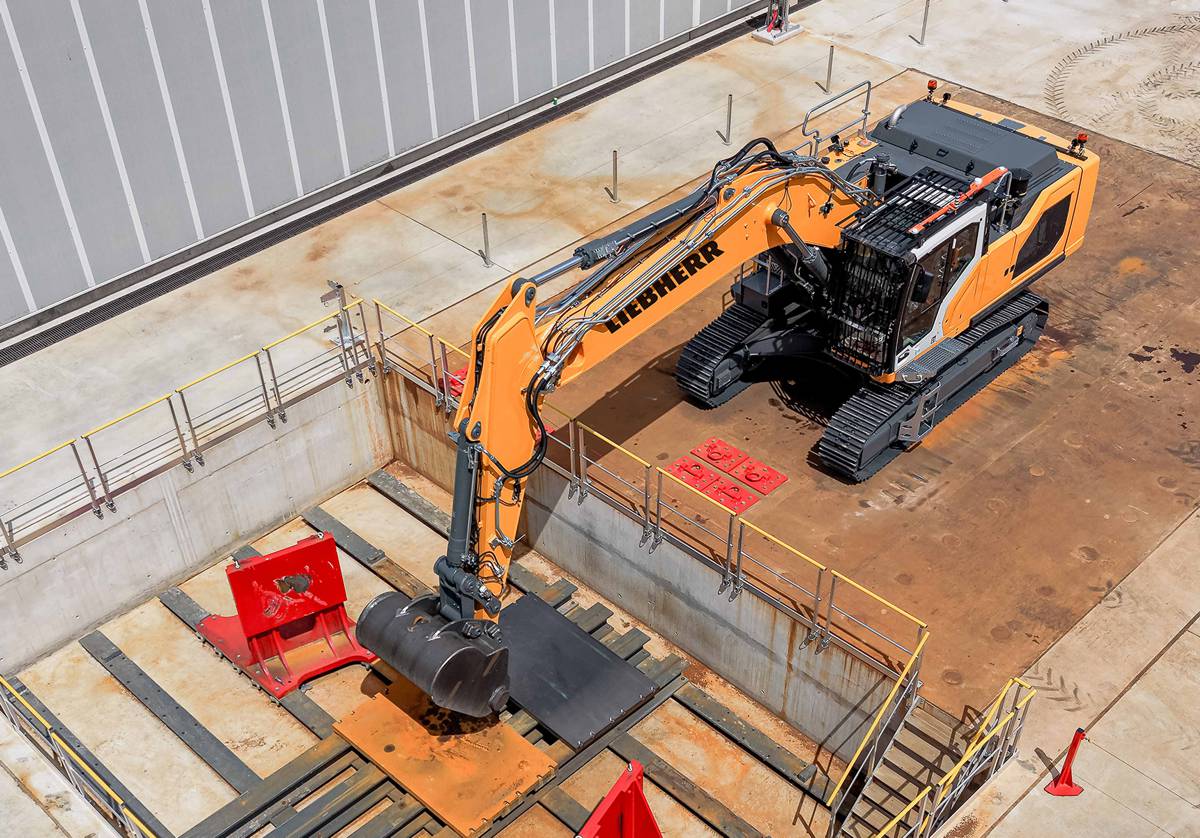
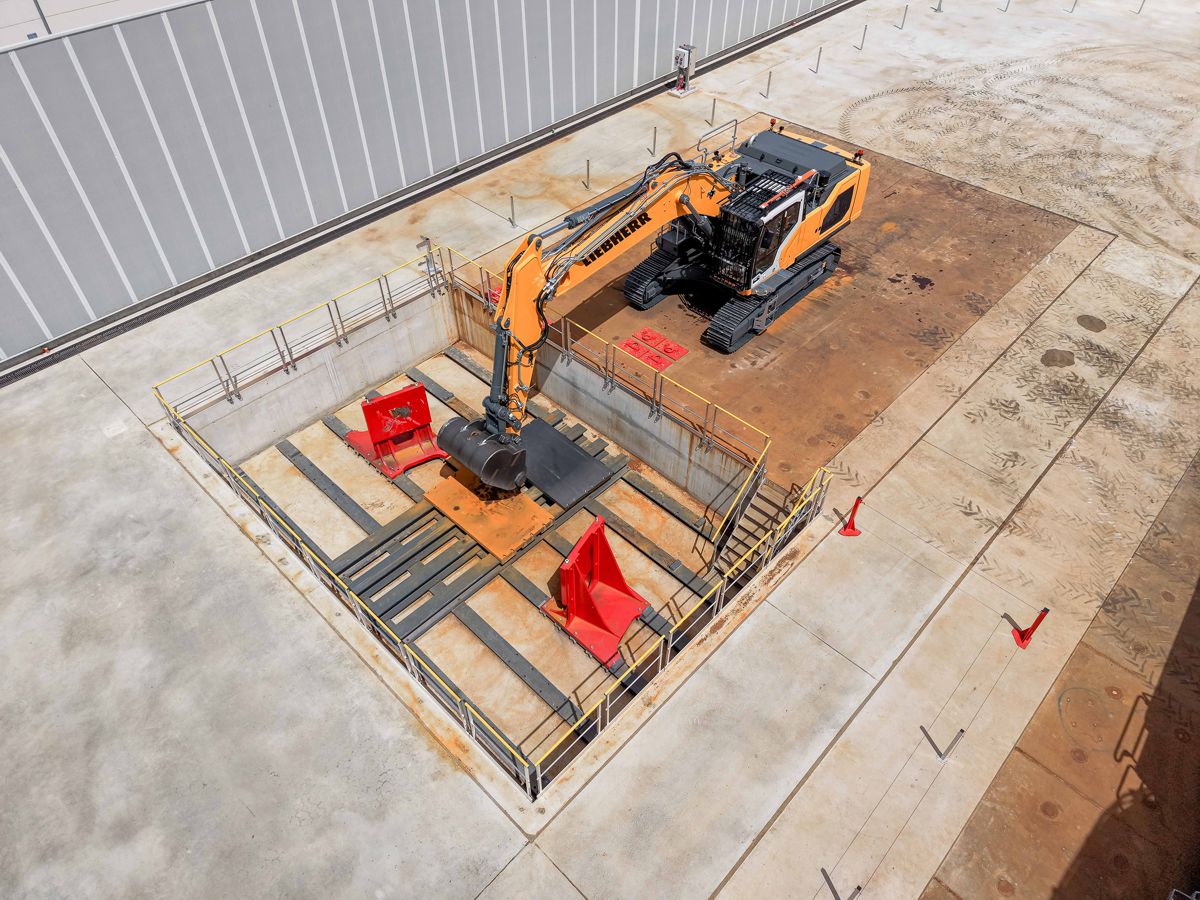
On paper, the new test rig that Liebherr France SAS commissioned at Colmar in early 2026 is a durability tool. It costs close to EUR 2.5 million, sits inside an enclosed hall, and exists to punish crawler excavator structures until their weak points reveal themselves. Read only at that level, it is a competent piece of engineering housekeeping from a manufacturer that has been building crawler excavators at the same Alsatian site since 1961.
The more interesting fact is buried in the detail of how the bench actually runs, because the machines on it operate without anyone in the cab. That single design decision turns a structural validation cell into something rarer and more strategically loaded: a permanent, in-house proving ground for autonomous operation, paid for under a durability budget.
The timing sharpens the point. Across 2026 the largest names in earthmoving have been competing to announce autonomous excavators rather than to prove them, with Caterpillar using CES to outline a machine line-up that will eventually include autonomous excavators, loaders, dozers and compactors while declining to commit to a commercial date. Develon has shown its Concept-X autonomous crawler excavator in Europe, and Komatsu, Volvo and SANY are all pushing automation into their heavy ranges.
Liebherr has quietly invested in the least glamorous part of the problem, the part that decides whether autonomy actually pays: validated structural robustness and repeatable, unattended machine cycles. The Colmar bench is a bet that reliability and autonomy are not two programmes but one engineering discipline, and that the manufacturer which masters the boring half will own the profitable half.
Briefing
- Liebherr France SAS has commissioned a test bench costing close to EUR 2.5 million for crawler excavators at its Colmar site, the group’s crawler excavator development and production centre since 1961 and the source of models spanning 14 to 100 tonnes.
- The rig compresses field wear at an acceleration coefficient of 17, so one hour on the bench reproduces roughly 17 hours of real-world operation across vibration, torsional loading, impact and bending.
- Machines on the bench run unmanned, making the facility a live proving ground for Liebherr Autonomous Operations as well as a structural validation tool, controlled remotely from a separate control room under continuous camera monitoring.
- Safety rests on layered physical, electronic and IT controls, including secured access, laser sensors, door contacts and GPS tracking that geofences the machines and prevents them leaving the enclosure without authorisation.
- The majority of the mechanical steel assemblies were fabricated in-house at Colmar, keeping validation, design engineering and production co-located as rivals including Caterpillar, Develon and Komatsu accelerate their own autonomy programmes.
Compressing Years of Site Punishment Into Controlled Hours
The engineering value of the bench comes from time compression. Field validation of a heavy crawler excavator is slow, expensive and hard to control, because the loads that eventually crack a boom foot or fatigue a chassis weld accumulate over thousands of hours across quarries, demolition sites and civil earthworks that no two operators use in the same way. Liebherr’s rig collapses that timeline.
With an acceleration coefficient of 17, a single hour of testing stands in for roughly seventeen hours of genuine site work, and the machine is subjected to a deliberately harsh replication of real conditions covering vibration, torsion, impact and bending rather than a gentle laboratory approximation. The result is that a structural weakness which might otherwise surface months or years into a fleet’s life can be provoked and understood before the design is frozen.
What makes the approach credible is that the test profiles are not invented in a simulation. They are built from load data captured during real operations at customer sites across a wide span of applications, then reproduced with enough consistency that engineers can trust a change on the bench to reflect a change in the field. Placing the rig on the same site as the development teams shortens the loop between a problem being seen and a solution being implemented, which is where durability engineering usually loses time.
For a manufacturer producing around two thousand crawler excavators a year at Colmar, a faster and more repeatable validation cycle feeds directly into warranty exposure, structural reliability and the confidence with which new designs can be released. That is the commercial substance behind an otherwise technical facility.
The Unmanned Test Cell as a Proving Ground for Autonomy
The feature that separates this bench from a conventional durability rig is that the machines are equipped to operate autonomously, and the facility is explicitly intended to advance the autonomy of Liebherr machines as it validates their structures. Because the tests need to run as often as required, keeping an operator in the seat would be impractical, so the rig was designed to work with no staff physically present.
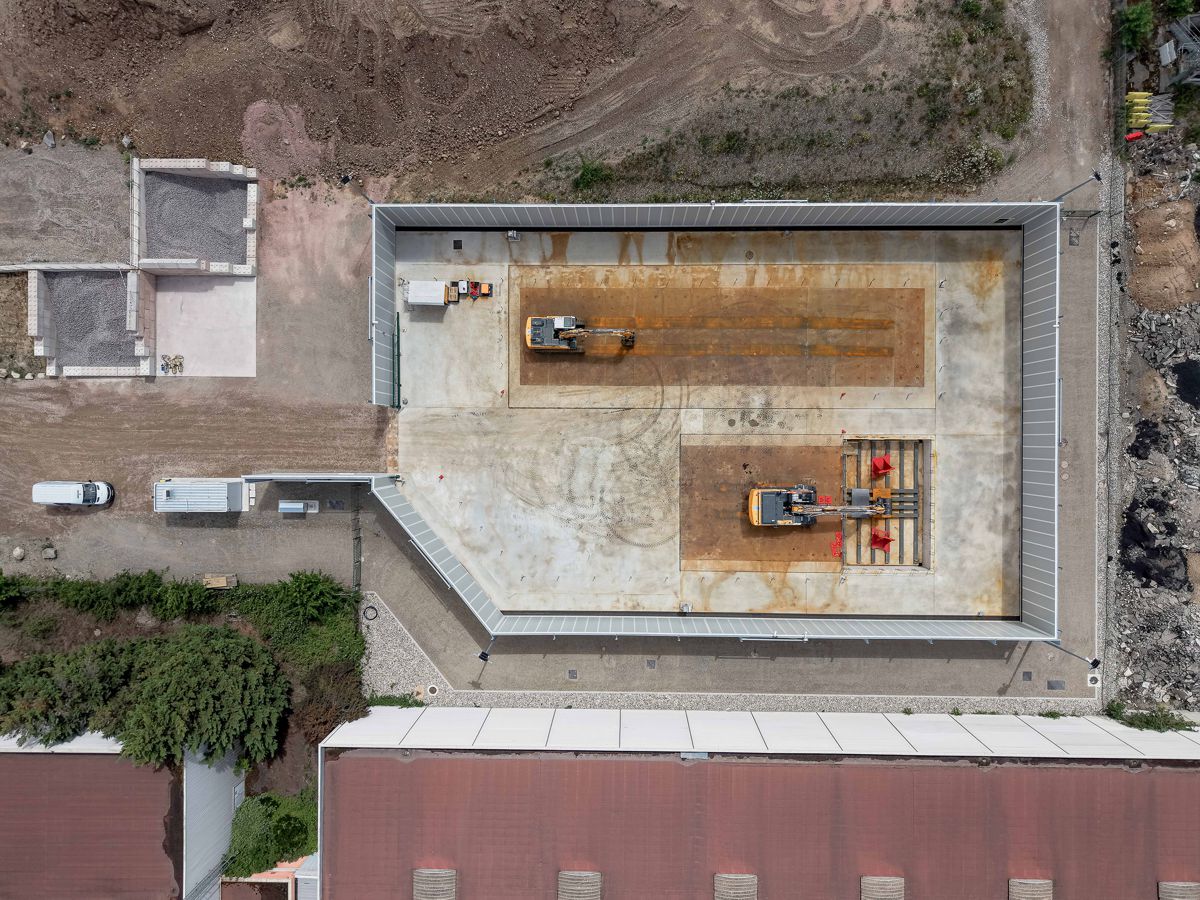
Procedures are commanded and monitored from an external control room, with a camera system giving technicians continuous visual oversight of an enclosure built around a test track and a trench, screened by a concrete wall and six-metre noise barriers to meet the industrial estate’s acoustic limits. In effect, Liebherr has created a bounded environment in which an unmanned excavator repeats demanding work cycles indefinitely, which is precisely the condition autonomous development needs and rarely gets safely.
The safety architecture reveals how seriously the autonomy dimension is taken. Protection is layered across physical measures such as the secured area and gate system, electrical and electronic measures including sensors, door contacts and laser scanning, and IT measures, most notably GPS tracking that geofences each machine and stops an autonomous excavator leaving the system without authorisation.
Those are the same categories of control that any operator will eventually have to satisfy to run autonomous plant on a live site, from perimeter management to positional certainty to fail-safe containment. By solving them first inside a repeatable, low-consequence test cell, Liebherr is building institutional knowledge about unattended machine behaviour under load, and doing so on hardware it has already validated structurally. The dual purpose is the strategic core of the investment, because it lets a single capital asset advance two of the industry’s most valuable capabilities at once.
A Reliability Bet in an Autonomy Arms Race
The wider construction equipment market has spent 2026 signalling intent on autonomy far faster than it has delivered proof. Estimates put the autonomous construction equipment sector at roughly USD 12.7 billion in 2023 and heading toward the high twenties of billions within the decade, with a widening labour shortage cited repeatedly as the structural driver. Caterpillar has framed a next generation of intelligent machines spanning excavators through compactors, and reports commercial autonomous operation of dozers and trucks at open-pit mines with meaningful per-machine labour savings, yet it has not committed to a date for autonomous excavators.
Develon has taken its Concept-X autonomous crawler excavator to European audiences, while Built Robotics continues to sell retrofit autonomy kits and Komatsu has fielded autonomous support machines. The announcements are plentiful, and the deployed, durability-proven autonomous excavator remains scarce.
Liebherr’s move reads as a deliberate counter-position within that landscape. Rather than lead with a headline autonomous excavator, the group is investing in the validation infrastructure that determines whether autonomy survives contact with real duty cycles, where uptime, structural integrity and lifecycle cost decide whether a buyer sees a return.
This is consistent with how Liebherr has advanced automation elsewhere, from its autonomous XPower wheel loader prototype under the Liebherr Autonomous Operations banner to its autonomous, battery-electric mining haulage work with Fortescue, described as the largest equipment deal in the group’s history. The common thread is that Liebherr tends to prove capability in controlled or captive settings before it markets it. In a market crowded with autonomy claims, a manufacturer that can demonstrate validated, repeatable unattended operation on a structurally proven machine holds a more defensible position than one that has merely shown a concept.
Keeping Development on the Doorstep of Engineering
The decision to site the bench directly alongside Colmar’s engineering teams, and to fabricate most of its steel structure in-house, is not incidental. It reflects a vertical-integration philosophy that Liebherr has been reinforcing across its French crawler excavator operation. Colmar has functioned as the group’s crawler excavator development centre for decades, produced its sixty-thousandth machine in 2019, and now spans a range from 14 to 100 tonnes covering earthmoving, quarrying, material handling, demolition and tunnelling, supported by an application centre that engineers customised machines.
The test bench extends that concentration of capability, aligning design, steel fabrication and autonomous validation on a single campus so that knowledge does not have to travel between sites or suppliers to influence the next design iteration.
That co-location also sits within a larger pattern of localised investment in Alsace. Liebherr France SAS is standing up a roughly EUR 170 million welded-components, pre-assembly and cab-assembly facility at Nambsheim, an explicit effort to strengthen local supply chains and add several hundred jobs. Set beside that figure, the test bench is a modest line item, but the two investments point the same way.
Liebherr is deepening control over the parts of the value chain that most affect quality, lead time and validation speed, at a moment when supply-chain resilience has become a competitive variable in its own right. For an industry that has learned hard lessons about dependency on distant suppliers, a manufacturer able to design, fabricate, build and validate within a tight geographic footprint carries a quieter but real advantage in responsiveness and cost control.
What Validated Structural Robustness Means for Buyers and Fleet Owners
For contractors, quarry operators and fleet owners, the significance of a facility like this is felt through total cost of ownership rather than through any single specification. A crawler excavator that has had its structural weak points provoked and corrected before series production is less likely to generate unplanned downtime, and unplanned downtime is where earthmoving economics are usually won or lost.
Accelerated validation feeds directly into the reliability of Liebherr’s current Generation 8 crawler excavators, and reliability in turn supports the metrics buyers actually track, from machine availability and repair frequency to the residual value a well-behaved fleet commands at resale. None of that is visible in a brochure, yet it is the substance of the purchasing decision for professional operators buying by the fleet.
The autonomy dimension adds a further layer for owners thinking beyond the current cycle. Autonomous plant only delivers a return when it runs for long, uninterrupted periods, which places even greater weight on structural endurance and on the maturity of the safety and positioning systems that keep an unmanned machine inside its bounds.
By developing containment, sensing and geofencing behaviour in the same environment where it proves structures, Liebherr is effectively co-developing the reliability and the autonomy that future customers will need to work together. Operators evaluating where to place long-term fleet commitments have reason to weigh not just a manufacturer’s autonomy announcements but the depth of the validation infrastructure standing behind them, because that infrastructure is what separates a demonstrable capability from a marketing one.
The Quiet Infrastructure of the Autonomous Jobsite
The prevailing vision of the autonomous construction site treats it less like a series of independent machines and more like a coordinated industrial process. Liebherr has articulated exactly that ambition around its 2026 digital roadmap, arguing that with AI and autonomous systems in place, in its own words, “A job site will be organised more like an industrial process”, with operations mapped in advance in the manner of a production line. Reaching that state depends on machines that behave predictably, endure long duty cycles and can be trusted to operate unattended within defined limits. The Colmar bench is a piece of the groundwork that vision requires, even though it will never appear on a job site itself.
Seen in that light, the EUR 2.5 million investment matters out of proportion to its size. It represents a manufacturer choosing to build the unglamorous validation capacity that autonomy will stand or fall on, at a point in the cycle when much of the sector is still competing on announcements. For construction and infrastructure leaders, the useful signal is where a serious OEM is putting engineering conviction rather than marketing spend, and Liebherr is putting it into proving that its machines are reliable enough, and controllable enough, to run without a driver.
The companies that win the autonomous era are unlikely to be the ones with the earliest concept reveals. They are more likely to be the ones that quietly built the test cells, the geofences and the accelerated-ageing rigs that turn autonomy from a demonstration into a dependable, bankable capability.
Key Industry Questions
- What is the acceleration coefficient of 17 and why does it matter commercially? The coefficient means that one hour on the bench reproduces the structural wear of roughly seventeen hours of real site work, achieved by intensifying the vibration, torsion, impact and bending loads a crawler excavator experiences in the field. Commercially, this compresses a validation process that would otherwise take months or years into a controlled and repeatable programme. Faster validation lets Liebherr identify and correct structural weaknesses before series production, which reduces warranty exposure, limits the risk of field failures and shortens the interval between spotting a problem and releasing a fix. For buyers, the downstream effect is higher machine availability and more predictable lifecycle cost, both of which sit at the centre of professional earthmoving economics.
- Why does an autonomous test bench matter more than another autonomous excavator announcement? Announcements demonstrate ambition, but they do not prove that an autonomous machine can endure long unattended duty cycles safely and reliably. The Colmar bench addresses that gap directly, because the excavators on it run unmanned, repeat demanding cycles indefinitely and are contained by the same categories of safety and positioning controls a live autonomous deployment would require. That gives Liebherr practical, accumulated knowledge of unattended machine behaviour under load. In a market where many rivals have shown concepts without committing to commercial dates, validated and repeatable unattended operation on a structurally proven machine is a more defensible competitive position than a prototype reveal, because it moves autonomy closer to something a fleet owner can actually bank on.
- How does this position Liebherr against Caterpillar, Komatsu and Develon in autonomy? Several major manufacturers have advanced autonomy through high-profile announcements, with Caterpillar outlining an intelligent machine line-up that will eventually include excavators without committing to a commercial date, and Develon showing an autonomous crawler excavator concept in Europe. Liebherr’s approach is quieter and infrastructure-led, investing in the validation capacity that determines whether autonomy survives real duty cycles rather than leading with a headline machine. This is consistent with how the group proved its autonomous wheel loader and its autonomous, battery-electric mining haulage before marketing them. The strategic wager is that reliability and autonomy are a single engineering problem, and that mastering unattended, structurally validated operation will matter more to buyers than being first to reveal a concept.
- What does validated structural robustness mean for total cost of ownership? Total cost of ownership for a crawler excavator is dominated by uptime, repair frequency and residual value rather than by headline purchase price. A machine whose structural weak points have been provoked and corrected before production is less prone to unplanned downtime, which is where earthmoving profitability is typically decided. Accelerated validation feeds directly into the reliability of Liebherr’s Generation 8 crawler excavators, supporting the availability figures and repair intervals that fleet owners track closely, and reinforcing the resale value that a dependable fleet commands. For operators buying by the fleet, this kind of pre-production validation is effectively invisible in a specification sheet yet forms the real basis of a sound long-term purchasing decision.
- Why did Liebherr build the steel structure in-house and co-locate the bench with engineering? Fabricating most of the bench’s mechanical steelwork in-house and placing it beside Colmar’s engineering teams reflects a vertical-integration philosophy that Liebherr has been reinforcing across its French operation. Co-location shortens the loop between identifying a structural issue and feeding a correction back into the next design, because insight does not have to travel between sites or external suppliers. It also sits within a wider pattern of localised investment in Alsace, including a much larger welded-components and assembly facility being established at Nambsheim. Concentrating design, fabrication, build and validation within a tight footprint improves responsiveness, protects quality and strengthens supply-chain resilience, which has become a genuine competitive variable across heavy equipment manufacturing.
- How significant is the safety and geofencing architecture for future autonomous deployment? The bench’s safety design layers physical, electronic and IT controls, including secured access, gate interlocks, laser sensors, door contacts and GPS tracking that geofences each machine and prevents it leaving the enclosure without authorisation. These are the same categories of control that operators will need to run autonomous plant on live sites, spanning perimeter management, positional certainty and fail-safe containment. By developing and refining them inside a bounded, low-consequence test cell, Liebherr accumulates practical knowledge of how to keep an unmanned machine reliably within defined limits. That experience is directly transferable to field autonomy, where the ability to guarantee containment and positional accuracy is often the difference between a system that regulators and insurers will accept and one they will not.
- What are the implications for the wider autonomous construction equipment market? The autonomous construction equipment sector was valued at roughly USD 12.7 billion in 2023 and is projected to expand substantially through the decade, driven heavily by a widening skilled-labour shortage. As that market matures, competitive advantage is likely to shift from who announces autonomy first to who can prove it endures. Investments in accelerated durability testing and unattended operation, of the kind Liebherr has made at Colmar, point to where serious engineering conviction is being concentrated. For contractors and infrastructure owners, the practical takeaway is to scrutinise the validation infrastructure behind an autonomy claim, because deployment readiness, not concept novelty, will determine which systems deliver a dependable return on live projects.
- Will accelerated ageing testing change how crawler excavators are procured? It is unlikely to change procurement mechanics overnight, but it strengthens the case for weighting reliability and validated durability more heavily in purchasing decisions. As manufacturers invest in accelerated ageing rigs and unattended test cells, the gap between machines that have been rigorously pre-validated and those that have not may widen in terms of field reliability and lifecycle cost. Procurement teams evaluating long-term fleet commitments have reason to ask how a manufacturer validates structural robustness and, increasingly, how it proves autonomous behaviour. Over time, evidence of deep validation infrastructure could become a more explicit differentiator in tenders and framework agreements, particularly for operators planning to adopt autonomous plant where endurance and containment matter most.
Strategic Takeaways
- Liebherr has converted a durability-testing investment into a permanent autonomy proving ground, signalling that the manufacturers likely to win the autonomous era are those building validation infrastructure rather than those with the earliest concept reveals.
- Accelerated ageing at a coefficient of 17 compresses years of field validation into controlled hours, feeding directly into warranty exposure, machine availability and the total cost of ownership metrics that drive professional fleet purchasing.
- Running unmanned machines inside a geofenced, sensor-guarded test cell lets Liebherr co-develop reliability and autonomy as a single engineering discipline, accumulating transferable knowledge of unattended operation that concept demonstrations cannot provide.
- Co-locating design, in-house steel fabrication and autonomous validation at Colmar, alongside the larger Nambsheim components investment, deepens vertical integration and turns supply-chain resilience into a competitive advantage in responsiveness and cost control.
- For buyers, policymakers and investors, the durable lesson is to judge autonomy claims by the depth of the validation infrastructure behind them, because deployment-proven endurance and containment, not concept novelty, will decide which autonomous systems generate a bankable return.