The Hague Removes Half a Million Paving Slabs in Urban Greening Programme
The Dutch city of The Hague has removed 507,436 paving slabs from its streets, squares and neighbourhoods during 2026, replacing hard surfaces with greenery to improve urban drainage, reduce heat exposure and create more attractive public spaces.
The programme has earned the city its third Golden Tile award in the Netherlands’ national NK Tegelwippen competition, which encourages municipalities and residents to replace unnecessary paving with vegetation. The Hague recorded the largest absolute number of tiles removed by any participating municipality, repeating its previous victories in 2021 and 2022.
While the competition encourages residents to transform gardens and communal spaces, much of The Hague’s progress has come through conventional infrastructure programmes. More than 350,000 paving slabs were removed through municipal projects, including street reconstruction, sewer replacement and public-realm improvements, with residents, schools, sports clubs and businesses contributing approximately 150,000.
The figures provide an interesting example of how urban greening can be incorporated into established municipal works rather than treated as an entirely separate environmental initiative.
Briefing
- The Hague removed 507,436 paving slabs in 2026, winning the Netherlands’ Golden Tile award for the highest total.
- Municipal infrastructure projects accounted for more than 350,000 slabs, while community initiatives contributed approximately 150,000.
- Nearly 28,000 slabs were removed at Plein 1813, while the Pletterijkade redevelopment introduced substantial new planting alongside infrastructure improvements.
- Sewer replacement in Belgisch Park provided an opportunity to plant 100 additional trees.
- The municipality has allocated €6 million for further urban greening during 2027 and 2028.
Integrating Green Infrastructure into Streetworks
Much of The Hague’s programme has been delivered alongside conventional public-realm improvements. Streets and public squares already scheduled for reconstruction provide opportunities to reconsider how much impermeable surface is necessary, particularly where existing layouts contain extensive paving that contributes little to pedestrian movement or other essential functions.
At Plein 1813, almost 28,000 paving slabs were removed to introduce additional greenery. Elsewhere, the redevelopment of Pletterijkade combined the replacement of a quay wall and sewer infrastructure with a wider redesign of the street. The completed project includes 575 m² of shrub planting and 340 m² of grass at Rijswijkseplein, along with new trees installed in engineered planting structures designed to provide additional growing space and water storage.
The Pletterijkade project also improved pedestrian and cycling infrastructure, widened sections of pavement and reduced the speed limit from 50 km/h to 30 km/h. The works were delivered as part of a comprehensive street reconstruction, demonstrating how drainage renewal, transport improvements and planting can be coordinated within a single construction programme.
In Belgisch Park, sewer replacement works provided another opportunity to introduce greenery, with 100 trees planted alongside the infrastructure improvements.
Combining these activities can offer practical advantages for municipal construction planning. Where contractors are already excavating streets to replace buried services, reinstatement works can accommodate planting beds, revised kerb arrangements and other surface-water management features without requiring an entirely separate intervention. The additional elements still require proper design, funding and maintenance provision, but coordinating them with scheduled works can reduce the need to reopen recently completed streets.
The approach also encourages municipalities to reconsider traditional reinstatement practices. Roads and pavements are frequently returned to their previous layouts following utility work, even where the surrounding public space could benefit from changes. Providing opportunities to review those layouts during the design stage allows planting and drainage requirements to be considered alongside pedestrian accessibility, traffic loading and utility protection.
Managing Rainfall Through the Urban Landscape
The Netherlands has extensive experience in managing water through engineered drainage networks, pumping systems and flood defences. Within its cities, however, extensive areas of impermeable paving create a different challenge, preventing rainfall from entering the ground and increasing the volume of surface water that must be carried by drainage systems.
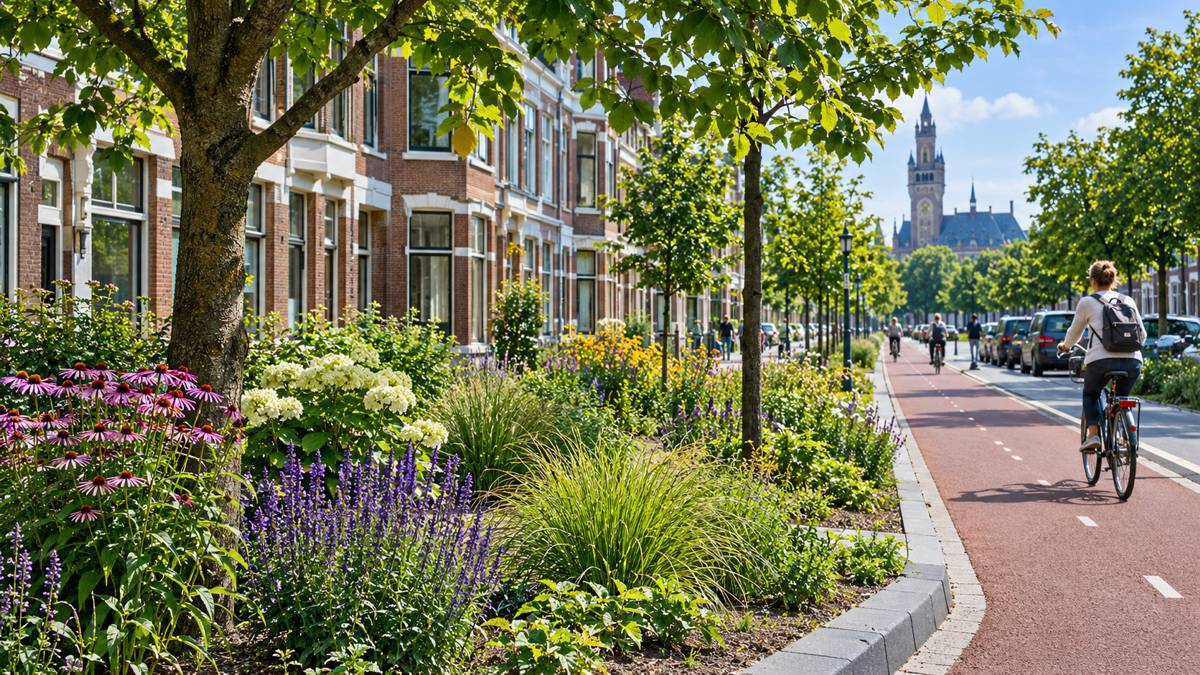
Replacing unnecessary paving with planted areas allows some rainfall to infiltrate locally where ground conditions are suitable. Vegetation can also help moderate summer temperatures through shading and evapotranspiration, particularly where sufficient space exists for trees to establish healthy root systems.
The practical performance of these measures depends heavily on what lies beneath the surface. Compacted soils, high groundwater levels, contamination and underground utilities can limit infiltration or restrict planting opportunities, while trees need adequate root space if they are to survive and develop without damaging nearby infrastructure. Removing a paving slab is therefore only the beginning of the process, with ground preparation and the design of the replacement area determining how effectively it performs.
Dutch climate adaptation guidance identifies several approaches to managing urban rainfall, including rain gardens, bioswales, permeable paving and underground water storage. Each has different construction and maintenance requirements, making the choice of intervention dependent on local conditions and the intended use of the public space.
For highway and drainage engineers, the objective is to introduce these features without compromising the operation of the street. Footways must remain accessible, road structures must withstand their intended loading and underground services must be protected. Well-designed green infrastructure can complement conventional drainage networks by managing some rainfall closer to where it falls, although engineered drainage capacity remains necessary for larger storm events.
The Hague’s work is therefore better understood as a programme of incremental improvements to the urban landscape than as a replacement for conventional flood protection. Its value will depend on the quality of individual projects, the amount of usable permeable ground created and how those areas are maintained over time.
Community Participation and Neighbourhood Improvements
Although municipal construction projects account for most of the slabs removed, the programme also relies on smaller interventions undertaken by residents and local organisations.
The national NK Tegelwippen competition began in 2020 as a challenge between Amsterdam and Rotterdam before expanding across the Netherlands. It uses a straightforward measure of participation: the number of paving slabs removed and replaced with greenery. Awards recognise both absolute totals and performance relative to municipal population, allowing communities of different sizes to compete.
In The Hague, the municipality works with sustainability organisation Duurzaam Den Haag on initiatives including Operatie Steenbreek, which encourages residents to remove unnecessary paving from gardens, courtyards and other neighbourhood spaces. These projects often involve relatively small areas, but they can be particularly valuable in densely developed districts where opportunities for major landscaping schemes are limited.
One example is Hobbemahof, a courtyard in the Schilderswijk neighbourhood where residents removed approximately 1,600 paving slabs. The space has been transformed into a community garden containing planting areas, vegetable beds and a greenhouse, providing somewhere for local women to grow food and spend time together.
The Golden Tile award was presented at Hobbemahof, recognising the contribution of residents alongside the municipality’s larger construction programme.
“This award recognises the enthusiasm and hard work of so many residents, businesses, schools and other community organisations that have made their surroundings greener,” said Isabelle Broeders, the city’s alderman responsible for public space.
The combination of municipal projects and community participation has allowed The Hague to pursue improvements at different scales. Major reconstruction schemes can accommodate substantial landscaping and drainage changes, while individual gardens, school grounds and courtyards create opportunities for planting in locations that might otherwise remain paved.
For residents, the immediate benefits are often more tangible than the technical performance of drainage systems. Additional vegetation, opportunities for growing food and more pleasant communal spaces can make a noticeable difference to everyday surroundings, particularly in neighbourhoods where private gardens and established trees are scarce.
Investment and Long-Term Maintenance
The Hague has committed a further €6 million to urban greening projects during 2027 and 2028, with the investment directed towards neighbourhoods containing extensive hard surfacing.
The allocation provides continuity beyond the annual competition and allows the municipality to pursue further improvements in areas where heat and surface-water problems are particularly pronounced. A detailed breakdown of the proposed expenditure has not been provided in the announcement, although the programme is expected to build on the city’s existing approach to neighbourhood greening.
“More greenery is urgently needed in the most heavily paved neighbourhoods,” said Broeders. “This is where residents feel the effects of heat and flooding most strongly. By targeting investment in greening, we are making neighbourhoods better places to live and preparing the city for the future.”
The construction of new planting areas also brings long-term responsibilities. Trees require suitable growing conditions, irrigation during establishment and periodic inspection, while planted drainage features may need sediment removal, vegetation management and maintenance to preserve their hydraulic performance.
These requirements are familiar to municipal asset managers, but they can become more significant as planting is distributed across numerous small sites rather than concentrated in established parks. Maintenance access, drainage connections and responsibility for individual assets all need to be considered during design, especially where green infrastructure is incorporated into highways and other heavily used public spaces.
Measuring performance presents another challenge. The number of paving slabs removed provides an accessible record of physical activity, but it does not establish how much additional rainfall can be absorbed, whether local flooding has been reduced or how significantly temperatures have changed. Those outcomes depend on the area and condition of the ground, the vegetation established and the surrounding drainage infrastructure.
A square metre of well-designed planting connected to a suitable drainage system may perform differently from an equivalent area of compacted soil. Similarly, newly planted trees will require years of growth before providing the shade and cooling benefits associated with mature urban tree cover.
The Netherlands’ national climate adaptation resources provide guidance on the selection and implementation of measures in the built environment, recognising that investment costs, maintenance requirements and performance vary considerably between locations.
Building Greener Streets Through Existing Infrastructure Programmes
The Hague’s achievement is striking in numerical terms, but its construction programme provides the more interesting story. More than half a million paving slabs have been removed across an established European city, with most of the work delivered through municipal projects rather than relying entirely on voluntary community activity.
The individual interventions are varied, ranging from courtyard gardens and neighbourhood planting to substantial street reconstruction and sewer replacement. Some provide additional opportunities for rainfall infiltration, while others contribute to shade, biodiversity and the quality of public space. Their long-term performance will depend on sound engineering, appropriate planting and continued maintenance.
With another €6 million committed for the next two years, The Hague has an opportunity to build on the work already completed and assess how effectively the new green spaces perform.
The annual competition provides a visible measure of progress, but the lasting results will be found in the streets, drainage systems and neighbourhoods where the paving has been removed.
Key Industry Questions
- What is NK Tegelwippen? NK Tegelwippen is a Dutch national competition encouraging municipalities, residents and organisations to replace unnecessary paving with vegetation. It began in 2020 and uses the number of removed paving slabs to measure participation.
- How many paving slabs did The Hague remove in 2026? The Hague recorded 507,436 removed slabs, winning the national Golden Tile award for the highest absolute total.
- How much of the work was completed through municipal projects? More than 350,000 slabs were removed through municipal infrastructure and public-realm projects, with approximately 150,000 contributed by residents, schools, sports clubs and businesses.
- How does removing paving help manage urban flooding? Replacing impermeable surfaces with suitable soil and planting can allow rainfall to infiltrate locally and reduce runoff entering drainage networks. Performance depends on soil conditions, groundwater levels and the design of the replacement area.
- Can urban greening be combined with sewer replacement? Yes. Planned sewer replacement and street reconstruction provide opportunities to introduce planting beds, trees and other climate adaptation measures alongside conventional reinstatement works.
- What happened during the Pletterijkade redevelopment? The project combined quay wall replacement, sewer renewal and street reconstruction with improved pedestrian and cycling facilities. The completed scheme includes 575 m² of shrub planting, 340 m² of grass and new trees.
- Does removing pavement automatically improve drainage? No. Compacted or poorly permeable ground may provide limited infiltration, while underground utilities and high groundwater can constrain design options. Ground conditions must be assessed before drainage benefits can be quantified.
- What is the difference between permeable paving and removing paving? Permeable paving retains a usable hard surface while allowing water to pass through its construction. Removing paving creates an exposed or planted area that can accommodate vegetation and, where conditions allow, rainfall infiltration.
- What funding has The Hague committed to further greening? The municipality has allocated €6 million for urban greening during 2027 and 2028, with priority given to heavily paved neighbourhoods.
Strategic Takeaways
- Scheduled infrastructure works provide opportunities for urban greening. Street reconstruction and sewer replacement can accommodate planting and drainage improvements within established municipal construction programmes.
- Ground conditions determine drainage performance. Removing hard surfacing can reduce runoff, but infiltration capacity depends on soil properties, groundwater levels and appropriate engineering design.
- Community participation extends the programme’s reach. Smaller gardens and neighbourhood projects complement larger municipal works, particularly in densely developed urban areas.
- Maintenance is a continuing infrastructure obligation. Trees, planted drainage features and other green assets require management throughout their operational lives.
- Physical outputs and environmental outcomes require different measurements. Paving removal totals document the scale of intervention, while flood resilience and cooling performance need additional assessment.