Warehouse Roofs Could Generate 36,000 GWh of Solar Power Annually
Britain’s industrial and logistics buildings could generate approximately 36,486 GWh of solar electricity annually if their available rooftop space were developed, according to research by property consultancy Cushman & Wakefield. Much of that potential remains unused, with structural constraints, grid connections, commercial leases and the economics of retrofitting complicating projects that can appear straightforward on paper.
Renewable energy company Good Energy is calling for an extension of Business Rates Improvement Relief to encourage investment in existing commercial properties. Its proposal comes as the Government considers further reform of the business rates system ahead of 2029, raising questions about how financial incentives can support improvements to buildings that were never originally designed to generate electricity.
Installing photovoltaic panels is only part of the challenge. Warehouses are often occupied under long leases, owned by property investment businesses and operated by companies with competing capital requirements. Making use of their roofs can involve structural assessments, electrical upgrades, insurance agreements and commercial negotiations before installation work begins.
Briefing
- Cushman & Wakefield estimates more than one billion square feet of usable industrial and logistics roof space could support solar generation.
- The theoretical annual generation potential is approximately 36,486 GWh.
- UK Warehousing Association research identified solar installations on approximately 5% of a sample of more than 300 warehouse rooftops.
- Good Energy wants the existing one-year Business Rates Improvement Relief extended for qualifying renewable energy improvements.
- A separate business rates exemption for eligible on-site renewable generation and storage equipment already runs until March 2035.
Britain’s Warehouse Solar Potential
Research published by Cushman & Wakefield identifies more than one billion square feet of usable roof space across large UK logistics and industrial properties. Its modelling suggests that deploying solar photovoltaics across the available area could produce approximately 36,486 GWh of electricity each year, with an estimated annual economic contribution of £3 billion based on the assumptions used in the research.
Those estimates describe potential rather than an immediately deliverable programme. Available roof area does not automatically translate into suitable generating capacity, particularly where existing buildings have limited structural reserves, complex roof layouts or electrical infrastructure requiring modification.
The UK Warehousing Association has examined the problem through its Solar Toolkit programme. Its original research used satellite imagery to assess more than 300 verified warehouse rooftops and found solar installations on approximately 5% of the sample. Although this does not establish a comprehensive current national installation rate, it provides an indication of historically limited deployment across a sector with considerable available space.
The association’s subsequent analysis estimated that the largest warehouses, those exceeding 100,000 square feet, could collectively accommodate approximately 17.3 GW of solar capacity. Unlike the Cushman & Wakefield electricity-generation estimate, this figure describes potential installed generating capacity, with actual annual output depending on location, system design and operating conditions.
Cushman & Wakefield’s research also identifies uneven adoption among property businesses. While 67% of its survey respondents reported having adopted or being in the process of installing solar, only 15% had deployed it across more than half of their portfolios. Even among organisations pursuing rooftop generation, installation programmes have often covered only part of their available property portfolios.
Retrofitting Existing Warehouses
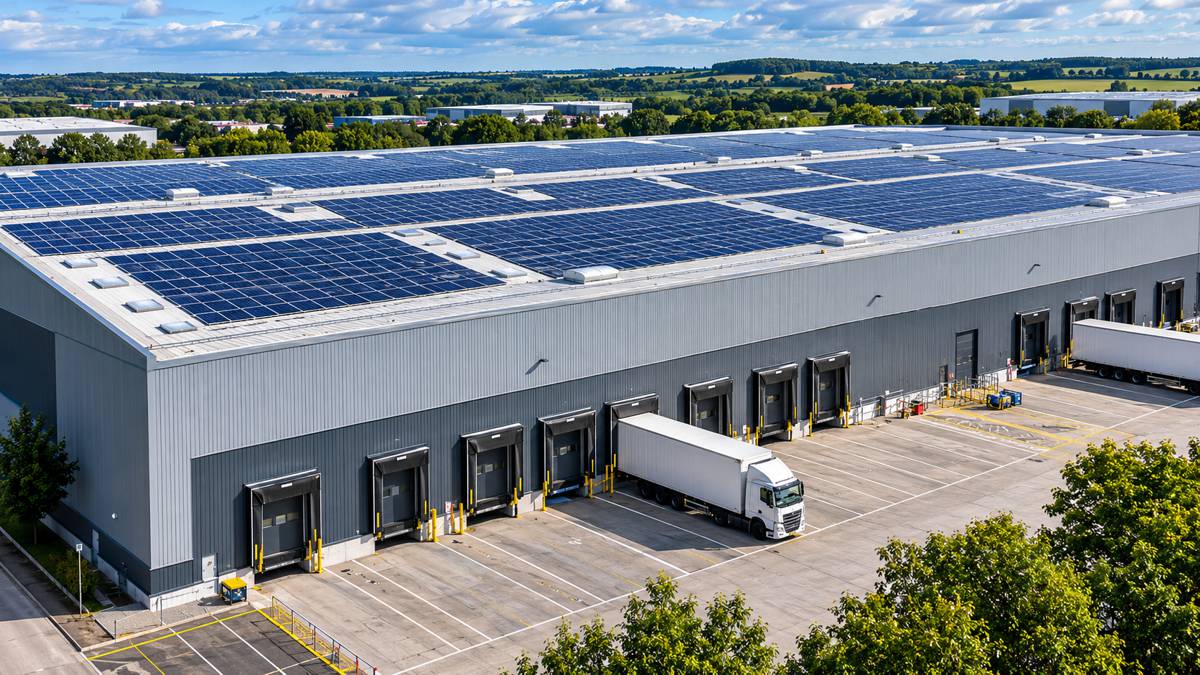
Modern distribution centres can provide attractive conditions for rooftop solar. Their extensive roof areas allow relatively large generating systems to be installed without acquiring additional land, while refrigeration, automation, lighting and materials-handling equipment can create substantial electricity demand throughout the working day.
The engineering suitability of an existing warehouse, however, depends on considerably more than roof area. A structural assessment must establish whether the building can accommodate the additional loads imposed by photovoltaic modules, mounting systems and associated equipment. Wind uplift, roof condition, drainage, existing plant and maintenance access also influence the installation design, while older buildings may require strengthening or roof replacement before a scheme becomes practical.
Electrical infrastructure presents another set of considerations. A solar installation must be integrated with the building’s distribution system, protection equipment and existing supply arrangements. Projects intending to export surplus electricity must address network connection requirements, while systems designed predominantly for on-site consumption need to match generation against the building’s electrical demand.
Commercial ownership can be equally complicated. Warehouse operators frequently lease their premises from institutional landlords or property investors, leaving one organisation responsible for the roof and another paying the electricity bill. The party making the investment may therefore be different from the business receiving the immediate financial benefit.
Projects can require agreements covering roof access, maintenance, insurance, responsibility for repairs, ownership of generating equipment and arrangements when a tenant’s lease expires. Power purchase agreements and other third-party financing structures can help distribute costs and benefits, although they introduce further contractual considerations that must be resolved alongside the engineering work.
Good Energy identifies these practical and commercial difficulties as persistent obstacles to deployment, particularly where investment decisions depend on agreement between several organisations. Even technically suitable buildings can remain undeveloped when the financial arrangements do not offer sufficient certainty to the parties involved.
Business Rates and the Investment Case
Good Energy’s proposal focuses on extending Business Rates Improvement Relief, which currently provides qualifying occupiers in England with protection against increases in business rates associated with eligible improvements for one year after completion.
Under the existing arrangements, an improvement must increase a property’s rateable value and satisfy the scheme’s eligibility requirements. The relief is also subject to occupation conditions, meaning it cannot necessarily be applied to every landlord-funded improvement or renewable energy project.
A separate business rates exemption already applies to eligible plant and machinery used for on-site renewable electricity generation and storage. Introduced in April 2022, that exemption is scheduled to remain in place until 31 March 2035. Good Energy is therefore advocating an extension of the broader improvement incentive rather than proposing a new exemption for qualifying rooftop photovoltaic equipment.
The Government has identified Improvement Relief as an area for potential reform, with further consideration dependent on evidence of how the scheme is being used. The statutory end date currently falls on 1 April 2029, although legislation allows ministers to extend both the duration of relief and the scheme’s expiry.
For commercial property owners contemplating extensive refurbishment, longer-lasting relief could improve the economics of qualifying works undertaken alongside solar installation. Its contribution would depend on whether those improvements satisfy the eligibility rules and how much additional rateable value they create, particularly where property alterations extend beyond installing generating equipment.
Carl Hogg, Managing Director of Services at Good Energy, said: “We have spent a lot of time debating how to make new buildings greener, but there is an enormous clean-energy opportunity sitting above businesses that are already operating today.”
He added: “The technology and commercial case are already there. What we need to focus on now are the practical barriers stopping projects from getting off the ground, whether that is the relationship between landlord and tenant, the condition of the roof, finance or difficulties around connecting to the grid.”
Solar Generation at BSH Corby
Good Energy points to its installation at the BSH distribution facility in Corby as an example of rooftop solar being integrated into a large operational warehouse.
The development uses approximately 1,200 photovoltaic panels and is expected to generate around 550 MWh of electricity annually. Good Energy estimates that between 70% and 80% of this output will be consumed on site, reducing the building’s reliance on purchased grid electricity.
The company estimates potential annual electricity savings of approximately £85,000 based on an illustrative electricity user, alongside an estimated reduction of 106 tonnes of carbon dioxide emissions. These are projected benefits rather than published measurements of annual savings achieved at the facility, with actual financial performance depending on electricity prices, consumption patterns, system output and the commercial arrangements governing the installation.
Good Energy’s project case study also describes the operational requirements involved in installing the system at a working distribution centre. The building remained in use, requiring installation activity to be coordinated with normal logistics operations and access arrangements.
Safety was incorporated into the electrical design through a firefighter gateway providing automatic shutdown when the site’s alarm system is activated, alongside manual emergency shutdown arrangements. Provision was also made for safe roof access during subsequent maintenance, allowing the photovoltaic installation to be serviced without unnecessarily interfering with warehouse operations.
Good Energy worked with the property owner and other project participants to address the practical complications associated with installing generating equipment on a leased commercial building. The project offers a useful example of how rooftop generation can be accommodated within an operating logistics facility, although the underlying commercial arrangements will differ considerably between properties.
The company suggests commercial solar schemes can achieve payback in under five years. Such estimates depend heavily on capital costs, roof condition, financing terms, electricity consumption and energy tariffs, particularly where additional structural or electrical work is required before panels can be installed.
New Building Standards and the Existing Estate
England’s Future Homes and Buildings Standards, introduced through amendments to the Building Regulations, are scheduled to take effect for most applicable building work from 24 March 2027, subject to transitional provisions.
The changes strengthen requirements governing energy efficiency and greenhouse gas emissions in new buildings. Although the regulatory provisions differ between residential and non-domestic development, the overall direction is towards buildings capable of operating with substantially lower emissions as the electricity system decarbonises.
These requirements do relatively little to resolve the physical limitations of warehouses that have already been built. Across the existing estate, the opportunity to accommodate photovoltaic arrays depends on decisions taken during original construction, including roof structure, electrical capacity, equipment placement and provision for maintenance access.
Retrofitting can compensate for some of those limitations, but frequently at additional cost. Roof strengthening, replacement coverings and upgraded electrical infrastructure may be necessary before installation work can proceed, while any intervention must account for the continued operation of the building and the movement of goods beneath it.
New warehouse developments can incorporate solar generation requirements earlier in the design process, allowing roof structures, electrical systems and maintenance arrangements to be considered together. For existing buildings, the same requirements must be reconciled with infrastructure already in place, often alongside refurbishment programmes that have their own budgets and operational constraints.
Project Economics and Roof Refurbishment
The commercial attraction of warehouse solar is strongest where electricity generation can be absorbed directly by building operations. Daytime consumption reduces dependence on export arrangements and allows generated electricity to displace purchased power, although the financial benefit still depends on the relevant tariff, installation cost and financing structure.
Large warehouses with extensive automation, refrigeration or continuous operations may offer particularly suitable demand profiles. Facilities with relatively low daytime consumption can require different system sizing, electricity export arrangements or potentially energy storage to improve their commercial performance.
Landlords must also consider the remaining service life of the building itself. A photovoltaic system intended to operate for several decades may be difficult to justify on a roof approaching major refurbishment, especially where removing and reinstalling panels would add significant expense. Conversely, replacing an ageing roof can provide an opportunity to incorporate structural improvements, mounting arrangements and electrical infrastructure as part of the same construction programme.
Coordinating these works can reduce duplicated site mobilisation, access equipment requirements and operational disruption. It also allows the design team to consider roof loading, waterproofing, drainage, panel layout and maintenance access together, rather than attempting to accommodate each requirement after a separate refurbishment has been completed.
For owners and occupiers, the investment decision ultimately rests on the condition of the property, the electricity it consumes and the contractual arrangements governing the site. Business rates relief may improve the financial case for qualifying improvements, but it cannot compensate for a roof that cannot accommodate the equipment or a building whose electricity demand does not justify the installation.
The scale of Britain’s warehouse estate offers considerable room for solar development, although its buildings differ widely in age, construction, ownership and operational requirements. At Corby, a functioning distribution centre has been equipped with rooftop generation while continuing its normal activities. Elsewhere, the first step may be a structural survey, a roof replacement or simply an agreement between a landlord and a tenant about who will own the panels and benefit from the electricity they produce.
Key Industry Questions
- How much electricity could UK warehouse roofs generate? Cushman & Wakefield estimates that available industrial and logistics rooftops could generate approximately 36,486 GWh annually. This is modelled potential rather than a forecast of actual electricity production.
- How many UK warehouses currently have solar panels? UKWA’s earlier survey of more than 300 warehouse rooftops identified installations on approximately 5%. The finding is sample-based and does not represent a complete, current census of the national warehouse estate.
- What is Business Rates Improvement Relief? It provides qualifying occupiers in England with one year of relief from increases in business rates attributable to eligible property improvements.
- Are commercial rooftop solar panels exempt from business rates? Eligible on-site renewable electricity generation and storage plant and machinery already benefit from a separate business rates exemption in England, currently scheduled to continue until 31 March 2035.
- What prevents older warehouses from installing solar? Common obstacles include roof load capacity, structural condition, electrical infrastructure, grid connections, insurance requirements, lease agreements and project financing.
- Can a tenant install solar panels on a leased warehouse? Potentially, subject to property rights, landlord consent, lease provisions, technical feasibility and the commercial arrangements governing equipment ownership and electricity supply.
- What determines the financial return on commercial rooftop solar? Installation costs, electricity consumption, self-consumption percentage, purchased electricity prices, export income, maintenance requirements and financing conditions all influence project economics.
- Will England’s new building standards require existing warehouses to install solar? The Future Homes and Buildings Standards primarily address applicable new building work and do not impose a general requirement to retrofit solar panels across the existing warehouse estate.
Strategic Takeaways
- Available roof area does not guarantee deliverable generating capacity. Structural suitability, roof condition and electrical infrastructure determine how much of the theoretical potential can be developed.
- Property ownership arrangements can be as significant as engineering constraints. Landlords, tenants and energy purchasers must agree how investment, maintenance responsibilities and financial benefits are allocated.
- On-site electricity consumption is central to commercial viability. Warehouses with substantial daytime demand can use generated electricity directly, reducing dependence on export revenues.
- Business rates incentives address only part of the investment equation. Existing renewable equipment exemptions and proposed extensions to Improvement Relief serve different purposes and have distinct eligibility requirements.
- Roof refurbishment offers an opportunity to integrate solar into broader building improvements. Coordinating structural work, waterproofing, electrical upgrades and photovoltaic installation can reduce duplicated costs and disruption.