






Urban Mining: Turning Electronic Waste into Industrial Metal Resources
A new industrial operation planned for North Carolina will recover gold, silver, copper and palladium without excavating a single tonne of rock. Following the completion of a US$40 million initial public offering on 12 November 2026, Modern Mining Technology Corp. has outlined an 18-month development programme for its first commercial-scale electronic waste processing operation, designed to produce approximately 40,000 gold equivalent ounces annually.
The development brings together mineral processing, chemical engineering, industrial construction and resource recovery in a sector known as urban mining. Rather than developing underground mineral deposits, companies are pursuing the valuable materials already circulating through the global economy, much of which enters the waste stream when electronic equipment reaches the end of its useful life.
Modern Mining’s research and development facility in Greenville, North Carolina, has been producing saleable metallic concentrates since November 2023. The next stage involves establishing continuous industrial production, securing long-term feedstock supplies and demonstrating that its recovery technology can operate economically at commercial scale.
Briefing
- Modern Mining has raised approximately US$40 million through its initial public offering.
- Its first commercial operation targets annual capacity of 40,000 gold equivalent ounces.
- Global electronic waste generation reached 62 million tonnes in 2022.
- A central purification facility is designed to accommodate concentrates from up to five regional processing plants.
- Commercial production growth is targeted within 12 to 18 months of the IPO.
Mining the Resources Above Ground
Decades of technological development have created an enormous inventory of metals embedded in computers, telecommunications equipment, industrial control systems, vehicles and consumer electronics. These materials have already passed through expensive mining, refining and manufacturing processes, yet considerable quantities are lost when equipment is discarded.
The Global E-waste Monitor 2024, published by the United Nations Institute for Training and Research and the International Telecommunication Union, recorded 62 million tonnes of electronic waste generated worldwide in 2022, an increase of 82 per cent since 2010. Only 22.3 per cent was documented as having been formally collected and recycled in an environmentally sound manner, while annual generation is projected to reach 82 million tonnes by 2030.
The metals contained within electronic waste generated during 2022 were valued at approximately US$91 billion, including US$19 billion in copper, US$16 billion in iron and US$15 billion in gold. Although these figures represent the estimated value of embedded materials rather than achievable recycling revenues, they establish the considerable scale of the secondary mineral resource.
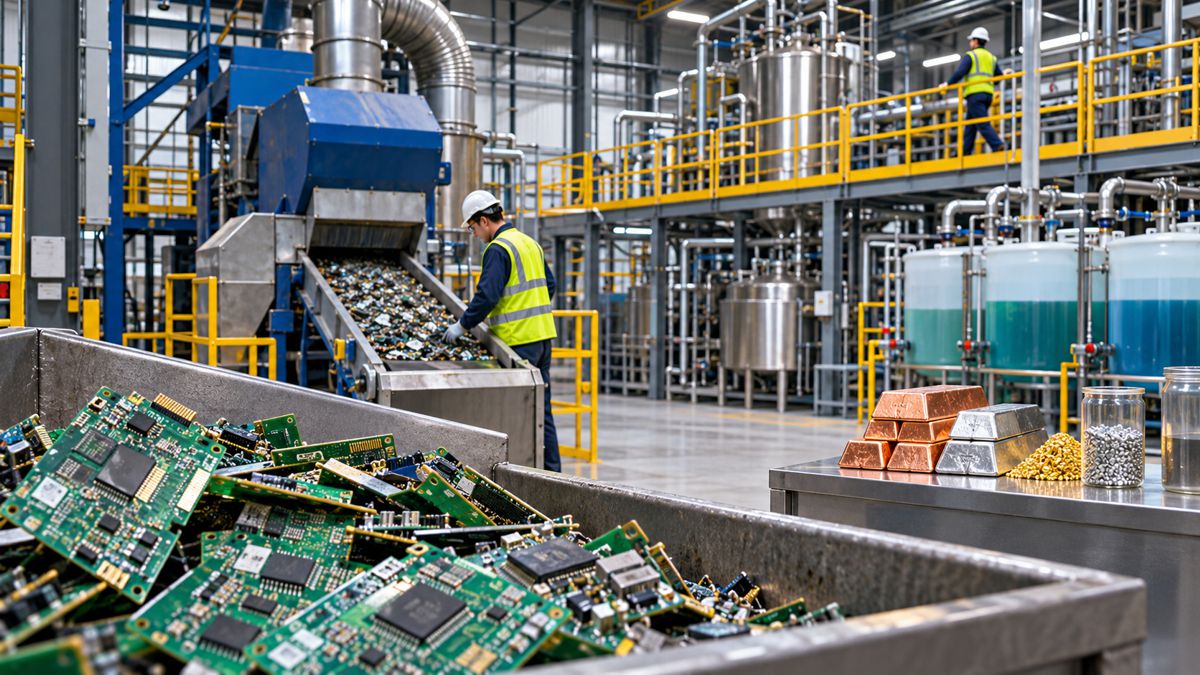
Printed circuit boards are particularly attractive because they contain relatively concentrated combinations of valuable metals. Gold is used in electrical contacts for its conductivity and resistance to corrosion, while copper forms conductive pathways throughout circuit boards. Silver, palladium and tin perform various other electronic and manufacturing functions, creating a complex feedstock with considerable potential value.
Unlike geological mineral deposits, these resources are continually replenished through equipment replacement, technological obsolescence and industrial modernisation. Recovering them economically requires an established collection network, specialist processing infrastructure and technologies capable of separating materials originally engineered to remain tightly integrated.
From Circuit Boards to Refined Metals
Modern Mining’s proposed industrial process adapts established mineral processing and metallurgical principles to a manufactured feedstock containing metals, plastics, epoxy resins and fibreglass. Mechanical size reduction and physical separation liberate metallic components from non-metallic materials, producing concentrates that can either be sold as intermediate products or transferred for further purification.
According to the company’s SEC offering circular, its initial commercial pre-concentration plant is designed to process up to one tonne of printed circuit boards per hour, equivalent to approximately 8,000 tonnes annually under its design operating assumptions.
The subsequent aqueous purification stage incorporates metallurgical techniques including selective leaching, precipitation, adsorption and copper electrorefining. These processes are intended to separate and recover individual metals, with the commercial operation targeting copper cathodes alongside gold, silver and palladium products.
Although Modern Mining describes its technology as proprietary, many of the engineering challenges will be familiar to conventional mineral processing specialists. Particle size, material liberation, separation efficiency and chemical selectivity all influence metal recovery, while maintaining consistent results becomes more demanding when incoming material originates from thousands of different electronic products manufactured over several decades.
Industrial electronic waste recovery is already an established activity, with specialist recyclers and metallurgical businesses processing discarded electronic components alongside other secondary materials. Modern Mining’s proposed operation enters this market with an aqueous processing model and a regional expansion strategy intended to compete with existing recovery routes.
The Economics of Urban Ore
Modern Mining’s offering circular presents a representative feedstock containing approximately 136 grams of gold and 151 kilograms of copper per tonne of printed circuit boards. The company estimates that its selected electronic waste feedstock can contain gold concentrations approximately 100 times higher than conventional gold ore grades used in its comparison.
Such figures require careful interpretation, particularly as conventional ore grades vary considerably between deposits and mining methods. The company’s representative feedstock is modelled using published material grades and anticipated supplier arrangements rather than a guaranteed specification for every incoming shipment.
High metal concentrations can reduce the volume of material requiring processing for a given quantity of recovered metal, but discarded circuit boards are already valuable industrial commodities. Specialist recyclers and metallurgical operators compete to acquire them, with purchase prices influenced by their anticipated recoverable metal content.
Urban mining consequently exchanges some of the costs associated with geological exploration, overburden removal and rock excavation for expenditure on feedstock acquisition, collection, sorting and transportation. Commercial performance depends on the relationship between material purchase prices, recovery efficiencies, operating costs and the market value of the resulting products.
For Modern Mining, establishing binding supply agreements with electronics recyclers, waste aggregators, manufacturers and IT asset disposition specialists forms a central part of its development programme. Long-term supplier relationships, reliable material grading and transparent commercial settlement procedures could prove as important to the business as the performance of its processing technology.
Regional Processing and Centralised Purification
Rather than constructing a complete metallurgical facility at every location, Modern Mining intends to develop a network of regional pre-concentration plants supplying a central purification operation in North Carolina. The purification facility is being designed to accommodate concentrates from as many as five plants, allowing mechanical processing and separation to take place closer to electronic waste suppliers before the concentrated material is transported for further recovery.
“We approach electronic waste with the mindset of a mining company, as an above-ground resource rather than simply a waste stream,” said Jeet Basi, President and CEO of Modern Mining Technology Corp. “Building our first commercial-scale plant is the step that turns that resource into a new source of supply for the U.S. market. We designed our model so that each pre-concentration plant we add can feed the same purification hub, giving us a clear path to growth.”
The arrangement has parallels with conventional mining districts, where several extraction operations supply a shared processing facility. Centralising complex metallurgical operations could reduce duplication of specialist equipment, analytical laboratories, chemical handling systems and skilled personnel, while regional processing could lower the cost of transporting non-metallic material over long distances.
The model also lends itself to phased infrastructure investment, with additional regional capacity introduced as supplier agreements are secured and commercial demand develops. Expansion would need to be coordinated with available purification capacity, however, as the central facility would represent a shared operational dependency across the network.
Engineering Commercial-Scale Recovery Facilities
Electronic waste recovery plants combine the engineering requirements of recycling infrastructure, mineral processing and chemical production. Beyond conventional industrial buildings and material handling systems, their construction requires appropriately designed machinery foundations, dust extraction, ventilation, water circulation, electrical distribution and process control equipment.
Chemical processing introduces further requirements for reagent storage, corrosion-resistant equipment, secondary containment, wastewater management and occupational safety. Modern Mining describes its demonstration-stage pre-concentration process as water-based and operating without chemical additives, with controlled chemical reagents introduced during subsequent purification. Its commercial plans also envisage recirculating process water and incorporating dust and noise management systems.
Although recovering metals from discarded electronics avoids the excavation and overburden removal associated with conventional mining, aqueous processing is not inherently free from environmental impacts. Electricity consumption, reagent manufacture, water demand, transportation, metal recovery rates and the treatment of residual materials must all be considered when assessing its environmental performance against established recovery and primary production methods.
Separated plastics, resins, fibreglass and chemical residues may also require specialist treatment or disposal. Establishing suitable downstream arrangements will form part of the wider environmental and regulatory responsibilities of the commercial operation.
Modern Mining intends to pursue certification under the R2 Responsible Recycling Standard, which establishes requirements for electronics reuse, recycling, material handling and downstream management. Certification could help the company establish relationships with corporate suppliers that must account for the eventual destination and responsible treatment of their discarded equipment.
From Demonstration to Commercial Production
Modern Mining’s Greenville demonstration facility completed commercial settlements for 41 product lots between December 2023 and June 2026, establishing that its intermediate metallic concentrates could find buyers. Producing saleable concentrates provides an important foundation for the business, although it does not establish the profitability or sustained operating performance of the complete proposed purification process.
The company’s 18-month commercial development programme envisages completing the initial pre-concentration and aqueous purification plants within six to nine months of the IPO, alongside supplier contracting and operator training. Commissioning and progressive increases in throughput are scheduled for months nine to twelve, followed by commercial production and revenue growth during months twelve to eighteen.
The initial commercial operation carries a design target of approximately 40,000 gold equivalent ounces annually. This expresses the combined value of recovered metals in equivalent gold units rather than representing the physical quantity of gold produced. The proposed expansion to as many as five regional pre-concentration plants forms part of the company’s subsequent growth strategy.
Moving from demonstration production to sustained industrial operation introduces challenges that cannot always be resolved through laboratory testing. Equipment wear, maintenance intervals, variations in feedstock composition, chemical consumption and unplanned stoppages become more apparent through extended operating experience, particularly when production volumes increase substantially.
The approximately US$40 million raised through the IPO provides capital to advance the business, although gross offering proceeds should not be interpreted as the construction budget or the net funding available for plant development. The initial facility will establish the engineering and commercial reference for subsequent expansion, with sustained throughput, recovery rates, product quality and operating costs providing the basis for future investment decisions.
Domestic Metal Production and Resource Security
Governments and manufacturers are increasingly concerned about the geographical concentration of mineral processing and refining capacity. Expanding domestic recovery operations offers an additional route towards diversifying supplies of selected metals without relying exclusively on new mineral extraction projects or overseas refining capacity.
Copper is particularly relevant to construction and infrastructure development, with electricity distribution networks, renewable energy installations, data centres, transport infrastructure and industrial equipment all requiring substantial quantities of conductive materials. Recovering metals from retired infrastructure could establish secondary resource cycles linking equipment replacement with future industrial production.
As telecommunications systems, electrical installations and computing facilities undergo successive generations of modernisation, their obsolete components become potential feedstock for specialist recovery businesses. The availability of appropriate collection, dismantling and processing infrastructure will determine how much of that material can be returned economically to industrial supply chains.
Urban mining is unlikely to displace conventional mineral extraction on a substantial scale in the foreseeable future, particularly given growing global infrastructure requirements. Secondary recovery can nevertheless complement primary production while extracting further value from materials that have already incurred the environmental and financial costs of their initial manufacture.
Building an Industry Around Discarded Resources
Expanding urban mining capacity creates opportunities throughout the industrial equipment and construction supply chain. Regional collection centres, automated sorting facilities, specialist dismantling operations, metallurgical plants and analytical laboratories will all require investment, alongside the transportation infrastructure connecting them.
Equipment manufacturers and engineering companies could find growing demand for machinery specifically suited to processing complex manufactured materials. Advances in sensor-based sorting, automated material characterisation, robotic dismantling and process control could improve recovery efficiencies while reducing occupational exposure to hazardous substances.
Modern Mining’s North Carolina operation will be judged by its ability to secure feedstock, maintain production and sell recovered metals at commercially sustainable margins. Establishing those foundations would provide a practical basis for extending its regional processing network and developing additional domestic recovery capacity.
The world’s cities, factories, offices and infrastructure already contain substantial inventories of processed minerals. Developing the industrial facilities to recover those resources economically and responsibly offers manufacturers another source of raw materials, while creating opportunities for the engineering and construction businesses needed to bring urban mining to commercial scale.
Key Industry Questions
- What is urban mining? Urban mining involves recovering valuable materials from discarded manufactured products, buildings, infrastructure and other human-made resources rather than extracting them directly from geological deposits.
- Which metals can be recovered from electronic waste? Depending on the feedstock and processing technology, electronic waste can contain recoverable copper, gold, silver, palladium, tin, aluminium, nickel and various other metals.
- What is aqueous metal recovery? Aqueous metal recovery uses liquid-based chemical and metallurgical processes to separate, concentrate and purify metals from suitable feedstock.
- What are gold equivalent ounces? Gold equivalent ounces express the combined value of several metals as an equivalent quantity of gold using specified commodity price assumptions. They do not represent the physical quantity of gold recovered.
- Why are printed circuit boards valuable to urban mining companies? Circuit boards contain relatively concentrated quantities of conductive and precious metals that can be mechanically separated and metallurgically processed.
- Can urban mining replace conventional mineral extraction? Urban mining can supplement primary mineral production and diversify supply chains, but available waste volumes, feedstock composition and recovery limitations mean conventional mining remains essential.
- Why use regional pre-concentration facilities? Regional facilities can reduce transportation requirements by removing non-metallic materials before sending higher-value concentrates to a central metallurgical operation.
- What are the principal commercial risks facing electronic waste processors? Feedstock acquisition costs, inconsistent material composition, metal price fluctuations, recovery efficiencies, equipment reliability and environmental compliance can all influence profitability.
- What is R2 certification? The R2 Standard establishes requirements for responsible electronics reuse and recycling, including material tracking, environmental management and downstream processing.
Strategic Takeaways
- Urban mining creates opportunities for specialist industrial construction, mineral processing equipment and automated material separation technologies.
- Competitive feedstock procurement is as fundamental to commercial viability as metallurgical recovery performance.
- Regional pre-concentration and centralised purification could support phased expansion while limiting duplicated capital expenditure.
- Sustained commercial production is essential for validating recovery efficiencies, operating costs and environmental performance.
- Domestic secondary metal recovery offers manufacturers and infrastructure supply chains an additional source of strategically important materials.