RAD Unveils Portable AI Security Tower for Construction Sites
Construction sites frequently need to move their security arrangements as machinery, materials and working areas shift around a project. Robotic Assistance Devices (RAD) has introduced a compact, solar-powered surveillance tower designed to make that process considerably easier, with a system that can be shipped in two parcels and assembled by one person in approximately 15 minutes.
Known as RAIA, the new equipment combines artificial intelligence, video surveillance and automated voice engagement in a portable format that eliminates the need for a dedicated trailer, towing vehicle or hitch. Developed by RAD, a subsidiary of US-based Artificial Intelligence Technology Solutions (AITX), the tower is intended for temporary and changing security requirements across construction, industrial and commercial environments.
Formally unveiled on 9 November 2026, RAIA is expected to become commercially available towards the end of the first quarter of 2027. RAD is positioning the system as a lower-cost alternative to conventional solar-powered CCTV trailers, although final pricing and detailed operating specifications have yet to be released.
Briefing
- RAD’s RAIA security tower ships in two parcels and is designed for installation by one person in approximately 15 minutes.
- Four cameras provide 360-degree viewing, supported by AI-based human and vehicle detection.
- The integrated SARA platform enables automated voice engagement, remote video access and two-way communication.
- Ground-standing and pole-mounted configurations are planned for construction, industrial and commercial applications.
- Initial deliveries are anticipated in late Q1 2027, with pricing and independently verified operating performance still to be established.
A Smaller Approach to Temporary Site Security
Mobile surveillance towers have become a familiar feature of construction compounds, infrastructure projects and industrial facilities. Conventional systems commonly use trailers equipped with telescopic masts, cameras, solar panels, batteries and communications hardware, allowing operators to establish surveillance without installing permanent infrastructure.
Although effective in many applications, their size and transport requirements can complicate deployment on projects with restricted access, limited space or frequently changing work areas. Moving a conventional tower may require a suitable towing vehicle, clear access routes and personnel to prepare the equipment for relocation, even when the distance involved is relatively short.
RAIA takes a different approach by separating temporary surveillance from the trailer traditionally used to carry it. The compact arrangement can be transported through ordinary parcel delivery services and assembled at the intended location, potentially allowing contractors to establish monitoring around smaller equipment compounds, temporary access points and isolated work areas without arranging specialist delivery.
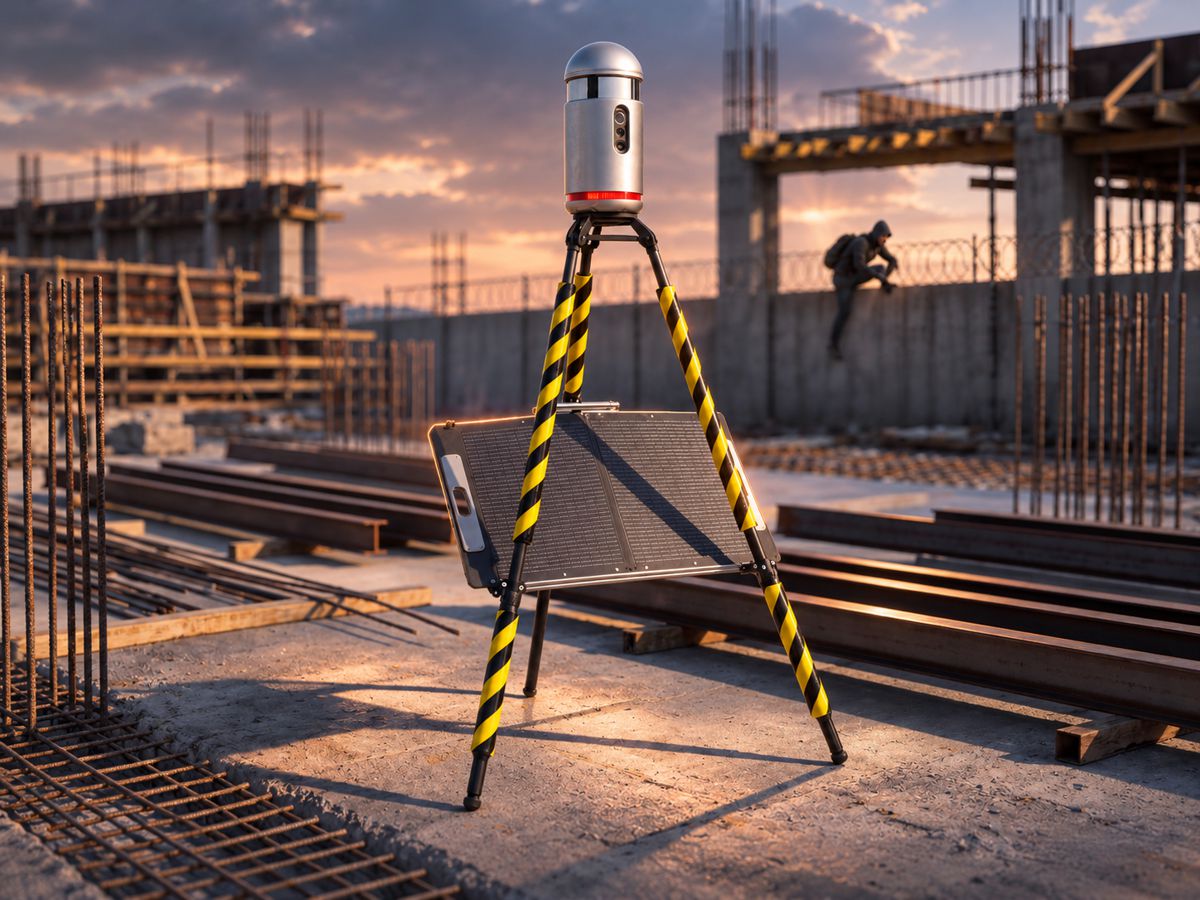
The ground-standing version uses a folding tripod that can be bolted or otherwise secured to the supporting surface. Installation positions can be selected according to visibility, available sunlight and communications coverage, while the equipment can be relocated as site requirements change. RAD is also developing RAIA-P, a pole-mounted configuration intended for locations where ground-standing equipment would obstruct operations or be more vulnerable to interference.
Both arrangements have potential applications on civil engineering projects where equipment storage, site boundaries and access arrangements move during successive construction phases. The appropriate mounting method will depend on local conditions, particularly where exposed locations, construction traffic or ground stability present additional considerations.
AI Detection and Autonomous Voice Engagement
RAIA incorporates four cameras providing a combined 360-degree field of view, with AI-based software designed to identify people and vehicles within monitored areas. Detected events can trigger RAD’s SARA autonomous voice engagement system, which uses customer-configured settings to determine how the equipment responds to activity.
Rather than relying exclusively on passive recording, the system can issue spoken messages intended to discourage unauthorised access or suspicious behaviour. Images associated with detected events are transmitted to the RAD dashboard, allowing operators to review the circumstances behind an alert, while on-demand live video and two-way audio provide the ability to inspect a location and communicate directly with people on site.
The arrangement could be useful around construction plant, fuel storage areas, temporary site entrances and materials awaiting installation, particularly where a permanent security presence would be difficult to justify. Automated detection and voice engagement may provide an initial response while monitoring personnel assess whether further intervention is necessary.
Four cameras may provide panoramic viewing coverage, although effective detection will still depend on camera positioning, obstructions, lighting and the configuration of monitored zones. RAD has previously described SARA as capable of initiating automated deterrence in less than one second following detection, with processing undertaken locally at the device. The quoted response time is a manufacturer-stated capability rather than a published result from independent construction-site testing.
Following Equipment Around a Construction Project
Construction sites rarely remain physically unchanged throughout a project. Earthworks give way to drainage, structural operations and finishing activities, while machinery, valuable materials and temporary facilities are continually repositioned to accommodate the next phase of work.
A security installation covering an early-stage plant compound may become less useful when the equipment moves elsewhere, particularly on highway projects and other linear infrastructure schemes where active working areas can extend considerable distances. Contractors may consequently need to relocate surveillance equipment several times during the life of a project or establish temporary coverage around individual storage and access locations.
Conventional surveillance trailers can be moved between these positions, but the process may involve arranging a suitable vehicle and ensuring sufficient access for manoeuvring. A smaller standalone system could simplify local redeployment, allowing surveillance coverage to follow construction activity without the same transport requirements.
RAD founder and chief executive Steve Reinharz described the thinking behind the design: “Getting security onto a property should not start with finding a truck and a trailer hitch.”
He added: “We designed RAIA to make putting security where you need it feel as straightforward as setting up a patio umbrella. One person. About 15 minutes. When the area that needs attention changes, you can reposition the unit. That simplicity is central to what RAIA brings to the market.”
The company’s quoted installation time is an approximate expectation rather than a guaranteed result for every site. Actual deployment will depend on preparing and securing the mounting position, establishing connectivity and configuring the surveillance functions.
The folding tripod arrangement will also require appropriate consideration of wind exposure, accidental contact with machinery and the stability of the supporting surface. On busy construction sites, selecting a secure position that maintains useful camera coverage without interfering with operations may be more important than achieving the fastest possible installation.
Solar Power and Remote Operation
RAIA’s solar-powered design is intended to reduce dependence on fixed electrical connections, allowing the equipment to operate in temporary locations where mains power may be unavailable or inconvenient.
Solar surveillance installations typically combine photovoltaic generation with battery storage to support operation outside daylight hours. Their practical endurance depends on the relationship between solar panel output, available battery capacity, equipment consumption and local weather conditions, particularly during winter when shorter days coincide with extended overnight monitoring requirements.
RAD has not yet published sufficient detailed technical information to establish RAIA’s battery capacity, solar panel output or operating endurance during prolonged periods of poor sunlight. These specifications will be relevant for contractors working in remote locations, exposed construction compounds and sites where uninterrupted overnight coverage is a priority.
Remote monitoring also depends on dependable communications. Image notifications, live video and two-way audio require a suitable connection, even where certain detection and response functions are processed locally. Contractors considering the equipment will therefore need to evaluate connectivity, power autonomy and camera placement together, rather than treating them as separate installation decisions.
Security Economics and Deployment Costs
RAD is promoting RAIA as a lower-cost alternative to conventional mobile surveillance trailers, with simpler transportation and installation forming part of its proposed commercial advantage.
In its product preview, the company estimated that rental charges could be up to 70% lower than those of competing security-as-a-service offerings. The figure remains an anticipated pricing comparison rather than an independently demonstrated saving, and RAD has acknowledged that lower rental charges do not necessarily translate into equivalent reductions in overall operating costs.
For construction contractors, the complete cost of temporary surveillance may include equipment rental, delivery, installation, communications, monitoring, maintenance, incident response and subsequent relocation. Smaller equipment could reduce handling and transport expenditure, particularly on projects where conventional trailer-mounted units require dedicated vehicle movements or where multiple temporary locations need coverage.
Nevertheless, the compact format does not automatically make RAIA a direct substitute for larger installations. Camera elevation, detection range, operating endurance and monitoring arrangements will influence the comparison, while the number of units required to cover a site may have a substantial effect on overall costs.
A single portable tower could be sufficient for a restricted equipment compound or temporary entrance, whereas a large construction site may require several monitoring positions or an established trailer-mounted system with greater elevation and coverage. Final commercial terms will determine where RAIA offers the more economical arrangement.
Competition in Mobile Surveillance
RAIA enters an established market served by specialist surveillance technology manufacturers, equipment rental businesses and remote monitoring providers.
According to The Business Research Company’s Mobile Surveillance Tower Market Report 2026, the global market is estimated at US$1.49 billion in 2026, compared with US$1.36 billion in 2025. The research organisation forecasts growth to approximately US$2.18 billion by 2030, covering a broad category that includes solar-powered, diesel-powered and hybrid surveillance towers.
Established businesses in the sector include LiveView Technologies, Wanco, Wireless CCTV, BauWatch and Knightscope, providing a competitive landscape in which surveillance capabilities, monitoring services and equipment availability are already important purchasing considerations.
RAD’s proposed advantage centres on a smaller physical footprint and simpler deployment, supported by its existing autonomous response technology. The ability to distribute equipment through parcel carriers could also appeal to security providers and distributors seeking to serve smaller locations without maintaining the transport arrangements associated with conventional trailer-mounted installations.
The commercial opportunity will depend on whether customers regard that convenience as sufficient reason to adopt a different surveillance format, particularly where established providers already offer managed monitoring and rapid response services.
Practical Security and Regulatory Considerations
Temporary surveillance equipment must be positioned where cameras can observe relevant activity without obstructing machinery, site traffic or access arrangements. Contractors also need to account for potential blind spots, accidental impacts and unauthorised interference, while configuring detection systems to distinguish suspicious activity from legitimate movements by employees, subcontractors, delivery drivers and maintenance personnel.
Automated voice engagement introduces another operational consideration. Although remote warnings may discourage some unauthorised activity, effective security still requires clear procedures for reviewing alerts and responding to incidents. Contractors will need to establish who receives notifications, how incidents are assessed and what action follows when an event requires intervention.
Data protection requirements are equally relevant where surveillance cameras capture workers, neighbouring properties or public areas. The UK’s Information Commissioner’s Office guidance on video surveillance addresses lawful processing, appropriate monitoring, transparency and the secure handling of recorded information. Its construction-site example illustrates the use of visible notices explaining surveillance arrangements and identifying a contact for enquiries.
Workplace surveillance can also require consultation, a data protection impact assessment and additional safeguards, particularly where audio recording is involved. Requirements vary between jurisdictions, making local regulatory compliance an important part of deployment planning for international contractors.
Commercial Availability and Construction Applications
RAD expects initial RAIA deliveries towards the end of the first quarter of 2027, although manufacturing schedules, final specifications and commercial terms remain subject to confirmation. Prospective customers and channel partners can request information through the company’s product demonstration service, with discussions covering placement, coverage, connectivity, pricing and delivery requirements.
The equipment’s practical appeal is closely connected to the temporary nature of construction. Plant compounds are dismantled, access roads are relocated, stored materials move closer to working areas and site boundaries change as projects advance, creating surveillance requirements that may last for weeks rather than years.
A compact security tower that can be delivered without specialist transport and repositioned by site personnel offers an alternative to moving larger equipment between these locations. Its suitability will ultimately depend on the coverage, reliability and operating endurance achieved in the field, but the underlying approach addresses a familiar problem for contractors managing security across changing construction environments.
Key Industry Questions
- What is RAD’s RAIA security tower? RAIA is a portable solar-powered surveillance system incorporating four cameras, AI-based human and vehicle detection, automated voice engagement and remote video access.
- How quickly can RAIA be installed? RAD estimates that one person can deploy the system in approximately 15 minutes. Actual installation times depend on site preparation, equipment anchoring, connectivity and configuration.
- Does RAIA require a trailer or towing vehicle? No. The equipment is designed to ship in two parcels and can be deployed without a dedicated surveillance trailer, towing vehicle or hitch.
- Can RAIA be used on construction sites? Yes. Potential applications include equipment compounds, temporary site entrances, material storage areas and changing construction work zones, subject to suitable installation conditions.
- How does RAIA respond to unauthorised activity? The integrated SARA platform can detect configured events and initiate automated voice engagement. Operators can also review alerts, access live video and communicate remotely through two-way audio.
- Does RAIA provide continuous 360-degree surveillance? Its four cameras provide 360-degree viewing coverage. Detection performance depends on camera positioning, obstructions, lighting and configuration, while continuous operation requires adequate power.
- How much does the RAIA security system cost? Final pricing has not been published. RAD intends to position RAIA below conventional solar-powered CCTV trailers, but the actual cost advantage will depend on rental terms and included services.
- When will RAIA become available? Initial deliveries are anticipated towards the end of the first quarter of 2027, subject to production and distribution arrangements.
- Can RAIA replace conventional CCTV security trailers? It may provide an alternative for smaller or temporary monitoring applications. Larger installations may remain preferable where greater camera elevation, extensive coverage or different power and monitoring capabilities are required.
Strategic Takeaways
- Parcel-based distribution could reduce the transport and handling requirements associated with conventional mobile surveillance towers.
- Portable monitoring offers a practical option for construction sites where equipment storage, access arrangements and working boundaries change throughout a project.
- AI detection and autonomous voice engagement can provide an initial security response, although effective incident management still requires appropriate human oversight.
- Solar autonomy, communications reliability, physical stability and camera performance will determine suitability for demanding construction environments.
- RAD’s proposed pricing advantage will depend on final commercial terms and the complete cost of providing equivalent surveillance coverage.