Boston Dynamics Spot Robots Complete 90,000 Inspections at GlobalFoundries
Two Boston Dynamics Spot robots have completed more than 90,000 inspections and travelled nearly 900 kilometres inside GlobalFoundries’ Singapore semiconductor manufacturing operations since April, achieving a reported mission success rate of 99%. Those results have helped establish the foundation for an expanded robotic inspection programme covering manufacturing facilities in the United States, Germany and Singapore, alongside plans to begin testing the company’s Atlas humanoid robot in 2027.
The agreement, announced on November 2026, builds on more than four years of collaboration between Boston Dynamics and GlobalFoundries (GF). Although the introduction of Atlas brings a new dimension to the partnership, the established Spot programme offers a more immediate picture of how autonomous mobile robots are being incorporated into industrial maintenance operations.
Semiconductor fabrication plants depend on extensive networks of mechanical, electrical and environmental control equipment, much of it operating continuously to support highly controlled manufacturing processes. Maintenance teams must identify developing faults before they interrupt production, making repeated equipment inspections particularly important. Mobile robots capable of following established routes and collecting consistent readings provide another means of monitoring these systems, especially in the extensive service areas beneath fabrication floors.
Briefing
- GlobalFoundries is expanding Spot deployments across manufacturing sites in New York, Vermont, Dresden and Singapore.
- Two Spot robots in Singapore have completed more than 90,000 inspections and travelled nearly 900 kilometres since April.
- The company reports a 99% mission success rate for its Singapore robotic inspection operations.
- GlobalFoundries has redeployed 875 routine inspections in two weeks and plans to more than double that number.
- Atlas humanoid testing will begin in early 2027, initially concentrating on potential applications, integration requirements and task development.
From Experimental Robotics to Routine Maintenance
GlobalFoundries began using Spot at its Burlington, Vermont, manufacturing facility more than four years ago, giving the company considerable experience with autonomous inspections before extending the programme to Singapore. The more recent deployment has produced substantial operational figures, with two robots completing over 90,000 inspections in sub-fab areas while travelling almost 900 kilometres. GlobalFoundries reports that 99% of their missions have been completed successfully, although it has not published a detailed breakdown of unsuccessful missions, inspection accuracy or the maintenance interventions resulting from the information collected.
Using updated hardware and software, the company has also redeployed 875 routine inspections in just two weeks, with plans to more than double that number through Spot’s advanced visual inspection capabilities. The announcement does not explain whether the figure refers to individual inspection points, configured inspection tasks or recurring inspection activities, making it difficult to assess precisely how much additional work the robots are undertaking. Nevertheless, the volume of completed inspections demonstrates sustained operation in an environment where monitoring equipment condition is an established part of maintaining production.
Pradip Singh, Chief Manufacturing Officer at GlobalFoundries, described how the programme has developed: “Spot has helped us shift from reactive to predictive maintenance, collecting data across thousands of inspection points to prevent downtime and keep our fabs running more efficiently. Scaling Spot and testing Atlas are the next steps in our journey to AI-enabled manufacturing, putting physical AI to work across our operations worldwide.”
The company has not disclosed the financial return from the programme or published comparative figures showing reductions in equipment downtime. Its decision to expand robotic inspections across additional facilities does, however, indicate that Spot has moved beyond an isolated technology demonstration and become part of GlobalFoundries’ wider approach to industrial asset management.
How Spot Performs Industrial Inspections
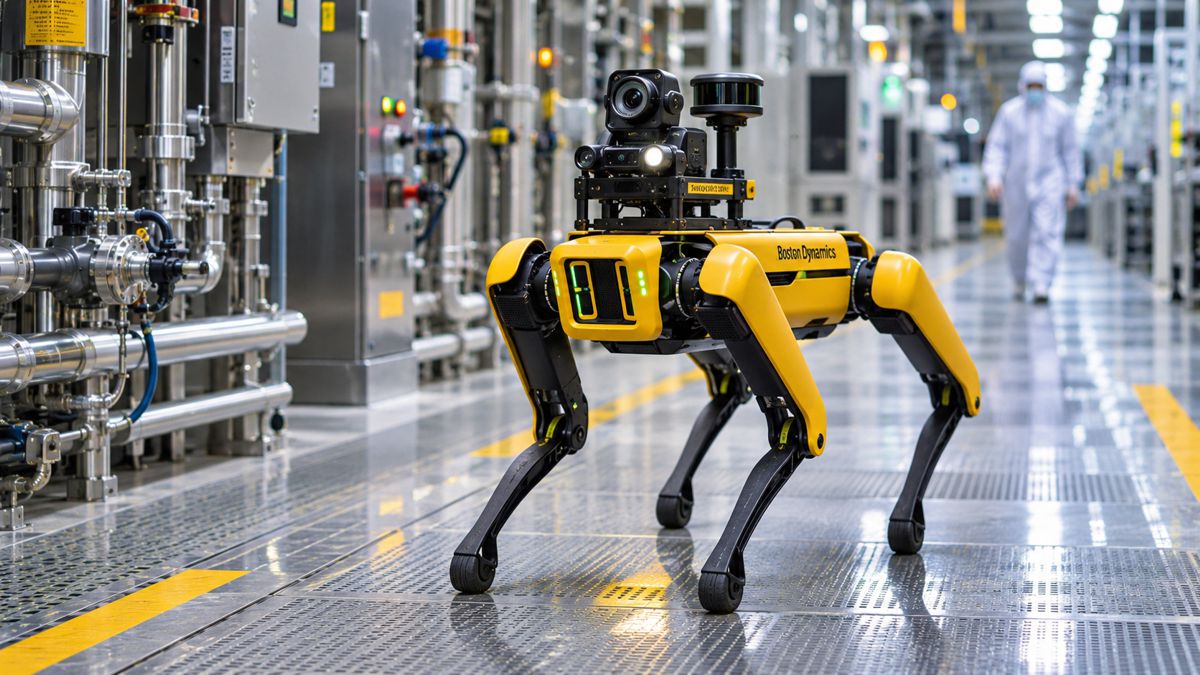
Spot uses four articulated legs to navigate industrial environments, allowing it to traverse obstacles and negotiate areas where conventional wheeled robotic systems may be less practical. Its autonomous inspection system can follow recorded routes, collect equipment readings and transmit information for review by maintenance personnel, with individual missions configured around the layout and inspection requirements of a facility.
According to Boston Dynamics’ industrial inspection documentation, the platform can carry visual, thermal and acoustic monitoring equipment, enabling it to read gauges, detect abnormal temperatures, investigate unusual sounds and record changes in equipment condition. These capabilities are particularly relevant to installations containing pumps, motors, cooling equipment, electrical systems and the extensive supporting infrastructure associated with semiconductor manufacturing.
The accompanying Orbit software provides a means of managing robotic inspection activities and organising the resulting information. Rather than relying entirely on personnel visiting equipment locations at scheduled intervals, maintenance teams can use autonomous robots to collect readings repeatedly from the same positions, establishing a record against which changes in operating conditions can be assessed. The information still requires appropriate interpretation, and a robotic inspection does not automatically establish the cause of a developing fault.
Mobile inspections can complement permanently installed monitoring instruments, which remain appropriate where continuous observation is required. A robot can move between multiple assets carrying its inspection equipment, while fixed sensors collect readings from specific locations without needing to revisit them. The balance between these approaches depends on the equipment involved, the frequency of inspection and the accessibility of each installation.
Boston Dynamics has documented similar applications at BMW Group’s manufacturing operations, where Spot uses thermal cameras, acoustic sensors and other instruments to investigate equipment conditions and support maintenance activities. Although the manufacturing environment differs from that of a semiconductor fabrication plant, the underlying inspection requirements are comparable: gathering consistent information from distributed equipment and making it available to maintenance teams without requiring every observation to be undertaken manually.
Global Deployment Across Four Manufacturing Locations
The expanded agreement covers GlobalFoundries’ facilities in Malta, New York; Burlington, Vermont; Dresden, Germany; and Singapore. Bringing these locations into a wider inspection programme will require individual routes, equipment configurations and maintenance procedures to be established around the conditions of each facility. Existing experience in Burlington and Singapore provides a foundation for the expansion, although the company has not specified how many additional robots will be deployed, the investment involved or when the programme will reach its intended scale.
Managing inspections across several manufacturing sites also introduces practical considerations beyond the capabilities of the robots themselves. Equipment layouts, access restrictions, personnel movement and maintenance schedules differ between facilities, while inspection data needs to remain accessible to engineers working within established operating procedures. As production areas are modified or equipment is replaced, autonomous routes and monitoring requirements may need to be updated to reflect those changes.
GlobalFoundries is simultaneously expanding its manufacturing capacity, including a new 300mm semiconductor fabrication plant at Malta, where construction officially began in November under a US-Japan investment initiative. The company has not linked this development directly to its robotic inspection agreement, but the investment provides additional context for the scale and complexity of the manufacturing infrastructure it operates.
The expansion will also allow GlobalFoundries to examine how consistently the inspection programme performs across different sites. The Singapore results provide an established operational reference, although differences in equipment, inspection frequency and plant configuration will influence the performance of each deployment.
Atlas Enters Semiconductor Manufacturing
Alongside the Spot expansion, GlobalFoundries will become the first customer outside the automotive industry to participate in Boston Dynamics’ Atlas early adopter programme. Onsite testing is scheduled to begin in early 2027, with the two companies planning workshops to identify potential applications, assess integration requirements and begin training for specific tasks.
The humanoid programme is considerably less mature than the established Spot operation. Whereas the quadruped robots are already undertaking routine inspections, Atlas is being developed for industrial activities that may require manipulation, physical interaction with equipment and movement through spaces designed around human workers. Boston Dynamics has identified part sequencing, machine tending and order building among its broader development applications, although GlobalFoundries has not confirmed which activities it intends to investigate at its semiconductor facilities.
The manufacturing environment will influence those decisions. Semiconductor production involves equipment operating under tightly controlled conditions, with contamination management, process reliability and personnel safety imposing particular requirements on activities close to sensitive manufacturing operations. Some maintenance and materials-handling tasks take place in supporting industrial areas, while others involve controlled production environments where introducing new robotic equipment may require additional assessment.
GlobalFoundries’ initial programme is intended to establish which applications are technically suitable and what would be required to integrate Atlas with existing operations. The company’s workforce development activities will form part of that process, allowing personnel to examine potential tasks, operational procedures and the practical requirements of working alongside humanoid robots.
The established relationship with Boston Dynamics gives both companies experience of deploying autonomous machines inside semiconductor facilities, but inspection and physical manipulation involve different technical challenges. A robot capable of repeatedly navigating an inspection route does not necessarily possess the precision, reliability or adaptability required to handle components or interact with production equipment. Those capabilities will need to be demonstrated through the planned trials.
Zack Jackowski, Chief Product & Technology Officer at Boston Dynamics, said: “GlobalFoundries was one of our earliest customers to adopt Spot, and we are excited to see the program continue scaling across the globe. Innovative companies like GF are realizing real operational value today while collecting the kind of data that will be extremely useful toward future manufacturing innovation in the next few years.”
The early adopter programme should provide Boston Dynamics with experience in another demanding industrial setting, while giving GlobalFoundries an opportunity to assess potential applications before committing to wider deployment. No commercial rollout timetable, confirmed task allocation or projected financial benefit has been disclosed for Atlas.
Industrial Robotics Beyond the Factory Floor
The inspection requirements demonstrated at GlobalFoundries are also familiar across infrastructure and industrial operations. Power stations, water treatment facilities, transport depots, tunnels and large building services installations contain extensive networks of mechanical and electrical equipment, much of which requires routine monitoring to identify wear, abnormal temperatures, leaks or developing faults.
Permanent facilities with established equipment layouts and predictable access routes provide suitable conditions for repeatable robotic inspections. Mobile systems can collect visual, thermal and acoustic information from distributed assets, allowing engineering teams to review conditions remotely and concentrate physical inspections on equipment requiring further investigation. The economics depend on inspection frequency, the cost of robotic operation and the ability to turn collected information into effective maintenance action.
Boston Dynamics has already documented applications in industrial environments beyond semiconductor manufacturing and automotive production, including food processing and other facilities where equipment reliability is important. These deployments illustrate how robotic inspections can be adapted to different operating conditions, although each installation requires its own assessment of access, safety and the equipment being monitored.
Live construction sites present additional challenges. Temporary access routes, moving machinery, changing ground conditions and frequent alterations to the working environment can make autonomous navigation and scheduled inspections considerably more difficult than in permanent industrial facilities. Completed infrastructure installations, where plant rooms, service corridors and equipment locations remain relatively stable, offer a closer comparison with the GlobalFoundries deployment.
Robotic inspection also has practical limits. Sensors can identify unusual conditions and collect information consistently, but they do not eliminate the need for experienced maintenance personnel, particularly where faults require investigation, repair or decisions about whether equipment should remain in service. The performance of an autonomous inspection system ultimately depends on the quality of the information it gathers and how effectively that information is incorporated into maintenance procedures.
GlobalFoundries’ expansion will provide further experience of operating these systems across geographically dispersed manufacturing facilities, while the Atlas programme begins exploring a different category of industrial robotics. For Spot, the next phase involves extending established inspection capabilities across additional equipment and operating environments. Atlas will first have to demonstrate which physical tasks it can undertake reliably within a semiconductor manufacturing operation.
The Singapore deployment offers a substantial foundation, with more than 90,000 inspections already completed and a wider international programme now planned. Whether humanoid robotics can develop a similarly practical role will depend on the results of the trials beginning in 2027.
Key Industry Questions
- What is Boston Dynamics Spot being used for at GlobalFoundries? Spot is conducting autonomous inspections of equipment and infrastructure within semiconductor manufacturing facilities, collecting readings that support maintenance and equipment condition monitoring.
- How many inspections have the robots completed in Singapore? Two Spot robots have completed more than 90,000 inspections since April, travelling nearly 900 kilometres and achieving a reported 99% mission success rate.
- Which GlobalFoundries facilities are included in the expansion? The programme covers Malta in New York, Burlington in Vermont, Dresden in Germany and Singapore.
- What types of industrial inspections can Spot perform? Depending on its sensor configuration, Spot can perform visual inspections, read gauges, monitor temperatures and collect acoustic information to help identify abnormal equipment conditions.
- What is the difference between Spot and Atlas? Spot is a quadruped robotic platform used for mobile inspections and industrial data collection. Atlas is a humanoid robot being developed for tasks involving physical manipulation and interaction with equipment.
- When will GlobalFoundries begin testing Atlas? Onsite testing is scheduled to begin in early 2027, with workshops examining potential applications, integration requirements and task-specific training.
- Has GlobalFoundries disclosed the financial benefits of Spot? The company has described improvements in maintenance practices and operational efficiency but has not published a quantified financial return, downtime reduction or detailed cost comparison.
- Could similar inspection robots be used in infrastructure maintenance? Yes. Mobile inspection systems can be considered for power stations, water treatment facilities, transport depots, tunnels and other permanent installations, subject to suitable operating conditions and safety requirements.
Strategic Takeaways
- Established operations: GlobalFoundries’ Singapore programme demonstrates sustained robotic inspection activity within a demanding industrial environment.
- Maintenance integration: Regular autonomous inspections can provide consistent equipment condition data, although effective maintenance still depends on appropriate interpretation and intervention.
- International expansion: Deploying Spot across four manufacturing locations will require adaptation to different plant layouts, equipment configurations and maintenance procedures.
- Humanoid development: Atlas remains at an exploratory stage in semiconductor manufacturing, with suitable tasks, operating requirements and commercial viability still to be established.
- Infrastructure applications: Permanent industrial and infrastructure facilities offer potential applications for robotic inspection, particularly where equipment is distributed across large sites with predictable access routes.