AI-Driven Robotics Accelerates Advanced Materials Research with AutoBot
Researchers at Lawrence Berkeley National Laboratory have developed an automated system capable of exploring more than 5,000 combinations of materials processing conditions while physically testing fewer than 1% of them. Known as AutoBot, the platform combines robotics, machine learning and optical analysis to investigate how manufacturing conditions affect metal halide perovskites, a promising family of semiconductor materials used in research into solar cells and other electronic devices.
The system selects its own experiments, uses the results to improve its predictions and progressively narrows the range of processing conditions worth investigating. In trials examining temperature, processing time and humidity, researchers identified the conditions producing high-quality perovskite films without having to manufacture and evaluate thousands of individual samples.
The findings, originally published in Advanced Energy Materials in 2025 and highlighted again by the US Department of Energy in November 2026, address a longstanding difficulty in materials research. Developing a new material often involves extensive experimentation, particularly when several manufacturing variables interact and a small adjustment to one condition can change the final product.
Briefing
- Lawrence Berkeley National Laboratory developed AutoBot, an automated platform integrating robotics, materials characterisation and machine learning.
- The system explored more than 5,000 possible processing combinations while experimentally testing fewer than 1%.
- Four variables were examined: annealing temperature, annealing duration, antisolvent application timing and relative humidity.
- Humidity during film deposition emerged as the strongest influence on the measured quality of the perovskite films.
- Researchers believe the experimental approach could be extended to other semiconductor materials, although industrial manufacturing applications require further development.
Building a Laboratory That Chooses Its Own Experiments
Materials development has traditionally relied on researchers preparing samples, adjusting processing conditions and measuring the results before deciding what to try next. Experience and scientific understanding can narrow the possibilities, but the number of experiments increases rapidly when temperature, moisture, chemical composition and processing times interact.
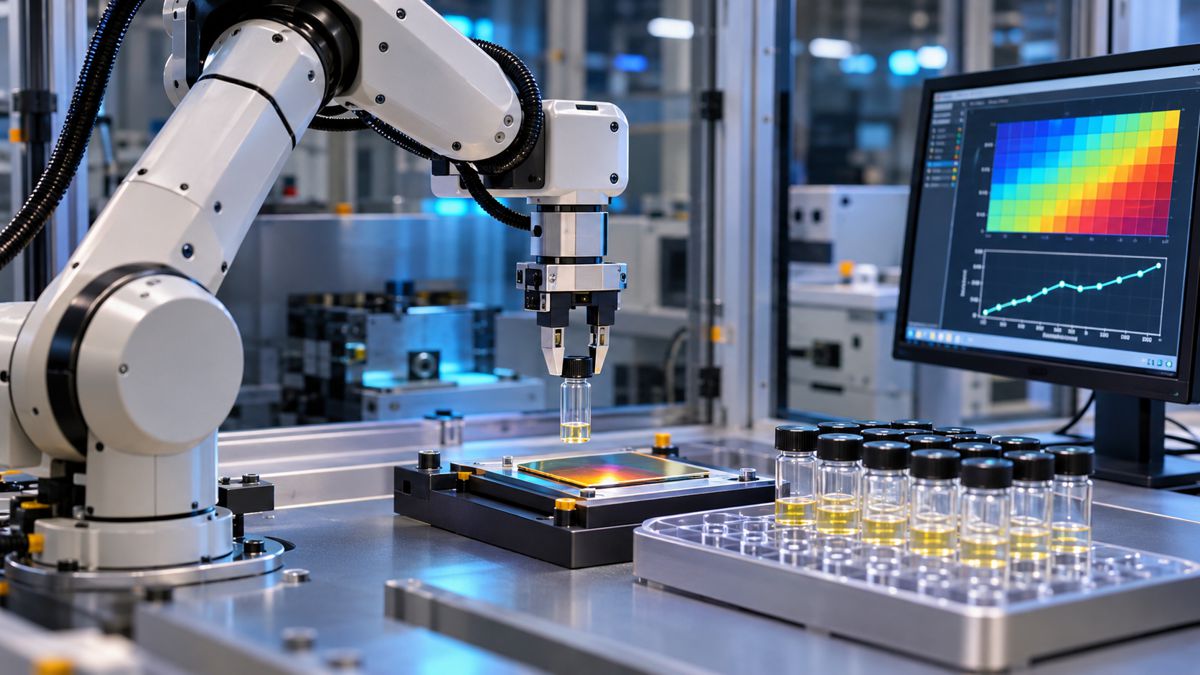
At the Molecular Foundry, a US Department of Energy research facility at Berkeley Lab, researchers brought these activities together in an automated workflow. AutoBot integrates robotic sample preparation, controlled processing equipment and optical measurement systems with machine learning software that recommends subsequent experiments.
The platform prepares thin films from chemical precursor solutions, controlling the manufacturing conditions before examining the resulting material. Its experiments included adjustments to annealing temperature and duration, the timing of an antisolvent treatment used to influence crystallisation, and the relative humidity present during film deposition.
Each sample is then assessed using three complementary techniques. Ultraviolet-visible spectroscopy measures the transmission of light through the material, photoluminescence spectroscopy examines emitted light, and photoluminescence imaging provides information about the uniformity of the finished film.
These measurements reveal different aspects of material quality. Strong photoluminescence, for example, does not necessarily mean that a film has formed uniformly, so the researchers combined the results into a weighted quality score rather than relying on any single measurement. The score provides the machine learning system with a consistent means of comparing samples and identifying which combinations of manufacturing conditions deserve further investigation.
The process operates as a closed loop, with each experiment contributing information that influences the selection of subsequent tests. Researchers still establish the experimental boundaries and determine how material quality should be measured, but the system can explore the available combinations without following an exhaustive testing schedule.
Exploring Thousands of Manufacturing Conditions
The Berkeley Lab team investigated four manufacturing parameters, creating an experimental space containing more than 5,000 possible combinations. Preparing and testing every variation would require considerable laboratory time, material consumption and equipment use, particularly when repeated measurements are needed to establish confidence in the results.
AutoBot approached the problem using Gaussian process regression and Bayesian optimisation. The machine learning model estimated the relationship between manufacturing conditions and material quality while accounting for uncertainty in its predictions. It then used Bayesian optimisation to identify additional experiments expected to provide the most useful information.
The researchers began with 16 randomly selected processing conditions before allowing the system to guide further experiments. The programme ultimately examined 40 distinct parameter combinations, with four samples produced under each condition to support the measurements.
Rather than attempting to identify the best result through repeated trial and error, AutoBot progressively developed a predictive understanding of how changes to the manufacturing process influenced the finished films. According to the research, the model’s learning rate had fallen to approximately 2% after sampling fewer than 1% of the possible combinations, indicating that additional experiments were providing comparatively little new information.
The research team completed the experimental programme over a few weeks, compared with its estimate of up to a year for a comparable manual investigation. That comparison relates to the particular experimental programme rather than an established performance benchmark for automated materials research generally.
The resulting model allowed the researchers to examine relationships between manufacturing variables without physically producing every possible combination. It also provided a basis for investigating which variables exerted the greatest influence on the material’s properties.
Humidity Proves Critical to Perovskite Quality
Metal halide perovskites have attracted considerable attention because of their useful optical and electronic properties. They can be processed into thin films from chemical solutions, offering potential manufacturing advantages for applications including solar cells, photodetectors and other optoelectronic devices.
Controlling their formation remains challenging. Changes in atmospheric moisture can influence crystallisation, film coverage and the stability of the material during fabrication, while interactions between processing conditions make it difficult to identify a consistently reliable manufacturing method.
AutoBot examined relative humidity levels between 5% and 55%, alongside adjustments to annealing conditions and antisolvent timing. Analysis of the experimental results identified humidity during film deposition as the most influential of the four variables examined.
High-quality films were obtained within a relative humidity range of approximately 5% to 25% when suitable processing conditions were used. Higher humidity generally produced less favourable results, with changes in crystallisation and material stability affecting the finished films.
The researchers carried out additional experiments to investigate these relationships, including photoluminescence measurements taken during film formation. Their observations provided further information about how humidity influences the formation of the desired perovskite crystal phase in the presence of an additive used in the precursor chemistry.
The findings helped establish a processing window for the particular material formulation under investigation. They also demonstrated that the machine learning model had identified a meaningful relationship between manufacturing conditions and material properties, rather than merely selecting samples that performed well against the initial measurements.
Humidity control has practical consequences for manufacturing equipment, particularly where tightly regulated atmospheric conditions require additional energy, specialised enclosures or more complicated production arrangements. Understanding the range of conditions under which a material can be produced reliably gives researchers a clearer starting point for developing a repeatable manufacturing process.
From Laboratory Optimisation to Industrial Manufacturing
Identifying favourable laboratory conditions is only one stage in developing a commercially useful material. Industrial production must deliver consistent results across larger quantities, different equipment configurations and operating conditions that may vary during continuous manufacturing.
For perovskite semiconductors, maintaining suitable atmospheric conditions is one of several challenges facing manufacturers. A laboratory process that tolerates a wider range of humidity levels could offer advantages during production development, although the AutoBot research did not demonstrate an industrial manufacturing line or establish the commercial economics of the processing conditions it identified.
The experiments also concentrated on the optical properties of the fabricated films. Light transmission, photoluminescence and film uniformity provide valuable information about semiconductor quality, but they do not independently establish the electrical performance, long-term durability or commercial reliability of a finished solar cell.
The automated experimental methodology could nevertheless be useful when investigating manufacturing tolerances. Rather than testing a small number of preferred formulations, researchers can examine how several processing variables interact and identify regions where changes in operating conditions have relatively little effect on the finished product.
Such information can help inform the design of subsequent development trials, although transferring laboratory findings to industrial equipment requires further testing. Differences in material quantities, processing speeds and environmental control can introduce behaviour that is difficult to reproduce using small laboratory samples.
AutoBot’s ability to combine several measurements into a single assessment also depends on the criteria selected by the researchers. A material optimised for optical quality may require different testing methods if mechanical strength, corrosion resistance, durability or manufacturing cost becomes the primary consideration.
Wider Applications in Advanced Materials Development
The experimental approach is not inherently restricted to perovskites. The Berkeley Lab researchers have identified other solution-processed semiconductors, including organic and oxide-based materials, as possible candidates for automated development.
These materials have different chemical properties and manufacturing requirements, but their production can involve similar challenges when multiple processing variables influence the finished product. A robotic platform capable of preparing samples, measuring their performance and using the results to guide further experimentation could substantially reduce the amount of repetitive testing involved.
Comparable challenges arise throughout construction materials research. Concrete formulations depend on interactions between cement chemistry, aggregates, admixtures, water content and curing conditions, while asphalt performance is influenced by binder properties, aggregate characteristics, mixing temperatures and additive concentrations.
Protective coatings, polymers and composite materials introduce further combinations of chemical composition and processing conditions that can be difficult to evaluate systematically. Automated experimentation could help researchers investigate these relationships, particularly when the available formulations are numerous and the performance requirements are clearly defined.
Applying AutoBot’s methodology to such materials would require different laboratory equipment and measurement systems. The Berkeley Lab platform was designed to prepare semiconductor thin films and evaluate their optical properties, whereas construction materials frequently require mechanical testing, environmental exposure or the preparation of substantially larger samples.
The time required to obtain useful measurements would also influence the effectiveness of automation. Optical characteristics can be assessed relatively quickly, while cementitious materials may need extended curing before strength testing, and some durability investigations require months of exposure to moisture, chemicals or fluctuating temperatures.
Even where testing cannot be accelerated, machine learning could help determine which experiments are worth conducting. A system that identifies the most informative combinations of materials and processing conditions could reduce unnecessary laboratory work without changing the time required for individual tests.
The Berkeley Lab research demonstrates how robotics and machine learning can be combined to investigate complex manufacturing processes with relatively limited experimental sampling. Its findings remain specific to semiconductor thin films, but the underlying method provides a practical basis for developing more efficient testing programmes across a wider range of materials.
Key Industry Questions
- What is AutoBot? AutoBot is an automated research platform developed at Lawrence Berkeley National Laboratory that combines robotic materials preparation, optical characterisation and machine learning to investigate manufacturing conditions.
- How does AutoBot reduce the number of experiments required? The system uses Bayesian optimisation to select experiments expected to provide the most useful additional information. Results are fed into a predictive model that guides subsequent testing.
- How many experiments were conducted? The research examined 40 distinct processing conditions, with four samples prepared under each condition. These represented fewer than 1% of the more than 5,000 possible parameter combinations.
- Which manufacturing variables were examined? The experiments investigated annealing temperature, annealing duration, antisolvent application timing and relative humidity during film deposition.
- Why was humidity important to the research? Humidity strongly influenced perovskite film formation and quality. The researchers identified favourable conditions at approximately 5% to 25% relative humidity for the particular material formulation studied.
- Does AutoBot manufacture commercial solar panels? No. The system produces and characterises laboratory-scale semiconductor films. Commercial solar cell manufacturing would require additional development, performance testing and production-scale validation.
- Could automated experimentation be applied to construction materials? The methodology could potentially be adapted to concrete, asphalt, coatings and other materials, provided suitable preparation, measurement and testing equipment is available. AutoBot itself has not been demonstrated for these applications.
- What is the difference between automated experimentation and conventional laboratory testing? Conventional laboratory programmes typically rely on researchers selecting experiments and evaluating results before planning further work. Closed-loop automated systems use experimental measurements to update predictive models and recommend subsequent tests.
Strategic Takeaways
- Experimental efficiency: Machine learning can reduce the number of physical experiments required to investigate complex manufacturing processes by selecting the most informative tests.
- Process optimisation: Examining interactions between manufacturing variables can help researchers identify processing conditions suitable for consistent material production.
- Measurement quality: Automated decisions depend on reliable testing methods and carefully selected performance criteria, particularly when several material properties must be considered.
- Industrial development: Laboratory optimisation provides useful process information but cannot replace production-scale trials, commercial performance assessments or long-term durability testing.
- Cross-sector applications: Similar experimental methods could support construction materials research, although mechanical testing, curing and environmental exposure introduce different automation requirements.