From Simulation to Physical Robots: China’s Push for General-Purpose Machine Intelligence
More than 1,800 development teams from 13 countries have entered a Chinese robotics competition designed to test whether artificial intelligence systems trained in virtual environments can adapt to physical machines and unfamiliar operating conditions.
The inaugural Robbyant Embodied AI Challenge, organised by Ant Group subsidiary Robbyant in partnership with ModelScope and Alibaba Cloud Tianchi, completed its online qualification stage on 27 October 2026. Finalists will move to Shanghai from 14–16 November, where their algorithms will be tested in a real-robot hackathon.
The competition centres on LingBot-VLA 2.0, an open-source vision-language-action foundation model released in July 2026 and trained using approximately 50,000 hours of robot trajectories alongside 10,000 hours of human-perspective video. Its developers are investigating whether a common AI model can learn physical behaviours that transfer between different machines, tasks and environments, reducing the need to develop entirely separate intelligent control systems for every application.
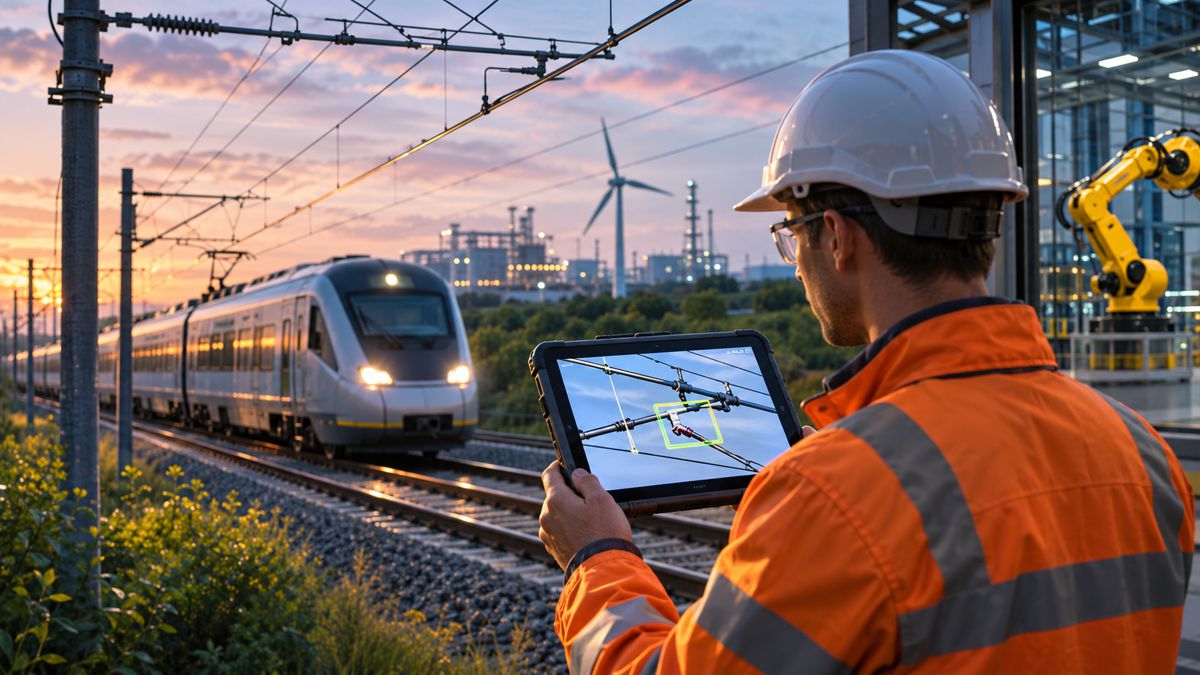
Although the immediate work is concentrated in robotics research and industrial automation, the underlying technology has potential relevance to construction equipment, mobile machinery, infrastructure inspection and other sectors where machines must operate in changing, imperfectly controlled environments.
Briefing
- More than 1,800 teams from 13 countries have registered for the Robbyant Embodied AI Challenge.
- The competition uses LingBot-VLA 2.0, an open-source robotics foundation model released in July 2026.
- The model’s training involved approximately 50,000 hours of robot trajectories and 10,000 hours of human-perspective video.
- Researchers are investigating how robotic intelligence can adapt across different tasks, machines and physical environments.
- Finalists will test their algorithms on physical robots in Shanghai from 14–16 November 2026.
Teaching Machines to Understand Their Surroundings
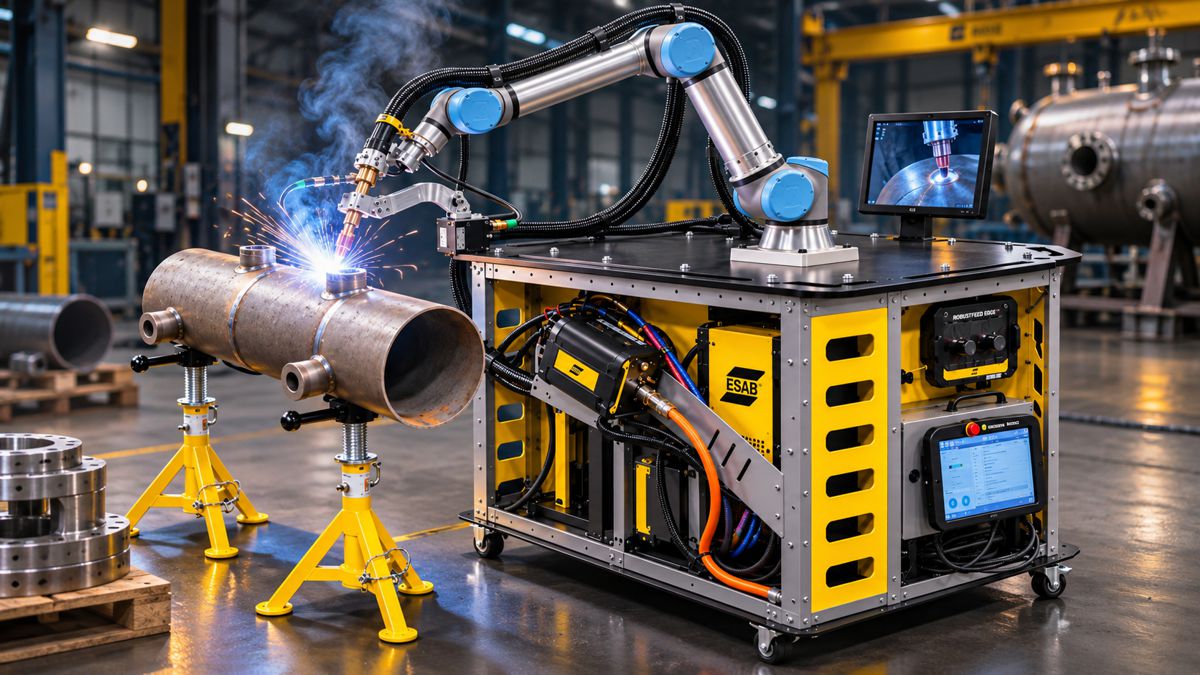
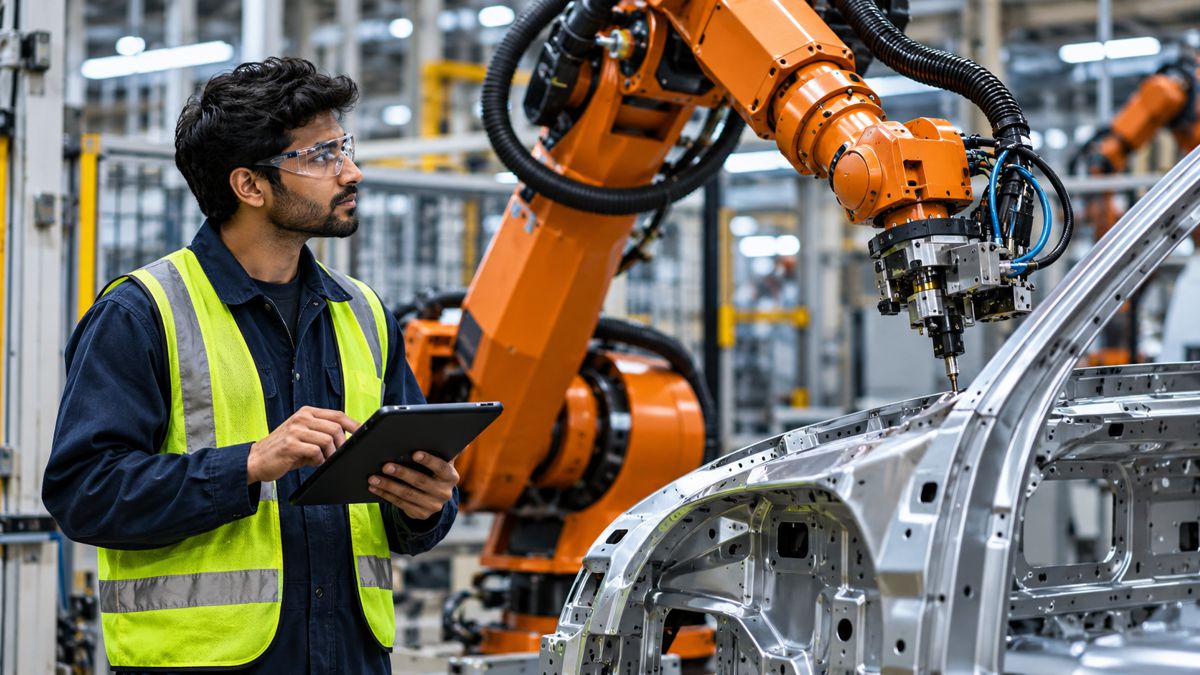
Traditional industrial robots are highly effective when operations are repetitive, predictable and carefully defined. A robotic arm welding vehicle bodies or moving components along a production line can perform thousands of movements with exceptional consistency, provided the working environment remains within its programmed limits.
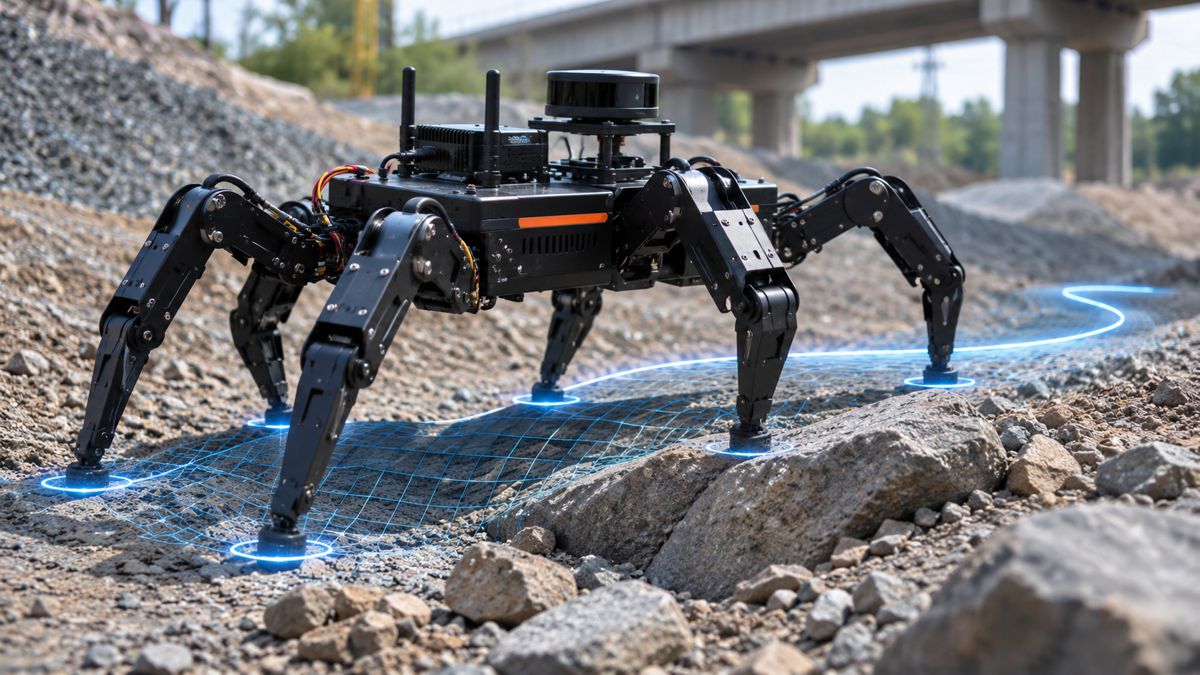
The difficulty increases when objects change position, materials behave unpredictably or a machine encounters circumstances that were not anticipated during development. These conditions are familiar in construction, maintenance and field operations, where machines must account for irregular ground, moving personnel, unfamiliar objects and variations in the work itself.
Vision-language-action models, generally known as VLA models, combine visual information with language-based instructions to generate actions that can be executed through a robot’s control system. A machine might be instructed to identify an object, approach it, grasp it and move it elsewhere, with the model interpreting visual observations and producing movements appropriate to the circumstances rather than following an entirely predetermined sequence.
The approach draws on advances in large AI models, but controlling motors and manipulating physical objects introduces difficulties that do not arise in purely digital applications. An incorrect movement can damage equipment, disrupt an operation or create a safety hazard, while successful performance depends on physical characteristics that may be difficult to represent accurately during training.
Research published in IEEE Access in September 2025 identified generalisation, data availability, computational demands and operational reliability among the continuing obstacles to deploying VLA systems. These challenges become particularly apparent when robots encounter conditions outside those represented in their training data.
Building Intelligence Across Different Machines
Robbyant’s LingBot-VLA 2.0 research offers an example of how developers are attempting to make robotic intelligence more adaptable.
In a technical paper published in July 2026, From Foundation to Application: Improving VLA Models in Practice, the research team describes a training dataset incorporating approximately 50,000 hours of robot trajectories collected across 20 robot configurations, supplemented by 10,000 hours of human-perspective manipulation video.
The diversity of this material is significant to the model’s development. A stationary industrial arm, a mobile manipulator and a humanoid robot may all be required to pick up an object, but their movements depend on different joints, degrees of freedom, balance requirements and control mechanisms. Training across several configurations gives researchers an opportunity to investigate whether useful behaviours can be transferred between machines rather than learned independently for each platform.
LingBot-VLA 2.0 extends its action representation beyond conventional dual-arm manipulation to include robotic hands, grippers, heads, waists and mobile bases. Its architecture also incorporates predictive modelling intended to help the system anticipate changes in its surroundings.
The researchers reported improvements in benchmark evaluations and demonstrated mobile manipulation capabilities across two robotic platforms. Those results were obtained under particular test conditions and do not establish that the model can reliably operate arbitrary robots or complete unfamiliar tasks without additional adaptation.
There are also important differences between learning new tasks, transferring behaviours to different hardware and performing consistently in unfamiliar environments. A model that can manipulate several objects using one robotic arm may still require substantial additional development before similar behaviours work on a machine with different mechanical characteristics.
For robotics manufacturers, a shared foundation model could eventually provide a starting point for developing intelligent behaviours across several products. The software would still need to be integrated with the mechanical systems, sensors and control architectures of each machine.
Moving From Virtual Tests to Physical Robots
Simulation allows robotics researchers to experiment with movements, objects and operating conditions without repeatedly putting expensive physical equipment at risk. Virtual environments can generate large numbers of training scenarios, introduce obstacles and reproduce difficult situations that would be inconvenient or unsafe to create in a laboratory.
However, a simulated robot operates within a mathematical representation of the physical world. Even sophisticated models cannot reproduce every variation in friction, material deformation, sensor performance, mechanical wear or unexpected contact.
A robot that successfully grasps an object in simulation may struggle when the real object is heavier, more slippery or positioned differently. A mobile robot may navigate a virtual floor without difficulty but encounter problems with uneven surfaces, reflections or obstacles that were not adequately represented during training. These differences form part of the simulation-to-reality problem, commonly shortened to sim-to-real.
The difficulty is apparent in Robbyant’s own LingBot-VLA 2.0 benchmark results. During physical robot testing, the model achieved a 60.0% task completion rate when an Astribot S1 robot was instructed to collect objects and place them inside a refrigerator under familiar conditions. When researchers introduced previously unseen objects and changed the robot’s starting position, the completion rate fell to just 13.3%. Each testing condition involved 15 independent trials.
The results demonstrate how performance can deteriorate when relatively modest changes are introduced to a robot’s working environment. Although refrigerator sorting is far removed from construction machinery, the underlying engineering problem is familiar. An autonomous excavator or material-handling robot must contend with changing object positions, variable materials and operating conditions that cannot always be anticipated during development. Successful performance under controlled conditions provides no guarantee of comparable reliability once those conditions change.
The Robbyant competition is structured around this challenge. Participants are evaluated on model training and fine-tuning, generalisation in simulation and adaptation to physical robots, with the final stage bringing development teams into a shared testing environment.
According to the organisers, 74.7% of participants come from universities and research institutions, while 25.2% are drawn from enterprises and frontline engineering roles. Master’s and doctoral students account for 67.4% of participants, reflecting the competition’s substantial academic research component.
Participating organisations include Tsinghua University, Peking University, Shanghai Jiao Tong University and Zhejiang University, alongside international institutions such as Carnegie Mellon University, University College London, the Technical University of Munich and the National University of Singapore.
Developers associated with Tencent, Alibaba, ByteDance, Microsoft, BYD and Xiaomi have also registered, together with teams from robotics companies including UBTECH, Fourier Intelligence and Agibot.
Participation figures demonstrate the breadth of research interest, although they provide little indication of how many systems will perform successfully outside their development environments. The Shanghai final will offer a more tangible comparison of different approaches when algorithms are transferred to physical hardware.
Longer sequences of activity will be particularly revealing. Small positioning errors, unsuccessful grasps or unexpected movements can disrupt subsequent operations, even when individual actions have performed well in isolation. A robot completing a sequence of ten movements must maintain an accurate understanding of its surroundings as the task progresses, rather than simply reproducing ten successful demonstrations.
Where Construction Machinery Fits Into the Research
Construction equipment presents a demanding environment for general-purpose robotic intelligence.
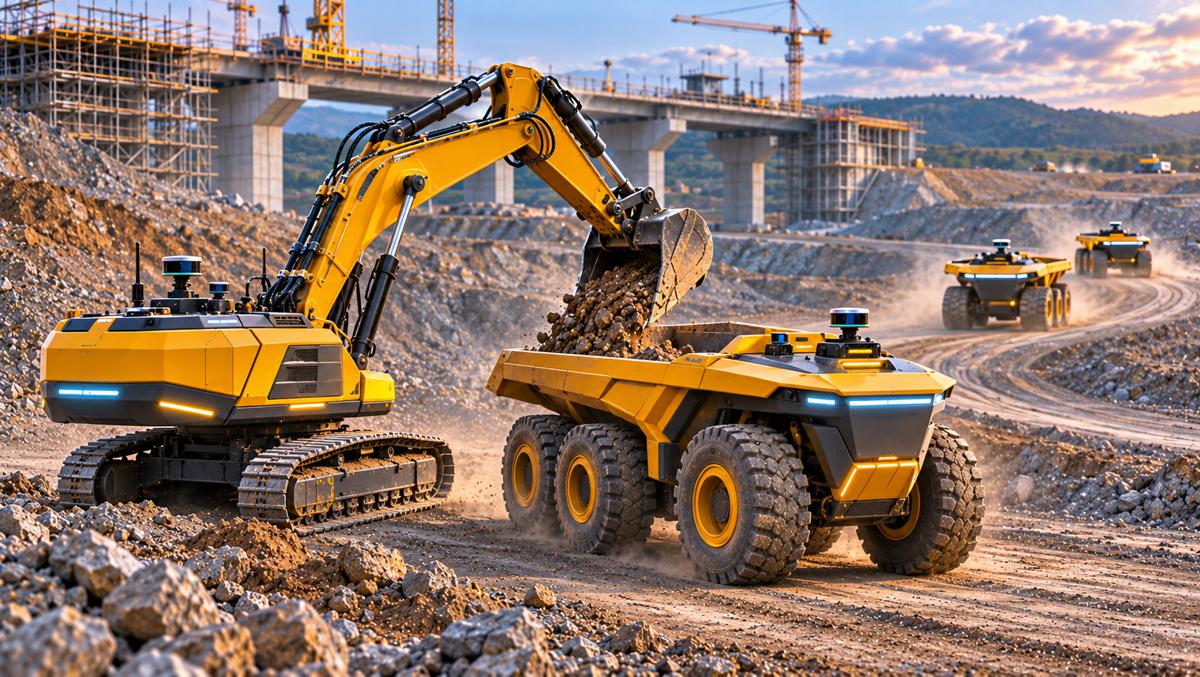
Excavators, wheel loaders, mobile cranes and autonomous haulage vehicles already use combinations of electronic controls, positioning systems, cameras and sensors. Machine guidance and automation technologies can assist operators or perform particular functions under defined operating conditions, with capabilities varying considerably between equipment types and manufacturers.
Much of this development relies on engineering solutions designed for specific machines and applications. An automated excavator must account for variable ground resistance, changing bucket loads, machine stability and hydraulic response. The force required to move a bucket through loose sand differs substantially from that needed to excavate compacted clay or fractured rock, while the machine’s geometry and balance change throughout each digging cycle.
A crane presents a different set of problems involving load movement, lifting geometry, stability and the need to maintain safe operating limits. Autonomous haulage introduces vehicle navigation, traffic management, obstacle detection and interaction with other machines.
General-purpose AI models could eventually assist perception, task planning and decisions within these systems, but that is distinct from directly controlling safety-critical machine movements. The mechanical and control engineering needed to operate a heavy excavator or mobile crane cannot be replaced simply by introducing a foundation model trained on robotic manipulation.
More immediate opportunities may exist in applications where movements are smaller, tasks can be clearly defined and the working environment can be managed.
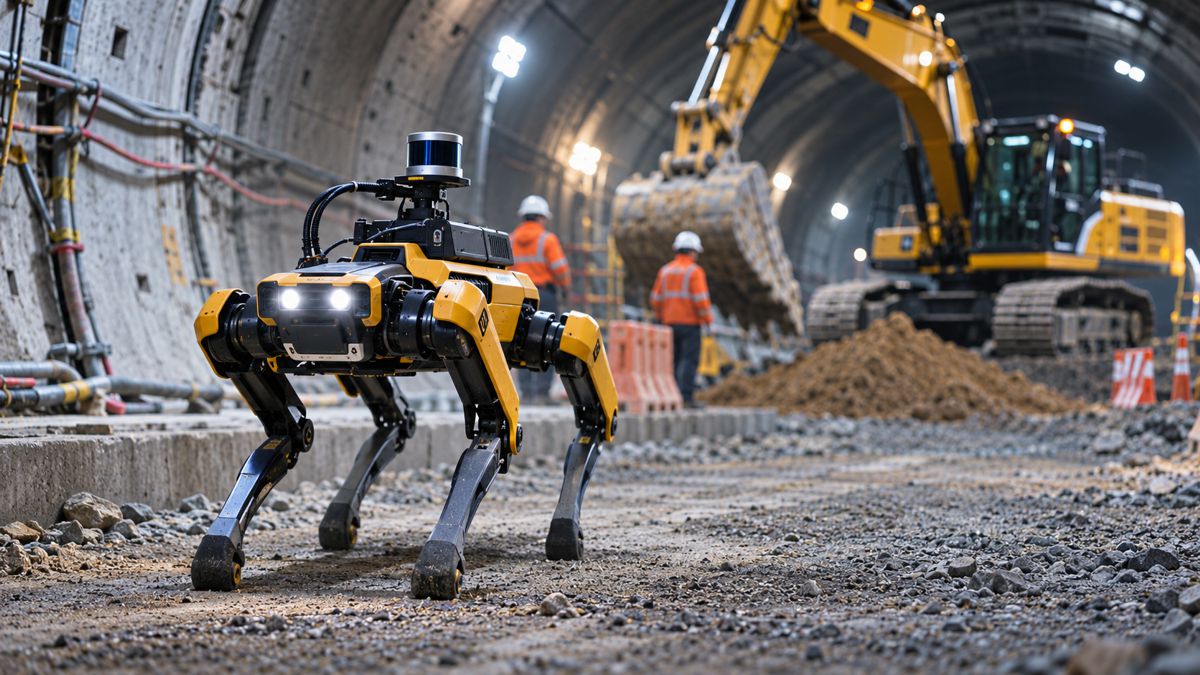
An autonomous inspection robot operating inside a tunnel under construction, for example, may need to navigate temporary cables, construction materials, uneven surfaces and equipment that changes position throughout the day. Improved visual interpretation and task-level decision-making could reduce the amount of route-specific programming required, although navigation, defect identification and physical manipulation would still present different technical challenges.
Industrial maintenance, prefabrication facilities, robotic material handling and automated construction workshops offer other possibilities. These settings provide greater control over working conditions than an open construction site, making it easier to establish operating boundaries and assess performance.
The published LingBot-VLA 2.0 research does not demonstrate autonomous control of construction machinery, and the competition does not establish that its models are suitable for safety-critical equipment operations. Any future deployment would require machine-specific integration, validated control systems, appropriate safeguards and extensive physical testing.
The Importance of Open Robotics Models
Robbyant’s decision to release LingBot-VLA 2.0 as an open-source model is another aspect of the development with potential commercial consequences.
Robotics foundation models require substantial investments in training data, computing infrastructure and specialist engineering. Collecting thousands of hours of physical robot demonstrations is especially demanding, since the work involves hardware, operators, sensors and carefully recorded movements.
Access to a shared foundation model gives smaller developers and research teams a starting point from which to investigate applications, fine-tune behaviours and evaluate performance on different machines. It also makes comparisons between development approaches more practical, particularly when researchers can use common models and evaluation procedures.
Open models do not remove the costs of hardware integration, application-specific training or operational validation. A software model may be freely available while the engineering needed to make it work reliably on a particular robot remains expensive and technically demanding.
For industrial equipment manufacturers, the commercial question is how much intelligent functionality can eventually become reusable software and how much must remain closely integrated with individual machines.
Established construction equipment manufacturers have decades of experience in hydraulic systems, drivetrains, structural engineering and machine controls. Foundation models may eventually complement that expertise through more adaptable perception and task-level intelligence, while the underlying equipment continues to depend on carefully engineered operating and safety systems.
From Research Demonstrations to Industrial Operations
The expansion of embodied AI research has produced increasingly sophisticated demonstrations of robots manipulating objects, responding to instructions and performing sequences of physical tasks. Commercial deployment demands greater consistency, particularly where machines operate for extended periods without close supervision.
A research review published in Robotics in October 2026 examined limitations across VLA systems and their evaluation methods, identifying persistent difficulties involving visual robustness, differences between robotic platforms and failures during extended task sequences. The authors also questioned whether existing benchmarks adequately establish performance under real operating conditions.
Industrial users must consider more than the percentage of tasks completed successfully. Equipment needs to recognise unsuccessful operations, respond predictably to unexpected conditions and recover or stop safely without creating unacceptable risks.
These requirements are familiar in construction, where dust, vibration, weather, changing terrain and the proximity of workers complicate the deployment of autonomous systems. They also help explain why controlled factories, logistics facilities and structured industrial environments remain attractive settings for developing and validating robotic intelligence.
The November competition in Shanghai should provide a useful comparison of how different development teams approach adaptation to physical robots. It will not, by itself, establish the commercial readiness of general-purpose robotic intelligence, but the results may indicate which methods are proving effective beyond simulation.
For construction and infrastructure, the most credible early applications are likely to involve inspection, material handling, industrial maintenance and other activities where robotic tasks can be clearly defined and operating conditions managed. More sophisticated integration with heavy machinery will depend on further advances in perception, physical reasoning, control engineering and demonstrated operational reliability.
The longer-term possibility is that equipment manufacturers will be able to draw on common AI foundations when developing intelligent machine functions, rather than building every capability independently. The quality of those systems will ultimately be judged through their performance on real equipment, under real working conditions, over thousands of operating hours.
Key Industry Questions
- What is embodied AI? Embodied AI refers to artificial intelligence systems that interact with the physical world through robots or other machines, using sensory information to make decisions and perform actions.
- What is a vision-language-action model? A VLA model combines visual observations and language-based instructions to generate actions that can be executed by a robot. The objective is to make robotic control more adaptable across different tasks and environments.
- What is LingBot-VLA 2.0? LingBot-VLA 2.0 is an open-source robotics foundation model developed by Robbyant, an embodied AI company within Ant Group. It is designed to improve generalisation across robotic tasks, hardware configurations and physical environments.
- How much data was used to train LingBot-VLA 2.0? The published research describes approximately 50,000 hours of robot trajectories across 20 configurations, supplemented by 10,000 hours of human-perspective manipulation video.
- What is the simulation-to-reality problem in robotics? Simulation-to-reality refers to difficulties transferring robotic behaviours developed in virtual environments to physical machines, where sensors, materials, mechanical characteristics and operating conditions may behave differently.
- Can general-purpose AI models control construction equipment? Such models may eventually support perception, planning and selected automated functions. However, experimental AI capabilities should not be confused with validated autonomous operating systems capable of safely controlling heavy machinery.
- Where could embodied AI first be useful in construction? Potential applications include automated material handling, robotic inspection, industrial maintenance and prefabrication facilities, where operating conditions can be more closely controlled than on active construction sites.
- Why are open-source robotics models commercially interesting? Open models can reduce the need for individual developers to build large AI systems from the beginning. They provide a common software foundation, although substantial engineering, training and validation are still required for practical deployment.
- When is the Robbyant Embodied AI Challenge final? The organisers have announced that the final will take place in Shanghai from 14–16 November 2026, with participants testing their algorithms on physical robots.
Strategic Takeaways
- Shared foundation models could reduce duplicated software development, allowing robotic behaviours to be adapted across different machines, provided hardware integration and validation remain effective.
- Training across different robot configurations may improve adaptability, but generalising between tasks, hardware and operating environments presents distinct technical challenges.
- Physical testing remains essential, particularly where small errors can accumulate during extended sequences of robotic activity.
- Controlled industrial operations provide a realistic starting point, with inspection, maintenance and material handling offering opportunities to validate intelligent robotic functions.
- Construction equipment will continue to require specialist engineering, with foundation models potentially complementing established machine controls rather than replacing safety-critical systems.