Beyond the Air Horn: Rethinking Emergency Communication on Construction Sites
Safety Systems Management reports that nearly 2,000 construction workers were evacuated in approximately ten minutes during safety drills at New York’s JFK Airport expansion, where 25 wireless emergency communication towers had been installed across the project. The exercise offers an example of how major construction sites are approaching a persistent safety problem: getting clear instructions to everyone when something goes wrong.
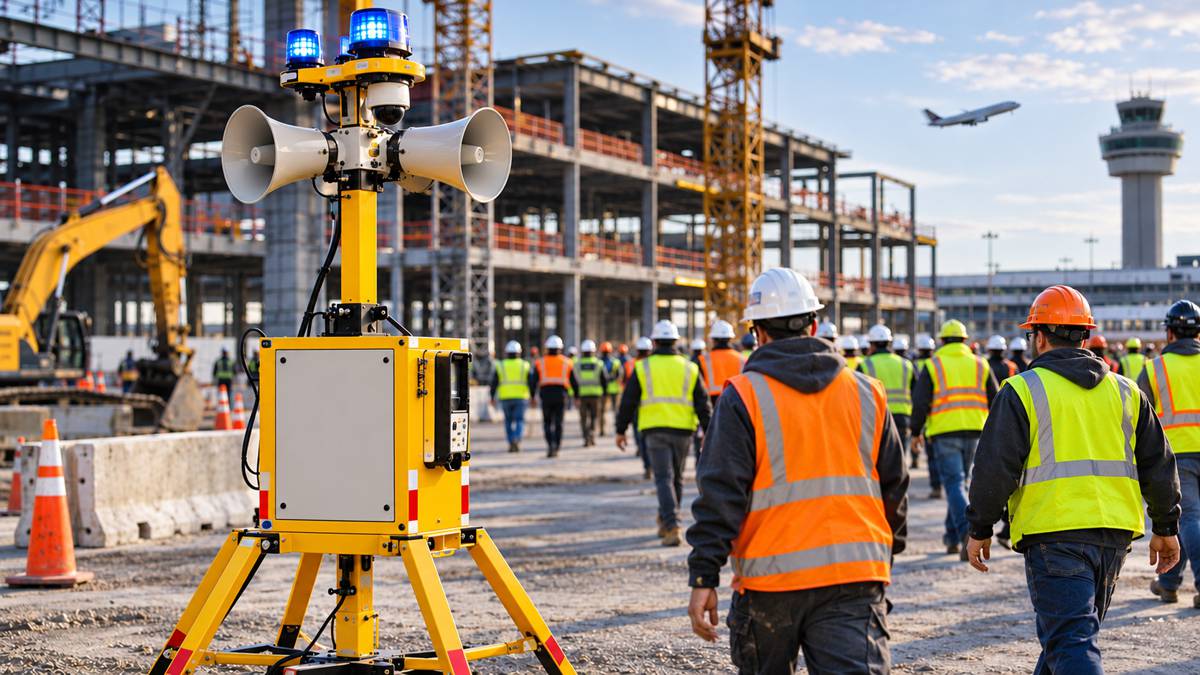
The system, developed by Georgia-based Safety Systems Management, uses portable communication towers to broadcast emergency announcements across active construction areas. Unlike a conventional air horn, the equipment can identify the nature of an incident and provide instructions on whether workers should evacuate, shelter in place or take other action. Its deployment at JFK, alongside a larger installation at a Georgia data centre project, demonstrates how wireless notification equipment can be incorporated into the safety arrangements of substantial construction programmes.
Briefing
- Safety Systems Management has deployed wireless emergency notification towers on major US construction projects.
- At JFK Airport, 25 towers were used during drills involving nearly 2,000 workers evacuated in approximately ten minutes.
- More than 70 towers were installed across ten buildings at a QTS data centre project in Fayetteville, Georgia.
- The equipment supports multilingual announcements, live voice communication, visual alerts and a manufacturer-rated 12-hour battery backup.
- US and UK safety requirements emphasise effective emergency procedures, appropriate warning arrangements and worker training, although neither jurisdiction universally mandates wireless communication towers.
The Communication Problem on Large Construction Sites
Cory Sherman, founder of Safety Systems Management, encountered the limitations of conventional evacuation arrangements during a fire drill at a 20-storey construction project in Atlanta. According to an account published by Georgia Tech, evacuating the building took more than 45 minutes. The circumstances of the exercise were not detailed, so it is unclear how much of the delay resulted from communication, building access or the time required for workers to descend multiple floors.
Air horns remain widely used because they are inexpensive, portable and familiar to construction workers. They require little infrastructure and can provide an immediate warning within a defined working area. Their limitations become more apparent when a project extends across several structures, underground work zones or numerous occupied floors, particularly when workers are separated by considerable distances.
An excavator operator working alongside running machinery may struggle to hear an alarm sounded elsewhere on site. Workers wearing hearing protection face similar difficulties, while subcontractors unfamiliar with local procedures may not immediately recognise what a particular signal requires them to do. Construction sites also change continuously as structures rise, temporary access routes are moved and new working areas are opened. Warning arrangements established during initial mobilisation may no longer provide adequate coverage several months into the programme.
The distinction between an alarm and an instruction becomes particularly relevant during incidents requiring different responses. A fire may call for evacuation, while severe weather or a hazardous event outside a building could require workers to remain under shelter. A warning signal alone cannot communicate those differences unless the workforce has been trained to associate particular signals with specific procedures.
Wireless Communication That Moves With the Project
Safety Systems Management developed its Mobile Communication Tower system around the changing configuration of construction sites. Individual towers can be positioned throughout a project and relocated as the work progresses, avoiding the need to depend entirely on permanent communication infrastructure that may not yet be installed or operational.
The system uses radio-frequency communication to distribute emergency announcements. According to the manufacturer’s technical information, the equipment accommodates up to 300 towers and provides 17 prerecorded messages, with capacity for an additional 15 customised announcements. These can cover different incidents, including fire evacuation and lockdown procedures, while live public address facilities allow authorised personnel to deliver instructions as circumstances develop.
Multilingual announcements are supported, including English and Spanish, allowing contractors to prepare standardised instructions for workers who may not share a common first language. The equipment also incorporates strobe lights to supplement audible warnings, particularly where background noise makes spoken announcements difficult to hear. Each tower includes a two-way intercom connection with the base station, enabling communication between personnel in the field and those coordinating the response.
The towers require a temporary electrical supply, but the manufacturer specifies a 12-hour battery backup and identifies solar power as an additional option. The system also supports local manual activation and wireless triggering devices, while optional LED message boards can display written instructions at selected locations.
These capabilities offer several methods of communicating during an incident, although their effectiveness depends on correct equipment placement, reliable operation and workers understanding the procedures associated with each announcement. The published battery specification is a manufacturer claim rather than an independently established endurance figure under every possible site condition.
Deployment at JFK Airport and the QTS Data Centre
The expansion of John F. Kennedy International Airport in New York provides a demanding environment for temporary emergency communication. Large construction teams operate across extensive work areas, with multiple contractors undertaking structural, mechanical and installation activities as the development progresses.
Safety Systems Management supplied 25 communication towers for the project. According to the company figures reported by Georgia Tech, nearly 2,000 workers were evacuated in approximately ten minutes during safety drills using the system.
The report does not provide the starting locations of workers, the distances involved or the assembly arrangements used during the exercises. Nor does it include independent comparative data showing evacuation performance before and after the equipment was introduced. The reported result therefore describes a particular exercise rather than establishing a general evacuation benchmark for large construction projects.
At the QTS data centre development in Fayetteville, Georgia, the company reports installing more than 70 towers across ten buildings. Data centre construction can involve extensive building footprints, substantial electrical and mechanical installations, temporary working platforms and large numbers of specialist subcontractors operating simultaneously.
The configuration of these sites changes considerably between structural construction, equipment installation and commissioning. As enclosed working areas develop and new buildings become occupied by construction teams, communication equipment may need to be repositioned to maintain coverage. A movable tower network allows the warning arrangements to be adapted without waiting for permanent building systems to become available.
The JFK and QTS installations illustrate two different deployment scales, with one serving a major transport infrastructure programme and the other covering a multi-building industrial development. Both require emergency communication to reach workers distributed across changing construction environments, although the appropriate number and placement of towers will vary according to the conditions of each project.
Emergency Communication and Regulatory Requirements
Emergency notification equipment operates within established safety planning obligations. In the United States, the Occupational Safety and Health Administration’s construction emergency action plan standard, 29 CFR 1926.35, specifies requirements for evacuation procedures, employee accounting, emergency reporting and the responsibilities of trained personnel.
The standard applies where an emergency action plan is required by a particular OSHA regulation, rather than imposing a universal written emergency action plan requirement on every construction project. Where applicable, it also requires an employee alarm system complying with the relevant provisions of OSHA’s construction standards, including appropriate signals for different purposes.
OSHA’s broader emergency preparedness guidance addresses the importance of recognisable alarms, communication arrangements and employee training. The regulatory framework does not prescribe wireless notification towers as the preferred solution, leaving employers to select arrangements appropriate to the hazards and operational conditions they face.
In Britain, the Construction (Design and Management) Regulations 2015 require suitable and sufficient arrangements for foreseeable emergencies where necessary for the health and safety of people on construction sites. Regulation 30 specifically addresses emergency procedures and the evacuation of a site or part of it.
Those arrangements must take account of the work being undertaken, the size and characteristics of the site, the location of working areas, equipment in use and the number of people likely to be present. Where emergency arrangements are required, the regulations also provide for people to be familiar with them and for the procedures to be tested at suitable intervals.
The Health and Safety Executive also emphasises coordination between employers sharing a workplace, together with suitable training and emergency exercises. Communication equipment forms part of those arrangements, alongside accessible escape routes, supervision, assembly areas and procedures for accounting for personnel.
Testing the System Under Site Conditions
Wireless emergency communication must be assessed against the physical conditions in which it will operate. Concrete structures, steelwork, excavation depth and temporary building layouts can affect radio coverage, while enclosed work areas and heavy machinery may make spoken announcements difficult to understand.
Coverage testing therefore needs to consider where workers are actually operating, including inside partially completed structures, below ground level and around machinery. A system that performs satisfactorily across an open construction compound may require a different arrangement when the project progresses into enclosed or obstructed working areas.
Power resilience is another consideration. Safety Systems Management specifies a 12-hour battery backup, but contractors would still need to establish how the equipment performs during extended power interruptions, how battery condition is monitored and what arrangements exist for maintaining operation if individual towers or communication links fail. Radio range, environmental protection, fault indication and compatibility with other site warning systems would also form part of a technical assessment.
Responsibility for issuing announcements must be clearly defined. Prerecorded messages provide consistency, while live broadcasts allow instructions to be adapted to an unfolding incident. Both approaches require procedures for authorising warnings and preventing conflicting directions, particularly where several contractors or safety teams operate across the same development.
Regular evacuation drills offer an opportunity to test the entire arrangement rather than simply confirming that the towers can produce an audible message. Exercises can establish whether announcements reach occupied areas, whether workers understand the instructions, how they respond and whether supervisors can account for personnel at designated assembly points. The results can then inform changes to equipment placement, evacuation routes and training as construction progresses.
From Site Safety Problem to Commercial Product
Sherman established Safety Systems Management in 2016 while continuing to work full-time, spending approximately three years developing the product before securing its first sale in 2019. The business has subsequently received support from the Advanced Technology Development Center, Georgia Tech’s startup incubator, through coaching, business development programmes and access to advisers.
According to the Georgia Tech account, Sherman and his brother remain closely involved in sales, installation, maintenance and customer service. The company’s progression from an observed evacuation problem to installations at major construction projects provides an example of specialist equipment being developed around a particular operational requirement.
For contractors, procurement considerations extend to equipment deployment, maintenance, training and the ability to reuse systems between projects. A wireless installation serving a long-term airport expansion may have different requirements from one used on a succession of shorter construction contracts. The relative economics would depend on project duration, the number of towers needed, installation arrangements and ongoing support, although publicly available pricing was insufficient to support a meaningful cost comparison.
Emergency Preparedness as Construction Progresses
Emergency procedures developed when a construction site is first established can become outdated as new structures are completed, access arrangements change and subcontractors move between working areas. Communication coverage needs to be reviewed alongside those changes, particularly when work progresses into enclosed buildings or locations where conventional alarms may be difficult to hear.
Portable wireless towers provide one way of maintaining communication across an evolving project without depending entirely on permanent infrastructure. The installations at JFK Airport and the QTS data centre show how the approach has been applied on large construction programmes, while the practical requirements of radio coverage, equipment reliability and worker training remain central to its effective use.
When an emergency occurs, workers need to recognise the warning, understand what is happening and know where to go. The equipment delivering that message must work alongside a familiar, regularly tested evacuation procedure, with supervisors able to confirm that everyone has reached safety.
Key Industry Questions
- What is a wireless construction site emergency notification system? It is a network of communication devices positioned around a construction site to deliver emergency warnings and instructions. Systems may use radio-frequency communication, audible announcements, visual alerts and centralised controls.
- How do wireless communication towers differ from conventional air horns? Air horns generally produce a warning signal, while communication towers can broadcast spoken instructions identifying the emergency and the action workers should take.
- Can emergency communication towers be relocated during construction? Mobile systems such as Safety Systems Management’s equipment are designed to be repositioned as site layouts and working areas change.
- Do OSHA regulations require construction sites to install wireless emergency systems? No. OSHA does not universally mandate wireless communication towers. Applicable standards require appropriate emergency arrangements, including alarm systems where specified, but the equipment selected depends on the relevant regulatory requirements and site conditions.
- Can wireless emergency systems deliver multilingual announcements? Yes. Some systems support prerecorded announcements in multiple languages. Safety Systems Management reports multilingual capabilities, including English and Spanish, through its Mobile Communication Tower equipment.
- How many communication towers does a construction project need? There is no universal number. Requirements depend on site dimensions, building configuration, radio coverage, background noise and workforce distribution. The manufacturer’s reported installations include 25 towers at JFK Airport and more than 70 at a Georgia data centre project.
- Can emergency notification towers operate during a power failure? Some systems incorporate battery backup or alternative power sources. Safety Systems Management specifies a 12-hour battery backup and offers solar power as an option, although actual endurance will depend on operating conditions.
- Can wireless communication systems replace evacuation training? No. Notification equipment supports emergency procedures but does not replace worker training, accessible escape routes, competent supervision or regular evacuation exercises.
- What should contractors assess before purchasing an emergency notification system? Important considerations include radio coverage, message intelligibility, power resilience, environmental protection, activation controls, maintenance requirements, compatibility with existing procedures and performance during realistic site exercises.
Strategic Takeaways
- Emergency communication arrangements should be reviewed as construction progresses, particularly when new structures, enclosed working areas and temporary access routes alter site conditions.
- Spoken instructions and multilingual messaging allow more detailed emergency directions than a conventional warning signal, provided workers understand the associated procedures.
- Portable wireless systems can be repositioned between working areas and projects, although installation planning must account for coverage, power availability and equipment resilience.
- Evacuation drill results provide useful operational evidence, but meaningful comparisons require consistent exercise conditions and reliable performance data.
- Procurement decisions should account for maintenance, training, system reliability and ongoing deployment requirements alongside the initial cost of communication equipment.