Rethinking Hand Protection on Road Construction Sites
On a road construction site, a worker fitting small components to a safety barrier may remove their gloves simply to handle a nut or washer. The protection needed when working with sharp steel can become an obstacle when the task demands precision, creating a familiar problem for site managers trying to maintain consistent use of personal protective equipment.
Similar difficulties arise when technicians operate tablets, concrete crews work with wet materials or maintenance teams handle tools through a winter shift. Different activities demand different forms of protection, yet the gloves issued to workers are frequently expected to accommodate several conflicting requirements.
Developments in ergonomic glove design, cut-resistant fibres and breathable materials are helping manufacturers address these practical limitations. Companies such as SHOWA are developing task-specific products that account for how gloves are worn throughout a working day, combining certified protection with the flexibility and comfort needed for construction activities.
Briefing
- Poor fit, restricted movement and discomfort can discourage consistent glove use on construction sites.
- Roadworks require different protection for steel handling, precision assembly, wet cement and outdoor conditions.
- EN 388 and EN ISO 374 provide important performance benchmarks, but certification must be matched to workplace hazards.
- SHOWA’s DURACoil, S-TEX and TEMRES technologies address cut resistance, flexibility and moisture management.
- Worker trials, durability and disposal conditions deserve consideration alongside purchase price.
Why Workers Remove Their Gloves
Anyone familiar with road construction will recognise the problem of gloves being removed to complete a seemingly straightforward task. A worker positioning fasteners on a roadside barrier may struggle with bulky material around the fingertips, while an electrical technician connecting equipment may need more tactile sensitivity than a heavy-duty glove can provide.
Digital equipment introduces another complication. Tablets and smartphones are increasingly used for drawings, inspection records, equipment documentation and site reporting, but gloves without touchscreen compatibility may force workers to remove their protection repeatedly. The problem is particularly apparent when manual handling and digital activities alternate throughout the working day.
Comfort presents a less visible difficulty. Poorly ventilated gloves can trap heat and moisture during physically demanding work, while stiff materials increase the effort required to repeatedly open and close the hand. These characteristics can contribute to fatigue and discourage continuous use, particularly during repetitive operations.
The Health and Safety Executive’s guidance on protective gloves emphasises the importance of selecting protection appropriate to the substances and hazards encountered. Material compatibility, working conditions and the limitations of the equipment all require consideration. A glove may achieve a high laboratory protection rating yet prove unsuitable for an operation if its construction makes the work unnecessarily difficult.
Understanding the Protection Requirements
Mechanical protection is commonly assessed against EN 388, which covers hazards including abrasion, cutting, tearing and puncture. Depending on the glove and its intended application, the standard also incorporates different cut-resistance assessments and an optional impact-protection rating.
For workers handling steel reinforcement, fabricated components or roadside safety barriers, cut resistance may be a primary consideration. However, resistance to cutting should not be confused with protection against crushing or trapping injuries. Impact-resistant gloves can offer protection against certain impacts, but handling heavy components still requires suitable lifting procedures, positioning methods and controls for moving equipment.
Chemical exposure presents a different set of requirements. The HSE warns that cement-based materials, including mortar and concrete, can cause serious skin damage through prolonged or repeated contact. Wet cement is highly alkaline and may produce chemical burns or occupational dermatitis, making an effective protective barrier essential.
The HSE’s construction guidance on cement recommends waterproof gloves suitable for contact with high-pH alkaline substances. Chemical-resistant gloves are assessed under EN ISO 374, although certification alone does not establish suitability for every chemical mixture or exposure duration.
Contractors using sealants, resins, solvents and specialist construction chemicals must consult the relevant safety data sheets and manufacturer resistance information. Concentration, contact time and the potential for material degradation can all affect performance, and a glove designed for one chemical application may be inappropriate for another.
Improving Dexterity Without Sacrificing Protection
Advances in engineered yarns, knitted liners and protective coatings have enabled manufacturers to produce gloves that combine mechanical resistance with greater flexibility. Thinner constructions can make it easier to manipulate small components while retaining protection against the hazards for which the product has been tested.
SHOWA’s DURACoil technology uses engineered yarn structures designed to balance cut resistance, flexibility and handling performance. Its S-TEX range also incorporates cut-resistant materials in gloves intended for industrial handling and construction applications.
The manufacturer’s selection includes lightweight products such as DURACoil Alpha XC510 for precision handling, alongside heavier-duty S-TEX options for working with steel components and reinforcement. The precise choice depends on the materials being handled, the relevant mechanical hazards and the protection ratings required.
Grip characteristics add another dimension. Dry steel, wet components, oily surfaces and abrasive materials can behave very differently, making the design of the palm coating important. A glove that performs well when assembling dry roadside equipment may offer less control when handling wet materials, even if its mechanical protection rating remains unchanged.
Touchscreen compatibility can also be useful where workers alternate between physical tasks and digital equipment. However, the feature must complement the protective requirements of the job rather than become the principal reason for selecting a particular glove.
Working with Wet Concrete and Construction Chemicals
Concrete and mortar operations place particular demands on hand protection because workers may experience prolonged exposure to wet, alkaline materials. Gloves must prevent the substance reaching the skin while providing sufficient grip and flexibility for the work involved.
SHOWA’s CS720 uses a double-dipped nitrile construction designed to provide liquid and chemical protection. It is among the products included in the manufacturer’s construction range for activities involving concrete, mortar and other substances where an appropriate chemical barrier is needed.
The suitability of any glove still depends on its certified resistance to the particular material being handled. Cuff design, immersion depth and the possibility of contamination entering the glove are relevant, especially where workers are repeatedly handling wet mixtures or cleaning tools and equipment.
Waterproof protection can also create moisture-management problems. Perspiration retained inside a glove may cause discomfort during extended wear, while contaminated interiors can expose the skin to substances the glove was intended to exclude. Appropriate replacement, hand hygiene and safe removal procedures therefore remain part of effective protection.
Managing Cold, Wet Weather and Repetitive Work
Highways maintenance and construction regularly take place in exposed conditions. Winter repairs, drainage projects, bridge maintenance and roadside installations may require workers to handle tools and components in cold or wet environments, sometimes for extended periods.
Insulation can improve comfort in low temperatures, but additional material may reduce tactile sensitivity and increase bulk. Waterproof coatings help prevent external moisture entering the glove, although they can also restrict the movement of perspiration away from the skin.
SHOWA’s TEMRES technology uses materials designed to combine water resistance with moisture management, while products such as TEMRES 282 and SHOWA 477 address different cold-weather and wet-working requirements. Selection depends on the balance between thermal protection, water resistance, grip and the dexterity needed for the activity.
Repetitive handling presents another consideration. Workers using hand tools or manipulating components throughout a shift repeatedly flex their fingers against the resistance of the glove material. Stiffer constructions may increase the effort involved, particularly where the activity requires frequent gripping and release.
A worker operating hand tools in cold conditions may therefore require a different glove from someone positioning large, wet components with mechanical lifting assistance, even when both are working on the same project.
Durability, Replacement and Environmental Performance
Protective gloves represent a continuing consumable cost for construction contractors, particularly on projects involving large workforces or activities that expose materials to frequent abrasion and contamination. Comparing products solely on purchase price can overlook differences in durability, replacement frequency and the amount of waste generated.
A glove that lasts longer under normal working conditions may offer better value than a cheaper alternative requiring frequent replacement. Equally, a more substantial product is not necessarily economical if its weight or stiffness makes it unsuitable for the work.
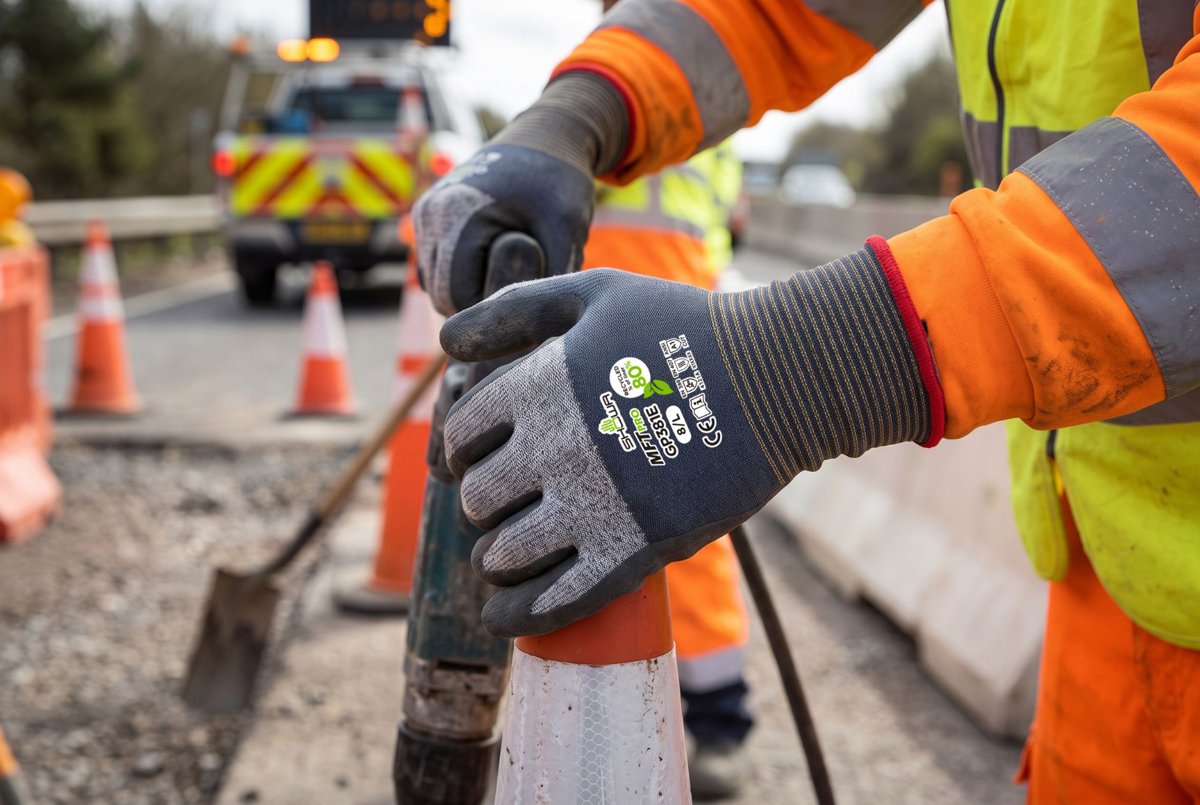
Manufacturers are also incorporating recycled materials and alternative formulations into protective equipment. SHOWA’s RECYCLED MFT PRO GP381E incorporates a liner containing more than 80% recycled fibres, combining recycled content with a lightweight knitted construction and microporous nitrile palm coating.
The company has separately developed Eco Best Technology (EBT), intended to accelerate the biodegradation of certain glove materials under specified conditions. SHOWA reports that products incorporating the technology achieved up to 82% biodegradation over 386 days in laboratory testing.
Such results require careful interpretation. ASTM D5511 and ASTM D5526 are laboratory methods for assessing anaerobic biodegradation under different test conditions, and a measured result does not establish that a glove will break down at the same rate in every landfill. Actual disposal environments vary, while gloves contaminated with chemicals may be subject to additional waste-handling requirements.
Recycled content, product durability and biodegradation characteristics address different aspects of environmental performance. For contractors assessing the overall impact of protective equipment, these characteristics need to be considered separately rather than treated as interchangeable measures of sustainability.
Bringing Glove Selection Back to the Worksite
Laboratory testing establishes a necessary foundation for protective equipment selection, but it cannot reproduce every condition encountered during road construction. Gloves may behave differently when wet, coated with dust, subjected to repeated abrasion or worn continuously through a demanding shift.
Practical trials allow site teams to evaluate products during normal activities, including assembling roadside infrastructure, handling reinforcement, operating tools and using digital equipment. Workers can assess fit, grip, flexibility and comfort while supervisors confirm that the gloves meet the protection requirements identified in the risk assessment.
Fit is particularly important across a workforce. A glove that performs well for one worker may be restrictive for another, and supplying a suitable range of sizes can reduce unnecessary discomfort without compromising the required protection.
Through its Sentinel by SHOWA programme, the manufacturer offers specialist support for assessing workplace hazards and selecting suitable gloves. Such services can assist contractors in comparing products against actual working conditions, although responsibility for PPE selection and compliance remains with the employer.
For highways contractors, the most useful evidence may come from the workers expected to wear the protection every day. Their experience of handling materials, using equipment and completing repetitive tasks can reveal limitations that are difficult to identify from a specification sheet alone.
Key Industry Questions
- What safety standard applies to cut-resistant construction gloves? EN 388 covers mechanical hazards including abrasion, cutting, tearing and puncture. The appropriate performance ratings depend on the hazards identified in the workplace risk assessment.
- Are ordinary cut-resistant gloves suitable for wet concrete? Not necessarily. Wet concrete contains highly alkaline substances that can cause skin burns and dermatitis. Gloves must provide an appropriate chemical barrier and prevent contact with the skin.
- Can gloves protect against crushing injuries? Impact-resistant gloves may offer limited protection against specified impacts, but they cannot eliminate crushing or trapping hazards associated with heavy materials and machinery. Suitable handling procedures and engineering controls remain necessary.
- Why is glove dexterity important in road construction? Workers frequently handle small fittings, tools and electrical components. Restricted movement and reduced tactile sensitivity can make these activities difficult and may encourage workers to remove their gloves.
- Do touchscreen-compatible gloves improve site safety? They can reduce the need to remove gloves when operating compatible digital equipment, provided the product also meets the protection requirements of the task. Touchscreen functionality is not a substitute for protective certification.
- How should contractors select gloves for chemical handling? Selection should follow the chemical safety data sheet, workplace exposure assessment and manufacturer resistance information. Relevant EN ISO 374 classifications can help establish suitability.
- Are biodegradable construction gloves suitable for ordinary waste disposal? Biodegradation claims depend on specified testing and environmental conditions. They do not override requirements for managing contaminated protective equipment or guarantee decomposition in every disposal environment.
- How can contractors assess the overall cost of protective gloves? Purchase price should be considered alongside service life, replacement frequency, task suitability and waste generation. Practical trials can help establish whether a product offers value under actual working conditions.
Strategic Takeaways
- Worker acceptance affects PPE performance: Gloves that significantly restrict movement or cause discomfort can undermine consistent use, regardless of their certified protection ratings.
- Protection ratings require context: Mechanical, chemical and environmental hazards must be assessed separately, particularly where workers move between different activities.
- Ergonomic design has operational value: Flexible materials, suitable grip coatings and touchscreen compatibility can reduce unnecessary interference with everyday construction tasks.
- Procurement decisions should consider service life: Replacement frequency, durability and worker suitability can influence the overall cost of hand protection more than the initial purchase price.
- Environmental performance needs careful interpretation: Recycled materials, extended product life and laboratory biodegradation results represent different characteristics and should be assessed on their individual merits.