






Durabook Expands Rugged Ground Control Portfolio for Unmanned Systems
Durabook has introduced an expanded portfolio of rugged ground control stations designed for drones, unmanned ground vehicles and maritime systems, bringing together configurable tablet and laptop platforms with physical controls, specialist software and communications equipment.
The announcement addresses a practical challenge facing operators of unmanned equipment. A drone surveying a railway corridor, an inspection robot working inside an industrial facility and a remotely operated vehicle on a construction site may all require different control arrangements, despite relying on similar computing and communications technologies. Equipment must also remain usable in conditions involving dust, rain, vibration and prolonged outdoor operation.
Rather than developing a universal controller, Durabook is offering a range of existing rugged computing platforms that system integrators can configure around particular vehicles and applications. The portfolio supports Windows-based operational software, including WinTAK, with Linux available for developers working with custom applications and alternative operating environments.
Briefing
- Durabook has introduced a configurable ground control station portfolio for aerial, ground and maritime unmanned systems.
- Five platforms are included, covering 8-inch and 10-inch tablet controllers and a laptop-based configuration.
- Windows compatibility includes WinTAK, while Linux support provides additional development options.
- Physical controls and communications interfaces can be adapted to individual vehicles and operator requirements.
- Rugged configurations offer environmental protection, with testing and certification varying by model.
Ground Control for Different Operating Environments
A ground control station provides the interface through which an operator monitors or commands an unmanned vehicle. Depending on the equipment, it may handle movement commands, camera positioning, sensor operation, telemetry and communications with other systems. Some installations require little more than a compact screen and a pair of joysticks, while others need a larger display, additional switches and access to several applications simultaneously.
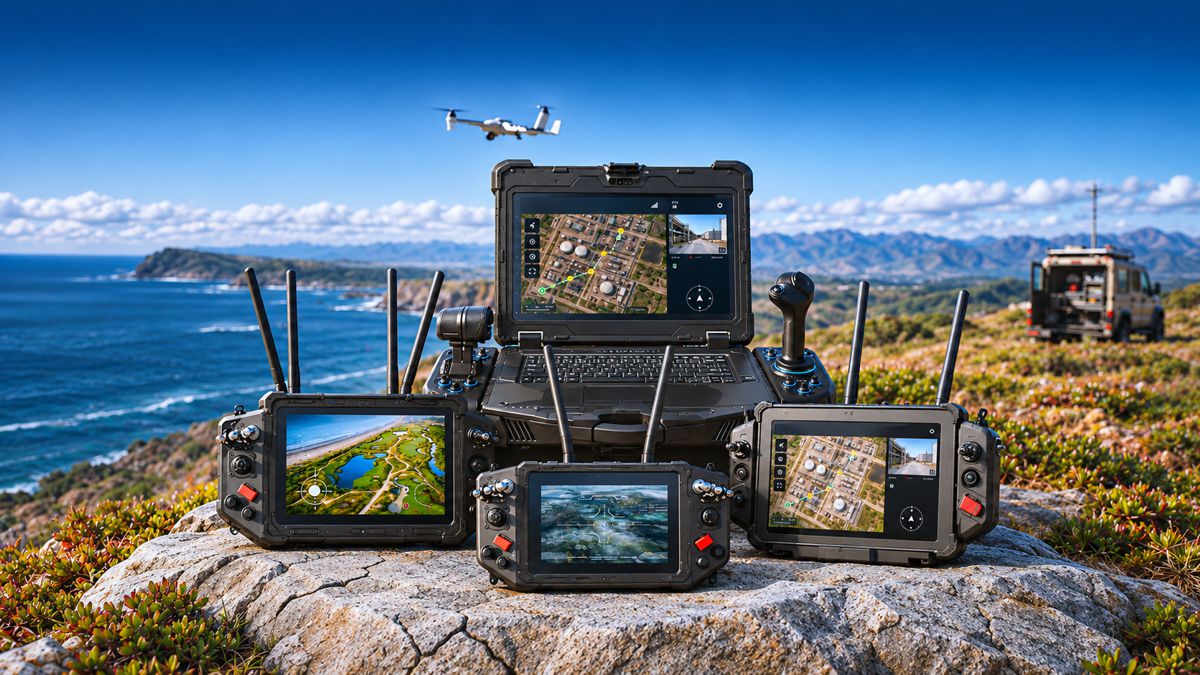
Durabook’s portfolio includes the GC-R8 and GC-R8S 8-inch tablet controllers, the larger GC-R10 and GC-R10S 10-inch versions, and the GC-Z14I laptop-based platform. The smaller controllers are suited to mobile operations where equipment needs to be carried between locations, while the larger formats provide more room for mapping, telemetry and other operational information. The laptop configuration offers a conventional keyboard alongside integrated physical controls, accommodating workflows that require more extensive software interaction.
The hardware can be configured for different unmanned platforms without requiring every operator interface to be developed from the beginning. A remotely operated ground vehicle, for example, may need separate controls for steering, propulsion and an articulated attachment, whereas an aerial inspection system might place greater emphasis on camera movement, sensor selection and flight controls.
These arrangements are determined by the vehicle and its operating software. The computing platform provides the foundation, with the final controller developed around the necessary interfaces, physical controls and communications equipment.
Configurable Controls and Vehicle Integration
Durabook offers configurable joysticks, assignable buttons, switches and thumbwheels, allowing commonly used functions to be operated directly rather than through touchscreen menus. Its GC-R8 ground control station, introduced in 2025, supports up to 36 configurable input/output channels, with options including Hall-effect joysticks, directional controls and guarded switches.
The arrangement of these controls can influence how comfortably and accurately an operator manages a vehicle while monitoring its surroundings. During an inspection, one control might operate the vehicle while another adjusts a camera or sensor. Equipment carrying a manipulator, cutting tool or other specialist attachment could require a more extensive interface, particularly where several movements must be coordinated.
Physical controls also provide an alternative to navigating touchscreen menus when an operator is wearing gloves or working in difficult conditions. Their usefulness depends on how the system is configured, and different equipment will place different demands on the operator.
Durabook works with customers and integration partners to define these arrangements, taking account of the intended tasks, connected equipment and operating environment. The resulting platform must still be integrated with the vehicle’s control architecture and software, including any safety functions required for the application.
Windows, Linux and Operational Software
The portfolio’s Windows-based configurations can accommodate applications such as WinTAK, part of the Team Awareness Kit family of geospatial information and operational coordination tools. Developed for use across military, emergency response and other field operations, WinTAK provides mapping and situational-awareness capabilities that allow personnel and equipment to be represented within a shared operational picture.
The software is particularly relevant where several teams or assets must be coordinated over a large area. Emergency responders may need to monitor personnel and vehicles across an incident, while infrastructure organisations working with remote inspection equipment could benefit from similar mapping and asset-location capabilities where the necessary integrations are available.
Linux support provides another route for organisations developing their own control software or using open-source applications. This can be useful where an unmanned system already relies on a particular software environment, although application compatibility must be established for the selected hardware and configuration. WinTAK itself is a Windows application and should not be confused with Linux-compatible components elsewhere in the TAK ecosystem.
The software environment also determines how information moves between the controller and the unmanned vehicle. Navigation commands, telemetry, mapping data and sensor feeds may be handled by separate applications or communications systems, requiring the integrator to establish how these elements operate together.
Communications for Remote Operations
Ground control equipment must connect reliably with the vehicle it operates, but the appropriate communications arrangement depends on the application, location and distance between operator and machine.
Durabook’s configurations can incorporate Wi-Fi, 4G/5G connectivity and third-party radio equipment, allowing integrators to select communications hardware suited to their unmanned systems. External radio-frequency modules can be included where a vehicle requires a dedicated link, while satellite backhaul can be incorporated through a separate terminal for operations beyond conventional terrestrial network coverage.
These options serve different purposes. Cellular or satellite connectivity may be used to exchange mapping information, transmit operational data or connect a field team with a remote coordination centre. Controlling the movements of an unmanned machine introduces additional requirements, particularly where delays, interruptions or unexpected commands could create a safety risk.
A satellite connection suitable for transferring data does not necessarily provide the latency and reliability required for real-time vehicle control. Communications architecture must therefore account for the vehicle’s control link, available bandwidth, loss-of-signal behaviour and any operational restrictions that apply to the equipment.
For construction and infrastructure applications, where unmanned vehicles may operate near personnel, machinery or live transport routes, these considerations form part of the wider system design. Rugged computing and flexible connectivity can support the deployment, but neither replaces the engineering needed to establish safe operating procedures.
Rugged Hardware for Demanding Conditions
Ground control stations used outdoors face conditions that conventional office computers are rarely designed to tolerate. Dust, rain, vibration and repeated handling are common across construction sites, industrial facilities and remote inspection work, while direct sunlight can make ordinary displays difficult to read.
Durabook’s controller portfolio includes configurations meeting requirements associated with MIL-STD-810H, MIL-STD-461G and IP66, although the company specifies that the applicable ratings vary by model and configuration. MIL-STD-810H sets out environmental testing methods covering conditions such as temperature, shock and vibration, while MIL-STD-461G addresses electromagnetic compatibility. IP66 indicates dust-tight protection and resistance to powerful water jets under defined test conditions.
The standards address different aspects of equipment performance, and compliance with one does not establish suitability for every operating environment. Environmental test results and protection ratings need to be considered alongside the hardware fitted to a particular controller.
The GC-R8 provides an example of the approach. Based on Durabook’s R8 rugged tablet, it incorporates a sunlight-readable display and the company’s fanless Coolfinity thermal design. Removing a mechanical cooling fan reduces one potential point of failure, while the display is intended to remain legible in bright outdoor conditions.
For operators carrying equipment across large construction sites or remote industrial locations, such practical characteristics may be as relevant as processor performance. A controller that can be carried, handled with gloves and used in poor weather must remain functional throughout the operation, particularly where it is the primary means of interacting with an unmanned vehicle.
Integration and Commercial Deployment
The range of unmanned equipment now available creates a complicated market for control hardware. Aerial drones, tracked inspection robots, autonomous industrial vehicles and unmanned surface vessels may use different communication protocols, software environments and operating methods, even when deployed for broadly similar inspection or monitoring tasks.
Building controllers around established rugged computing platforms offers integrators a way to concentrate development work on the vehicle-specific elements. This can reduce the amount of hardware engineering required, although the final system still needs software integration, communications validation and appropriate operational testing.
Durabook has not disclosed pricing, production volumes or customer deployment figures for the expanded portfolio. The commercial proposition will therefore depend partly on the cost of configuring individual systems and how readily existing vehicle software and communications equipment can be accommodated.
The company is positioning its ground control stations as configurable hardware for organisations developing or operating unmanned equipment, rather than complete control systems requiring no further engineering. With different controller sizes, operating-system options and physical interfaces available, the remaining challenge is to bring those components together in a package that works reliably with the intended vehicle and operating environment.
Key Industry Questions
- What is a ground control station? A ground control station is the hardware and software interface used to monitor or command an unmanned vehicle. It can combine movement controls, telemetry, mapping, sensor operation and communications within a single operator platform.
- Which Durabook ground control stations are available? The portfolio includes the GC-R8, GC-R8S, GC-R10, GC-R10S and GC-Z14I, covering compact tablet-based controllers and a larger laptop-based platform.
- Can Durabook controllers operate unmanned construction machinery? They may be suitable where the vehicle’s control architecture, software and communications equipment can be integrated. Compatibility must be established for the particular machine, and safety requirements remain application-specific.
- What is WinTAK used for? WinTAK is a Windows-based mapping and situational-awareness application within the Team Awareness Kit ecosystem. It supports the exchange and display of geographical and operational information used to coordinate personnel and equipment.
- Do Durabook ground control stations support Linux? Yes. Durabook identifies Linux support as an option for custom and open-source applications, although the available configurations and individual software requirements must be checked.
- Can satellite communications be used for unmanned vehicle control? Satellite backhaul can be incorporated through a separate terminal, but suitability for real-time control depends on latency, reliability, vehicle requirements and the overall communications architecture.
- What does IP66 protection mean? IP66 indicates that equipment is dust-tight and protected against powerful water jets under specified test conditions. It does not mean the equipment is waterproof when submerged.
- What are the advantages of physical controls on a ground control station? Joysticks, switches and assignable buttons provide direct access to frequently used functions, potentially reducing reliance on touchscreen menus during vehicle movement, camera operation or specialist equipment handling.
Strategic Takeaways
- Established computing platforms can reduce controller development work. Integrators can concentrate on the interfaces and controls required by individual unmanned vehicles.
- Physical layout remains closely tied to the application. Camera operation, vehicle movement and specialist attachments require different combinations of controls.
- Software flexibility broadens integration options. Windows and Linux environments can accommodate different operational applications and development requirements.
- Communications capability must be assessed separately from computing performance. Vehicle control links, cellular networks and satellite backhaul have different operational characteristics.
- Commercial suitability depends on the completed system. Hardware cost, integration effort, environmental performance and operational testing will determine whether a configuration is appropriate.