ULMA BRIO NEO Brings Lighter Components to Ringlock Scaffolding
ULMA Construction has introduced BRIO NEO, a lighter generation of its established ringlock scaffolding system, with redesigned components intended to improve handling, assembly and transport efficiency. The new equipment remains compatible with the existing BRIO range, allowing contractors and rental companies to upgrade their inventories without replacing entire scaffolding fleets.
The development focuses on the practical demands of temporary works, where scaffolders routinely handle substantial quantities of equipment during erection, modification and dismantling. Reducing component weight can ease these operations, while improvements to connections, stacking arrangements and repairability offer potential savings throughout the equipment’s working life.
Briefing
- New system: ULMA Construction has introduced BRIO NEO, an updated generation of its modular ringlock scaffolding equipment.
- Reduced weight: The redesigned NEO platform support is 25% lighter than its predecessor.
- Structural improvements: A new scaffolding pin offers up to three times the load capacity of the previous version.
- Fleet compatibility: BRIO NEO components are compatible with existing BRIO equipment, allowing gradual upgrades.
- Maintenance and logistics: Improved stacking arrangements and replaceable platform brackets are designed to reduce handling and maintenance costs.
Reducing Weight While Maintaining Structural Performance
Ringlock scaffolding uses modular standards, ledgers and multidirectional connection points to construct working platforms around buildings, industrial installations and civil engineering structures. Its versatility allows contractors to develop configurations ranging from straightforward façade access to suspended and cantilevered arrangements around complex structures.
Assembly remains labour-intensive, particularly where equipment must be repeatedly handled, transferred between levels or positioned in restricted working areas. Individual component weights influence the physical demands placed on scaffolders, while connection arrangements affect the time required to erect and dismantle a structure.
ULMA has addressed these considerations through component redesign rather than replacing the underlying BRIO system. According to the company’s BRIO NEO technical information, the redesigned platform support weighs 25% less than its predecessor, while the new working platforms incorporate improved hooks and anti-lift safety features.
Revised gripping areas, non-slip surfaces and self-locking mechanisms are intended to make components easier to handle and position. ULMA also describes its NEO platform as the lightest on the market, although independently comparable weight data covering competing systems has not been provided to substantiate that claim.
The improvements address a recognised construction safety concern. The UK’s Health and Safety Executive identifies repetitive lifting, awkward postures and the handling of heavy or bulky materials as contributors to musculoskeletal injuries. Lighter equipment can help reduce manual handling demands, although safe scaffolding operations continue to depend on appropriate working methods, lifting arrangements and competent supervision.
Revised Components for Complex Scaffolding Arrangements
Beyond conventional working platforms, BRIO NEO includes redesigned components for more demanding temporary access applications.
ULMA has revised its suspended scaffolding support to simplify connections and reduce the number of anchoring elements required. The accompanying NEO pin provides up to three times the load capacity of the previous version, according to the manufacturer, while an updated double spigot offers additional structural capacity.
For arrangements requiring scaffolding to span obstacles or extend between limited support points, the BRIO truss offers a lighter structural solution. ULMA reports weight reductions of up to 48% compared with conventional arrangements, although the precise saving depends on the configuration being assessed.
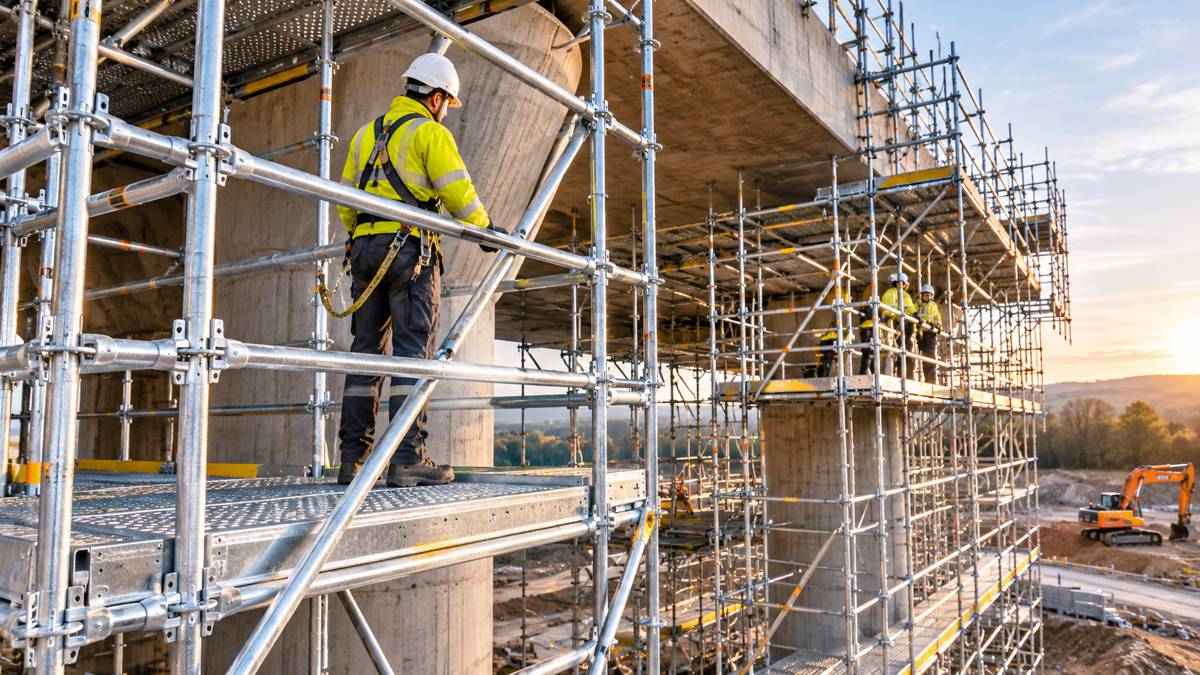
Suspended scaffolding is particularly useful around bridges, industrial facilities and other structures where suitable ground-level support is unavailable or impractical. Lower component weights can simplify the handling of assemblies in these environments, provided the completed arrangement satisfies the required loading conditions and engineering calculations.
Access equipment has also received attention. The NEO aluminium staircase incorporates revised profiles intended to improve strength and stability, while the redesigned metal trapdoor separates the access opening and ladder into independently handled components. These can be stacked separately, and the arrangement provides unobstructed access in spans of up to 1.5 metres.
The wider range includes updated guardrails, ledger connections, sheet supports and working platform accessories, with changes directed towards simplifying common assembly operations and reducing unnecessary handling.
Compatibility Protects Existing Equipment Investments
Scaffolding contractors and rental companies frequently operate inventories accumulated over many years. Equipment represents a considerable capital investment and can remain serviceable long after its initial purchase, making compatibility an important consideration when manufacturers introduce new generations of proprietary systems.
ULMA has retained compatibility between BRIO NEO and the previous BRIO range, allowing operators to incorporate redesigned components into existing inventories rather than replacing entire fleets.
High-use components can therefore be upgraded first, while established standards, ledgers and other equipment remain in service where suitable. Contractors expanding their inventories can also purchase newer components without creating a separate equipment system requiring its own storage, maintenance and logistical arrangements.
For rental businesses, this approach offers flexibility when managing equipment availability across different projects. Existing stocks can continue to be deployed alongside newer components, subject to the manufacturer’s approved configurations and technical requirements.
Physical compatibility does not remove the need for proper design and inspection. As the Health and Safety Executive’s scaffolding guidance explains, proprietary scaffolding must be erected in accordance with manufacturers’ instructions, with appropriate design information available for the intended arrangement.
Where different generations of components are combined, their structural suitability, load ratings and approved use within the completed scaffold must still be established.
Storage, Transport and Equipment Maintenance
Scaffolding logistics involve considerably more than delivering materials to a construction site. Components are loaded, transported, unloaded, sorted, assembled, dismantled and returned to storage, often repeatedly during their working lives.
ULMA has revised the stacking arrangements of several BRIO NEO components to make more efficient use of storage and transport space. Changes to component geometry and connection details may also reduce the number of individual elements needed for certain configurations, simplifying materials management.
Lighter equipment can increase the quantity carried within a vehicle’s payload limit, while more compact stacking improves the use of available loading space. Actual transport savings will depend on vehicle capacity, component dimensions and whether deliveries are constrained primarily by weight or volume.
Maintenance has received similar attention. The new working platforms incorporate riveted end brackets that can be replaced individually when damaged, avoiding the need to discard an otherwise serviceable platform.
ULMA also specifies high-strength steel and pre-treated components intended to provide corrosion resistance and durability. The emphasis on repairability allows equipment owners to address localised damage without routinely replacing complete assemblies, although repairs must follow approved procedures and inspection requirements.
Across large rental inventories, the ability to replace a damaged bracket rather than an entire platform could reduce both maintenance expenditure and material waste.
Productivity and Whole-Life Equipment Costs
The commercial performance of BRIO NEO will depend on how its component-level improvements translate into everyday site operations.
ULMA identifies easier assembly, reduced handling effort and improved logistics among the benefits of the redesigned equipment. Its published information provides specific weight and structural comparisons, but does not establish a system-wide reduction in erection time or quantify potential labour and transport savings.
Those figures would require comparisons using equivalent scaffold configurations, installation teams and working conditions. A lighter platform or simplified connection may offer a measurable advantage during repetitive installation work, while its contribution to a more complex scaffold will vary with the structure and assembly method.
Purchase price is only one consideration for equipment owners. Labour requirements, transport frequency, maintenance costs, component losses and service life all influence the economics of a scaffolding fleet.
BRIO NEO’s compatibility with existing equipment gives operators the opportunity to assess these improvements progressively. Components can be introduced where replacement or expansion is already required, allowing contractors to evaluate their performance under actual site conditions before committing to wider adoption.
For a mature equipment system, this approach avoids many of the complications associated with introducing an incompatible product range. Contractors retain the value of their existing inventories while gaining access to lighter components, revised structural connections and more maintainable working platforms.
ULMA’s latest development is therefore an evolution of established scaffolding engineering, concentrating on the equipment and operations that construction teams already use every day.
Key Industry Questions
- What is BRIO NEO scaffolding? BRIO NEO is an updated generation of ULMA Construction’s modular ringlock scaffolding system, incorporating lighter components, revised structural connections and improvements to handling, maintenance and logistics.
- Is BRIO NEO compatible with existing BRIO scaffolding? Yes. ULMA states that BRIO NEO components are compatible with the previous BRIO range, allowing new and existing equipment to be combined in approved configurations.
- How much lighter is BRIO NEO? Weight reductions vary by component. The redesigned NEO platform support is 25% lighter than its predecessor, while ULMA reports structural weight reductions of up to 48% for certain BRIO truss arrangements. These figures do not represent the weight reduction of an entire scaffold.
- Does BRIO NEO increase scaffolding load capacity? Some redesigned components offer greater structural capacity. The NEO pin, for example, is reported to provide up to three times the load capacity of its predecessor. Complete scaffold load ratings remain dependent on the approved configuration and structural design.
- Can BRIO NEO be used for bridge and industrial scaffolding? The system includes suspended scaffolding supports, truss elements, access stairs and other components suitable for civil engineering and industrial applications, subject to project-specific design requirements.
- How can lighter scaffolding improve worker safety? Lower component weights can reduce manual handling demands, particularly during repetitive erection and dismantling operations. Appropriate risk assessments, fall protection, lifting methods and competent installation remain essential.
- Can damaged BRIO NEO components be repaired? Certain components incorporate repairable features, including individually replaceable riveted end brackets on working platforms. Repairs must follow the manufacturer’s approved procedures.
- Does BRIO NEO reduce transport costs? Lighter components and revised stacking arrangements may improve vehicle utilisation, although savings depend on equipment quantities, vehicle capacity, loading arrangements and transport distances.
Strategic Takeaways
- Gradual fleet upgrades: Compatibility allows existing BRIO users to modernise equipment inventories without committing to wholesale replacement.
- Reduced handling demands: Lighter components and revised connections target repetitive manual operations during erection and dismantling.
- Complex access applications: Improved suspended scaffolding connections and lighter truss arrangements provide additional options for demanding temporary works.
- Longer equipment life: Replaceable platform brackets and durable component designs offer opportunities to reduce maintenance expenditure and material waste.
- Measurable performance: Manufacturer weight and capacity figures establish specific engineering improvements, while wider productivity savings will depend on project conditions and operating practices.