






SkyDrive and Kyushu Electric Power Bring Electric Aviation into Japan’s Urban Planning
Japanese electric aircraft developer SkyDrive has signed a partnership agreement with Kyushu Electric Power to investigate how electric vertical take-off and landing (eVTOL) aircraft could be incorporated into urban developments and regional transport networks.
Announced November 2026, the agreement brings together an aircraft manufacturer working towards commercial operations in 2028 and an established energy company with interests in electricity infrastructure, property development and community planning. Their collaboration will examine possible transport services, operating arrangements and the facilities needed to accommodate electric aircraft in Japan’s towns and cities.
The agreement remains exploratory, with no confirmed routes, aircraft orders or construction contracts. Nevertheless, it brings together two areas of expertise that will need to work closely if compact electric aircraft are to progress from demonstration flights to regular passenger services. Designing an aircraft capable of taking off vertically is one challenge; finding somewhere suitable for it to operate, recharge and collect passengers is another.
Briefing
- SkyDrive and Kyushu Electric Power announced a comprehensive partnership on 18 November 2026.
- The companies will investigate eVTOL integration into urban development, regional mobility and tourism.
- SkyDrive’s SD-05 aircraft accommodates one pilot and two passengers, with a published range of 15–40 kilometres.
- Potential infrastructure requirements include vertiports, electrical charging facilities and connections to existing transport networks.
- Commercial operations are targeted for 2028, subject to aircraft certification and operational approvals.
Integrating Electric Aviation into Urban Development
Japan’s declining population and changing travel patterns are placing pressure on regional transport services, particularly in communities where maintaining conventional connections has become increasingly difficult. SkyDrive and Kyushu Electric Power intend to investigate whether compact electric aircraft could offer additional options for selected journeys while supporting tourism and local economic activity.
Their agreement covers three areas of collaboration: evaluating eVTOL applications in community and urban development, establishing workable business arrangements with relevant organisations, and identifying services that could address regional transport challenges.
Kyushu Electric Power brings experience extending well beyond electricity generation and distribution. The company operates across renewable energy, information and communications technology, overseas business and urban development, giving it an established presence in activities that could support future aviation infrastructure.
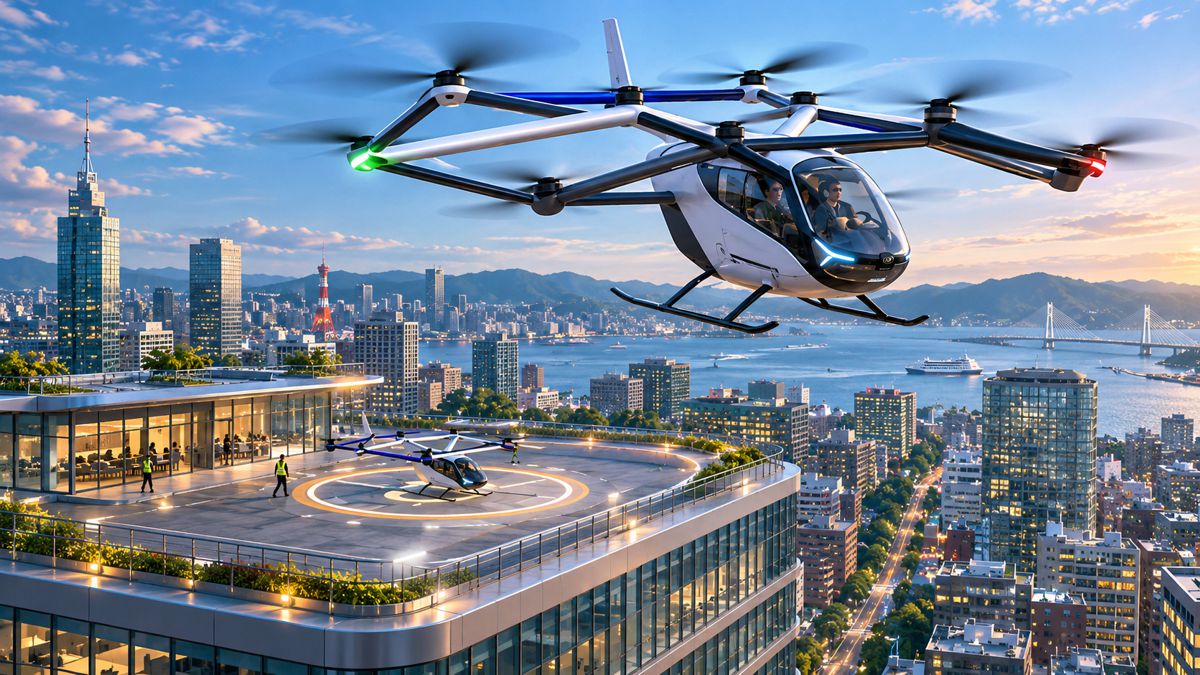
Incorporating electric aircraft into planned developments would introduce several practical considerations. Landing facilities must be accessible to passengers without disrupting existing buildings or transport networks, while charging equipment needs an adequate electricity supply. Rooftops could provide attractive locations in densely developed areas, although their structural capacity, fire safety provisions and proximity to surrounding buildings would require careful assessment.
New developments may offer greater flexibility than established urban districts, where available land, building configurations and existing infrastructure can limit the options. Planning for aviation facilities during the design stage could allow passenger access, electrical connections and building services to be considered together rather than added once construction is complete.
Building the Infrastructure for Electric Aviation
The introduction of eVTOL services would create demand for a specialised category of transport infrastructure known as vertiports. These facilities are intended to accommodate vertical take-off and landing, aircraft servicing and passenger movements, with their configuration determined by the type and frequency of operations.
A small site serving occasional sightseeing flights would have different requirements from a facility handling regular scheduled departures. Both would need suitable landing arrangements and safe passenger access, while more intensive operations could require additional aircraft stands, charging capacity, maintenance facilities and waiting areas.
Electricity supply presents a particular consideration for the partnership. Battery-powered aircraft need sufficient charging capacity to support their intended operating schedules, and the demands placed on local distribution networks would have to be assessed alongside those of surrounding buildings and businesses.
Charging arrangements also influence aircraft utilisation. Operators must accommodate flight times, battery reserves, charging periods and passenger turnaround requirements within a commercially workable timetable. Where several aircraft use the same facility, their combined electrical demand could influence the size and cost of the supporting infrastructure.
Rooftop installations introduce further engineering challenges, particularly where an existing building was not designed to accommodate aviation operations. Structural loading, access arrangements, fire protection and the effects of rotor airflow would all require consideration, alongside the relevant aviation and planning requirements.
Japan already has experience developing dedicated facilities for demonstration operations. In March 2025, Osaka Metro unveiled the OSAKAKO Vertiport, a purpose-built facility subsequently used for SkyDrive demonstration flights associated with Expo 2025.
The project provided a practical example of aviation infrastructure being developed within an established urban environment. Its demonstration role should not, however, be confused with an operational network of commercial passenger services, where infrastructure requirements would be shaped by daily utilisation, maintenance arrangements and regulatory approvals.
The SKYDRIVE SD-05 Aircraft
SkyDrive is developing the SKYDRIVE SD-05, a compact battery-electric aircraft designed for short journeys without conventional runways. The aircraft accommodates three occupants, comprising one pilot and two passengers, and uses a multicopter arrangement with 12 independently controlled electric rotors.
According to SkyDrive’s published technical specifications, the aircraft measures approximately 12.1 metres long, 11.4 metres wide and 3 metres high, with a maximum take-off weight of 1,400 kilograms. Its stated flight range is 15–40 kilometres, with a maximum cruising speed of 100 km/h.
The aircraft’s compact dimensions and distributed propulsion arrangement are intended to provide flexibility when selecting landing locations. SkyDrive also describes multiple levels of redundancy within its propulsion, flight-control and battery systems, although these remain subject to the testing and certification requirements applicable to commercial aviation.
Manufacturing activities began in March 2024 at a Suzuki Motor Corporation facility in Iwata, Shizuoka Prefecture. The partnership draws on Suzuki’s automotive production and quality-control experience, with SkyDrive preparing for aircraft manufacturing while development and certification activities continue.
Public demonstrations at Expo 2025 in Osaka provided an opportunity to showcase the aircraft outside its normal development environment. The company subsequently continued flight testing, including a June 2026 campaign in which the SD-05 reached 100 km/h.
The higher-speed tests examined aircraft stability, manoeuvrability and the behaviour of its propulsion and flight-control systems. They also allowed engineers to compare actual flight characteristics with predictions developed through simulation and earlier testing, an essential part of establishing the evidence needed for certification.
Certification and Commercial Readiness
SkyDrive’s aircraft development programme is progressing alongside discussions with aviation regulators in Japan and the United States. In March 2026, the company reached agreement with the Japan Civil Aviation Bureau on the General Certification Plan for the SD-05, establishing the overall approach to demonstrating compliance with applicable aircraft requirements.
The plan covers the activities and processes needed to support type certification, while further assessments address individual systems, structures, propulsion equipment and other technical elements. Agreement on the general plan represents progress through the certification process rather than approval for commercial passenger operations.
The company is targeting 2028 for the introduction of commercial services, although that timetable remains dependent on completing the required aircraft certification and obtaining the relevant operational approvals.
Meanwhile, SkyDrive has been establishing relationships with organisations that could contribute to future services. These include transport operators, prospective aircraft customers and regional development partners, allowing operational requirements and potential applications to be examined while aircraft testing continues.
The distinction between successful demonstration flights and sustained commercial operations is substantial. An approved aircraft must be supported by qualified personnel, maintenance arrangements, suitable infrastructure and services capable of attracting enough passengers to justify their costs.
Regional Connectivity and Commercial Viability
Kyushu’s geography offers a variety of environments in which short-distance electric aviation could be investigated. The region includes major urban centres, mountainous districts, coastal communities and islands, with some journeys involving lengthy surface routes despite relatively short straight-line distances.
An aircraft operating over several tens of kilometres might offer an alternative for particular connections, especially where geography makes road or rail journeys inconvenient. Tourism presents another possible application, with scenic flights and transfers between visitor destinations offering opportunities to assess demand before committing to more extensive services.
Carrying only two paying passengers creates a demanding commercial proposition, particularly once aircraft utilisation, pilot costs, maintenance and landing infrastructure are considered. The SD-05’s compact design may allow smaller facilities than those required by larger aircraft, but limited seating capacity also restricts the revenue available from each departure.
Weather conditions, flight restrictions and the availability of conventional transport will influence which routes are practical. A service intended to provide dependable regional connectivity would need sufficient operational reliability, while a tourism-focused application might have greater flexibility to accommodate seasonal or weather-related variations in demand.
For communities experiencing population decline, eVTOL aircraft are therefore more likely to complement established transport services than replace them. Their initial appeal may be strongest on specialised routes where the journey offers a clear advantage over existing options and where passenger demand can support relatively small aircraft.
These questions form part of the commercial and operational assessment envisaged by the agreement. Local authorities, landowners, transport organisations and infrastructure providers could all have roles in developing suitable services, although no particular locations or routes have yet been announced.
From Feasibility Studies to Operational Services
SkyDrive’s collaboration with Kyushu Electric Power adds an infrastructure and community development dimension to its existing aircraft programme. It also follows a series of partnerships through which the company has been exploring regional applications, manufacturing arrangements and the operational requirements of electric aviation.
For Kyushu Electric Power, the agreement creates a framework for examining how a new transport technology might fit into future urban developments and regional planning initiatives. Electricity supply and property development are already established areas of its business, while aviation infrastructure would introduce additional technical and regulatory requirements.
The companies must now determine which applications offer a credible commercial case, where landing facilities could be located and how the necessary investment and operating responsibilities might be shared.
With commercial operations targeted for 2028, those assessments will be taking place while SkyDrive continues its certification programme. Whether the partnership eventually produces passenger services will depend on identifying routes capable of supporting regular operations, securing suitable landing sites and establishing a viable operating model for aircraft carrying just two passengers.
Key Industry Questions
- What have SkyDrive and Kyushu Electric Power agreed to do? The companies will investigate eVTOL applications in urban planning, regional mobility, community development and related commercial activities. No specific passenger routes or construction projects have been confirmed.
- What aircraft is SkyDrive developing? The SKYDRIVE SD-05 is a compact electric vertical take-off and landing aircraft designed to carry one pilot and two passengers over relatively short distances.
- When could commercial operations begin? SkyDrive is targeting 2028, subject to completing aircraft certification, obtaining operational approvals and establishing suitable infrastructure.
- What infrastructure would eVTOL services require? Potential requirements include vertiports, electrical charging facilities, passenger access arrangements, aircraft handling areas and connections to existing transport networks.
- Could eVTOL aircraft operate from building rooftops? Potentially, although suitable buildings would need to meet structural, aviation safety, fire protection and operational requirements. Rooftop suitability must be assessed individually.
- What role could an electricity company play in eVTOL development? An electricity company could contribute expertise in network capacity, power distribution, charging infrastructure and the integration of electrical systems into urban developments.
- Could compact eVTOL aircraft replace conventional public transport? Their limited passenger capacity and range make widespread replacement unlikely. More practical initial applications may include tourism and specialised connections where conventional journeys are comparatively inconvenient.
- Has the SD-05 received type certification? SkyDrive has reached agreement with Japan’s Civil Aviation Bureau on its General Certification Plan, but the aircraft has not yet completed type certification.
- What is the published flight range of the SD-05? SkyDrive currently lists a range of 15–40 kilometres, although operational performance and the conditions under which commercial flights may be conducted remain subject to development and certification.
Strategic Takeaways
- Urban integration: Future eVTOL services will require landing facilities to be incorporated into existing or planned developments, with particular attention to access, structural requirements and surrounding land uses.
- Electricity infrastructure: Charging capacity, battery turnaround and local network availability will influence vertiport design and operating schedules.
- Regional applications: Tourism and geographically constrained journeys may offer more credible early markets than conventional high-capacity public transport routes.
- Commercial economics: The SD-05’s two-passenger capacity places particular pressure on aircraft utilisation, infrastructure costs and achievable ticket revenue.
- Development priorities: Aircraft certification and infrastructure planning can progress together, but commercially viable routes and approved operating arrangements will determine whether regular services can begin.