






Cleaning Up Space to Protect the Infrastructure We Depend On
The UK Space Agency has awarded a £61 million contract to develop a spacecraft capable of capturing and removing two redundant satellites from low Earth orbit. Led by ClearSpace UK, the programme is targeting their removal by 2032 and could help establish an engineering industry dedicated to maintaining, repairing and decommissioning infrastructure in space.
The UK’s Active Debris Removal mission addresses a problem familiar to infrastructure operators on Earth. Decades of investment in new assets have created a substantial legacy of obsolete equipment, much of which was installed without adequate provision for its eventual removal. In orbit, however, redundant infrastructure continues travelling at extraordinary speeds, threatening operational spacecraft and the terrestrial services they support.
Construction machinery, precision surveying, fleet management, maritime logistics and environmental monitoring increasingly depend on satellite navigation, communications and Earth observation. Protecting the infrastructure that delivers those services is becoming an engineering challenge in its own right, extending well beyond the traditional business of manufacturing and launching spacecraft.
Briefing
- ClearSpace UK has secured a £61 million contract to deliver Britain’s first national Active Debris Removal mission.
- The spacecraft is scheduled to launch in 2029, with the removal of two redundant satellites targeted by 2032.
- Europe’s parallel ClearSpace-1 mission entered its construction phase in November 2026 under a €102 million contract awarded to OHB.
- Accumulating orbital debris threatens satellite services supporting construction, transport, communications and critical infrastructure.
- Technologies developed for debris removal could underpin a wider commercial industry encompassing satellite servicing, refuelling and orbital construction.
Bringing Asset Management into Orbit
Infrastructure on Earth is generally designed around an operational lifespan, with arrangements for inspection, maintenance, component replacement and eventual decommissioning. Bridges undergo structural assessments, industrial plants have scheduled maintenance programmes, and offshore installations are subject to increasingly sophisticated end-of-life obligations. Much of the satellite industry, by comparison, has developed around spacecraft expected to operate independently until their fuel reserves are exhausted, components fail or their technology becomes obsolete.
Historically, the expense and complexity of reaching satellites after deployment have made repairs commercially impractical in many circumstances. An otherwise functional communications satellite can become redundant simply because it no longer has sufficient propulsion capability to maintain its operational position, leaving valuable equipment stranded in orbit.
Dedicated servicing spacecraft offer an alternative approach. Extending operational lifespans, providing additional propulsion and eventually replacing selected components could reduce the frequency with which entire systems need to be manufactured and launched. These activities fall within the emerging field of In-Orbit Servicing, Assembly and Manufacturing (ISAM), which encompasses engineering disciplines ranging from remote inspection and maintenance to construction and industrial logistics.
Britain’s £61 Million Orbital Clean-Up Mission
The UK Space Agency announced its national Active Debris Removal mission on 15 October 2026, appointing the British operation of ClearSpace as its industrial delivery partner. The £61 million contract follows a competitive procurement process initiated in 2025, when the agency launched a tender valued at £75.6 million.
The spacecraft is scheduled to launch in 2029 from SaxaVord Spaceport in Scotland. Once operational, it will attempt to locate, approach and capture two defunct satellites before lowering their orbits sufficiently to facilitate atmospheric re-entry and disposal.
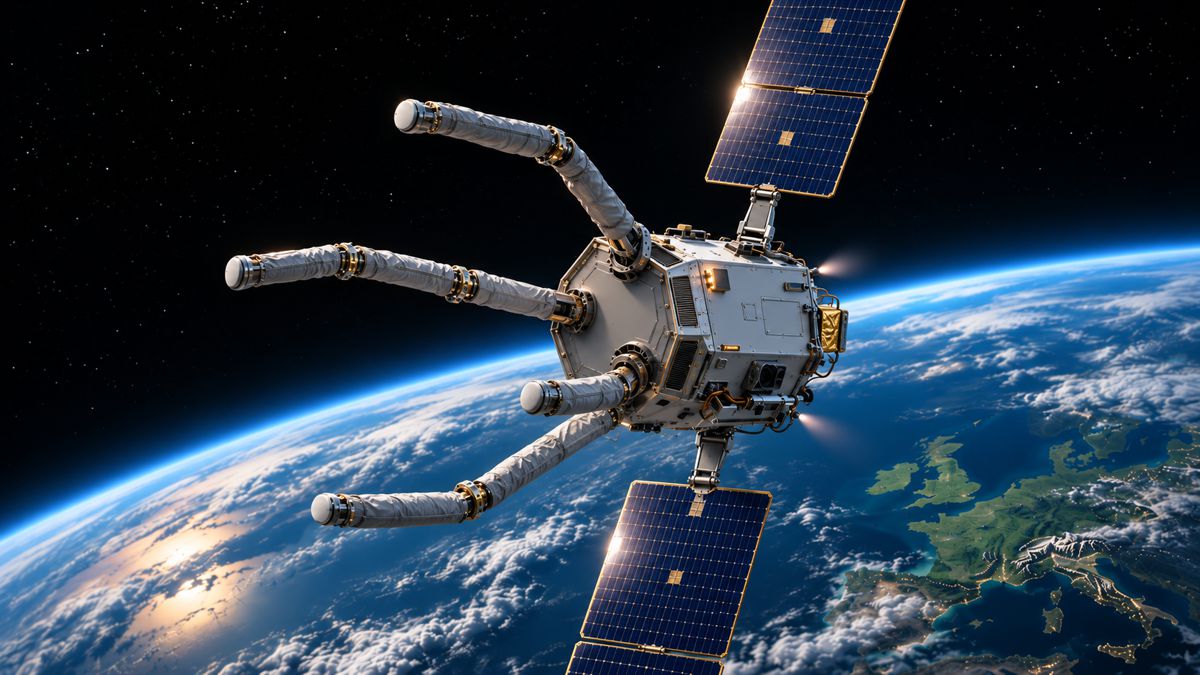
The spacecraft will employ robotic capture mechanisms and autonomous navigation systems to operate around objects that were never designed to be retrieved. Its design will also accommodate future refuelling, potentially allowing the vehicle to undertake additional operations if suitable supporting infrastructure becomes available.
For ClearSpace, the programme provides a funded opportunity to develop and demonstrate technology with applications extending beyond debris removal. Government procurement is establishing an initial market for an engineering service that addresses a recognised operational problem, but for which a mature commercial customer base has yet to emerge.
The Growing Problem of Orbital Waste
Objects in low Earth orbit typically travel at approximately 28,000 kilometres per hour, with potentially much higher relative velocities when their trajectories intersect. Even small fragments can penetrate spacecraft structures, damage solar arrays or disable sensitive equipment, while collisions between larger objects can generate thousands of additional fragments.
The resulting accumulation is associated with the Kessler Syndrome, a theoretical collision cascade in which existing debris generates further debris, progressively increasing the hazards associated with operating in particular orbital regions.
The European Space Agency’s 2026 Space Environment Report, based on data collected through the end of 2025, estimates that the orbital environment contains approximately 54,000 objects larger than 10 centimetres, 1.2 million objects measuring between one and ten centimetres, and 140 million fragments measuring between one millimetre and one centimetre. Only a proportion of this population can be routinely tracked.
Although disposal practices are improving, modelling indicates that existing debris can continue generating new fragments through collisions even without further launches. Preventing the creation of additional waste therefore addresses only part of the problem.
Removing large redundant satellites and discarded rocket stages offers a means of reducing the potential for future fragmentation events. An intact spacecraft may represent a more valuable removal target than numerous smaller fragments because of the quantity of debris it could generate in a collision.
Engineering an Autonomous Orbital Recovery Vehicle
Recovering a redundant satellite presents a combination of surveying, mechanical handling, robotics and control engineering challenges. The servicing spacecraft must establish the position and motion of its target, approach safely and determine how to secure a mechanical connection without damaging either vehicle.
Unlike an operational spacecraft equipped for docking, a defunct satellite may be rotating unpredictably, with no functioning communications or attitude control systems. Its external structures may also have deteriorated, while accessible components may never have been designed to withstand the forces associated with capture.
Optical sensors, computer vision, autonomous navigation algorithms and precision propulsion systems allow a recovery vehicle to assess the target’s movement while controlling its own trajectory. The capture mechanism must accommodate the transfer of angular momentum when contact occurs, maintaining sufficient control of the combined spacecraft to perform subsequent orbital manoeuvres.
Avoiding the creation of additional debris is fundamental to the operation. An unsuccessful capture attempt would be preferable to damaging a satellite and creating hundreds of fragments, particularly where the resulting debris could threaten other spacecraft operating at similar altitudes.
The engineering disciplines involved have established counterparts in subsea robotics, nuclear decommissioning, autonomous construction machinery and remote industrial handling. Space imposes different physical and environmental constraints, but the requirements for dependable sensing, controlled mechanical interaction and operation without direct human intervention are familiar.
Europe’s Parallel Debris Removal Programme
The British programme forms part of a wider international effort to develop practical spacecraft recovery capabilities. On 17 November 2026, the European Space Agency and German aerospace manufacturer OHB System formally marked the beginning of the construction phase of ClearSpace-1 under a €102 million contract.
The mission, currently scheduled for launch in 2030, will target PROBA-1, a 95-kilogram Earth observation satellite originally launched in 2001. OHB leads an industrial consortium that includes ClearSpace, Indra and OHB Sweden, bringing together expertise in spacecraft engineering, robotic capture and autonomous operations.
The technical challenges associated with recovering satellites that have no dedicated retrieval interfaces also expose limitations in existing spacecraft design. Future satellites could incorporate standardised capture points, optical navigation markers and servicing connections, allowing recovery vehicles to operate across spacecraft from different manufacturers rather than requiring bespoke systems for every mission.
The approach would be familiar to industrial machinery manufacturers, where standard lifting points, accessible maintenance panels and replaceable components are established design considerations. Incorporating equivalent provisions into spacecraft could simplify eventual maintenance and disposal, while reducing the cost and complexity of servicing operations.
Satellite Maintenance Is Already a Commercial Reality
While active debris removal remains an emerging capability, commercial satellite life extension has already been demonstrated. In February 2020, Northrop Grumman’s SpaceLogistics subsidiary successfully docked its first Mission Extension Vehicle with Intelsat 901, a communications satellite operating in geostationary orbit. A second vehicle subsequently docked with Intelsat 10-02 in April 2021.
Rather than replacing the satellites’ existing communications equipment, the servicing vehicles provide propulsion and positional control, enabling otherwise functional spacecraft to remain operational beyond the limitations imposed by their original fuel reserves.
The commercial case is particularly attractive for expensive satellites whose revenue-generating systems remain functional. Purchasing additional years of operation can be more economical than commissioning, manufacturing and launching a replacement, particularly when the existing spacecraft continues to meet customer requirements.
Refuelling and robotic component replacement would expand the range of operational limitations and faults that can be addressed in orbit. Their economics will depend on servicing costs, spacecraft accessibility, reliability and the remaining commercial value of the assets involved. Designing satellites with future maintenance in mind could materially improve those calculations.
From Maintenance to Orbital Construction
The technologies required to inspect, capture and manoeuvre satellites also have applications in orbital assembly and construction. Space infrastructure is currently constrained by the payload capacity and dimensions of launch vehicles, requiring satellites, scientific instruments and space station modules to be manufactured on Earth and engineered to survive the mechanical and acoustic loads associated with launch.
Robotic assembly would allow larger structures to be delivered as modular components, reducing dependence on the dimensions of individual launch vehicle fairings. Large communications antennas, scientific observatories, solar power installations and commercial space stations could all benefit from greater flexibility in their construction.
Manufacturing under microgravity conditions introduces further possibilities, including structural arrangements that would be difficult to assemble or support on Earth. Operational forces, thermal cycling, materials performance and the launch requirements of individual components would remain important design considerations.
A dependable orbital construction industry would require much more than individual robotic assembly demonstrations. Transport services, standardised mechanical connections, inspection procedures, quality assurance systems and reliable handling equipment would need to be established alongside a pipeline of projects capable of supporting industrial investment.
Many of the capabilities required already exist within terrestrial engineering supply chains. Manufacturers specialising in precision robotics, machine vision, remote inspection, advanced materials and hazardous-environment handling systems possess expertise that could be adapted to orbital operations, subject to the considerable qualification requirements associated with vacuum conditions, radiation exposure, temperature extremes and launch loads.
Digital twins and advanced simulation could also support the development of these services, allowing engineers to evaluate target conditions, rehearse capture operations and assess mechanical interactions before committing spacecraft to expensive and potentially irreversible manoeuvres.
Developing a Circular Economy in Space
Current debris removal programmes generally envisage destroying redundant satellites through atmospheric re-entry. Although this removes hazardous objects from orbit, it also destroys equipment and materials that required considerable expenditure to manufacture and launch.
Recovering components from redundant spacecraft and reusing their materials in orbit would avoid some of the expense associated with transporting replacements from Earth. Establishing that capability, however, would require an entirely different generation of recovery and processing equipment.
Satellites contain diverse materials, electronics, composite structures and potentially hazardous residual substances. Robotic disassembly, materials separation, storage and processing would require specialised facilities and substantial energy resources, making orbital recycling a considerably more complex proposition than the recovery and disposal missions currently under development.
Atmospheric disposal also introduces environmental considerations. Researchers are examining the potential effects of spacecraft re-entry products on atmospheric chemistry, while space agencies continue to address the separate physical risks associated with components that survive re-entry and reach the Earth’s surface.
As launch activity increases, environmental assessments will need to consider the complete spacecraft lifecycle, encompassing manufacturing, launch, operation, maintenance and eventual disposal. The growing environmental and economic risks associated with these activities are examined in the OECD’s The Space Economy at a Glance 2026.
Who Pays to Clean Up Space?
One of the principal barriers to establishing a commercial debris removal industry is determining who should pay for the work. A functioning satellite has an identifiable operator with a direct financial interest in extending its operational life, whereas removing historical debris benefits numerous organisations without necessarily generating revenue from the recovered object.
The problem has parallels with contaminated industrial land, abandoned mining operations and redundant infrastructure for which the original owners may no longer have the financial resources to meet their environmental obligations. Responsibility becomes particularly difficult to establish when the costs of remediation exceed the value of the original asset.
Governments and space agencies are currently well positioned to commission demonstration missions, absorbing development risks that private operators may be unwilling to finance. Establishing a sustainable commercial market would require arrangements that incorporate the costs of decommissioning into the original economics of satellite deployment.
Potential mechanisms include financial guarantees, industry-funded recovery programmes and disposal services purchased before launch. Satellite manufacturers could also face greater commercial pressure to incorporate reliable end-of-life systems and standardised servicing interfaces into their designs, particularly where insurers or customers place a financial value on recoverability.
Ownership introduces another complication. Under Article VIII of the 1967 Outer Space Treaty, ownership of spacecraft and their components is not extinguished by their presence in space. A redundant satellite cannot therefore be treated as freely available scrap simply because it has ceased operating.
International cooperation, permissions, insurance and liability arrangements will need to develop alongside recovery technology. Spacecraft capable of approaching and capturing other satellites also have security implications, reinforcing the need for transparent operations and confidence between governments and commercial operators.
Building an Industry Beyond the Launchpad
The UK Space Agency is using its national debris removal programme to engage the wider public through a competition to name the spacecraft, with entries closing on 10 December 2026. Behind the competition lies an opportunity to introduce prospective engineers to an industrial sector combining robotics, mechanical engineering, computer science, environmental management and advanced manufacturing.
The economics of space have traditionally been measured in launch costs, payload capacity and the operational performance of individual spacecraft. As orbital infrastructure becomes more extensive and valuable, its maintenance, accessibility and eventual disposal will become increasingly important considerations in the original design and investment decisions.
The development of robotic recovery vehicles represents an early attempt to address those responsibilities. Beyond debris removal lies the prospect of an engineering industry capable of inspecting, maintaining, upgrading and eventually constructing infrastructure in orbit.
After decades of investing in the machinery needed to reach space, humanity is beginning to develop the machinery needed to look after it.
Key Industry Questions
- What is active debris removal? Active Debris Removal (ADR) involves deploying specialised spacecraft to recover, relocate or remove selected redundant satellites, rocket stages and other objects from orbit.
- Who is delivering the UK’s national space debris removal mission? ClearSpace UK has been appointed as prime contractor under a £61 million agreement with the UK Space Agency. The spacecraft is scheduled to launch in 2029, with the removal of two redundant satellites targeted by 2032.
- How dangerous is space debris? Objects in low Earth orbit travel at extremely high velocities. Even small debris fragments can damage spacecraft, while collisions between larger objects can generate additional debris that threatens other satellites.
- Can satellites already be serviced in orbit? Commercial satellite life-extension services have been successfully demonstrated. More sophisticated capabilities, including refuelling, robotic component replacement and general-purpose maintenance, remain at varying stages of development.
- What is In-Orbit Servicing, Assembly and Manufacturing? ISAM encompasses technologies and services for inspecting, maintaining, refuelling, assembling, manufacturing and decommissioning infrastructure in space.
- Who pays for space debris removal? Government agencies currently fund several major demonstration programmes. A mature commercial market may require arrangements involving satellite operators, manufacturers, insurers and regulatory authorities, particularly for historical debris.
- Could space debris be recycled instead of destroyed? Potentially, although orbital recycling would require advanced recovery, disassembly and materials processing facilities. Current removal missions generally concentrate on atmospheric disposal.
- Who owns redundant satellites? Spacecraft ownership is not automatically extinguished when a satellite stops functioning. International space law retains ownership rights and provides for continuing jurisdiction and control by the relevant state of registry.
- What opportunities could orbital infrastructure create for construction and engineering companies? Potential opportunities include autonomous robotics, modular structural systems, precision manufacturing, remote inspection, digital twins, advanced materials and specialised engineering testing facilities.
Strategic Takeaways
- Government procurement can establish initial demand for orbital maintenance and recovery services while absorbing early technology development risks.
- Designing satellites with standardised servicing interfaces could reduce future maintenance, life-extension and decommissioning costs.
- Commercial satellite life extension provides an established business precedent for more sophisticated orbital engineering services.
- Terrestrial engineering companies with expertise in robotics, remote handling and modular construction could diversify into orbital infrastructure supply chains.
- Sustainable space development will require operators to incorporate maintenance and disposal into the full lifecycle economics of spacecraft.