LiDAR and AI Bring Automated Hazard Detection to Live Motorway Roadworks
Four roadside monitoring towers covering approximately one kilometre of a live UK motorway have completed an 11-month trial of automated hazard detection, with results suggesting that LiDAR and artificial intelligence could substantially reduce the time taken to identify dangerous incidents within roadworks.
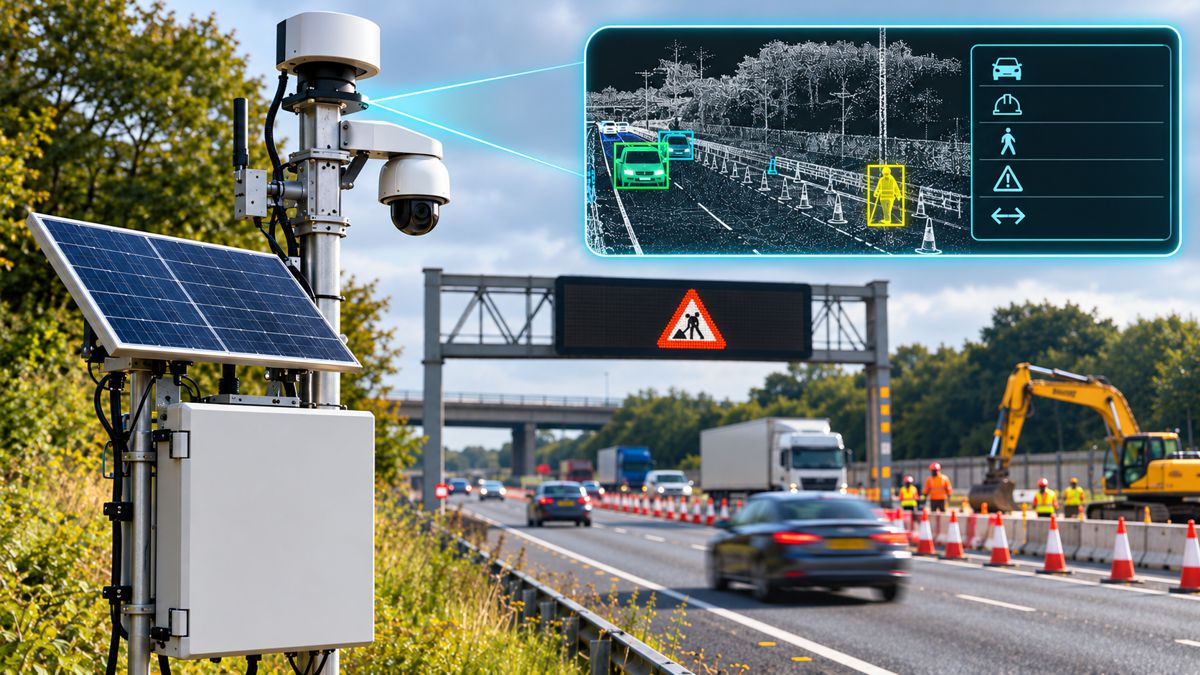
Developed by Chesterfield-based Roadside Technologies, the VECTA system combines three-dimensional laser scanning, edge AI and automated CCTV to identify stopped vehicles, work-zone incursions, pedestrians and other hazards. During the trial, the technology operated alongside a remote CCTV monitoring service, allowing automated alerts to be compared with operator-led observation under live traffic conditions.
Roadside Technologies reports that VECTA detected, classified and issued alerts on roadworks hazards within the same second and, for 98% of the incidents included in its comparison, generated alerts 98% faster than the conventional monitoring service. The findings, announced in October 2026 following two years of development and testing, have supported the system’s commercial release.
Briefing
- Four VECTA towers were tested across approximately 1km of live UK motorway over 11 months.
- Automated hazard detection and alerting were reported to operate within the same second.
- Roadside Technologies claims 98% faster alerts for 98% of comparative incidents against operator-led CCTV monitoring.
- Vehicle classification accuracy reached 100% during daytime and 98% at night in a validation sample of 1,500 vehicles.
- The LiDAR and edge AI platform combines hazard detection, CCTV verification and traffic analytics within one monitoring system.
Monitoring Roadworks Beyond the CCTV Screen
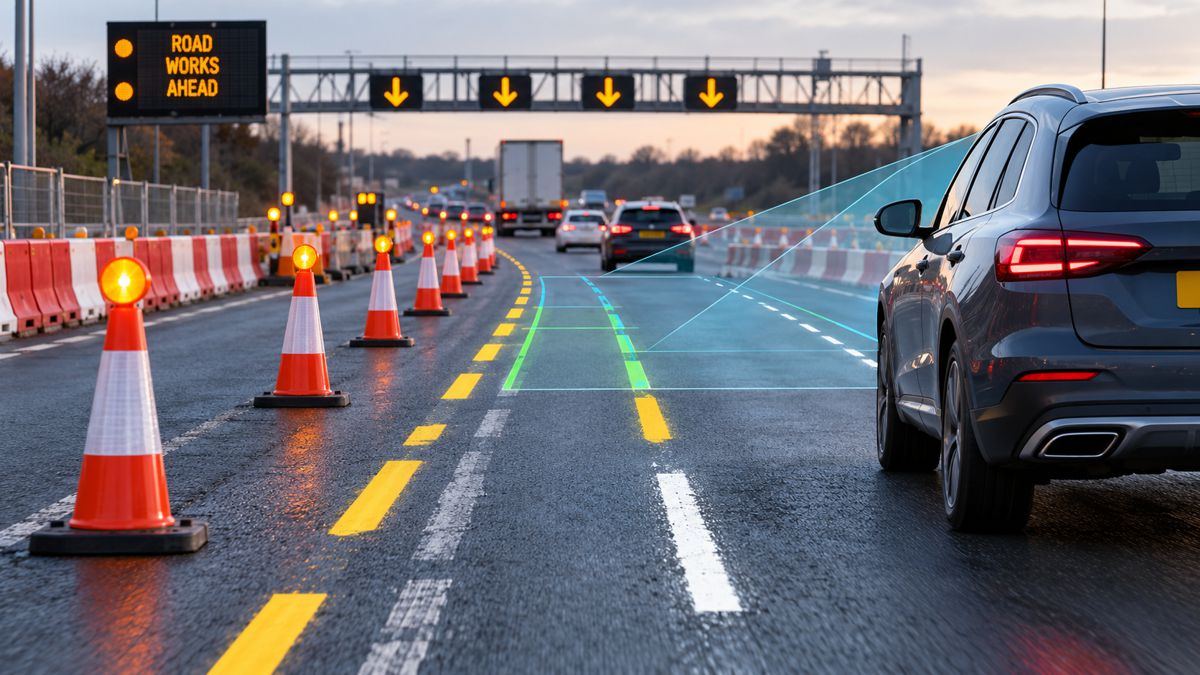
Motorway roadworks place moving traffic alongside temporary barriers, cones, construction vehicles and personnel, often in layouts that change as work progresses. An unexpected vehicle movement or incursion into a closed working area can create an immediate hazard, particularly where traffic continues at speed close to the workforce.
CCTV provides operators with a direct view of these conditions, but monitoring relies on incidents being recognised as they develop. A camera may record an event without anyone observing it at that moment, especially when monitoring personnel are responsible for multiple locations.
VECTA uses LiDAR sensors to continuously measure the position and movement of vehicles and other objects. According to Roadside Technologies, the system combines short- and long-range scanning with perception software that identifies objects, tracks their movements and assesses them against predefined hazard categories.
The resulting point-cloud data maintains a continuously updated three-dimensional representation of the monitored road environment. By comparing detected movements with the boundaries and operating conditions of a work zone, the software can identify events such as vehicles crossing a cone line, entering a protected area or travelling in the wrong direction.
When a hazard is identified, a pan-tilt-zoom camera automatically turns towards the relevant location, allowing an operator to inspect the live footage and determine the appropriate response.
Coverage depends on the positioning of the towers, road geometry and obstructions within the monitored area. The trial used four towers across approximately one kilometre of motorway, although the company has not published detailed coverage maps or the spacing requirements for different road configurations.
Eleven Months of Motorway Data
The motorway deployment produced a considerable volume of operational information. Roadside Technologies reports that its monitoring database generated more than 473 million messages during the trial, including records associated with approximately 166,000 vehicle detections. More than 3.5 million unique object identifiers were recorded within a single month.
The data supported assessment of vehicle classification, traffic flows, queue formation, work-zone incursions, wrong-way driving and automated alert generation. Operating over 11 months also exposed the equipment to changing traffic conditions, seasonal weather and variations in lighting.
Vehicle classification and counting were separately checked against CCTV recordings covering a sample of 1,500 vehicles. The company reported 100% daytime classification accuracy, 98% night-time classification accuracy and 97% vehicle counting accuracy, including performance in rain, low light and poor weather.
Classification accuracy is, however, a different measure from the reliability of hazardous-event detection. The published results do not disclose the complete number of incidents used in the comparative alert-speed assessment, the distribution of detection times, or the false-alert and missed-event rates for individual hazard categories.
Those figures would help establish how reliably the system distinguishes genuine hazards from routine movements, particularly where temporary traffic arrangements involve construction vehicles, changing access points and personnel working close to live traffic.
The reported 98% improvement relates to detection and alert generation. It does not establish an equivalent reduction in emergency response times or demonstrate a measured reduction in accidents.
From Detection to Operational Response
An automated warning is only the first stage of managing a motorway incident. Once an alert reaches a control room, the situation must be verified, its severity assessed and an appropriate response initiated.
VECTA’s integration of automated detection with directed CCTV is designed around that sequence. Rather than requiring an operator to locate an incident across several camera feeds, the system identifies its position and presents the corresponding video for inspection.
The platform also brings together live CCTV, historical event records, reporting tools and traffic analytics. Contractors responsible for temporary traffic management could use these records to investigate incidents, examine traffic behaviour and review the effectiveness of work-zone arrangements.
Roadside Technologies positions VECTA as a supplement to established CCTV monitoring rather than a replacement. Human operators remain responsible for confirming alerts and deciding how to respond, while the automated detection system provides an additional layer of observation.
Chris Moseley, Managing Director of Roadside Technologies, said: “This trial gave us the opportunity to prove VECTA in a live motorway environment, against genuine operational events and challenging weather conditions. The results demonstrate how intelligent, automated detection can give operators earlier awareness of developing hazards while complementing the CCTV systems and operational processes they already rely on. It is an important milestone for VECTA and for our ambition to help make roadworks safer and better informed.”
The operational challenge is particularly acute in temporary works, where traffic patterns can change rapidly and a vehicle crossing a cone line may present an immediate danger. Early warning provides operators with more opportunity to intervene, although the effectiveness of the complete safety arrangement still depends on alert prioritisation, communications and the procedures used to manage incidents.
The Wider Context of Motorway Detection Technology
Automated incident detection is already established on parts of England’s strategic road network. National Highways has installed radar-based stopped-vehicle detection technology on existing all-lane-running smart motorways, enabling control-room operators to identify stationary vehicles and initiate appropriate traffic-management measures.
The performance of these systems has been subject to independent scrutiny. In its March 2026 assessment of strategic road network safety, the Office of Rail and Road reported that stopped-vehicle detection continued to meet national performance requirements.
The regulator identified three principal measures: a stopped-vehicle detection rate of at least 80%, a false discovery rate below 15%, and an average detection time of no more than 20 seconds.
These provide useful examples of how highway authorities evaluate automated monitoring, but they are not directly comparable with VECTA’s motorway trial. Conventional stopped-vehicle detection focuses on stationary vehicles, whereas VECTA is intended to identify a broader range of events within roadworks. The technologies were also assessed under different operating conditions and methodologies.
The Office of Rail and Road has separately raised concerns about delays to National Highways’ operational technology renewal programme, including legacy equipment and the complexity of integrating newer systems with existing infrastructure. Compatibility with established CCTV, communications and traffic-management platforms remains an important consideration for additional roadside monitoring equipment.
Temporary work zones present particular demands. Lane arrangements, access points and physical boundaries may change repeatedly during a project, requiring sensors and detection parameters to be repositioned or reconfigured.
Roadside Technologies states that VECTA towers can operate off-grid using solar panels and battery storage, removing the requirement for a permanent mains connection. This could make the equipment suitable for temporary installations, although deployment would still depend on power requirements, communications coverage and the physical characteristics of each site.
From Highway Innovation Programme to Commercial Product
VECTA originated through the National Highways Hazard Protection on Roads Accelerator, delivered by Connected Places Catapult.
The programme was established to help smaller technology businesses develop methods of protecting road users against unexpected hazards. It offered development support, access to highway-sector expertise and opportunities for selected companies to trial their technology with National Highways and its supply chain.
Participating SMEs could receive initial funding of £15,000 to £30,000, with selected businesses eligible for up to a further £60,000 towards trials. The programme also provided commercial development and procurement-readiness support, helping participants prepare their products for potential adoption by infrastructure operators.
Roadside Technologies subsequently developed and tested VECTA over a two-year period, culminating in the live motorway deployment and commercial release announced in October 2026. The company says the technology is the subject of a pending patent application.
The product extends its existing activities in variable message signs and highway monitoring equipment. At Highways UK 2026, held at Birmingham’s NEC on 14 and 15 October, the company demonstrated its VECTA Cloud monitoring platform and previewed an integration with variable message signs.
Such integration could allow detected hazards to feed more directly into roadside information systems, although the available material does not establish whether automated sign activation forms part of the current commercial product or remains under development.
Deployment and the Next Stage of Validation
An 11-month live-road trial gives Roadside Technologies a useful operational reference as it begins marketing VECTA to motorway operators and traffic-management contractors. The combination of hazard detection, vehicle classification, queue monitoring and visual verification also offers the possibility of consolidating functions that may otherwise require separate systems.
Commercial adoption will depend on performance beyond detection speed. False alerts, missed events, equipment availability, tower spacing and the workload imposed on monitoring personnel all influence the effectiveness of an automated system. Installation costs, maintenance requirements and compatibility with existing control-room software will shape the financial case, particularly for temporary projects where equipment must be moved between sites.
Further deployments across different road layouts and work-zone configurations would help establish how consistently the trial results can be reproduced. The published findings demonstrate rapid automated detection under live motorway conditions, but provide less detail on the reliability of individual hazard categories or the performance of the complete incident-response process.
For motorway operators, earlier identification of developing hazards is an attractive proposition. The next test for VECTA will be whether that capability can be delivered consistently and economically across the varied conditions encountered in everyday highway maintenance and construction.
Key Industry Questions
- What is VECTA? VECTA is a roadside monitoring system developed by Roadside Technologies that combines LiDAR, edge AI and CCTV to detect hazards and analyse traffic movements.
- How does LiDAR detect motorway hazards? LiDAR measures distances using laser light to create a three-dimensional representation of the road environment. Perception software tracks objects and identifies movements or conditions associated with predefined hazards.
- How quickly can VECTA detect an incident? Roadside Technologies reports that the system can detect, classify and alert on roadworks hazards within the same second. This is its reported detection and alerting performance, not the total time needed to resolve an incident.
- What hazards can the system identify? The stated capabilities include stopped vehicles, pedestrians, wrong-way driving, congestion, queue formation, work-zone entry and incursions across temporary cone lines.
- Does VECTA replace motorway CCTV? No. The platform incorporates CCTV and automatically directs a camera towards detected incidents, allowing operators to verify alerts and determine the appropriate response.
- What accuracy did the motorway trial achieve? In a validation sample of 1,500 vehicles, Roadside Technologies reported 100% daytime vehicle classification accuracy, 98% night-time classification accuracy and 97% counting accuracy. Comprehensive hazard-detection accuracy figures were not disclosed.
- Can the equipment operate without mains electricity? Roadside Technologies states that VECTA towers can operate off-grid using solar power and battery storage. Suitability depends on local site conditions and operating requirements.
- How does VECTA differ from conventional stopped-vehicle detection? Conventional motorway stopped-vehicle detection is principally designed to identify stationary vehicles. VECTA is intended to detect multiple hazard categories, including work-zone incursions and pedestrians, while providing traffic analytics and visual verification.
- Is VECTA commercially available? Yes. Roadside Technologies announced its commercial release in October 2026 following development, testing and an 11-month motorway trial. Public pricing and detailed commercial terms have not been established.
Strategic Takeaways
- Work-zone monitoring: Three-dimensional detection offers a way to monitor temporary traffic arrangements and hazards beyond stationary vehicles.
- Operational response: Automatically directing CCTV towards detected incidents may reduce the time operators spend locating hazards while retaining human verification.
- Performance assessment: Detection speed must be considered alongside missed events, false alerts, equipment availability and the complete incident-response process.
- Infrastructure integration: Compatibility with existing CCTV, communications networks and traffic-management systems will influence deployment costs and operational acceptance.
- Commercial validation: The extended motorway trial provides an operational reference, with wider deployments needed to establish performance across different road layouts and working environments.