






From Brick Phones to Satellites: The Next Great Leap in Communications Infrastructure
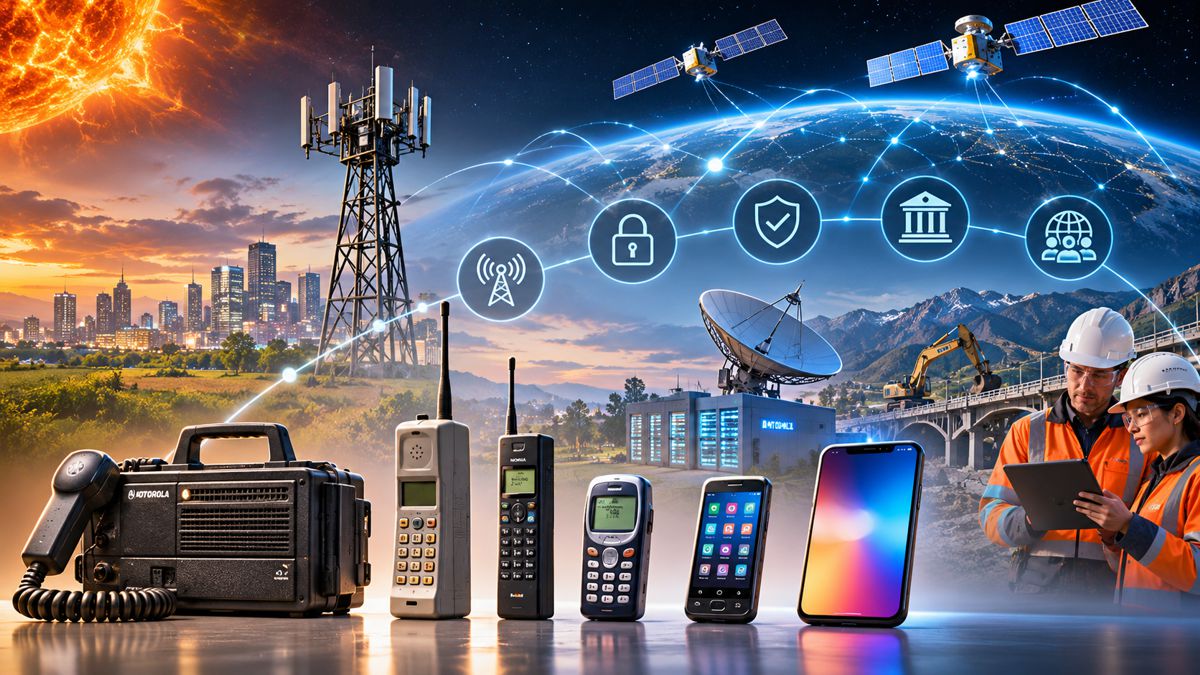
Some of the earliest commercially available Motorola mobile telephones consisted of a substantial box with a carrying handle and a conventional telephone receiver attached by a coiled cable. The familiar brick-sized mobile phones followed, giving way to slimmer handsets with extended aerials and eventually devices small enough to slip into a shirt pocket. There was no text messaging, mobile internet or digital photography. The extraordinary achievement was simply being able to make a telephone call while away from home or the office.
Over the following four decades, mobile telephones became smaller, cheaper and considerably more capable, while the communications infrastructure supporting them developed into one of the largest and most sophisticated engineering undertakings in history. Governments and telecommunications companies invested heavily in towers, fibre-optic cables, switching centres, data centres and electrical infrastructure, periodically upgrading their networks as successive generations of technology emerged.
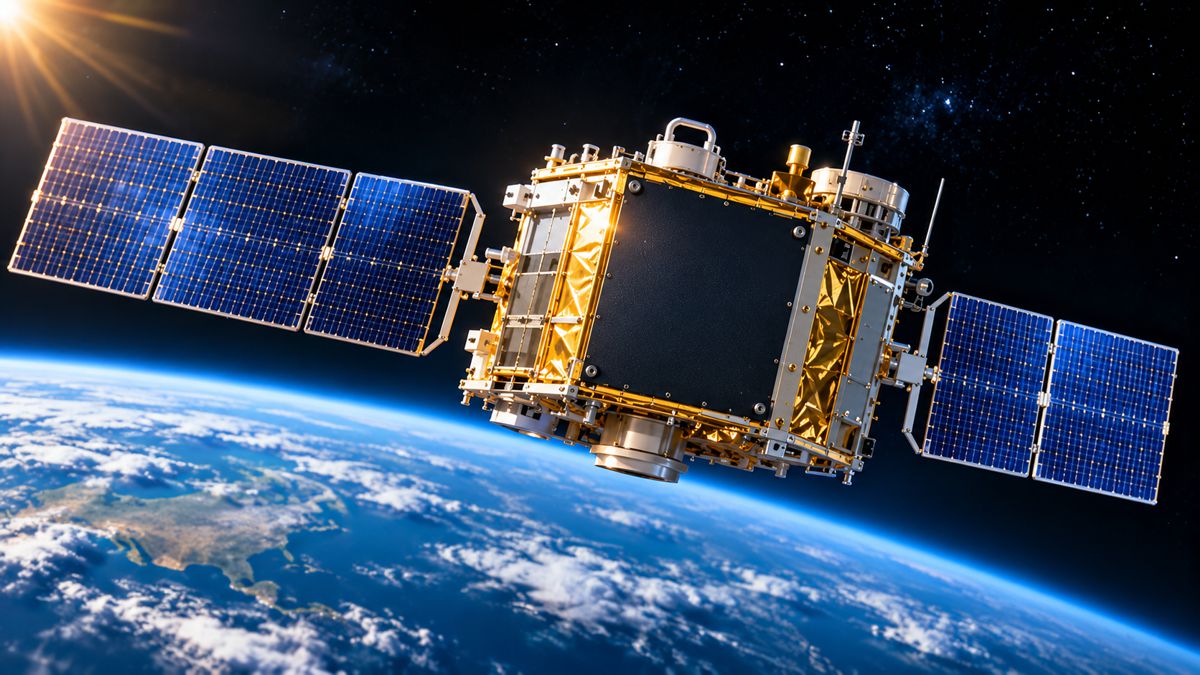
That established investment cycle now faces a different form of competition. Satellites orbiting hundreds of kilometres above the Earth are beginning to communicate directly with conventional smartphones, potentially extending mobile coverage into regions where constructing terrestrial infrastructure has never been commercially attractive.
On 25 November 2026, DIGITIMES reported that Samsung Electronics had entered the bidding process to supply telecommunications equipment for SpaceX’s expanding Starlink Mobile network. Earlier in the month, Qualcomm confirmed a separate agreement to supply technology for SpaceX’s planned nationwide terrestrial 5G network in the United States.
The emerging convergence of satellite and terrestrial communications presents opportunities for another great technological leapfrog. It also opens a considerably more complicated discussion about infrastructure investment, national sovereignty, government control, data privacy and the physical security of networks upon which entire economies could eventually depend.
Briefing
- Four decades of mobile telecommunications development have required successive generations of infrastructure investment, equipment replacement and network expansion.
- Developing economies have historically benefited from adopting newer communications technologies without the financial burden of maintaining extensive legacy networks.
- Direct-to-device satellite connectivity could reduce the requirement for terrestrial infrastructure in remote and sparsely populated regions.
- SpaceX’s parallel investment in terrestrial 5G demonstrates the commercial potential of integrated orbital and ground-based communications networks.
- Government control, data sovereignty, space weather, cybersecurity and deliberate interference present significant challenges as dependence on orbital communications increases.
Building the First Cellular Networks
Early mobile telephone systems were largely vehicle-based, relying on bulky radio equipment, considerable electrical power and relatively limited network capacity. Cellular technology introduced a different approach by dividing geographical areas into individual radio coverage zones, allowing frequencies to be reused and telephone calls to be transferred between cells as subscribers moved through the network.
In 1983, the US Federal Communications Commission approved the Motorola DynaTAC 8000X, recognised by Motorola as the first commercial handheld cellular telephone. Commercial cellular networks were already emerging in Japan and parts of Europe, while Britain introduced its first commercial cellular services in 1985. Mobile telephony remained an expensive business tool, accessible primarily to corporate customers and individuals prepared to pay substantial premiums for the convenience.
Behind every mobile telephone stood a considerable engineering undertaking. Operators needed to acquire spectrum, identify suitable antenna locations, negotiate land leases, construct towers, install power supplies and connect base stations to switching centres. Coverage depended upon geography, population density and the commercial viability of individual installations, with rural communities frequently waiting years for services available in major cities.
The first generation of analogue cellular networks established much of the physical and commercial architecture that would underpin mobile communications for decades. Although the electronic equipment would subsequently pass through several technological generations, the underlying requirements for land, power, transmission infrastructure and strategically located antennas remained remarkably consistent.
Four Decades of Infrastructure Investment
The introduction of second-generation digital networks during the 1990s improved network capacity, introduced text messaging and established more sophisticated arrangements for subscriber authentication and international roaming. Third-generation networks brought practical mobile internet access, followed by 4G services capable of supporting video streaming, cloud applications and increasingly data-intensive commercial activities.
With 5G, telecommunications infrastructure has become more closely integrated with industrial operations. Private mobile networks are being deployed across factories, ports, mines and logistics facilities, supporting automated machinery, robotics and real-time asset monitoring. The mobile network has developed from a means of personal communication into an operational component of industrial infrastructure.
Each generation has brought new commercial opportunities accompanied by another round of capital expenditure. Existing towers and equipment compounds can frequently be reused, but antennas, radios, computing equipment, transmission systems and network software require periodic replacement or upgrading. Higher-frequency deployments may also necessitate additional installations to achieve the required coverage and capacity.
The physical infrastructure has developed into an investment sector in its own right, with specialist tower companies acquiring and operating telecommunications sites under long-term commercial arrangements with mobile operators. Fibre networks, data centres and associated infrastructure attract investment from pension funds and institutional investors seeking dependable revenues from essential services.
Much of that investment assumes terrestrial infrastructure will remain the principal means of delivering mobile connectivity. The arrival of orbital networks introduces a new variable into an established financial model, particularly where geographical coverage is expensive to provide and subscriber demand remains relatively low.
The Advantage of Being Late
One of the recurring characteristics of telecommunications development has been the ability of countries with relatively limited infrastructure to adopt technologies that were unavailable when more developed economies constructed their original networks.
Across Europe and North America, fixed-line telephony involved decades of investment in copper cables, underground ducts, overhead lines, local exchanges and individual property connections. Maintaining and eventually replacing those networks became a substantial financial and engineering undertaking, with telecommunications operators carrying the costs of infrastructure built around technologies that were gradually becoming obsolete.
Many developing economies avoided part of that expenditure by adopting cellular communications directly. A mobile tower could serve thousands of subscribers without requiring a separate physical telephone line to every household or business, while prepaid services made telecommunications accessible to customers without established credit histories or conventional banking arrangements.
Later adopters also benefited from more mature technology, internationally established standards and increasingly competitive equipment suppliers. Rather than progressing through every generation of cellular infrastructure, countries could adopt newer network technologies as investment became available.
Mobile connectivity subsequently provided a platform for financial services, commercial transactions and public administration. In markets where physical banking infrastructure was relatively limited, mobile payment systems developed into an everyday means of conducting business, sometimes achieving levels of adoption that exceeded those of more established economies.
The technological leapfrog was never universal. Electricity supply, affordability, digital literacy and access to capital continued to constrain deployment. According to the International Telecommunication Union’s Facts and Figures 2026, approximately 6.3 billion people are now using the internet, while around two billion remain unconnected. Fifth-generation mobile coverage reaches 86% of the population in high-income countries, compared with just 4% in low-income economies.
For governments considering how to close that gap, commercially viable satellite-to-smartphone connectivity offers another opportunity to bypass expensive stages of infrastructure development. The decisions being made today about national coverage programmes, telecommunications subsidies and long-term infrastructure investment will increasingly need to account for capabilities that may become commercially available before those investments reach maturity.
Moving the Mobile Base Station into Orbit
Satellite telephones have existed for decades, although they traditionally required specialised handsets, dedicated communications networks and relatively expensive subscriptions. Their use was largely concentrated in maritime operations, remote industrial locations, emergency services and other environments beyond conventional cellular coverage.
Direct-to-device satellite technology addresses several of those limitations by enabling communications with compatible conventional mobile phones. Rather than requiring subscribers to carry a separate satellite handset, the network communicates using radio technologies already familiar to the mobile telecommunications industry.
Starlink Mobile is developing this capability around compatible LTE devices, with satellites incorporating communications equipment capable of performing functions traditionally associated with terrestrial mobile base stations. Subscribers travelling beyond the coverage of conventional mobile towers can potentially establish a connection with an orbiting satellite, subject to service availability, device compatibility and suitable reception conditions.
Low Earth orbit offers advantages over traditional geostationary satellite communications. The shorter transmission distance reduces signal propagation delays and improves the feasibility of communicating with relatively low-powered handheld devices. However, individual satellites move rapidly relative to the Earth’s surface, requiring sophisticated network coordination and the continuous transfer of connections between spacecraft.
Mobile handsets have small antennas and limited transmission power, while orbital communications must accommodate changing transmission distances, Doppler shifts and the simultaneous demands of numerous subscribers. Satellite antenna design, beamforming, spectrum allocation and ground infrastructure all influence the capacity and reliability of the service.
SpaceX is facing competition from companies developing alternative approaches. AST SpaceMobile is developing large satellite communications arrays designed to provide cellular broadband directly to unmodified smartphones, working with established mobile operators to extend their geographical coverage.
The telecommunications industry is formalising these developments through international standards. The ITU’s February 2026 Recommendation M.2177 establishes technical specifications for satellite-based 5G radio interfaces, incorporating work on non-terrestrial networks undertaken by the 3rd Generation Partnership Project, or 3GPP. Satellite communications are gradually becoming part of the mainstream mobile telecommunications architecture.
Coverage, Capacity and the Economics of Space
Providing cellular coverage across a remote mountain range, desert or sparsely populated agricultural region can be an expensive undertaking. Individual installations may require access roads, electrical connections, backup generation, equipment compounds, security arrangements and transmission infrastructure stretching considerable distances. Maintenance personnel must travel to remote installations that may serve relatively few paying subscribers.
An orbital network can potentially serve many such regions using shared infrastructure. Once a constellation is established, extending coverage into another geographically accessible market may require substantially less local construction, although spectrum licensing, commercial arrangements and ground infrastructure remain necessary.
Satellites face a different economic challenge in densely populated areas, where available radio capacity must be shared among users within individual beams. Terrestrial networks can reuse frequencies across numerous comparatively small cells, allowing operators to accommodate concentrated demand. A city containing hundreds of thousands of simultaneous smartphone users presents a fundamentally different engineering problem from a remote highway carrying occasional vehicles.
Indoor reception, underground facilities and obstructed urban environments also favour terrestrial connectivity. Concrete structures, metal-clad industrial buildings and natural obstacles can prevent handheld devices from establishing reliable satellite connections, while applications such as industrial automation may require levels of service availability that are more readily achieved using dedicated local networks.
There are substantial costs associated with constructing and operating satellite constellations, including spacecraft manufacturing, launches, ground stations, orbital coordination and the regular replenishment of ageing satellites. Spacecraft operating in low Earth orbit have finite operational lives and must be replaced if the network is to maintain its coverage and capacity.
SpaceX benefits from the integration of spacecraft manufacturing, launch operations and telecommunications services. Other operators must develop comparable capabilities, purchase launch services or establish commercial partnerships across several sectors, potentially exposing them to higher costs and greater dependence on external suppliers.
Even with those advantages, SpaceX recognises the continuing importance of terrestrial infrastructure. On 4 November 2026, Qualcomm announced that it had been selected to supply cellular infrastructure platforms for Starlink Mobile’s planned nationwide US terrestrial 5G network.
The emerging competition therefore extends beyond satellite operators attempting to capture underserved markets. Companies capable of combining orbital coverage with high-capacity terrestrial infrastructure could compete directly with established mobile operators, offering a single communications service across environments that previously required separate networks and subscriptions.
Rethinking Terrestrial Infrastructure Investment
Telecommunications towers are long-lived physical assets, even though the equipment mounted on them may pass through several technological generations. Infrastructure investors have consequently treated many telecommunications sites as relatively dependable sources of rental income, particularly where several operators share installations under long-term commercial agreements.
The emergence of orbital connectivity does not immediately undermine that business model. Towers in densely populated urban areas, busy transport corridors and industrial centres are likely to remain commercially valuable for the foreseeable future. Fibre-optic networks will continue to carry enormous quantities of data between terrestrial facilities, computing infrastructure and satellite gateways.
The position is less certain for proposed installations in marginal coverage areas, particularly those dependent on public subsidies or universal service obligations. A government considering a national telecommunications expansion programme must assess the costs of maintaining its infrastructure over several decades, during which satellite capacity, handset capabilities, network standards and launch economics could develop substantially.
Building a mobile tower to connect a small settlement may remain the most economical option where local demand is sufficient. In other locations, satellite services could provide adequate connectivity without the associated expenditure on roads, towers and electrical infrastructure. Hybrid networks could also serve communities through satellite backhaul connected to local terrestrial distribution systems.
There is a further commercial consideration for established telecommunications companies. Ownership of the physical network and ownership of the customer relationship need not remain with the same organisation. Global connectivity providers could purchase access to terrestrial infrastructure where they require additional capacity, while relying on their own orbital networks elsewhere.
Traditional mobile operators might consequently find themselves supplying network capacity to businesses competing directly for their customers. The commercial disruption could occur long before terrestrial infrastructure becomes technologically obsolete, affecting everything from wholesale network agreements to the valuation of future tower construction programmes.
Communications Without Borders
Mobile telecommunications have largely developed around national boundaries. Operators acquire licences within individual countries, construct domestic networks and establish commercial agreements with foreign operators to provide international roaming.
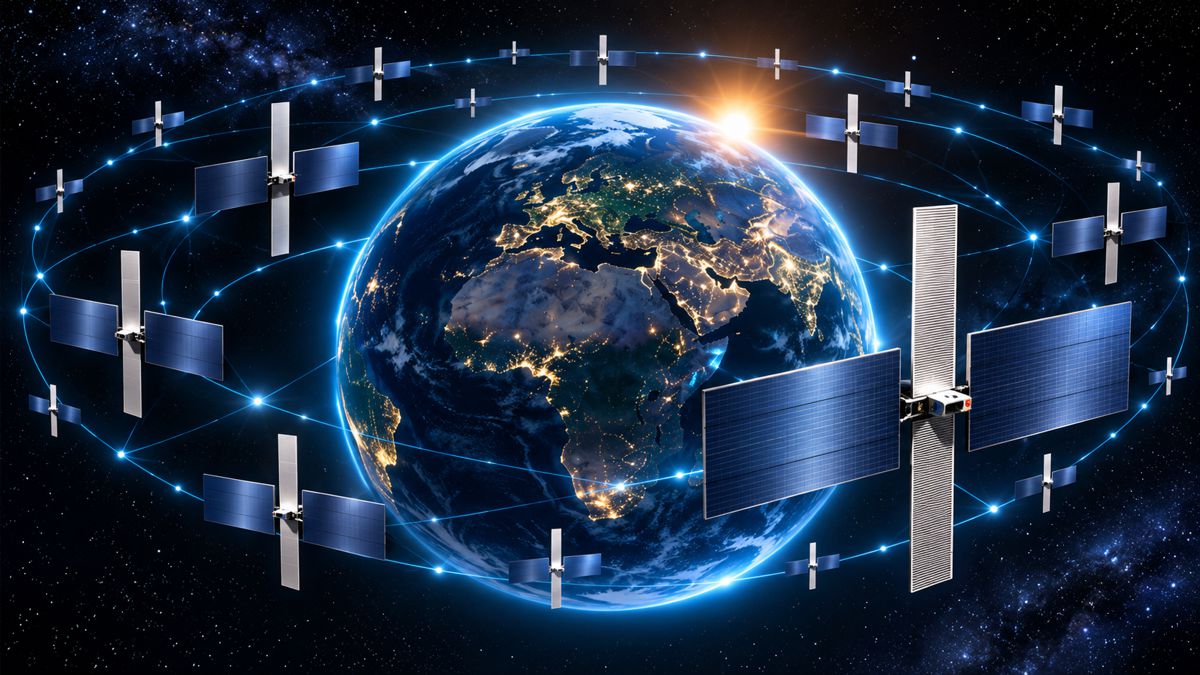
Satellite constellations operate according to a different geographical logic. Individual spacecraft may pass over several countries during a single orbit, while inter-satellite communications can potentially transfer data over considerable distances before returning it to terrestrial infrastructure.
A subscriber travelling between Europe, Africa and Asia might eventually retain access to the same underlying orbital network throughout the journey, subject to regulatory approval and commercial service arrangements. International construction companies, shipping operators and logistics businesses could procure connectivity across multiple jurisdictions through a single commercial agreement, reducing some of the administrative complexity associated with managing communications across national networks.
Such a model would challenge established international roaming arrangements and introduce new forms of competition into domestic telecommunications markets. However, eliminating the engineering necessity for separate national networks does not eliminate national regulatory authority, and the geographical reach of satellite technology may prove considerably easier to establish than the legal right to operate across international borders.
Government Control and National Sovereignty
Governments have historically exercised considerable influence over communications infrastructure because telephone exchanges, mobile towers, cable networks and international gateways are physically accessible assets operating within established legal and regulatory systems.
That authority supports legitimate public functions, including emergency communications, criminal investigations, spectrum management, consumer protection and national security. In some jurisdictions, it also provides the mechanisms through which authorities restrict access to information, impose censorship or suspend communications services.
Satellite connectivity introduces an alternative communications pathway, potentially reducing dependence on domestic infrastructure. Nevertheless, a satellite passing overhead does not automatically acquire the legal right to provide services to the population beneath it.
The ITU’s framework for satellite regulation and coordination recognises the responsibility of national administrations for licensing satellite systems, alongside international arrangements governing radio frequencies and interference.
In March 2024, the US Federal Communications Commission established its Supplemental Coverage from Space framework, creating a regulatory mechanism through which satellite operators could extend mobile coverage using spectrum arrangements involving terrestrial wireless operators.
Other countries are adopting approaches that place greater emphasis on domestic control. India’s Department of Telecommunications, for example, requires authorised satellite communications providers to comply with conditions covering domestic gateways, lawful interception and the routing of Indian communications traffic.
These requirements can substantially influence the architecture and economics of an international satellite network. A constellation theoretically capable of routing communications across continents without touching the ground may still need to deliver traffic through infrastructure located within the subscriber’s country. Governments can also require operators to restrict services geographically, using subscriber authorisation and network management systems to impose service boundaries.
The prospect of communicating independently of domestic infrastructure will remain attractive to populations living under restrictive regimes, although their ability to do so will depend upon national enforcement capabilities, the technical characteristics of individual networks and the willingness of commercial operators to provide services.
There is also the possibility that a satellite provider could independently restrict connectivity in response to commercial disputes, regulatory pressure, international sanctions or operational decisions. The relocation of telecommunications infrastructure into orbit may redistribute control between governments and corporations without necessarily increasing the freedom or independence of subscribers.
Data Privacy Beyond National Borders
A conventional mobile telephone network already generates substantial quantities of information about its subscribers. Beyond the content of communications, operators can process device identifiers, billing records, network activity and information about the location of connected equipment.
The growing integration of mobile connectivity with vehicles, industrial machinery, personal devices and financial services increases the commercial and strategic value of that information. A global communications provider could potentially establish a remarkably comprehensive picture of the movement and activities of individuals and businesses across multiple jurisdictions.
For construction companies, logistics operators and infrastructure owners, communications metadata alone could reveal commercially sensitive information about operational locations, fleet movements and project activity. For individual subscribers, similar information could provide insight into travel patterns, personal associations and everyday activities without requiring access to the content of telephone calls or messages.
Starlink’s existing Global Privacy Policy identifies several categories of technical information associated with its satellite internet services, including equipment location, network performance and assigned internet protocol addresses. The precise arrangements governing future direct-to-smartphone services will depend upon their architecture, commercial partnerships and applicable legal requirements.
Data protection becomes particularly complicated when the subscriber, network operator, spacecraft, ground gateway and data processing facilities are subject to different legal jurisdictions. Chapter V of the European Union’s General Data Protection Regulation already establishes conditions governing the transfer of personal information outside the European Economic Area, and orbital communications networks do not inherently escape those obligations.
Operators serving European customers may face European data protection requirements while simultaneously being subject to legislation and lawful government demands elsewhere. Encryption can protect communications content from unauthorised access, although it does not necessarily conceal the metadata required to establish and maintain a connection.
For international businesses, procuring communications services could increasingly involve assessing where information is processed, which organisations can access it, how long it is retained and what happens when conflicting legal obligations arise. Establishing liability following a data breach or prolonged international service interruption could prove equally complicated where several operators and jurisdictions are involved.
From National Monopolies to Global Operators
The telecommunications industry has undergone successive periods of nationalisation, privatisation, deregulation and consolidation. Many countries dismantled established telecommunications monopolies to introduce competition and encourage investment in new services, although the resulting markets frequently consolidated around a relatively small number of infrastructure owners.
The economics of satellite telecommunications could introduce a different form of market concentration. Establishing a globally competitive constellation requires considerable investment in spacecraft, launch services, spectrum, ground facilities, software development and ongoing operations. Established providers benefit from economies of scale by distributing certain fixed infrastructure costs across subscribers in numerous countries.
SpaceX’s combination of spacecraft manufacturing, launch capabilities and telecommunications operations creates a strong competitive position. Its ability to develop satellite connectivity while constructing terrestrial networks could place it in competition with traditional mobile operators across several parts of the telecommunications market.
Other companies are pursuing partnership-based approaches in which satellite infrastructure extends the coverage of existing operators. Under such arrangements, national telecommunications companies could retain their subscriber relationships while purchasing access to orbital capacity.
The eventual balance between wholesale partnerships and direct competition will influence whether satellite communications strengthen existing telecommunications markets or concentrate control within a smaller number of global providers. Established mobile operators may find satellite companies to be valuable infrastructure partners in remote regions while facing competition from the same organisations elsewhere.
Governments will also need to consider how conventional competition policy applies to globally distributed infrastructure. A national regulator can impose conditions on a domestic telecommunications operator, but its commercial and political leverage may be more limited when dealing with an international constellation upon which its economy has become dependent.
The availability of competing networks, interoperability between services and the ability of subscribers to change providers will become particularly important where telecommunications infrastructure supports essential public services.
The Emerging Telecommunications Space Race
The European Union’s development of its own satellite communications infrastructure demonstrates how closely connectivity has become associated with sovereignty and strategic independence.
The IRIS² programme is intended to provide secure communications capabilities for European governments alongside commercial connectivity services. The European Commission signed a 12-year concession agreement with the SpaceRISE consortium in December 2024, bringing together European satellite operators to develop the infrastructure.
Europe’s approach reflects concerns about communications resilience, cybersecurity and dependence on infrastructure controlled outside the European Union. China is also developing large-scale satellite constellations, including its Guowang and Qianfan programmes, while American commercial operators continue to expand their orbital communications capabilities.
Regional operators and governments elsewhere may establish partnerships with these networks rather than attempting to finance independent constellations. The result could be a communications landscape divided between competing commercial and geopolitical ecosystems, with service availability influenced by national licensing arrangements, equipment compatibility and international relationships.
Governments seeking to preserve strategic independence may be willing to finance communications infrastructure that would be difficult to justify on purely commercial grounds. Maintaining independent connectivity for essential public services could become comparable to maintaining domestic energy generation, strategic fuel reserves or national transport infrastructure.
The economics of satellite communications favour global scale, while the political requirements of sovereignty encourage regional independence and some duplication of infrastructure. Countries without the resources to develop independent constellations could find themselves making difficult decisions about which international providers they are prepared to depend upon.
Protecting Communications Infrastructure in Space
Moving telecommunications infrastructure into orbit introduces a different set of engineering and security challenges. Terrestrial networks are vulnerable to flooding, earthquakes, extreme weather, vandalism and deliberate sabotage, but damaged equipment can generally be accessed by maintenance personnel. Repairing a malfunctioning commercial satellite hundreds of kilometres above the Earth is considerably more difficult, with replacement remaining the practical option in many circumstances.
Space weather represents a particular concern. Energetic particles associated with solar activity can damage electronic components, degrade solar panels and interfere with onboard computing systems. Geomagnetic storms can also heat and expand the Earth’s upper atmosphere, increasing atmospheric drag on spacecraft operating in low Earth orbit.
In February 2022, SpaceX experienced the loss of 38 of 49 recently launched Starlink satellites following a geomagnetic disturbance. The spacecraft were still operating at relatively low orbital altitudes when increased atmospheric density prevented many of them from successfully raising their orbits.
Subsequent scientific research examined how even moderate geomagnetic storms could adversely affect low Earth orbit infrastructure. Established satellites operating at higher altitudes may respond differently, but the incident demonstrated the vulnerability of large-scale commercial spacecraft deployment to conditions beyond the control of network operators.
The US National Oceanic and Atmospheric Administration monitors solar activity and its effects on spacecraft, radio communications, navigation systems and terrestrial electricity networks. As societies become more dependent upon orbital infrastructure, space weather forecasting could acquire greater operational significance for telecommunications companies, emergency services and critical infrastructure owners.
Large constellations provide considerable redundancy because individual spacecraft can fail without necessarily interrupting the wider network. However, severe space weather can affect numerous satellites simultaneously, while shared electronic components, software platforms and operational systems introduce the possibility of correlated failures across a constellation.
Radiation-tolerant electronics, shielding, autonomous recovery systems, orbital manoeuvring capabilities and replacement spacecraft all contribute to operational resilience, although each carries additional engineering and financial costs. The commercial pressures associated with producing thousands of relatively inexpensive satellites must therefore be balanced against the requirements of infrastructure that could eventually support essential public services.
Jamming, Cyberattacks and Systemic Network Failure
Deliberate interference presents a different challenge. Satellite communications depend upon radio transmissions that can be disrupted through intentional interference, while the software and terrestrial systems responsible for managing orbital infrastructure remain exposed to cybersecurity threats.
Jamming does not necessarily require physical damage to a satellite. Radio interference can disrupt the connection between spacecraft and terrestrial equipment, potentially denying services within affected geographical areas. The effectiveness and extent of such interference depend upon network design, transmission frequencies, available countermeasures and the characteristics of the affected equipment.
The consequences of a cyberattack could be more geographically extensive, particularly where numerous spacecraft and subscribers depend upon shared software, network management platforms or terrestrial communications facilities.
In February 2022, a cyberattack against Viasat’s KA-SAT satellite communications network caused disruption in Ukraine and several European countries. A subsequent European Union declaration attributed the attack to the Russian Federation. Among the consequences was the loss of remote monitoring and control connectivity affecting thousands of wind turbines in Germany, demonstrating how disruption to shared communications infrastructure can extend into other countries and industrial sectors.
The US National Institute of Standards and Technology has developed cybersecurity guidance addressing the terrestrial infrastructure responsible for satellite command and control. Protecting orbital communications requires attention to the entire network, encompassing spacecraft, ground stations, subscriber equipment, software platforms and the organisations responsible for operating them.
Malicious interference is only one source of systemic risk. Software defects, unsuccessful updates, equipment manufacturing faults and failures within shared network management systems can also create widespread disruption. A geographically distributed constellation may contain thousands of individual spacecraft while remaining dependent upon a comparatively small number of common technological systems.
The consequences of interruption become considerably more serious when communications networks support electricity distribution, transport management, financial transactions, emergency services and industrial operations. A prolonged outage affecting a major international provider could simultaneously disrupt businesses and public services across several continents.
Physical threats also extend to orbital debris and the potential deliberate destruction of spacecraft during military conflict. Debris generated by individual satellite collisions or destructive anti-satellite operations can threaten infrastructure operated by organisations and countries entirely unconnected with the original incident. Unlike terrestrial communications sites, orbital infrastructure occupies an environment where the physical consequences of interference can extend far beyond the original asset.
Maintaining independent terrestrial communications infrastructure may consequently remain a strategic necessity, even where orbital services offer a more attractive commercial proposition. The additional expenditure associated with maintaining alternative networks could prove modest compared with the economic consequences of a prolonged interruption to essential communications.
Connecting Construction and Critical Infrastructure
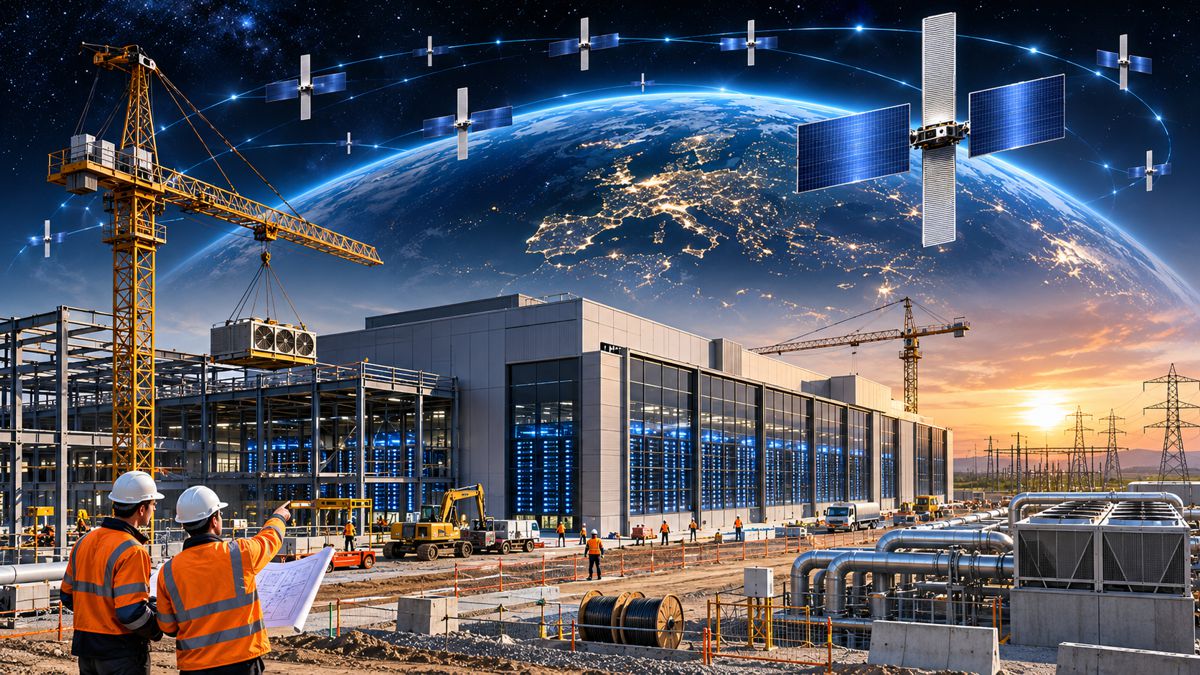
For construction, mining, transport and logistics businesses, reliable connectivity remains a significant operational constraint in remote working environments. Large infrastructure projects frequently begin in locations where permanent electricity supplies, access roads and telecommunications networks have yet to be established, leaving contractors to install temporary communications facilities before sophisticated digital construction systems can operate effectively.
Satellite-to-device connectivity could simplify workforce communications, equipment monitoring, environmental reporting and emergency response. Highway maintenance teams operating across remote road networks could retain access to digital asset management systems beyond conventional cellular coverage, while international logistics businesses could maintain more consistent communications with vehicles, containers and personnel travelling between countries.
The suitability of orbital communications will depend upon the application. A monitoring device transmitting occasional measurements has substantially different requirements from an autonomous haul truck exchanging continuous streams of operational data. Safety-critical machinery will continue to require appropriate local control systems and fail-safe operation when communications are interrupted, regardless of the network technology involved.
For critical infrastructure owners, independent terrestrial and orbital communications pathways could improve operational resilience. A satellite connection may remain available following damage to local telecommunications infrastructure, while terrestrial networks can provide continuity during certain satellite service interruptions.
Genuine redundancy requires operational independence wherever practical. Two communications services relying on the same underlying constellation, ground gateway or network management platform may provide less protection than their separate commercial branding suggests. Understanding the physical and digital architecture behind contracted telecommunications services will become increasingly important for infrastructure owners developing business continuity arrangements.
The Arrival of 6G
The international telecommunications industry is already developing the technical foundations for sixth-generation mobile communications. The ITU’s IMT-2030 programme establishes the framework through which future mobile telecommunications technologies will be assessed and standardised.
Previous mobile generations developed primarily around improvements to terrestrial cellular communications. Although satellite systems have long supported telecommunications through dedicated services and backhaul connections, their integration into mainstream mobile standards introduces different architectural possibilities.
Future devices could move between terrestrial cells, private industrial networks and orbital infrastructure with increasingly limited intervention from subscribers. Network management systems could determine the most appropriate connection according to capacity, service availability, latency, energy consumption and commercial arrangements.
The development of integrated networks could also change how telecommunications infrastructure is procured. Rather than independently specifying satellite terminals, mobile subscriptions and private network services, organisations may increasingly purchase connectivity packages encompassing several technologies.
Considerable engineering, standardisation and commercial work remains before such arrangements become routine, and the adoption of sixth-generation telecommunications will remain uneven across different economies. Nevertheless, 6G could represent the generation in which the distinction between conventional mobile networks and satellite communications begins to lose its commercial and operational relevance.
Communications Infrastructure in 2050
By the middle of the century, consumers may have little reason to know whether their mobile telephone is communicating through a conventional antenna in a city, a private network inside an industrial facility or a satellite orbiting hundreds of kilometres overhead.
The physical infrastructure supporting those services could nevertheless become more complex. Alongside terrestrial towers, fibre-optic cables and data centres, telecommunications networks will require satellite manufacturing facilities, launch infrastructure, ground stations and systems capable of coordinating thousands of spacecraft. Orbital congestion, collision avoidance, astronomical interference, spacecraft disposal and the continual replacement of ageing satellites introduce infrastructure management responsibilities on a planetary scale.
For developing countries, satellite communications could provide another opportunity to bypass expensive stages of infrastructure development. Rather than attempting to replicate the terrestrial networks constructed by wealthier economies over several decades, governments could combine targeted urban and industrial infrastructure with orbital coverage across less populated regions.
There is, however, a considerable difference between avoiding unnecessary capital expenditure and surrendering control over essential national infrastructure. Countries dependent upon foreign telecommunications providers may find themselves exposed to commercial disputes, changes in international relations and decisions made by organisations beyond their effective jurisdiction.
The evolution from cumbersome transportable Motorola telephones to satellite-connected smartphones represents an extraordinary engineering achievement within a single working lifetime. Those early mobile networks were expensive, geographically fragmented and limited in their capabilities, yet their fragmentation provided a degree of separation between failures and disruptions occurring in different parts of the world.
Modern integrated networks offer unprecedented reach and efficiency, accompanied by the potential for failures, commercial decisions and political disputes to have consequences across geographical boundaries. Preserving competition, interoperability and independent communications pathways will become increasingly important as telecommunications infrastructure develops into a global system.
Universal connectivity remains an enormously worthwhile engineering ambition. Achieving it without creating universal dependency may prove to be the greater challenge.
Key Industry Questions
- Could satellite communications eventually replace mobile phone towers? Satellite networks could replace some terrestrial installations in sparsely populated and geographically isolated areas. Urban environments, industrial facilities and indoor locations will continue to favour terrestrial networks because of their capacity and reception advantages.
- Can ordinary smartphones connect directly to satellites? Compatible smartphones can already access certain satellite communications services without dedicated external antennas. Available functions depend upon handset compatibility, network capabilities, spectrum arrangements, subscriptions and geographical location.
- Could developing countries bypass conventional telecommunications infrastructure? Satellite connectivity could reduce the need to construct terrestrial networks across remote regions. Local infrastructure will remain necessary where population density, industrial requirements or service capacity justify the investment.
- Can governments prevent satellite communications within their borders? Governments retain authority over domestic telecommunications licensing and spectrum use. They can impose geographical service restrictions, domestic gateway requirements and other regulatory conditions, although their enforcement capabilities vary.
- Does satellite connectivity provide greater data privacy? Not inherently. Privacy depends upon encryption, network architecture, operator policies and applicable legislation. Satellite communications providers may still collect subscriber information and communications metadata or face lawful government disclosure requirements.
- How vulnerable are satellite networks to solar storms? Solar activity can damage spacecraft electronics, disrupt radio communications and increase atmospheric drag on satellites operating in low Earth orbit. Constellation design, radiation protection, space weather monitoring and operational procedures can reduce these risks without eliminating them entirely.
- Can satellite communications be jammed or hacked? Satellite networks are susceptible to intentional radio interference and cybersecurity threats affecting spacecraft, terrestrial facilities and subscriber equipment. Effective security requires protection of the entire communications system rather than individual satellites alone.
- What risks do satellite networks introduce for infrastructure investors? Improving orbital connectivity could reduce demand for new terrestrial installations in marginal coverage areas. Investors must also consider technological obsolescence, changing wholesale network arrangements and competition from integrated global communications providers.
- How will satellite communications influence 6G? Future mobile telecommunications standards are expected to support closer integration between terrestrial and non-terrestrial networks, potentially allowing devices to move more seamlessly between different forms of communications infrastructure.
- Why should critical infrastructure maintain independent communications networks? Alternative networks reduce dependence upon individual operators, technologies and shared infrastructure. Independent terrestrial and orbital communications pathways can improve resilience against natural disasters, cyberattacks, technical failures and deliberate interference.
Strategic Takeaways
- Telecommunications infrastructure investment should increasingly be evaluated against the combined capabilities and long-term economics of terrestrial and orbital networks.
- Developing economies could avoid unnecessary infrastructure expenditure through satellite connectivity, provided affordability, service capacity and national sovereignty are adequately addressed.
- Commercial disruption may occur through control of subscriber relationships and wholesale network arrangements long before terrestrial telecommunications infrastructure becomes obsolete.
- Data jurisdiction, corporate concentration and regulatory compliance will become increasingly important considerations when procuring international communications services.
- Independent terrestrial and orbital communications pathways will remain essential safeguards against excessive technological dependency, space weather, cybersecurity threats and systemic network failure.