






Why Asia’s Compact Trucks Deserve a Place in Western Construction
A truck barely wider than a small car, with a load platform capable of carrying building materials, tools and equipment, is an everyday sight across much of Asia. Compact working trucks have served construction sites, farms, local businesses and municipal services for decades, combining surprisingly generous cargo space with dimensions that make them particularly useful in congested towns and cities.
Yet across much of Europe and North America, this practical vehicle format remains relatively uncommon. Contractors generally choose between pickups, panel vans and larger chassis-cab trucks, despite the availability of smaller vehicles that can offer an unusually efficient relationship between overall dimensions and usable load space.
Hyundai’s forthcoming replacement for the Porter, one of South Korea’s most familiar commercial vehicles, has brought renewed attention to the category. Prototype photographs reveal a substantial redesign, with electric and LPG powertrains reportedly planned for 2027. It is a timely development for a vehicle class that has spent generations doing useful work without attracting much attention beyond its established markets.
Briefing
- Hyundai’s next-generation Porter is reportedly being developed for 2027 with electric and LPG powertrains.
- Compact dropside trucks are widely used across Asia for construction, agriculture, deliveries and maintenance.
- Cab-forward layouts provide generous load platforms within relatively short and narrow vehicles.
- Europe’s Piaggio Porter NP6 and electric NPE demonstrate the practicality of the format in Western markets.
- Modern safety engineering and electrification could support wider interest in compact commercial trucks.
The Working Truck That Asia Never Abandoned
South Korea’s Hyundai Porter and Kia Bongo are among the most recognisable examples of a commercial vehicle designed primarily around the load it carries. Their compact cabs sit directly above or close to the front axle, leaving much of the remaining chassis available for a flat cargo platform with folding sides.
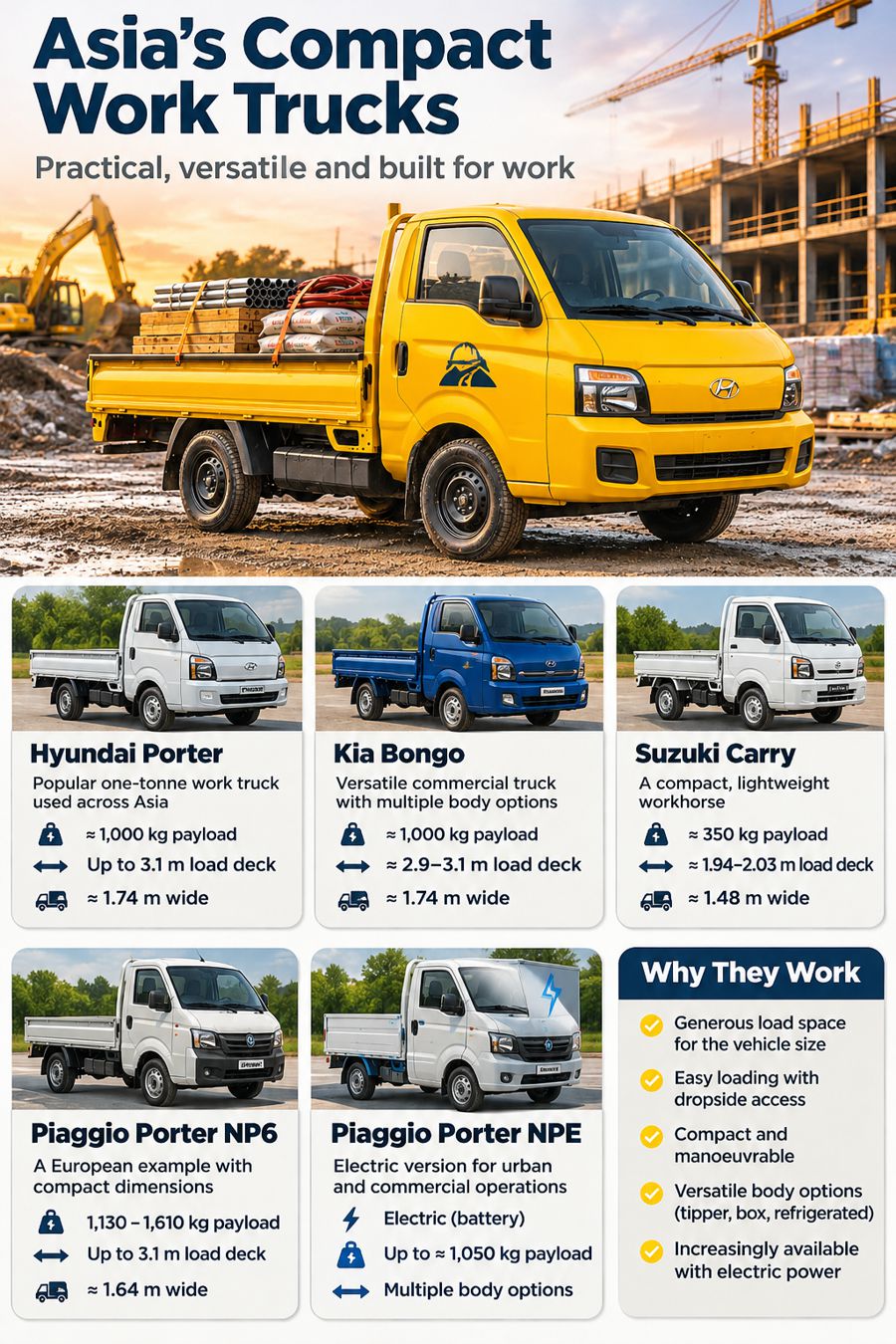
The Hyundai Porter II is offered in several cab and wheelbase configurations, with loading platforms extending to approximately 3.1 metres on certain versions. Despite that useful cargo length, the vehicle is only around 1.74 metres wide, allowing it to negotiate streets and access routes that can be awkward for larger commercial vehicles.
The Kia Bongo III follows a similar approach, providing a straightforward commercial platform that can accommodate different bodies and equipment. Across both ranges, the emphasis remains firmly on working capacity, with cab layouts, wheelbases and body configurations selected according to the intended operation.
The proportions are distinctive. Where a conventional bonneted vehicle devotes considerable length to the engine compartment and passenger accommodation, a compact forward-control truck places more of its overall footprint at the disposal of the load. A dropside body also allows materials to be approached from several directions, rather than restricting access to a tailgate or enclosed cargo opening.
For a small contractor, the attraction is easy to understand. Timber, pipes, scaffolding components, bags of cement and a collection of tools can be arranged on a relatively unobstructed platform. The folding sides simplify access, while a suitable body can accommodate pallets, bulk materials or specialist equipment without requiring a larger vehicle simply to provide sufficient floor space.
These trucks have become an established part of commercial life in Asian markets where smaller businesses frequently handle their own transport. They are used by agricultural suppliers, building contractors, delivery operators and maintenance teams, often performing several different duties during the working day.
Their durability as a vehicle category reflects a straightforward engineering principle: keep the cab compact, maximise the working area and avoid carrying unnecessary vehicle dimensions around every delivery.
Making the Most of a Small Footprint
The relationship between vehicle size and available carrying space is the principal advantage of the compact truck format.
Moving the cab forward allows a longer cargo deck within a shorter overall vehicle, while a low platform can simplify repeated loading and unloading. On dropside bodies, opening the side panels provides access for materials that would be difficult to manoeuvre through the rear doors of a conventional van. Forklift loading can also be more straightforward where the platform dimensions, load distribution and equipment access permit it.
For construction operations, these apparently modest details can make a considerable difference to everyday work. A low deck reduces the distance workers must lift tools and materials, while open sides allow long or awkwardly shaped items to be handled without negotiating an enclosed cargo space.
The same layout offers considerable flexibility for specialist bodies. Small tippers, refrigerated compartments, enclosed boxes and maintenance equipment can all be installed on suitable chassis, although the resulting payload and axle loading must be assessed for each configuration.
There are technical compromises. Traditional cab-over trucks have limited space ahead of the occupants in which to package frontal impact protection, and achieving modern crash performance within a short vehicle requires careful structural engineering. Wheelbase, suspension design and weight distribution also influence ride comfort, stability and handling, particularly when carrying dense materials.
These limitations have not prevented compact trucks from serving demanding commercial applications, but they explain why their design differs from vehicles intended for motorway journeys, substantial towing duties or challenging off-road conditions.
From Japanese Kei Trucks to One-Tonne Workhorses
The compact truck category includes vehicles of quite different sizes and capabilities, and the distinction is particularly relevant to construction operators.
Japan’s Suzuki Carry represents one end of the spectrum. In its domestic kei-class configuration, it has a rated payload of 350 kg, with a cargo platform approximately two metres long and a loading height of around 650 mm on standard versions.
These dimensions make the Japanese Carry useful for light-duty deliveries, grounds maintenance and work in confined spaces, although its modest payload limits the quantity of dense construction materials it can transport. The larger Carry models sold in some international markets have different dimensions and carrying capacities and should not be confused with the Japanese kei version.
The Hyundai Porter and Kia Bongo occupy a heavier category, with nominal one-tonne configurations designed for more substantial commercial use. Their longer platforms and stronger chassis make them better suited to building supplies, construction tools and more demanding transport duties.
That difference becomes apparent when considering materials. A vehicle carrying landscaping tools, plants and lightweight supplies faces very different loads from one transporting paving blocks, aggregate or mechanical equipment. Available platform area matters, but it cannot compensate for an insufficient payload rating.
Manufacturers specify carrying capacities according to vehicle configuration, and the actual allowance depends on the body, occupants, fuel or battery weight and any permanently installed equipment. Gross vehicle weight, individual axle ratings and load restraint arrangements remain essential considerations regardless of how spacious the platform appears.
Europe’s Compact Truck Alternative
The compact working truck is not entirely absent from Western markets. Italy’s Piaggio has developed the concept specifically for European commercial operations, demonstrating that the format can coexist with contemporary safety, emissions and type-approval requirements.
The Piaggio Porter NP6 uses a semi-cab-over layout with a cab width of just 1,640 mm. Depending on configuration, Piaggio quotes chassis payload capacities ranging from approximately 1,130 kg to 1,610 kg, while the most compact version occupies a footprint of only 6.9 square metres.
Those figures provide a useful illustration of the vehicle’s packaging efficiency. A relatively narrow commercial chassis can accommodate substantial carrying capacity without the overall dimensions normally associated with a larger truck.
The Porter NP6 range has been developed with petrol/LPG and petrol/CNG powertrains, alongside different wheelbases, axle configurations and body options. Its suitability for specialist conversions has attracted municipal and commercial operators, including Italian postal services, which ordered 300 vehicles in 2022.
Piaggio has also taken the concept into the electric market. The Porter NPE, unveiled at Ecomondo in November 2024 and subsequently brought to market, retains the compact format while introducing battery-electric propulsion. It is offered with two wheelbase options and a chassis payload of up to approximately 1,050 kg, according to Piaggio’s 2026 product information.
The manufacturer has continued developing specialist applications, including an electric tipper intended for municipal technical services and environmental maintenance. At Ecomondo 2026, Piaggio showcased the NPE’s suitability for different commercial bodies, while subsequent demonstrations included configurations aimed at local authorities and utility operators.
These are practical applications of an established vehicle architecture rather than experimental concepts. They also demonstrate that compact working trucks need not be restricted to Asian markets or conventional combustion engines.
Nevertheless, Piaggio occupies a comparatively specialised position within Europe’s extensive light commercial vehicle sector. Conventional vans and larger chassis-cab vehicles benefit from established fleet relationships, widespread servicing facilities and a broad selection of specialist bodies. Compact trucks must compete within that existing commercial structure.
Why Western Markets Developed Differently
The relatively limited presence of compact forward-control trucks in Europe and North America cannot be explained by a single regulatory or technical obstacle.
European commercial vehicles must satisfy applicable type-approval requirements covering safety, emissions and vehicle systems. The EU’s General Safety Regulation has progressively introduced additional requirements across different vehicle categories, including measures concerning occupant protection, driver assistance and vulnerable road users.
A traditional flat-front cab presents particular engineering challenges when accommodating frontal impact structures and modern safety systems. Developing a compliant vehicle may involve lengthening the front structure, reinforcing the passenger compartment or adopting a different seating arrangement, all of which can influence weight and available cargo space.
Yet manufacturers have already demonstrated that compact commercial vehicles can comply with the relevant European requirements. The larger commercial obstacle may be the investment needed to adapt a vehicle to additional markets while supporting relatively modest sales volumes.
Homologation, emissions certification, distribution, replacement parts and servicing arrangements all carry costs. Established manufacturers can spread these expenses across popular van and chassis-cab ranges, whereas a specialist compact truck must generate sufficient demand to justify its position.
Western operating preferences also differ. Many contractors need vehicles capable of regular motorway journeys, towing substantial trailers or carrying several workers alongside their tools. European fleets frequently rely on panel vans because they provide secure, weather-protected storage, while larger chassis-cab vehicles accommodate specialist bodies and heavier equipment.
North American commercial vehicle development has followed its own path, shaped by different regulations, road conditions and established vehicle categories. Larger pickups and conventional commercial trucks dominate many applications, leaving a relatively narrow market for small forward-control vehicles.
The result is a commercial environment in which compact working trucks must compete with established alternatives, even where their packaging offers genuine practical advantages.
Hyundai Prepares a New Generation
Hyundai’s next-generation Porter could offer an indication of how the compact truck category develops as manufacturers reconsider safety, propulsion and vehicle technology.
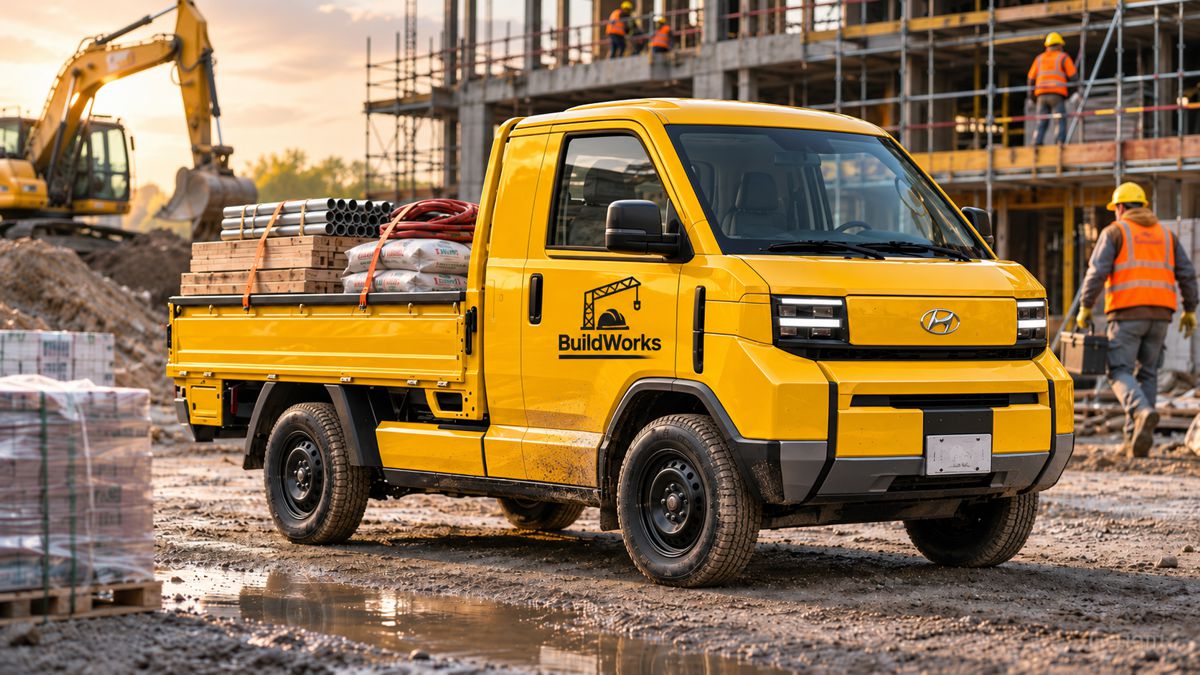
Prototype photographs published in November 2026 by Carscoops and Autoevolution reveal a substantially revised front end. The traditional flat-front cab-over profile has given way to a short bonnet, with the passenger compartment positioned further back than on the existing model.
This arrangement provides additional space ahead of the occupants and may allow Hyundai to incorporate improved frontal impact protection. Whether it also influences overall length, load platform dimensions or carrying capacity will become clearer when the production vehicle is officially presented.
South Korean reporting by Maeil Business Newspaper identifies the development programme as LT2, with a launch reportedly targeted for 2027. Electric and LPG variants are understood to be under development, while Hyundai’s Pleos software platform is also expected to feature.
The inclusion of advanced vehicle software in an affordable commercial workhorse presents its own commercial considerations. Fleet operators may welcome improved diagnostics, connectivity and vehicle management capabilities, but additional electronics and software development can increase costs in a market where purchase price and operating expenses remain central concerns.
Hyundai already sells an electric version of the existing Porter in South Korea, so the next generation represents an evolution of an established electric commercial vehicle rather than an entirely new entry into the segment.
Final specifications have not been confirmed, including battery capacity, range, payload, dimensions and pricing. Nor has Hyundai announced a European launch programme, despite speculation that the revised design could make the vehicle more suitable for international markets.
Electric Power and the Construction Duty Cycle
Battery-electric propulsion could be particularly appropriate for some compact truck operations, although its practicality depends heavily on how the vehicle is used.
Municipal maintenance teams, utility contractors and local building businesses frequently work within defined service areas, returning to depots or workshops after relatively predictable journeys. Short routes, repeated stops and periods of stationary operation can suit electric vehicles, especially where overnight charging is available.
Electric drivetrains also remove exhaust emissions at the point of use and can reduce noise during low-speed operations. These characteristics are attractive for road maintenance, urban construction and work around residential or pedestrian areas, provided the vehicle meets the necessary carrying requirements.
Battery weight remains a significant consideration in smaller commercial vehicles. The available payload must account for the complete vehicle configuration, while heavily loaded journeys, gradients, temperature and auxiliary electrical equipment can affect operating range.
Construction conversions introduce additional demands. Electric tipping systems, compressors, work lights and powered equipment all require energy, and the installation must be compatible with the chassis, electrical systems and permitted axle loads.
The Piaggio Porter NPE provides an existing European example of a compact electric chassis intended for commercial body conversions. Hyundai’s forthcoming model may bring further developments in battery integration, safety and vehicle management, although its technical characteristics are not yet known.
For contractors with predictable local operations, total operating cost will depend on purchase price, available payload, energy consumption, maintenance and charging arrangements. Longer-distance or heavily loaded applications may continue to favour other commercial vehicle types.
Practical Roles in Construction and Infrastructure
Compact working trucks have applications across construction activities that involve frequent access to smaller sites rather than large quantities of material delivered to a central location.
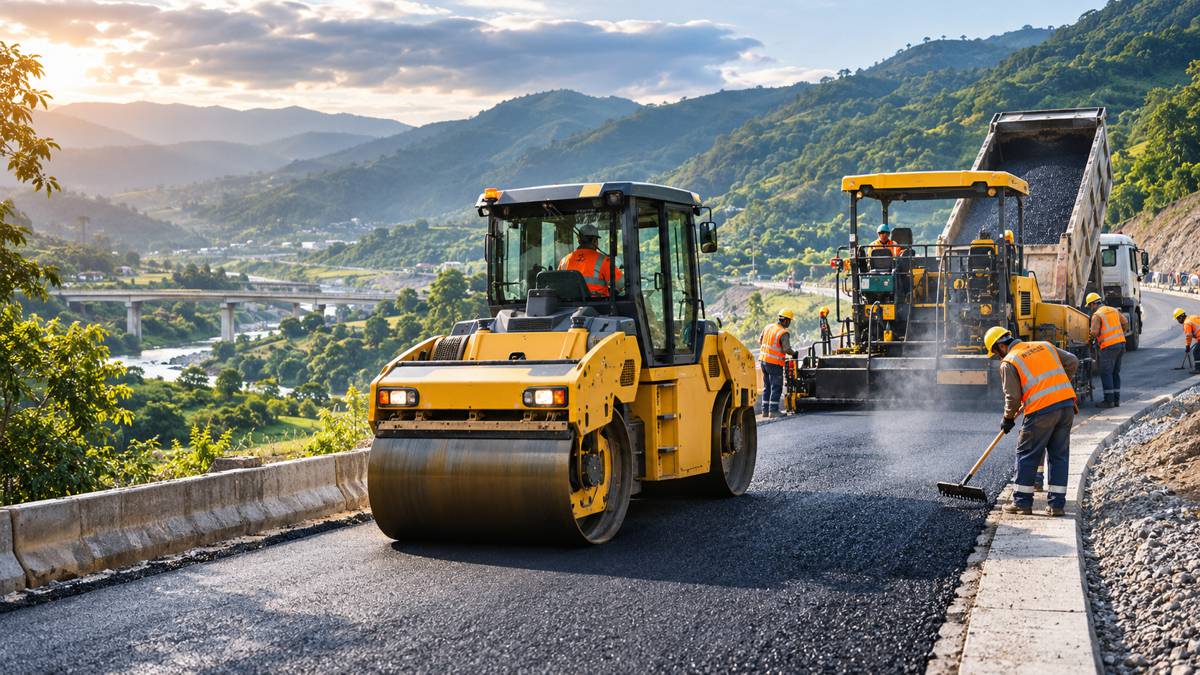
Road maintenance is an obvious example. Crews carrying temporary barriers, signs, tools and small quantities of repair materials often need a vehicle that can reach restricted working areas and allow equipment to be unloaded directly beside the operation. A compact dropside or tipper can provide that access without the physical footprint of a larger truck.
Utility maintenance presents similar requirements, particularly for water, electricity and telecommunications teams making repeated visits to urban locations. A practical load platform can accommodate tools, fittings and equipment while leaving the vehicle small enough to negotiate narrow service roads or crowded streets.
Landscaping contractors, grounds maintenance teams and facilities operators already use comparable vehicles for moving equipment, plants, soil and waste. Airports, ports and large industrial estates also provide potential applications where relatively short journeys and restricted access routes favour smaller commercial vehicles.
The open platform is not always preferable. Expensive tools, sensitive equipment and materials requiring protection from weather or theft may be better accommodated in an enclosed van or secure specialist body. Some construction activities also demand substantially greater towing or off-road capability than these vehicles typically provide.
Matching the vehicle to its actual workload is therefore more useful than comparing nominal size categories. A compact truck carrying tools and materials between local sites performs a different task from a commercial vehicle towing an excavator or transporting a crew over long distances.
Reconsidering the Small Working Truck
Commercial vehicle fleets tend to develop around familiar platforms, particularly where operators already have established maintenance facilities, body specifications and purchasing arrangements. Introducing another vehicle category requires a convincing operational advantage rather than an appealing design alone.
Compact forward-control trucks offer that advantage in circumstances where load accessibility, carrying efficiency and limited overall dimensions are more valuable than additional passenger space or long-distance capability. Their longstanding use across Asia provides substantial evidence that the format works, while Piaggio’s European range demonstrates its adaptability to contemporary commercial requirements.
Hyundai’s next-generation Porter may bring fresh attention to the category, particularly if improved frontal protection and electric propulsion are accompanied by practical payloads and competitive operating costs. Whether the vehicle reaches Western markets remains uncertain, and established alternatives will continue to serve many construction applications effectively.
For contractors whose work involves moving materials and equipment through confined streets, small sites and busy urban environments, however, the compact working truck deserves consideration. It is a remarkably straightforward approach to commercial vehicle design, refined over decades in markets where every metre of load platform and every centimetre of road space has a practical value.
Key Industry Questions
- What is a compact forward-control truck? A compact forward-control truck places its cab above or close to the front axle, allowing more of its overall length to be allocated to cargo. Examples include the Hyundai Porter, Kia Bongo and Piaggio Porter.
- Why are compact trucks common across Asia? Their compact dimensions, accessible load platforms and versatility suit local deliveries, agriculture, construction and maintenance. Established manufacturing and service networks have also supported their widespread use.
- How much can a compact working truck carry? Payload varies considerably between vehicle classes. Japanese kei trucks commonly offer approximately 350 kg, while larger commercial models can provide one tonne or more, depending on specification and body configuration.
- Are compact trucks available in Europe? Yes. The Piaggio Porter NP6 and electric Porter NPE are established European commercial vehicles, although compact forward-control trucks remain less prominent than conventional vans and larger chassis-cab models.
- What is the advantage of a dropside load platform? Folding sides improve access to materials and equipment, allowing loading and unloading from different directions where the body design permits. This can be particularly useful for pallets, long materials and awkwardly shaped items.
- Why have compact trucks struggled to establish larger Western markets? Regulatory adaptation costs, established commercial vehicle preferences, distribution requirements and competition from conventional vans and chassis-cab trucks all influence market development.
- Are compact electric trucks suitable for construction operations? They can suit local maintenance and construction activities involving predictable routes and depot charging. Available payload, operating range and specialist equipment requirements must be assessed against the intended duty cycle.
- What is known about Hyundai’s next-generation Porter? The vehicle is reportedly being developed under the LT2 programme for a possible 2027 launch, with electric and LPG powertrains and revised front-end architecture. Final specifications and international availability remain unconfirmed.
Strategic Takeaways
- Efficient vehicle packaging: Forward-control designs can provide substantial usable cargo space without the length or width of larger commercial vehicles.
- Construction fleet applications: Road maintenance, utilities, landscaping and local construction deliveries offer opportunities where compact dimensions and accessible load platforms are valuable.
- European market potential: Existing Piaggio models demonstrate technical feasibility, but distribution networks, operating requirements and established fleet preferences remain commercial barriers.
- Electric integration: Predictable local duty cycles suit electrification, although battery weight, payload and specialist body equipment require careful consideration.
- Future development: Hyundai’s forthcoming Porter could combine modern safety engineering and electric propulsion with a proven compact truck format, potentially supporting wider international interest.