






The Devolution of the Pickup Truck: Bigger, Heavier and Less Practical
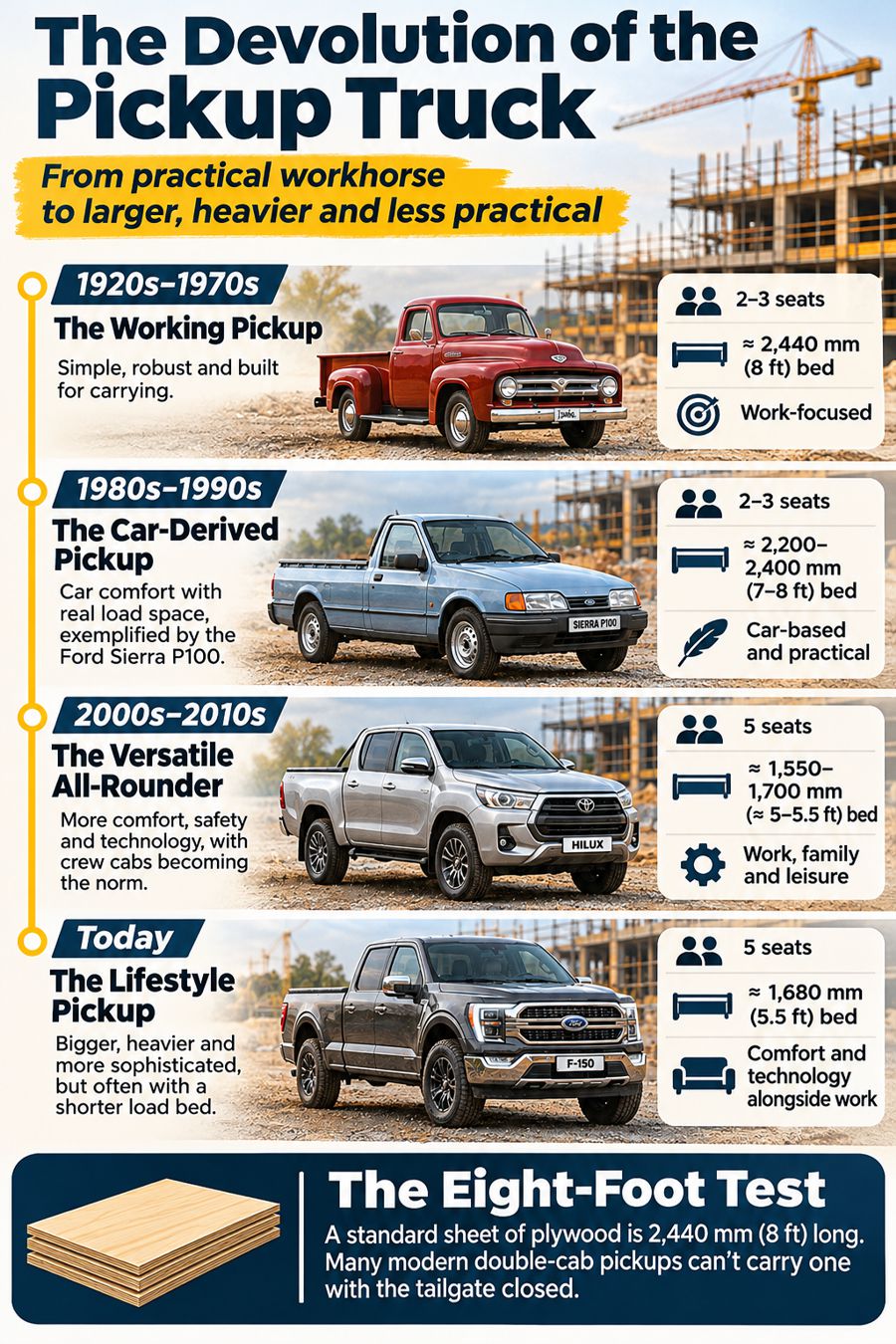
A standard sheet of plywood measures 8 ft by 4 ft, or approximately 2,440 by 1,220 mm. For generations of builders, carpenters and tradespeople, carrying one was an ordinary requirement of a working pickup. A simple cab, a long load bed and a robust chassis provided most of what a contractor needed, without unnecessary complexity or expense.
Today, a double-cab pickup can stretch well beyond five metres in length, accommodate five adults in considerable comfort and carry an impressive collection of electronic systems. Yet the load bed behind those spacious passenger seats may be little more than 1.5 metres long, leaving a standard sheet of building material extending well beyond the tailgate unless other carrying arrangements are made.
The pickup has evolved from a relatively straightforward commercial vehicle into a family car, executive transport and lifestyle product, often retaining formidable towing and off-road capabilities while surrendering a substantial proportion of its cargo space to passenger accommodation. The transformation has been commercially successful, particularly in North America, but for construction professionals it raises an interesting question about whether a vehicle can become more capable, comfortable and sophisticated while becoming less practical for some of the tasks it was originally designed to perform.
Briefing
- Traditional working pickups prioritised simple cabs, long load beds and straightforward mechanical construction.
- Modern double-cab configurations can sacrifice approximately 800 mm of cargo length compared with single-cab alternatives.
- Ford’s 2026 F-150 range still offers an 8 ft bed, alongside popular crew-cab versions with beds as short as 5.5 ft.
- Car-derived pickups, including the Ford Sierra P100 and Volkswagen Caddy, once offered another approach to practical light commercial transport.
- Increased passenger accommodation, technology and premium equipment have changed the balance between vehicle size, carrying capacity and everyday usefulness.
When the Load Bed Came First
The pickup emerged from a straightforward commercial requirement: a vehicle capable of transporting people and materials without the size or expense of a conventional truck. Early designs combined passenger-car mechanical components with an open cargo platform, giving farmers, builders and small businesses a practical way to move equipment and supplies.
Ford’s Model T Runabout with Pickup Body, introduced in April 1925, was the company’s first factory-produced pickup. The vehicle cost $281, and Ford sold nearly 33,800 examples during its first year, according to the Henry Ford Museum’s historical collection.
Subsequent generations developed into increasingly capable working vehicles, with stronger chassis, larger engines and cargo beds intended for demanding commercial use. In North America, six-foot and eight-foot beds became familiar configurations, allowing contractors to carry timber, sheet materials, tools and building supplies with relatively little difficulty.
The traditional single cab was central to the arrangement. Two or three occupants sat ahead of a substantial open platform, while the suspension and drivetrain were selected according to the loads the vehicle was expected to carry.
Comfort gradually improved, and manufacturers were already experimenting with additional seating and more refined interiors by the 1970s. Nevertheless, the basic commercial proposition remained recognisable. The pickup was equipment, bought primarily to perform a job, and the open load bed was a defining part of its usefulness.
A vehicle could be scratched, dented and covered in mud without its owner necessarily feeling that an expensive consumer product had been diminished. Its value was measured in the materials it carried, the trailers it pulled and the places it could reach.
The Brief Era of the Car-Derived Pickup
There was also a period when manufacturers approached the working pickup from a different direction, adapting passenger-car platforms into commercial vehicles with useful cargo beds and familiar driving characteristics.
One of Britain’s more memorable examples was the Ford P100, which originated in South Africa as a Cortina-derived pickup before reaching the British market in 1982. It offered a straightforward single-cab layout, a substantial load platform and much of the mechanical familiarity of Ford’s popular passenger cars.
The concept was developed further when Ford introduced the Sierra-based P100 in November 1987, ahead of the 1988 model year. Manufactured at Azambuja in Portugal, the replacement combined the Sierra’s front body structure and passenger compartment with a dedicated commercial rear chassis and suspension.
The engineering was considerably more involved than simply attaching a cargo bed to a saloon car. Ford needed to accommodate a live rear axle, appropriate load-bearing structures and suspension capable of handling commercial duties while retaining the Sierra’s recognisable appearance.
In an August 1989 road test, Commercial Motor recorded a payload of 970 kg for the turbo-diesel P100, confirming that this apparently modest car-derived pickup was a serious working vehicle.
The P100 was not an isolated experiment. Volkswagen developed the original Golf-based Caddy pickup, extending the car’s wheelbase to accommodate a larger load platform. The Volkswagen Caddy I, introduced to European markets in 1982, became another familiar light commercial alternative.
Contemporary reporting also placed vehicles such as the Hyundai Pony pickup and smaller car-derived utilities alongside more substantial one-tonne models. A March 1990 Commercial Motor market review described a surprisingly varied selection of pickups, with different capacities and operating characteristics.
Elsewhere, Chevrolet’s El Camino, Ford’s Ranchero and Australia’s long-running Holden and Ford utilities demonstrated other interpretations of the car-based pickup. Some prioritised performance and recreational appeal, while others remained firmly associated with tradespeople, farming and everyday commercial transport.
The Sierra P100 disappeared from the British market in 1993, as buyers increasingly turned towards dedicated pickups and more versatile small vans. Car-derived utilities continued in other markets, particularly Australia, but their prominence in Britain declined as commercial vehicle development moved in different directions.
The P100 now seems an unusual design, yet its underlying proposition remains interesting. It combined relatively modest exterior dimensions, passenger-car familiarity and useful carrying capacity without attempting to be an oversized multipurpose vehicle.
The Eight-Foot Sheet Test
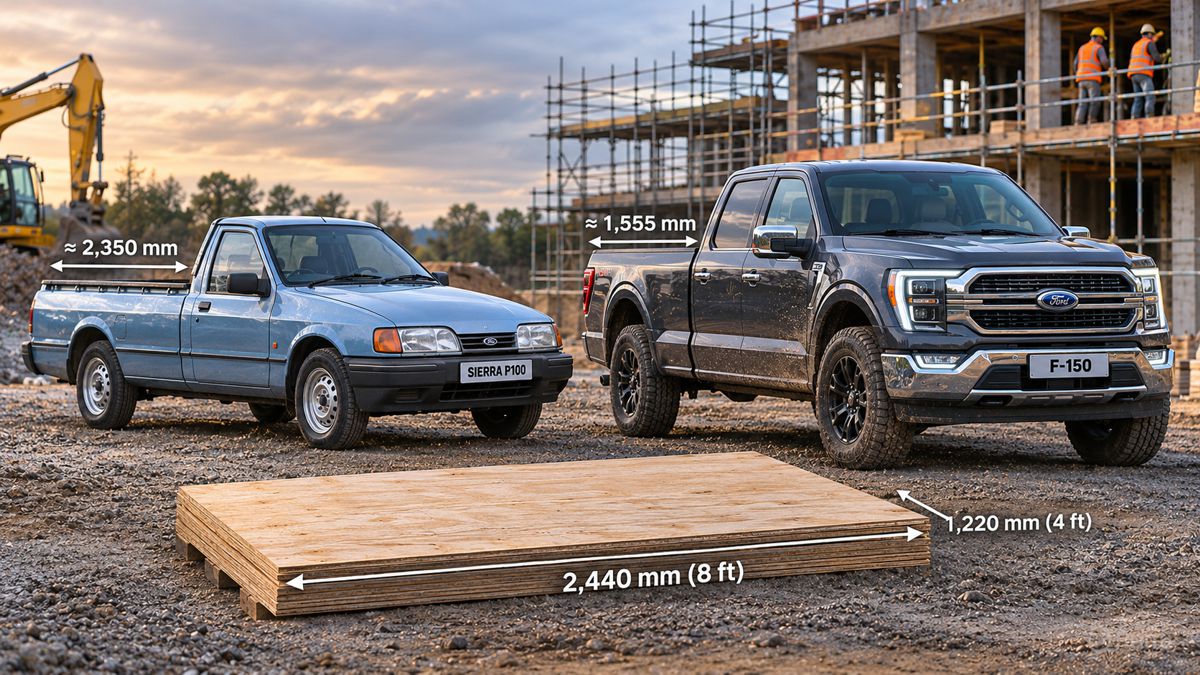
The changing proportions of the modern pickup can be illustrated through a simple comparison: the space available for a standard 8 ft by 4 ft sheet of plywood.
The dimensions remain familiar across construction markets, particularly for plywood, plasterboard and other sheet materials. Although alternative metric sizes are widely available, 2,440 by 1,220 mm remains a useful reference for assessing a vehicle’s load-carrying arrangements.
Traditional long-bed pickups were developed around practical cargo requirements of this kind. An eight-foot platform could accommodate the length of a standard sheet with the tailgate closed, provided the internal dimensions and wheel-arch clearance were sufficient.
Modern double-cab models present a different proposition.
Toyota’s published Hilux body-builder information provides a particularly useful comparison. A long-wheelbase single-cab version has a cargo deck measuring 2,350 mm, while the double cab offers 1,555 mm. That represents a reduction of 795 mm in bed length, despite both configurations belonging to the same model family.
The Toyota Hilux body-builder specifications also demonstrate how manufacturers balance cab arrangements, chassis layouts and carrying space across different versions of the same commercial vehicle.
Neither of these Hilux platforms provides a completely unobstructed eight-foot bed with the tailgate closed, but the single-cab configuration comes considerably closer to the traditional working format. The double cab offers substantially more passenger accommodation at the expense of cargo length.
The Ford Ranger provides another example. Its double-cab load box measures approximately 1,638 mm along the floor, with around 1,224 mm between the wheel arches. That width allows a standard Euro pallet to fit between the arches, a practical feature that Ford specifically promotes in its Ranger commercial vehicle information.
A Euro pallet measures 1,200 by 800 mm, however, and accommodating one is a very different proposition from carrying an eight-foot sheet of plywood or several metres of timber.
The Ranger Double Cab is approximately 5.4 metres long, depending on version, yet its cargo platform occupies less than one-third of that overall length. Its substantial passenger compartment provides comfort and versatility, but the trade-off is unmistakable when measured against the dimensions of common construction materials.
The Rise of the Four-Door Pickup
Extended-cab pickups appeared decades ago, followed by increasingly popular four-door arrangements that offered proper rear seating without abandoning the open cargo platform. The appeal was obvious to customers who wanted one vehicle capable of serving several purposes.
A pickup could transport a work crew, carry tools and equipment, tow a trailer and provide comfortable family transport outside working hours. Manufacturers responded with improved seating, quieter interiors, more sophisticated suspension and equipment that had previously been associated with passenger cars.
The transformation accelerated as pickups became increasingly attractive to recreational and private buyers. Higher-end models began offering leather upholstery, large infotainment displays, premium audio systems, advanced driver assistance and elaborate exterior styling.
These developments expanded the market far beyond customers whose primary requirement was a working load platform. The pickup became a desirable vehicle in its own right, capable of combining commercial credentials with the comfort and convenience of a large passenger car.
North America’s full-sized pickups provide perhaps the clearest illustration of the resulting design choices.
The 2026 Ford F-150 remains available with several cab and bed combinations, including a Regular Cab with an 8 ft bed. Its SuperCrew versions offer considerably more passenger accommodation, with 5.5 ft or 6.5 ft beds depending on configuration.
The shorter SuperCrew platform measures approximately 1.68 metres, yet the vehicle itself occupies substantially more road space than many smaller commercial trucks with longer cargo platforms.
Ford has clearly not abandoned the traditional working pickup, and the availability of an eight-foot bed demonstrates that substantial carrying space remains part of the range. However, combining a full crew cab with a longer load platform requires a larger overall vehicle, increasing the space needed for parking, manoeuvring and everyday driving.
Manufacturers face a straightforward packaging problem. Passenger accommodation, load-bed length and overall vehicle dimensions compete for space within a conventional bonneted pickup layout. Improving one inevitably affects the others unless the vehicle becomes larger.
This is why a modern pickup can offer more seats, more technology and considerably greater sophistication while providing a shorter cargo bed than a much simpler vehicle from an earlier generation.
Height, Weight and Everyday Usability
Load-bed length is only one measure of practical usefulness. The height of the cargo platform, the width between the wheel arches and the vehicle’s permitted payload also influence how effectively a pickup performs construction duties.
Higher ground clearance can be valuable on rough sites, agricultural land and poorly maintained access roads. Larger tyres, sophisticated four-wheel-drive systems and improved traction control have made modern pickups capable performers in demanding conditions, often considerably surpassing their predecessors.
However, a high-riding vehicle can also have a cargo platform positioned well above a comfortable manual loading height. For workers repeatedly lifting cement bags, tools, paving materials or heavy equipment, that additional distance can become a practical disadvantage.
High body sides further complicate access, particularly when smaller items have moved towards the front of the bed. Manufacturers have responded with integrated steps, powered tailgates, sliding cargo systems and other equipment intended to improve loading convenience.
These features can be useful, although they also add weight, complexity and sometimes considerable expense to what was once a fairly straightforward cargo-carrying arrangement.
Vehicle mass introduces a separate consideration. Modern safety structures, larger passenger compartments, additional equipment and more complex drivetrains can increase kerb weight, although the extent varies significantly between models and generations.
An imposing pickup does not automatically have an impressive legal payload. Carrying capacity depends on the difference between the vehicle’s permitted maximum mass and its operating weight, accounting for occupants, fuel, accessories and any permanently installed equipment.
Four-wheel-drive systems, heavy wheels, canopies, toolboxes and additional passengers can consume part of that allowance before construction materials are loaded.
Towing capacity must also be considered separately from payload. A vehicle rated to pull a substantial trailer may have a relatively modest remaining allowance for materials in its bed, particularly once trailer nose weight and axle limits are included.
For contractors, the relevant figures are the permitted weights, usable cargo dimensions and actual working configuration rather than the vehicle’s physical presence or engine output alone.
The Commercial Logic Behind Bigger Pickups
The modern pickup’s development has been driven by changing customer expectations as much as manufacturer priorities.
Traditional commercial buyers tend to concentrate on reliability, carrying capacity, operating costs and servicing requirements. These are important considerations, but they offer relatively limited opportunities for manufacturers to differentiate premium models through additional equipment.
A pickup marketed as family transport, an adventure vehicle and a professional product can appeal to a much broader range of customers. Some value towing and off-road capability, while others are attracted by passenger comfort, styling, technology and the elevated driving position.
Manufacturers have responded with extensive model ranges, often offering basic commercial specifications alongside considerably more expensive premium variants. The resulting market supports significant investment in new drivetrains, safety systems, interior technology and vehicle platforms.
It would be misleading to suggest that manufacturers simply imposed these developments on customers. Demand for comfortable crew-cab pickups is genuine, and many buyers appreciate the convenience of a vehicle that can accommodate family transport and commercial work without requiring two separate vehicles.
Nevertheless, the commercial success of passenger-focused configurations inevitably influences product development, dealership inventories and the specifications most prominently promoted to potential buyers.
A straightforward single-cab workhorse offers less opportunity for luxury equipment, but may provide better value to a contractor whose principal requirements are transporting materials, towing equipment and reaching construction sites.
There is also a broader distinction between markets. North American full-sized pickups occupy a different category from vehicles such as the Toyota Hilux, Ford Ranger and Isuzu D-Max, which are widely used across Europe, Africa, Australia and parts of Asia.
Their dimensions, payload classifications, engines and intended operating conditions vary considerably. The evolution of the pickup has therefore been uneven, with manufacturers developing different products for different commercial and consumer expectations.
Progress Has Brought Genuine Improvements
Not every increase in pickup size or complexity represents a loss of practicality.
Modern vehicles benefit from substantial advances in crash protection, braking performance, stability control, emissions technology and driver assistance. Reinforced passenger compartments, improved suspension and electronic safety systems have contributed to vehicles that are generally more refined and better equipped than those of earlier decades.
Greater comfort also has a legitimate commercial value. Construction supervisors, engineers and contractors may spend several hours travelling between projects, often over long distances and in difficult weather. Reduced fatigue, improved heating and air conditioning, quieter cabins and more supportive seating are practical benefits rather than unnecessary luxuries.
Powertrain development has also produced improvements in towing performance, off-road capability and operational flexibility. A modern pickup can handle demanding commercial duties that would have challenged some older vehicles, particularly where towing capacity and traction are important.
The increase in vehicle size has not always come at the expense of cargo dimensions, either. When Toyota introduced its substantially redesigned Hilux in 2005, the manufacturer reported that the new vehicle had grown in overall dimensions and gained a longer load deck.
That historical example complicates any suggestion that pickup practicality has simply declined with each successive generation. The more significant change has been the increasing prominence of configurations that allocate greater space to passengers, accompanied by customer expectations that have pushed pickups towards the passenger vehicle market.
A double-cab pickup is therefore not inherently less capable than an older single-cab model. It is optimised for a different combination of requirements, even if those requirements sometimes conflict with the traditional purpose of an open load bed.
The Economics of a Construction Pickup
For construction businesses, vehicle purchasing decisions extend well beyond the initial price or the equipment included in a particular specification.
Fuel consumption, maintenance, insurance, depreciation, tyres, taxation and financing all contribute to the total operating cost. The ability to carry the required tools, equipment and materials without additional transport arrangements is equally important.
A modern double-cab pickup may provide excellent towing capability and comfortable transport for a work crew, but those advantages must be considered alongside its available cargo space.
If a contractor regularly needs a trailer because materials cannot fit within the load bed, the additional equipment changes the operating proposition. Trailers require maintenance, storage and parking space, while their use can introduce weight, licensing and manoeuvring considerations.
Accessories such as roof racks, load-bed extensions, sliding platforms and enclosed canopies can improve versatility, but they may also add weight and expense. In some circumstances, these installations compensate for limitations introduced by the vehicle’s original design.
Alternative commercial vehicles can be more appropriate for particular tasks. A panel van provides weather protection and security for tools, while a dropside chassis-cab vehicle can offer easier loading and a larger working platform. Compact commercial trucks may provide advantages for local deliveries and restricted urban sites.
The pickup continues to occupy a valuable position between these categories, particularly when four-wheel drive, towing capacity and passenger accommodation are required together.
The most economical vehicle is not necessarily the cheapest to purchase or the most impressive on a specification sheet. It is the one that performs its intended duties without repeatedly requiring additional equipment, carrying arrangements or operational compromises.
The Working Pickup Still Has a Future
Despite the prominence of luxury double-cab models, the traditional working pickup has not disappeared. Regular-cab and single-cab configurations remain available in selected markets, while manufacturers continue to offer commercial specifications intended for demanding fleet operations.
Their continued existence reflects requirements that have changed remarkably little over generations. Contractors still need to move tools, timber, boards, equipment and materials between suppliers, workshops and construction sites, often over difficult ground and in conditions where a passenger car would be unsuitable.
Electrification is adding another dimension to vehicle development, bringing opportunities for onboard electrical power, lower exhaust emissions at the point of use and improved low-speed torque. It also introduces questions about battery weight, payload, towing range and charging infrastructure, particularly for heavily loaded commercial operations.
The modern pickup will undoubtedly continue to develop around different customer priorities, and there is room for comfortable crew-cab vehicles alongside simpler commercial models. A contractor who regularly transports several workers and tows heavy equipment has different requirements from a carpenter whose principal concern is carrying sheet materials.
Yet the pickup’s remarkable evolution has created an increasingly visible contradiction. Vehicles have become larger, more powerful, more sophisticated and often considerably more expensive, while the dimensions of the materials they are expected to carry have remained essentially unchanged.
After a century of development, perhaps the simplest measure of a working pickup’s usefulness is still whether it can carry an eight-foot sheet of plywood without requiring an elaborate solution.
Key Industry Questions
- Why have modern pickup trucks become larger? Passenger accommodation, safety engineering, powertrain development and demand for premium equipment have influenced pickup design. Growth varies considerably between manufacturers, vehicle classes and markets.
- Can a modern pickup carry an 8 ft by 4 ft sheet of plywood? Some long-bed pickups can accommodate an eight-foot sheet with the tailgate closed, provided there is sufficient internal width. Many double-cab models have shorter beds and require alternative arrangements, including properly secured loads extending beyond an open tailgate where regulations permit.
- How much load-bed space is lost with a double cab? The difference varies by vehicle. Toyota’s published Hilux dimensions show a 2,350 mm deck for a long-wheelbase single cab compared with 1,555 mm for a double cab, a reduction of 795 mm.
- Are single-cab pickups still manufactured? Yes. Regular-cab and single-cab pickups remain available in selected markets, including configurations of the Ford F-150. Availability depends on model year, country and manufacturer.
- What was the Ford Sierra P100? The Sierra P100 was a car-derived commercial pickup manufactured in Portugal and introduced for the 1988 model year. It combined a Sierra-based passenger compartment with a commercial chassis and a nominal one-tonne payload.
- Why did car-derived pickups become less common in Britain? Dedicated commercial pickups, increasingly versatile small vans and changing customer preferences reduced demand. Similar utility vehicles continued in other markets, particularly Australia.
- Does a larger pickup automatically carry more weight? No. Payload depends on the vehicle’s maximum permitted mass, operating weight and configuration. Additional passengers, accessories and equipment can reduce the allowance available for cargo.
- Why are double-cab pickups popular with construction businesses? They combine passenger transport, towing capability, four-wheel drive and an open cargo platform. This versatility can be valuable where several workers travel together and the vehicle performs different duties.
- Are electric pickups suitable for construction? They can offer useful low-speed torque and onboard electrical power, although payload, charging arrangements, operating range and towing requirements must be assessed against the intended workload.
Strategic Takeaways
- Cargo dimensions remain fundamental: Overall vehicle size and engine performance provide little indication of whether a pickup can carry common construction materials efficiently.
- Passenger accommodation carries a physical cost: Four-door configurations frequently reduce available bed length unless the overall vehicle becomes larger.
- Traditional designs retain commercial value: Single-cab pickups and earlier car-derived utilities demonstrate the benefits of prioritising a practical load platform over additional passenger space.
- Modern technology offers genuine advantages: Safety, comfort, towing performance and improved drivetrains can justify greater sophistication where the capabilities are required.
- Fleet decisions should reflect actual work: Payload, loading height, cargo dimensions and total operating costs offer a more useful basis for vehicle selection than styling or equipment levels.