Edge Detection and the Shift From Paving Craft to Sensor-Guided Control
A single laser sensor bolted to the side plate of a paving screed does not, on the face of it, sound like a strategic development. Yet the quiet arrival of automated screed width control on Germany’s B535 federal road points to a deeper change in how asphalt is laid, priced and staffed. Vögele’s Edge Detection system, deployed by lead contractor Eiffage Infra-Bau SE during a two-lane rehabilitation near Heidelberg-Schwetzingen, took a task that has always depended on operator skill and handed it to a sensor.
The significance lies less in the hardware than in what it signals, because road paving is following earthmoving, mining and agriculture into an era where machine intelligence rather than manual dexterity increasingly governs the quality of the finished surface. For contractors wrestling with a shortage of experienced operators, volatile bitumen prices and rising work-zone liability, that shift changes the commercial calculus of every paving job.
Edge Detection belongs to Vögele’s AutoTrac steering and screed width control suite, part of the Dash 5 generation of pavers. On its own it automates one narrow function, keeping the screed extension aligned to the joint edge of an adjacent paving strip. Placed in context, it is one rung on an automation ladder that now runs from physical-reference sensors through to fully GPS-referenced paving controlled from a digital jobsite platform. Understanding where that ladder leads, and who captures the value along the way, matters more to infrastructure owners and equipment buyers than the specification of any single sensor.
Briefing
- Vögele’s Edge Detection laser sensor automated screed width control on a 1.6 kilometre rehabilitation of the B535 near Heidelberg-Schwetzingen, where lead contractor Eiffage Infra-Bau SE ran two Dash 5 pavers and two mobile feeders in staggered hot-to-hot paving.
- The sensor scans a 70-degree field ahead of the screed side plate, detects edges with a rising or falling profile of at least 2 centimetres, and adjusts the screed extension automatically across paving widths that varied between 8 and 11.80 metres.
- Automating width control frees the screed operator from constant manual adjustment to concentrate on paving quality, a direct response to an acute and worsening shortage of skilled paving crews across Europe and North America.
- By metering exactly the mix needed at the joint, the system curbs over-paving and reduces asphalt consumption, a meaningful saving as bitumen and mix costs squeeze contractor margins.
- Edge Detection sits within Vögele’s wider AutoTrac suite and its GPS-referenced Smart Pave system, both now underpinned by parent company John Deere’s StarFire positioning and Operations Center platform, signalling the convergence of road paving with precision-agriculture-style machine control.
The Labour Arithmetic Behind Automated Screed Control
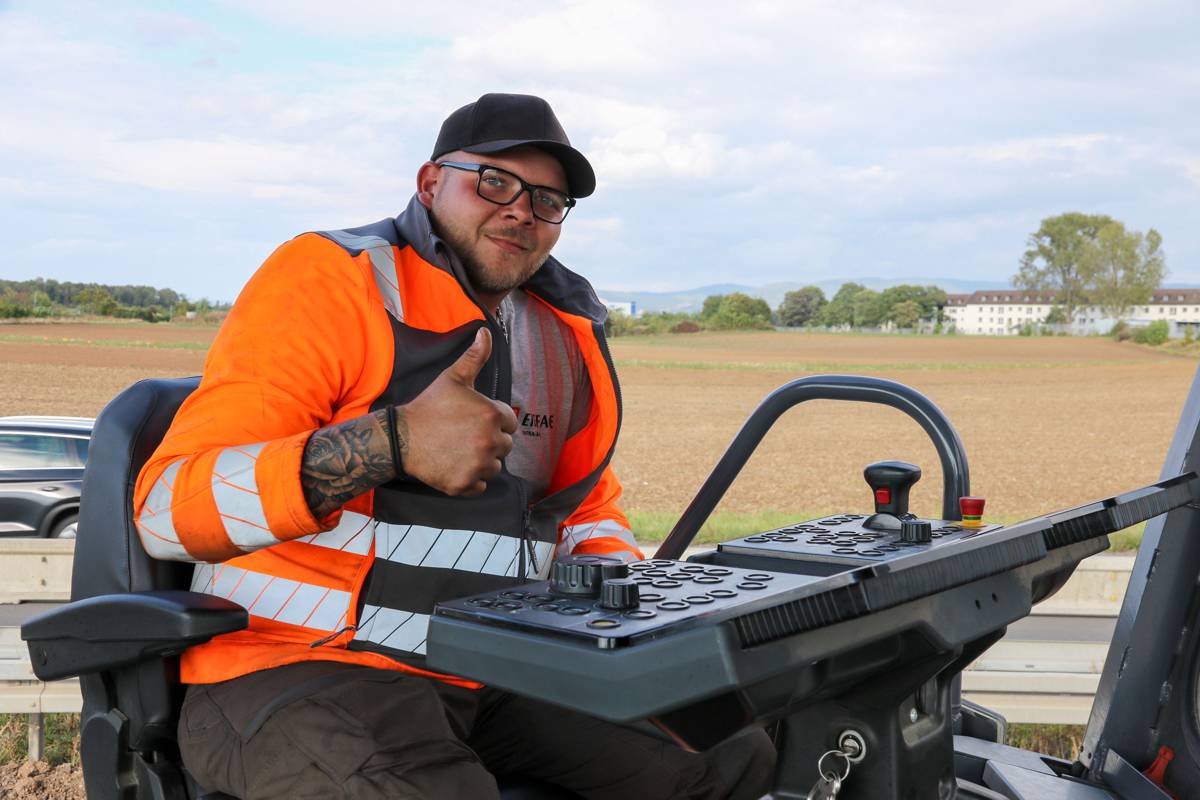
The clearest commercial driver behind sensor-guided paving is not technological ambition but arithmetic. Across the sections of the B535 where paving width varied between 8 and 11.80 metres, a conventional process would have required the screed operator to extend and retract the screed by hand, tracking the joint edge by eye while managing everything else at once. Edge Detection removed that burden and allowed the operator to concentrate on the quality of the mat instead.
That reallocation of attention matters because the pool of people able to do the job well is shrinking. The Associated Builders and Contractors estimates that the United States construction sector needs roughly 349,000 additional workers in 2026 and a further 456,000 in 2027, much of it simply to replace retiring foremen and craft professionals rather than to staff new work.
The paving trade feels this pressure acutely. The National Asphalt Pavement Association puts the core asphalt workforce at around 150,000 people within a broader highway construction pool of some 350,000, and the average American construction worker is now over 42, with fewer than one in six under the age of 35. Experienced screed hands, the people who can read a joint and feather a width change by instinct, are among the hardest roles to backfill.
Automation does not replace them, but it does stretch the productive reach of the operators a contractor already employs, letting a competent crew achieve results that once demanded a specialist. In a market where a substantial share of contractors have at times turned down work for lack of labour, that multiplier effect is the difference between bidding a job and passing on it.
Material Discipline and the Bitumen Cost Equation
If labour is the structural pressure, material cost is the immediate one, and this is where Edge Detection earns its place on the balance sheet most directly. Because the sensor follows the joint edge precisely, the screed lays down exactly the width required to form a clean join with the adjacent strip and no more.
Paver operator Michael Wenz put the benefit plainly: ‘The reliable edge following by the Edge Detection sensor enables us to avoid paving more than the actual width required. That saves material and cuts our costs’. On a large rehabilitation contract, small percentages of avoided over-paving compound quickly into tonnes of asphalt mix and a measurable line on the project margin.
That saving lands at a sensitive moment for contractors. Asphalt mix costs remain elevated, driven by bitumen prices, energy, haulage and the tariff-related volatility that has unsettled construction material supply chains through 2025 and into 2026. Industry outlooks for the year consistently name cost escalation alongside labour as the twin forces eroding contractor margins and straining schedules.
Technology that trims material waste at the point of placement addresses the problem where it is most controllable, on the machine itself, rather than leaving contractors exposed to commodity markets they cannot influence. The economic logic is quietly compelling, because the same sensor that reduces an operator’s workload also protects the mix budget.
The B535 Rehabilitation as a Working Template
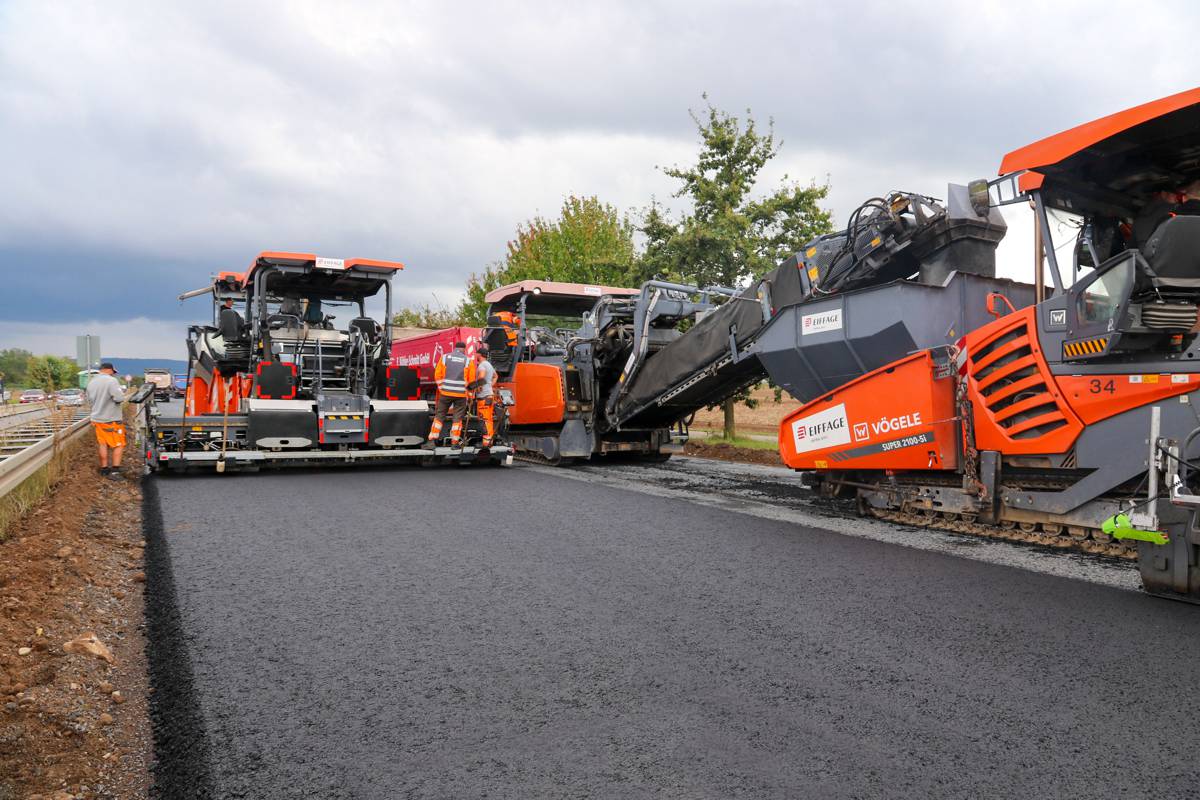
The Heidelberg-Schwetzingen job shows how these gains materialise in practice on a demanding site. The B535 is an important bypass, and the damaged 1.6 kilometre two-lane section needed rapid, precise renewal with minimal disruption. Eiffage first milled the failed pavement down to the base layer, then rebuilt it with a 10 centimetre binder course and a 4 centimetre surface layer.
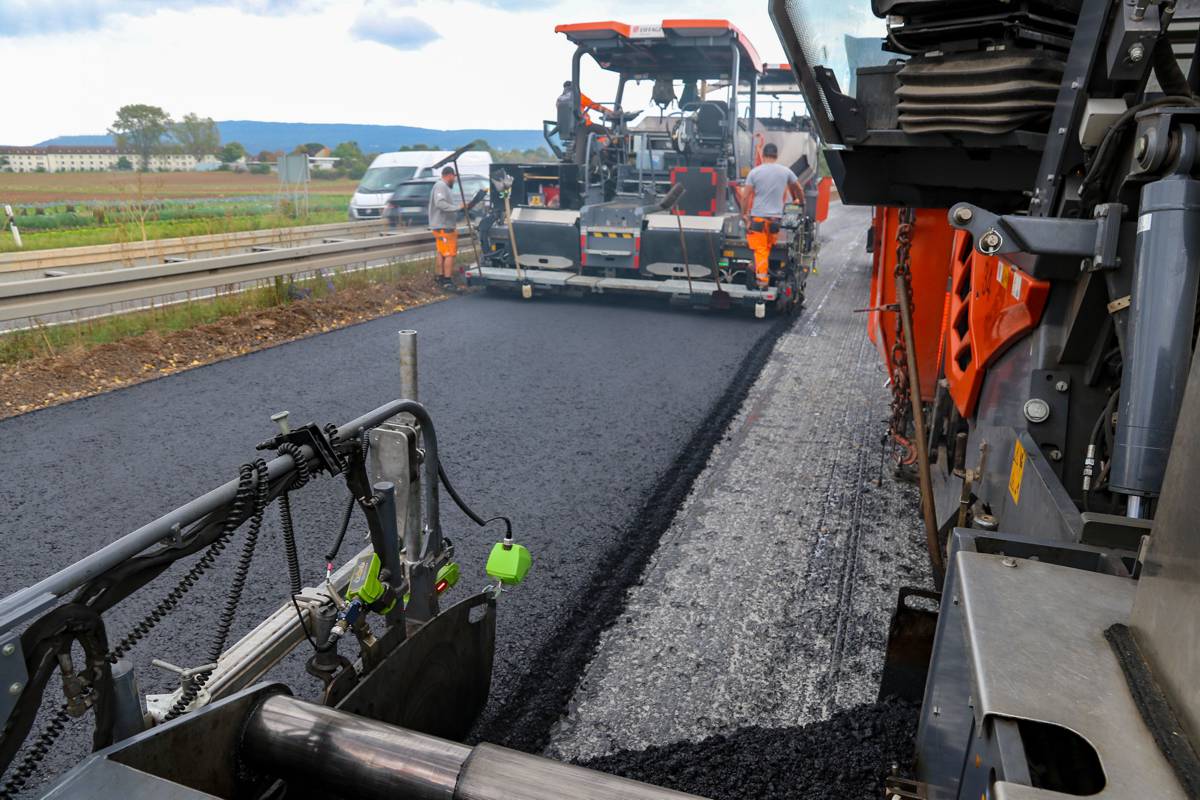
To keep the operation moving, the contractor chose staggered hot-to-hot paving using two latest-generation Vögele pavers, a SUPER 1900-5 X and a SUPER 2100-5 X, each supplied continuously by an MT 3000-2i Offset mobile feeder so that neither paver ran short of mix.
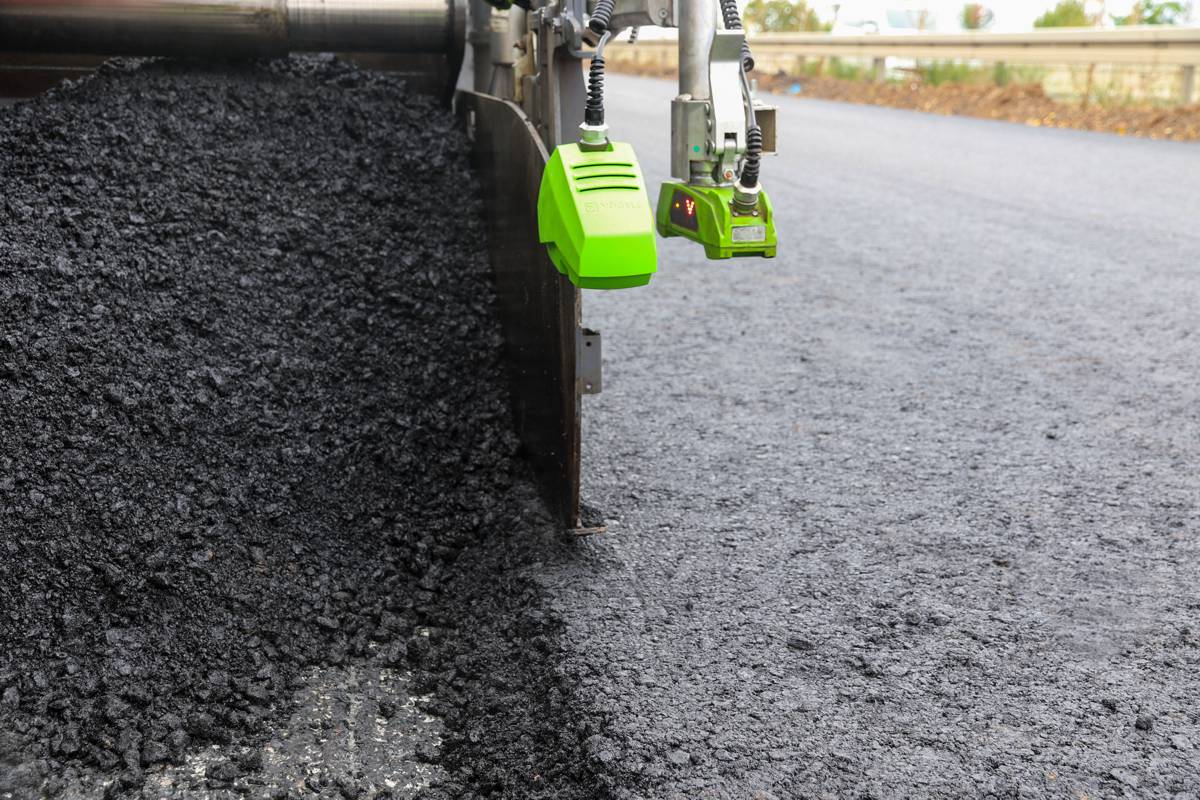
The first paver laid a strip alongside the central safety barrier. The second, carrying the Edge Detection sensor on the left side plate of its AB 600 screed, followed in parallel and used the fresh joint edge of the first strip as its reference. Scanning a 70-degree field ahead of the side plate, the sensor detected the edge and drove the screed extension to follow it automatically wherever the width changed.
The result, in the operator’s words, was a cleaner process: ‘This allowed us to lay down the second strip very smoothly, precisely and quickly’. Hot-to-hot paving of this kind produces a stronger, more durable longitudinal joint than laying cold against an already-compacted strip, and automating the width control let the crew hold that quality across a fluctuating profile without slowing the paving train.
Keeping Operators Out of the Danger Zone
There is a safety dividend to automation that rarely appears in equipment brochures but weighs heavily on any contractor’s risk register. Manual screed width adjustment can require operators to work at the edge of the machine, closer to live traffic and moving plant than anyone would wish. By handling that adjustment automatically, Edge Detection reduces the need for crew to occupy those hazardous positions when paving runs alongside flowing traffic. In an environment where the margin for error is measured in seconds and centimetres, removing a reason to stand in the wrong place is a genuine gain.
The statistics justify the attention. Struck-by incidents are the leading cause of non-fatal injuries and the second most common cause of death among construction workers, and United States road construction sites recorded 1,462 fatal occupational injuries between 2011 and 2022 according to NIOSH analysis. Work zone fatalities rose by around half over the decade to 2023, and the National Safety Council attributes an average of 54 worker deaths a year to being struck by vehicles in work zones.
Every task that can be performed from a safer position, or automated so that no one need perform it in a live lane, chips away at an exposure that has proved stubbornly difficult to reduce through signage and speed enforcement alone. For contractors, that is both a duty-of-care imperative and, increasingly, an insurance and liability consideration.
From Physical References to Virtual Ones
Edge Detection is most revealing when read as one step in a deliberate progression. Within the AutoTrac suite, Vögele already offers Steering Control for automated direction, Edge Control which follows a tensioned stringline using an ultrasonic sensor, and a fixed screed width setting, alongside the edge-following Edge Detection used on the B535.
These are all physical-reference systems, in that the machine reads something real in the world, a kerb, a stringline or a joint, and reacts to it. At Bauma 2025 in Munich, Vögele took the next step with the world premiere of Smart Pave, which controls a paver’s width, position and direction fully automatically using virtual references drawn from installation geometries stored digitally rather than from anything physically present on site.
What makes that progression strategically important is the backbone underneath it. Smart Pave draws its geometry from the John Deere Operations Center and fixes the paver’s position using Deere’s StarFire dual-antenna satellite system, the same precision-positioning technology that guides tractors across fields to centimetre accuracy. This is no coincidence. Vögele has belonged to John Deere since the American manufacturer acquired Germany’s Wirtgen Group, and its five road-building brands, for around 5.2 billion US dollars in 2017.
The automation ladder now visible in Vögele’s pavers mirrors the precision-agriculture playbook Deere spent two decades building, in which the recurring commercial value migrates from the machine itself towards the positioning, guidance and data-management layer that sits on top of it. Bastian Fleischer, Head of Product Management at Vögele, frames the objective in team terms: ‘We design our machines to build an ideal team with their operators’, with the paver absorbing routine tasks so that crews can focus on paving and quality assurance.
What the Automation Ladder Means for Buyers
For infrastructure owners and equipment buyers, the practical message is that a paver is no longer bought as a fixed capability. The Dash 5 platform is designed so that automation functions can be combined and layered, controlling one side of the screed with Edge Detection against a kerb while the other follows a stringline with Edge Control, and it leaves room to move up to GPS-referenced paving as sites and budgets allow.
Procurement decisions increasingly turn on which automation and documentation options a machine supports, and on how cleanly its data flows into the platforms that clients and highway authorities now expect for quality records. The Wirtgen Group Performance Tracker and comparable digital documentation tools reflect a wider tightening of the paper trail around paving quality.
That points to a competitive divide that will widen over the coming procurement cycles. Contractors who invest in sensor-guided and data-referenced paving stand to convert scarce operator skill into repeatable output, defend their margins against material inflation, and present clients with the documented quality that increasingly wins and retains work. Those who stay with fully manual methods will not fall off a cliff, but they will find themselves competing on a narrowing set of advantages.
Edge Detection, unglamorous as it looks bolted to a screed side plate, is a marker of where that advantage is heading. The contractors reading the signal early, and building automation into how they bid, staff and deliver, are the ones best placed to shape the next decade of road construction rather than react to it.
Key Industry Questions
- What exactly does Vögele’s Edge Detection sensor do during paving? Edge Detection is a laser sensor mounted on the screed side plate that keeps the screed extension aligned to a reference edge, such as the joint of an adjacent paving strip or a kerb. It scans a 70-degree field ahead of the side plate and detects edges with a rising or falling profile of at least 2 centimetres. When the operator activates the function, the relevant screed extension follows that edge automatically as the paving width changes. On the B535 it held a clean join across widths that varied between 8 and 11.80 metres, removing the need for constant manual extension and retraction and letting the operator focus on the quality of the mat rather than on chasing the edge by eye.
- How does automated screed width control help with the skilled labour shortage? It does not add workers, but it stretches the capability of the crew a contractor already has. Reading a joint and adjusting width smoothly by hand is a skill that takes years to develop, and experienced screed operators are among the hardest paving roles to recruit and retain. By handling width control automatically, the system lets a competent operator achieve results that previously demanded a specialist and frees attention for quality monitoring. With the Associated Builders and Contractors projecting a need for hundreds of thousands of additional construction workers through 2026 and 2027, much of it to replace retirees, technology that raises the output of existing crews directly addresses the constraint most likely to limit how much work a contractor can take on.
- Does automating the screed width genuinely save material? The saving is mechanical rather than rhetorical. When width is controlled by hand, operators tend to err on the side of laying slightly wide to guarantee a clean join, and that surplus adds up across a long contract. By following the joint edge precisely, Edge Detection lays only the width needed, so less asphalt mix is placed to achieve the same result. On a large rehabilitation the avoided over-paving compounds into tonnes of mix and a visible improvement in project margin. With bitumen, energy and haulage keeping mix prices elevated through 2026, trimming waste at the point of placement is one of the few material savings a contractor can capture directly on the machine rather than at the mercy of commodity markets.
- Why does hot-to-hot paving with two pavers matter for joint quality? The longitudinal joint between two paving lanes is often the first place a road surface fails, because a strip laid cold against an already-compacted neighbour bonds poorly. Hot-to-hot paving runs two pavers in a staggered formation so the second strip is laid and compacted while the first is still hot, producing a far stronger and more durable joint with fewer weak points for water to penetrate. On the B535, two SUPER pavers supplied continuously by mobile feeders kept the operation moving without interruption. Adding Edge Detection let the trailing paver hold a precise join across a changing width without slowing the train, combining the durability benefit of hot-to-hot working with the consistency of automated width control.
- How does Edge Detection differ from Smart Pave and GPS-based paving? Edge Detection is a physical-reference system, reacting to something real on the ground, in this case the joint edge of an adjacent strip. Vögele’s wider AutoTrac suite includes other physical-reference tools such as Edge Control, which follows a tensioned stringline. Smart Pave, launched at Bauma 2025, works differently, controlling the paver’s width, position and direction from virtual references using installation geometries stored digitally and satellite positioning rather than anything physically present on site. In practice, physical-reference systems suit jobs with a clear edge to follow, while virtual-reference paving suits complex geometries planned in advance. The two approaches coexist on the same Dash 5 platform, and contractors can move up the ladder as sites, skills and budgets allow.
- What does John Deere’s ownership of Vögele mean for road contractors? John Deere acquired the Wirtgen Group, and with it Vögele, for around 5.2 billion US dollars in 2017, bringing five road-building brands under a company with deep expertise in precision agriculture. That heritage is now visible in paving. Smart Pave uses Deere’s StarFire satellite positioning and the John Deere Operations Center platform, the same guidance and data backbone that steers tractors to centimetre accuracy across fields. For contractors, the practical implication is that road construction is being drawn into a mature machine-control and data ecosystem, where value increasingly sits in positioning, guidance and documentation rather than in iron alone. Fleet decisions will increasingly involve which digital platform a machine ties into, not simply its paving specification.
- What should contractors prioritise when investing in paving automation? The strongest returns come from matching automation to the constraints that bind a particular business. Where skilled operators are scarce, systems that raise the output of existing crews, such as automated width and grade control, pay back through capacity. Where margins are squeezed by material cost, features that reduce over-paving protect the mix budget on every job. Where work runs alongside live traffic, automation that keeps crews out of hazardous positions lowers both risk and insurance exposure. Buyers should also weigh how cleanly a machine’s data flows into the documentation platforms clients now expect, and whether the equipment leaves room to move up to GPS-referenced paving later. Automation bought to solve a defined problem tends to pay back faster than automation bought for its own sake.
Strategic Takeaways
- Sensor-guided screed control turns scarce operator skill into repeatable output, making automation a direct answer to a labour shortage set to constrain contractor capacity through 2026 and 2027.
- Material savings from precise edge-following are captured on the machine itself, giving contractors a rare lever against elevated bitumen and mix costs that they can control without depending on commodity markets.
- Automating tasks that once required operators to work near live traffic converts an equipment feature into a measurable safety and liability advantage, in a work-zone environment where struck-by incidents remain stubbornly high.
- Vögele’s progression from physical-reference sensors to GPS-referenced Smart Pave, built on John Deere’s StarFire positioning and Operations Center, signals that recurring value in road paving is migrating from the machine to the positioning, guidance and data layer above it.
- Procurement is shifting from buying a fixed paving capability to buying a platform, and contractors who layer automation and documentation into how they bid and deliver will open a widening competitive gap over fully manual fleets.