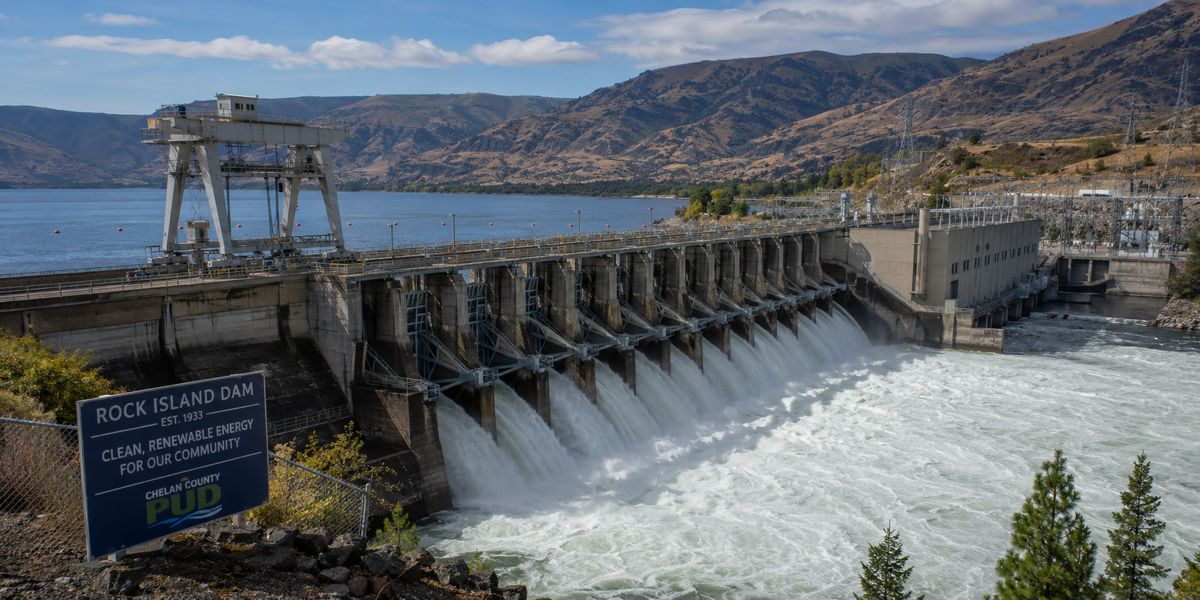
Columbia River Dam Spillways Brace For A Generational Rebuild
Chelan County Public Utility District has handed Tetra Tech the lead design role on a multi-year programme to rebuild the spillways at two of the Columbia River’s veteran hydroelectric dams, placing the engineering firm at the centre of one of the Pacific Northwest’s more consequential infrastructure renewals.
Tetra Tech will act as lead design engineer within a delivery team headed by Kuney Construction and J.F. Brennan, taking on planning, assessment, engineering and construction support for the spillway modernisation of Rock Island Dam and Rocky Reach Dam in Washington State. The award has been structured as a single, multi-year progressive design-build contract, which keeps the designer and the builders inside the same tent from the earliest planning right through to construction.
It’s the kind of job that rarely lands on a front page, yet it speaks to a problem now confronting utilities right across the developed world. Much of the hydropower fleet that underpins clean, dispatchable electricity was built two or three generations ago, and the steel gates, hoists and concrete that govern how rivers are managed are running well past the assumptions their original designers worked to. Getting that machinery wrong on a river the size of the Columbia simply isn’t an option, so the calls Chelan County PUD makes here will carry weight well beyond Washington.
Briefing
- Tetra Tech has been named lead design engineer on the spillway modernisation project for Chelan County PUD, working alongside Kuney Construction and J.F. Brennan.
- The work covers Rock Island Dam and Rocky Reach Dam, two hydroelectric facilities on the Columbia River, the fourth largest river in the United States by flow.
- Scope runs from condition assessments and new spillway gates to gate auto-hoists, controls, concrete rehabilitation, advanced seismic analysis and potential failure mode studies.
- Chelan County PUD operates the second largest non-federal, publicly owned hydroelectric system in the country, backed by an AA+ credit rating.
- Phased construction at Rock Island is scheduled to run from 2027 into the early 2030s.
The Work Beneath The Waterline
Spillways are the unglamorous safety valves of any dam, the gated channels that pass floodwater, surplus flow and, on the Columbia, water released to help young fish migrate downstream. When they jam, leak or can’t be raised quickly, the whole risk picture for a facility changes.
Tetra Tech’s brief reflects that. Its engineers, scientists and technical specialists will carry out critical infrastructure condition assessments and run structural, mechanical and electrical analyses to develop new spillway gates, gate auto-hoists and controls, alongside a programme of spillway concrete rehabilitation across both sites.
The deeper technical work is where the contract earns its keep. The team will perform advanced seismic analyses, build structured risk and potential failure mode assessments, and run targeted value engineering studies before settling on design solutions for each dam.
Both facilities have to keep generating and keep passing water while the work goes on, so the design has to thread itself through live, decades-old structures rather than start from scratch. That constraint, more than any single component, is what makes spillway renewal on a major river such a specialist undertaking.
Why The Progressive Route Makes Sense
Progressive design-build, or PDB, has been gaining ground on complex water and hydropower jobs for a reason. Rather than fixing a price against a finished design and then hunting for a contractor, the owner selects a single design-build team early, on qualifications, and the group develops the scope, the risk allocation and the cost together as the picture sharpens. For Chelan County PUD, that means Tetra Tech and the Kuney and Brennan crews are collaborating from the assessment stage onward, not meeting for the first time once drawings are already locked.
For ageing dam work, that collaborative model is close to a necessity. Nobody knows exactly what they’ll find behind a gate that has been in service for decades until they get in and look, and a rigid lump-sum contract tends to punish everyone when the unexpected turns up.
The single-award, multi-year structure gives the utility room to phase the work, fold in value engineering as conditions are confirmed, and keep one accountable team on the hook from start to finish. It’s a procurement choice as much as an engineering one, and it signals how seriously Chelan County PUD is treating the unknowns buried in these structures.
A System Most People Never Notice
The two dams matter more than their relatively quiet profile suggests. Chelan County PUD runs the second largest non-federal, publicly owned hydroelectric generating system in the United States, and Rock Island and Rocky Reach are its backbone. Rocky Reach alone carries an installed capacity of roughly 1,300 megawatts across eleven turbines, while Rock Island contributes some 629 megawatts. Both are run-of-the-river plants, drawing their output from the Columbia’s flow rather than from a vast stored reservoir, which makes the reliable operation of their gates and spillways central to how the whole system behaves.
That output does more than keep local lights on. Surplus energy sales into the wider Western market provide the bulk of the district’s operating income, which in turn helps fund the utility’s electricity, water, wastewater and fibre services.
The financial footing behind all this is unusually solid, with Chelan County PUD holding an AA+ credit rating that ranks among the strongest utility ratings in the country. When a publicly owned utility with that kind of balance sheet commits to rebuilding its spillways, it tends to set a reference point that other dam owners watch closely.
Ageing Assets On A Working River
History runs deep at these sites. Rock Island was the first dam ever to span the Columbia, completed in 1933 near the geographical centre of Washington, a Depression-era project that opened the era of hydropower on the river long before the Army Corps of Engineers arrived with its bigger schemes. Rocky Reach followed in the late 1950s and early 1960s. Decades of faithful service have left their mark, and the components now under review are old enough that renewal is overdue rather than premature. By the time recent planning work was under way, Rocky Reach’s spillway gates had already been in service for more than 45 years.
Age is only half the story. Seismic understanding has moved on considerably since these dams were designed, which is why advanced seismic analysis and potential failure mode work sit so prominently in the scope. Modernising the gates, hoists and controls also brings operational and worker-safety benefits the original electromechanical systems can’t match. For an asset expected to keep running for decades more, the logic is straightforward: rebuild the critical machinery now, to current standards, while the work can be planned and phased rather than forced by a failure.
Tetra Tech’s Hand On The Design
Tetra Tech comes to the job as one of the larger names in water, environment and sustainable infrastructure engineering, with more than 25,000 staff and a consulting practice that spans the full water cycle. The firm leans heavily on what it brands its Leading with Science approach, and its chief executive framed the appointment in those terms.
“Chelan County Public Utility District owns and operates the second largest non-federal, publicly owned hydroelectric generating system in the nation,” said Roger Argus, Tetra Tech CEO. “Tetra Tech is pleased to use our Leading with Science® approach and high-end hydropower expertise to improve the safety and operational reliability of this critical infrastructure and support Chelan County PUD in providing a safe, resilient power supply for their customers.”
For Tetra Tech, listed on the Nasdaq under the ticker TTEK, the contract adds to a hydropower portfolio that has become a steady source of work as utilities turn to refurbishing rather than retiring their dams. Chelan County PUD has earmarked close to 12 million US dollars for spillway modernisation and repairs at Rock Island in its 2026 budget alone, with phased construction at that dam slated to run from 2027 into the early 2030s.
As hydropower’s role in firming up grids loaded with wind and solar grows, jobs like this one look set to become a more familiar feature of the infrastructure pipeline, and the engineering of safe, resilient spillways will keep climbing the agenda.