Upcycling From Plastic Waste to Structural Adhesives
For most of the recycling industry’s history, the economics of plastic have run in one direction, and it has been downhill. Every mechanical recycling pass shortens polymer chains, degrades performance and pushes the material toward lower-grade uses until it drops out of circulation altogether. That is why the majority of the world’s polyethylene terephthalate is never recovered at all, despite PET being one of the most recyclable plastics in common use.
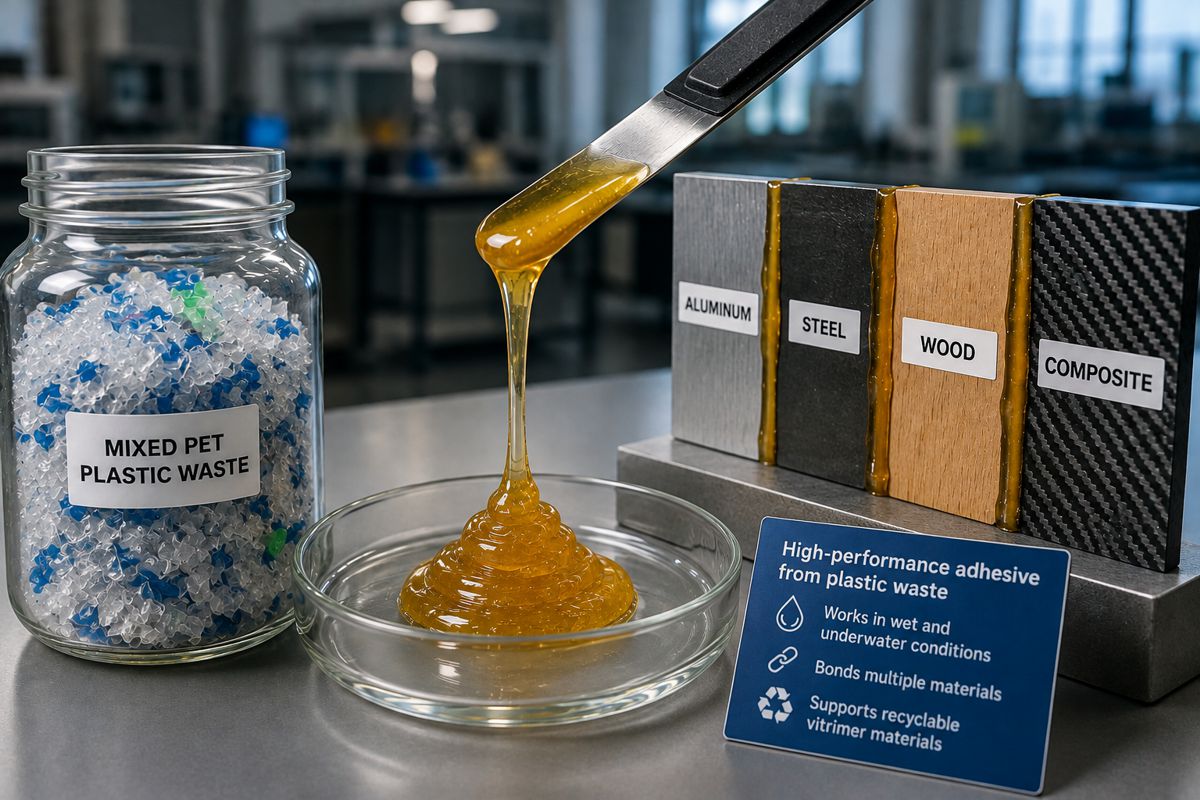
A research group at the United States Department of Energy’s Oak Ridge National Laboratory has now demonstrated a route that inverts that logic, taking mixed and contaminated PET waste and converting it into two materials worth considerably more than the bottles and packaging they came from. One is a reversible, underwater-capable adhesive that outperformed several commercial epoxies in laboratory testing. The other is a recyclable vitrimer plastic that beats virgin PET on strength and stiffness.
The commercial significance sits less in the chemistry than in where it points the money. The global adhesives market is worth more than USD 70 billion a year, with construction accounting for roughly a third of consumption, and the fastest-growing value is concentrated in exactly the high-performance segments this work targets: structural bonding, dissimilar-material joining and applications that demand reliability in wet or submerged conditions.
A feedstock that currently trades at a discount, or costs money to dispose of, is being repositioned as the starting point for specification-grade products. The work was carried out as foundational research funded by the DOE’s Office of Science and documented in its Stories Behind the Science series, which chronicles the process and the accidents behind the studies it supports. The accident, in this case, turned out to be the product.
Briefing
- Researchers at Oak Ridge National Laboratory have upcycled consumer PET waste into a tough, reversible adhesive that works in both dry and wet environments and outperformed several commercial epoxies in testing.
- The same deconstruction process yields a recyclable vitrimer plastic that exceeds virgin PET’s ultimate tensile strength by around 80 per cent and its stiffness by around 150 per cent, and that can recover embedded carbon fibre during recycling.
- The route is catalyst-free and uses a commercially available amine, with solvent-free crosslinking at room temperature, keeping material and energy costs low and tolerating mixed PET streams that defeat conventional mechanical recycling.
- The adhesive’s reversibility, achieved through heat-sensitive dynamic bonds, allows it to be removed and reapplied without loss of integrity, opening applications in repair, rework and design for disassembly.
- The team has published in Science Advances and ChemSusChem, filed a patent, and is now pursuing removable temporary bonds and the joining of dissimilar materials, a persistent challenge in automotive and lightweight assembly.
Why Mechanical Recycling Leaves Value on the Table
The problem the Oak Ridge team set out to address is structural rather than behavioural. Global plastic production stands at roughly 400 million tonnes a year and is on a trajectory to approach double that by 2050, with PET alone accounting for around 70 million tonnes annually. Mechanical recycling, the dominant commercial process, physically grinds and remelts material, and each cycle leaves the polymer chains a little more damaged than before. The result is a system that recovers only a fraction of what it processes, with barely a fifth to a quarter of PET waste recycled globally, and that steadily loses value even on the portion it does capture.
For an infrastructure and manufacturing economy under mounting pressure to demonstrate circularity, that is an expensive inefficiency rather than a solved problem.
Anisur Rahman, the research and development staff member who led the Oak Ridge study, framed the objective in commercial terms from the outset. “We were basically trying to find a way to recover value that was outside of traditional mechanical recycling processes,” he said. The distinction matters because it reframes the exercise. Instead of trying to make recycled PET behave more like virgin PET, a race the material tends to lose, the team treated the waste as a chemical feedstock to be deconstructed and rebuilt into something with different, and higher, market value. That shift, from recovery toward upcycling, is where the strongest commercial logic in this story resides, and it aligns with a wider movement of investment toward chemical routes that can handle the mixed and contaminated streams mechanical plants reject.
From a Laboratory Nuisance to a Product
The adhesive itself arrived by way of a problem the researchers initially tried to eliminate. Mary Danielson, then a postdoctoral researcher at Oak Ridge and now a research assistant professor with the University of Tennessee-Oak Ridge Innovation Institute, had broken PET down into a yellow, viscous liquid and could not get it off her characterisation equipment. The liquid stuck to everything. Rather than treat that as a failure, the team reconsidered it, and Danielson recalled the moment of reframing as a simple question: “It’s sticking to everything. What if that was a feature, not a bug?” That reversal turned a stalled experiment into the origin of a material with genuine commercial reach.
The process behind it is deliberately unglamorous, which is precisely what makes it interesting to anyone thinking about scale-up. The team avoided expensive catalysts and instead used a commercially available amine to deconstruct the plastic, heating a PET feedstock until it broke down over several hours into the sticky macromonomer.
Crosslinking then took place without solvents and at room temperature, producing a network held together by dynamic, heat-reversible bonds. Because the chemistry tolerates variety, the researchers were able to work with a mix of PET types, including egg cartons, fabric fibres and drinks bottles, rather than the clean, clear, single-stream PET that conventional recycling demands. Low-cost inputs, modest energy requirements and tolerance for contamination are the three variables that most often decide whether a laboratory result survives contact with an industrial cost model, and this route scores reasonably on all three.
A Single Adhesive for Jobs That Normally Need Several
Where the material becomes commercially disruptive is in its versatility. Most industrial bonding today is a fragmented affair, with different chemistries specified for different substrates and conditions, and each switch adding inventory, training and process complexity on the factory floor or the job site. The Oak Ridge adhesive bonded wood, glass, metal, paper and polymers, held up in freshwater, seawater and high-pressure conditions, and could be tuned for either structural or pressure-sensitive duty by adjusting the ratio of liquid to crosslinker.
In one standard lap-shear test on metal, it “pulled apart so hard that you could hear the metal sing,” as Danielson described the measurement, and across the reported testing it surpassed several commercial epoxies. Rahman summarised the tunability plainly: “If you want to get the best performance, you just need to tweak it a little bit.”
The reversibility is arguably the more strategically important property. Conventional structural adhesives set permanently, which makes them excellent for assembly and awkward for everything that comes after, from repair and rework to the eventual disassembly that circular-economy regulation increasingly expects. Gentle heating breaks the dynamic bonds in this material, allowing the adhesive to release cleanly and then reform on cooling with its integrity intact.
In Rahman’s assessment, quoted in Oak Ridge’s own announcement of the work, “None of the commercial adhesives can be used this way.” For sectors moving toward design for disassembly, whether in building facades, electronics or vehicles, a bond that can be undone on demand changes the calculus of whole-life cost and end-of-life recovery, and it does so without the customer having to accept weaker initial performance.
The Underwater Advantage Where Infrastructure Pays Most
The property most likely to command a premium is the one the team almost did not test. Rahman suggested trying the adhesive underwater, an environment where the overwhelming majority of conventional adhesives simply fail, and Danielson agreed on the grounds that it cost little to find out. The result held. That single capability opens onto some of the most expensive maintenance problems in heavy infrastructure, because bonding beneath the surface is where current practice is weakest and where the cost of failure is highest.
Subsea pipelines, offshore wind foundations, submerged cable systems, bridge piers, port structures and ship hulls all depend on repair methods that are slow, diver-intensive or reliant on mechanical clamps and wraps, and many of them require dewatering or dry-docking that can cost operators far more in lost availability than the repair itself.
The design principle behind the underwater performance borrows from marine biology, and specifically from the way mussels anchor themselves to wet rock and then release and reattach. “We thought, ‘Maybe mussels also work this way’,” Rahman said, and the team confirmed the mechanism using instruments at the Center for Nanophase Materials Sciences, a DOE Office of Science User Facility at Oak Ridge.
The adhesive combines a water-repelling core with water-attracting arms, and pairs that with a crosslinker carrying both characters, producing a network that grips a surface while keeping water out of the seal. Mussel-inspired chemistry has been pursued for years precisely because the offshore energy, shipping and coastal infrastructure sectors need adhesives that cure and hold in saltwater, under cyclic wave loading and across dissimilar materials such as steel, concrete and composite.
A tough, reversible version made from waste feedstock, if it can be industrialised, would land in a segment where buyers already pay well for performance and reliability.
Dissimilar Materials, Composites and the Wider Circular Play
Beyond the adhesive, the same deconstruction chemistry produced a vitrimer plastic that reframes the recycling proposition again. Vitrimers are a class of plastic whose bonds can break and reform under stimulus, letting them be reshaped and reprocessed like a thermoplastic while retaining the durability of a thermoset, and their long-standing barrier to commercialisation has been matching or beating the parent material on performance and cost.
The Oak Ridge vitrimer cleared that bar, exceeding virgin PET’s ultimate tensile strength by roughly 80 per cent and its stiffness by roughly 150 per cent, while remaining chemically recyclable in a closed loop. It can also be combined with reinforcement such as carbon fibre and then release that fibre intact during recycling, a capability with direct relevance to the composite structures used in wind blades, pressure vessels, transport and increasingly in construction, where end-of-life recovery of high-value fibre has been a stubborn problem.
The commercial thread running through both products is the joining and recovery of materials that do not naturally go together. Rahman’s group is now working to apply the adhesive to the bonding of dissimilar materials, a challenge the automotive industry has wrestled with for years as it mixes steel, aluminium, composites and polymers to cut weight.
Structural adhesives are already displacing welding and riveting in multi-material assembly, from vehicle bodies to electric-vehicle battery packs, because bonding avoids the thermal distortion and galvanic complications that mechanical fastening introduces. A reversible adhesive that bonds across substrate types and can be undone for repair or recycling would sit squarely in that growth corridor, and it would do so with a sustainability story attached rather than bolted on afterwards.
What Industry Leaders Should Watch From Here
The honest position is that this remains laboratory-stage work, and the distance between a strong result in a materials paper and a qualified product on a procurement schedule is measured in years, not months. Scale-up economics, long-term durability under real service conditions, regulatory qualification for structural and marine use, and consistent supply of suitable waste feedstock all have to be proven before any infrastructure owner writes a specification around it.
Two peer-reviewed papers and a filed patent do not amount to a commercial supply chain. What they do amount to is a credible signal about direction, and the direction is one that materials suppliers, construction chemicals groups and infrastructure asset owners have reason to track closely.
The pattern of recent dealmaking suggests the market is already moving toward the ground this work occupies. Saint-Gobain’s USD 1.2 billion acquisition of Fosroc consolidated construction chemicals and adhesive technologies, and Henkel’s purchase of Seal for Life extended its reach into protective and sealing solutions for energy and water infrastructure, both signs that purchasing power in bonding and sealing is concentrating around infrastructure-grade, performance-led applications.
Danielson, reflecting on how the discovery came about, offered a description that applies as neatly to the commercial opportunity as to the science: “Like most good science, it was a mix of luck, attention to the serendipity of the moment, and also the fundamentals.”
For the industries that specify, buy and maintain the built environment, the fundamentals here point toward a future in which waste streams are treated as inputs to premium materials, and in which the value that mechanical recycling has been shedding for decades starts, at last, to move the other way.
Key Industry Questions
- What makes upcycling PET into adhesive more valuable than recycling it into new bottles? Mechanical recycling degrades PET a little with each pass, shortening the polymer chains and pushing the material toward lower-grade uses until it exits circulation. That process caps the recovered value and explains why so little PET is recycled at all. Chemical upcycling breaks the plastic down and rebuilds it into a different product, in this case a high-performance adhesive and a recyclable vitrimer, both of which command higher prices than commodity recycled PET. The route also tolerates mixed and contaminated feedstock that mechanical plants reject. For asset owners and materials buyers, the significance is that a low-value or negative-value waste stream becomes a starting point for specification-grade materials, which changes the economics of recovery rather than simply improving collection rates.
- How large is the commercial opportunity in adhesives? The global adhesives market is worth more than USD 70 billion a year and is growing steadily, with building and construction accounting for around a third of consumption. The fastest value growth is in high-performance segments including structural bonding, dissimilar-material joining and applications requiring reliability in wet conditions, which is precisely where the Oak Ridge material aims. Recent consolidation reinforces the trend, with Saint-Gobain acquiring Fosroc for USD 1.2 billion and Henkel buying Seal for Life to extend into infrastructure sealing. A waste-derived adhesive that performs at the top end of the market would enter a segment where buyers already pay premiums for reliability, giving any eventual commercial product a favourable place to compete on value rather than price alone.
- Why does an underwater adhesive matter for infrastructure owners? Bonding beneath the surface is one of the weakest points in current maintenance practice, because most conventional adhesives fail in wet conditions. Repairs to subsea pipelines, offshore wind foundations, submerged cables, bridge piers and ship hulls typically rely on slow, diver-intensive methods or mechanical clamps, and many require dewatering or dry-docking that costs operators far more in lost availability than the repair itself. An adhesive that cures and holds underwater, bonds dissimilar materials such as steel and concrete, and can be removed and reapplied would reduce both the cost and the disruption of these interventions. For owners of marine and coastal assets, that combination targets some of the most expensive and least well-served maintenance problems in the sector.
- What does reversibility change in practice? Conventional structural adhesives set permanently, which suits assembly but complicates everything afterward, from repair and rework to eventual disassembly. The Oak Ridge adhesive uses heat-sensitive dynamic bonds that break under gentle warming and reform on cooling, allowing it to be removed cleanly and reapplied without losing integrity. That property matters as circular-economy regulation increasingly expects products to be designed for disassembly and material recovery. A reversible bond lets manufacturers correct mistakes during production, lets operators repair rather than replace, and lets components be separated at end of life for recycling. It effectively decouples the strength of a bond from its permanence, which has traditionally been a trade-off buyers had to accept.
- Is this ready for commercial deployment? No. This is laboratory-stage research, supported by two peer-reviewed papers and a filed patent, but not yet a commercial product or supply chain. Several hurdles remain before any infrastructure owner could specify it, including scale-up economics, long-term durability under real service conditions, regulatory qualification for structural and marine use, and reliable supply of suitable waste feedstock. The gap between a strong materials-science result and a qualified procurement-ready product is typically measured in years. What the work provides is a credible signal of direction rather than an immediate solution, and it warrants monitoring by materials suppliers and asset owners rather than inclusion in near-term project planning.
- Why is the vitrimer plastic significant alongside the adhesive? The same deconstruction chemistry produces a vitrimer, a plastic whose bonds can break and reform, giving it the reprocessability of a thermoplastic with the durability of a thermoset. The Oak Ridge vitrimer exceeded virgin PET’s tensile strength by around 80 per cent and its stiffness by around 150 per cent, while remaining recyclable in a closed loop. It can also incorporate carbon fibre and release that fibre intact during recycling. That last point addresses a long-standing problem in composites, where recovering high-value reinforcement from wind blades, pressure vessels and structural panels has been difficult and costly. A recyclable, high-performance composite matrix made from waste PET would have relevance well beyond adhesives.
- Which industries are most likely to adopt this first? The strongest early fit lies where current adhesives perform worst and where buyers already pay for reliability. Offshore energy, shipping, and coastal and marine infrastructure stand out because of the underwater capability and the high cost of conventional repair. Automotive and electric-vehicle assembly are another candidate, given the industry’s need to bond dissimilar lightweight materials and the team’s active work on that challenge. Sectors moving toward design for disassembly, including electronics and building facades, could value the reversibility. Adoption in any of these would depend on qualification and scale-up, but each represents a segment where the material’s specific advantages address a genuine and expensive gap rather than competing on commodity terms.
- How does this fit the wider circular-economy agenda? The work aligns with a shift in how waste is valued, treating discarded PET as a chemical feedstock rather than a disposal problem. Regulation is moving in the same direction, with recycled-content expectations and design-for-disassembly requirements tightening across major markets. Chemical upcycling routes that can handle mixed and contaminated streams, produce higher-value outputs and enable closed-loop recovery fit that policy trajectory better than volume-focused mechanical recycling alone. For construction and infrastructure, which consume large quantities of both plastics and adhesives, the appeal is a model in which material recovery generates premium products and reduces reliance on virgin inputs, strengthening the commercial case for circularity rather than resting it on compliance.
Strategic Takeaways
- The centre of gravity in plastic recovery is shifting from volume recycling, which loses value with every pass, toward chemical upcycling that turns mixed waste into premium materials, and infrastructure players should watch where that value migrates.
- Underwater and dissimilar-material bonding represent the highest-value openings for a reversible waste-derived adhesive, targeting maintenance problems in subsea, offshore and marine assets where conventional adhesives fail and repair costs are steepest.
- Reversibility decouples bond strength from permanence, positioning this class of adhesive for a regulatory future built around repair, rework and design for disassembly rather than one-time assembly.
- A recyclable vitrimer that beats virgin PET on strength and stiffness, and that releases carbon fibre intact during recycling, addresses a stubborn gap in composite end-of-life recovery relevant to wind, transport and construction.
- Consolidation in construction chemicals and infrastructure sealing signals that purchasing power is concentrating around performance-led bonding, giving credible waste-derived alternatives a favourable long-term route to market once scale-up and qualification are proven.