Matco Tools Upgrades REX Impact Wrench for Professional Workshop
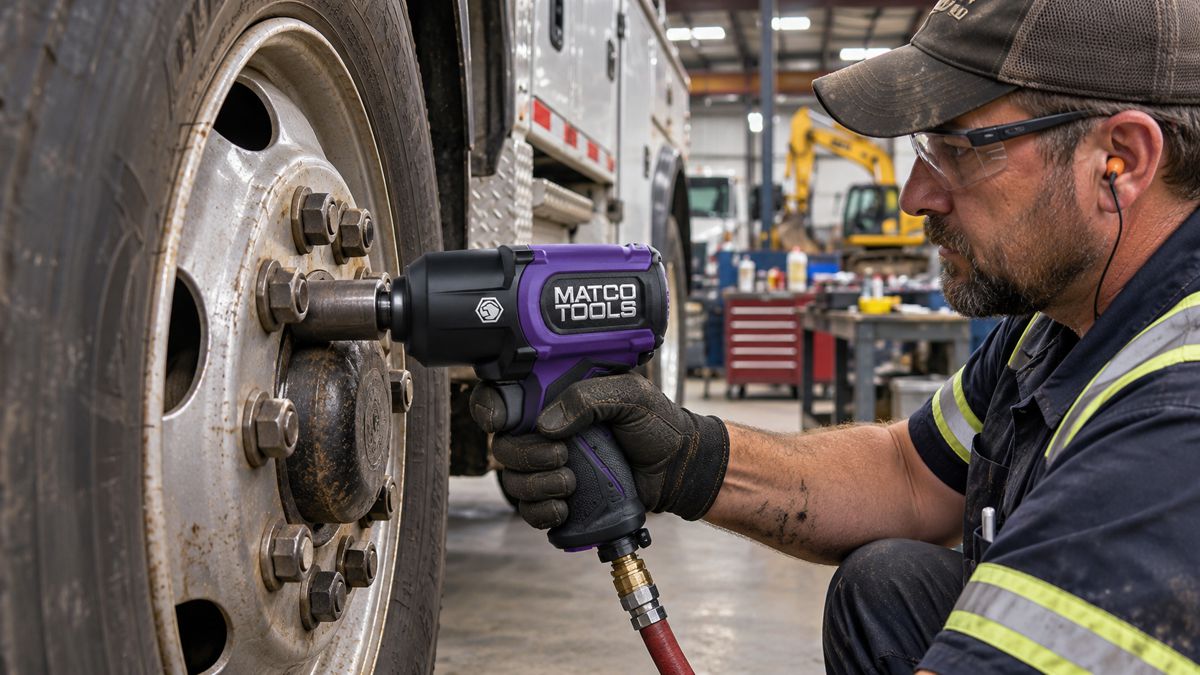
Matco Tools has introduced its REX 2.0 pneumatic impact wrench, increasing the claimed breakaway torque of its half-inch drive platform to 1,900 ft-lb (approximately 2,576 Nm), alongside improvements to the grip, housing and internal drive components.
The new model, designated MT4779B, succeeds the original REX impact wrench, which delivered 1,700 ft-lb of breakaway torque. The increase is approximately 12%, compared with a more modest 5.6% rise in the manufacturer’s stated maximum working torque, from 900 to 950 ft-lb.
Although developed primarily for automotive technicians, the REX 2.0 may also interest workshops maintaining commercial vehicles and construction machinery, where high-torque pneumatic tools remain part of routine maintenance operations.
Briefing
- Matco Tools has launched the REX 2.0 half-inch pneumatic impact wrench with a claimed 1,900 ft-lb breakaway torque.
- Maximum working torque increases from 900 to 950 ft-lb compared with the original REX.
- A redesigned composite housing incorporates dual-material construction and textured gripping surfaces.
- The MT4779B features a reverse-biased drive, 7,500 rpm free speed and 1,200 impacts per minute.
- The new wrench carries a two-year warranty and is being promoted through Matco’s North American mobile distribution network.
Developing the REX Pneumatic Platform
The original Matco REX impact wrench was already positioned towards the higher-output end of the company’s half-inch pneumatic tool range. Its published specifications included 1,700 ft-lb of breakaway torque, 900 ft-lb maximum working torque and a composite housing that Matco described as weighing approximately 4.6 lb.
The replacement retains the familiar pistol-grip arrangement and half-inch square drive, but introduces a reverse-biased mechanism designed to provide greater loosening performance. The emphasis is on fastener removal, particularly where corrosion, contamination or prolonged service can make conventional removal difficult.
According to the MT4779B product specifications, the new wrench delivers 1,900 ft-lb of breakaway torque and 950 ft-lb of maximum working torque, with a free speed of 7,500 rpm and an impact rate of 1,200 blows per minute. The free speed and impact rate are unchanged from the figures listed in the original REX specification table, suggesting that Matco has concentrated on improving torque delivery rather than increasing operating speed.
The increase in breakaway torque is proportionately greater than the improvement in working torque. Although both figures demonstrate the manufacturer’s claimed performance gains, their practical value depends on the application, operating conditions and air supply available at the tool.
Understanding Breakaway and Working Torque
Impact wrench manufacturers frequently emphasise breakaway torque because it provides an indication of the force available to loosen resistant fasteners. However, breakaway torque and working torque describe different operating characteristics and should not be treated as interchangeable.
Breakaway torque concerns overcoming the initial resistance of a tightened or seized fastener, whereas working torque relates to the tool’s capability during normal fastening operations. Published figures depend on manufacturers’ testing procedures, and peak performance ratings do not necessarily represent the torque delivered repeatedly under workshop conditions. Comparisons between competing products therefore require some care, particularly where test methods are not directly comparable.
A high breakaway torque rating does not make an impact wrench suitable for every fastening operation. Wheel assemblies, structural connections and other safety-critical components may require controlled tightening sequences and specified final torque values. Ingersoll Rand’s technical guidance makes clear that an impact wrench should not be treated as a precision torque-control device, with calibrated equipment and the appropriate service procedures required where final tightening accuracy is critical.
Ergonomics and Mechanical Durability
Matco has revised the REX housing using dual-material composite construction and thermoplastic rubber gripping surfaces, with a textured finish intended to improve comfort and control during extended use.
The tool incorporates a variable-speed trigger and rear-mounted forward/reverse control. Matco also identifies improved directional control retention and a heavy-duty proprietary anvil among the mechanical changes, with the latter intended to withstand repeated high-load operation.
These features are particularly relevant where technicians move repeatedly between wheel assemblies, suspension components, chassis fasteners and other mechanical work during a shift. Grip geometry, tool balance and vibration influence handling, especially when access is restricted or the operator must work in an awkward position.
A composite housing can reduce the physical burden of repetitive work, although overall handling also depends on weight distribution, the connected air hose and the position in which the wrench is used. Matco describes reduced hand fatigue as a design objective, but has not provided independently verified comparative ergonomic or vibration measurements for the two REX generations.
The manufacturer lists a sound level of 95 dB(A) for the MT4779B, compared with 96 dB(A) for the previous model. These published figures offer a basic specification comparison, although workplace noise exposure depends on operating conditions, duration and the surrounding environment. Appropriate hearing protection remains an important consideration in busy maintenance facilities.
Air Supply and Workshop Performance
Pneumatic impact wrenches remain familiar equipment in professional maintenance facilities, particularly where compressed-air distribution is already installed throughout the workshop. Unlike cordless alternatives, they do not depend on onboard battery capacity and can operate repeatedly without charging interruptions, provided the air system supplies sufficient pressure and volume.
Compressor capacity, hose diameter, connectors and air-line condition all influence the performance available at the tool. Matco recommends a 3/8-inch air hose and specifies a quarter-inch air inlet for the MT4779B. Workshops considering the wrench should verify that their existing compressed-air installation meets the manufacturer’s operating requirements, especially where several pneumatic tools are used simultaneously.
Ingersoll Rand’s pneumatic impact wrench troubleshooting guidance identifies inadequate airflow and pressure as common causes of reduced tool speed and torque. It recommends checking dynamic pressure at the tool inlet while the wrench is operating, rather than relying solely on the pressure indicated at the compressor. Correct lubrication, suitable fittings and routine hose inspection also contribute to reliable performance.
Applications in Construction Equipment Maintenance
Although the REX range is marketed predominantly towards automotive mechanics, high-output half-inch pneumatic impact wrenches can also have a place in workshops supporting construction equipment, service vehicles and ancillary machinery.
Potential applications include removing fasteners from light commercial vehicles, selected suspension and chassis assemblies, machinery guards, brackets and other mechanical components where fastener specifications and service procedures permit their use. The half-inch drive format can provide better access than larger industrial impact wrenches, particularly in restricted working spaces.
However, the tool’s high breakaway torque does not establish its suitability for every heavy-equipment application. Large construction machinery may require three-quarter-inch or one-inch drive impact wrenches, hydraulic torque equipment or alternative controlled fastening procedures, depending on fastener size, loading and service requirements.
Impact-rated sockets must also be compatible with the intended operation. A workshop maintaining a mixed fleet of vehicles and construction machinery will generally require several tool sizes rather than relying on a single high-output wrench for every task.
The REX 2.0 therefore fits into the broader selection of equipment used by professional maintenance engineers, where accessibility, appropriate torque capacity and dependable operation are often more useful than the highest published performance figure alone.
Distribution and Professional Support
The REX 2.0 is being introduced through Matco’s established North American distribution network, which includes more than 1,900 independent mobile distributors. The company has built its commercial model around direct relationships with professional technicians, providing access to tools, customer support and warranty services through local distributors.
Matco lists a two-year warranty for the MT4779B. For technicians and workshop operators who rely on their tools for daily maintenance work, product support and replacement arrangements can be important considerations alongside initial purchase cost and mechanical performance.
The company is also using its longstanding motorsport involvement to promote the launch. A specially wrapped Matco-sponsored Top Fuel dragster driven by Antron Brown is scheduled to appear at the National Hot Rod Association season finale at Pomona, California, from 13 to 15 November 2026.
The event will bring distributors and customers together for product demonstrations, linking the new wrench with the professional mechanical work associated with drag racing. Although the promotional setting is automotive, the underlying development is familiar across industrial maintenance: increasing available torque while retaining manageable tool dimensions and improving the operator’s grip and control.
High-Torque Tools in Professional Maintenance
Cordless impact wrenches continue to offer greater mobility for technicians working away from fixed workshop installations, while pneumatic equipment remains practical where compressed-air infrastructure is already available and repetitive maintenance work justifies its use.
The REX 2.0 continues Matco’s development of the conventional half-inch air impact wrench, combining higher claimed torque with revisions to the housing, controls and drive components. The published specifications establish measurable improvements over the previous generation, although independent comparative testing would provide a clearer picture of performance under sustained workshop conditions.
For professional maintenance operations, selecting an impact wrench remains a balance between the fasteners being handled, the available air supply, operator comfort and expected service life. The new REX offers another high-output option within that established tool category.
Key Industry Questions
- What is the maximum breakaway torque of the Matco REX 2.0? Matco specifies 1,900 ft-lb, approximately 2,576 Nm, for the MT4779B half-inch pneumatic impact wrench. This is a manufacturer-published figure rather than an independently verified test result.
- How does the REX 2.0 compare with the original REX? Breakaway torque increases from 1,700 to 1,900 ft-lb, while maximum working torque rises from 900 to 950 ft-lb. The newer model also introduces revised gripping surfaces, a reverse-biased drive and mechanical improvements.
- What is the difference between breakaway torque and working torque? Breakaway torque concerns overcoming the initial resistance of a fastener during removal. Working torque relates to normal fastening performance, although definitions and test procedures can differ between manufacturers.
- Can the REX 2.0 be used for construction equipment maintenance? It may be suitable for selected maintenance tasks involving vehicles and machinery, provided the fasteners, sockets and operating procedures are compatible. Larger or safety-critical assemblies may require different equipment.
- Does the REX 2.0 require a compressor? Yes. It is a pneumatic tool powered by compressed air rather than an onboard battery. Matco recommends a 3/8-inch air hose, and users should verify the complete air supply requirements before operation.
- Can the REX 2.0 tighten wheel nuts to their final specified torque? An impact wrench should not be relied upon to establish precise final torque. Safety-critical wheel fasteners should be tightened and verified according to the vehicle manufacturer’s procedures using appropriate calibrated equipment.
- What ergonomic improvements have been introduced? The REX 2.0 incorporates a redesigned dual-material composite housing, thermoplastic rubber gripping surfaces and a variable-speed trigger. Matco claims these changes improve comfort and control.
- What warranty is provided with the Matco REX 2.0? Matco lists a two-year warranty for the MT4779B pneumatic impact wrench. Purchasing arrangements and availability should be confirmed with the relevant distributor.
Strategic Takeaways
- The increase in breakaway torque is proportionately greater than the improvement in maximum working torque, with the principal claimed performance gain concentrated on difficult fastener removal.
- Pneumatic tool performance depends on the workshop’s compressed-air installation as well as the wrench’s mechanical specifications.
- Grip design, vibration, balance and noise remain important considerations where impact wrenches are used repeatedly throughout a shift.
- High-output half-inch tools can serve a useful range of maintenance applications but do not replace larger or specialised equipment for demanding heavy-machinery work.
- Matco’s mobile distribution network and warranty support remain part of the purchasing proposition alongside torque, durability and operating requirements.