Who Really Owns Innovation? A Global Guide to Patents and Intellectual Property
Patents can protect valuable inventions, but securing international rights and defending them against competitors requires careful planning and significant resources. Engineers, inventors and manufacturers need to understand how intellectual property works, what it costs and where the system falls short.
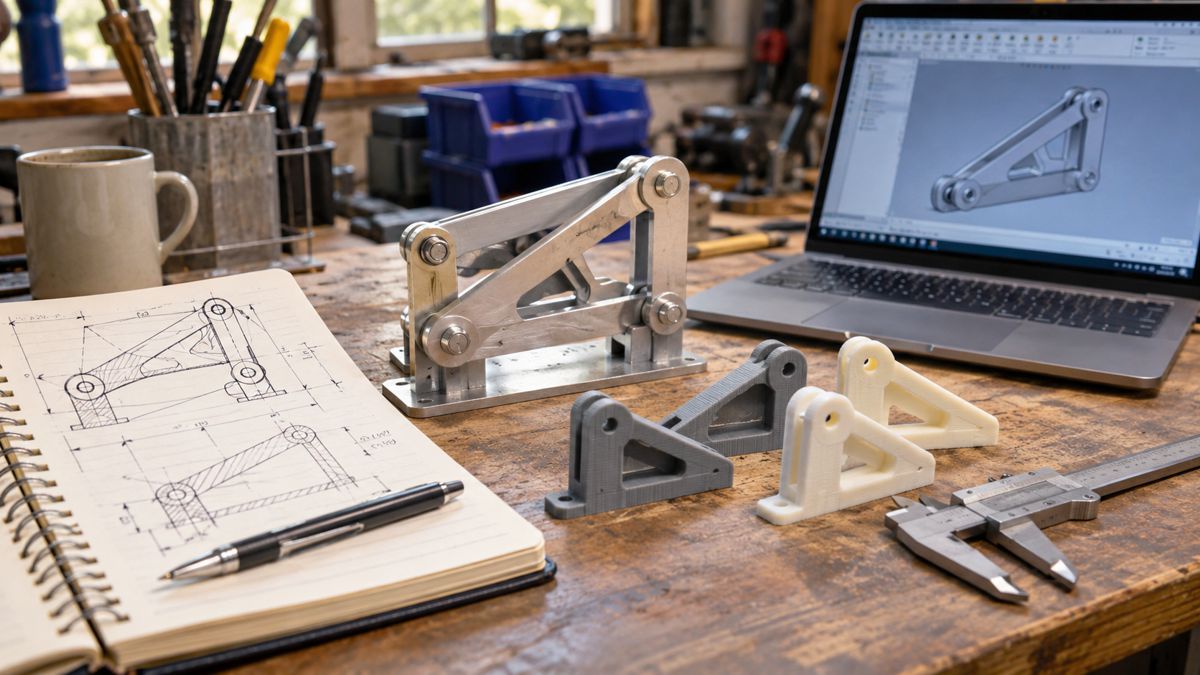
An engineer develops a safer roadside device, a technician discovers a more efficient manufacturing process, or a construction worker invents a tool that eliminates hours of repetitive labour. The idea might be relatively simple, inexpensive to manufacture and capable of solving a problem faced by thousands of businesses. Turning it into a commercial product, however, introduces challenges that have little to do with engineering.
Should the inventor apply for a patent before approaching a manufacturer? How much will international protection cost, and what happens if a larger company develops a suspiciously similar product? More importantly, what practical value does a patent have if its owner cannot afford the lawyers needed to defend it?
These questions have become increasingly relevant as computer-aided design, affordable 3D printing, open-source software and global manufacturing networks make innovation accessible to individuals and smaller businesses. Developing a prototype is no longer necessarily the greatest obstacle. Understanding intellectual property rights, navigating international legal systems and establishing a viable commercial strategy can be considerably more difficult.
The financial imbalance is particularly striking. An eligible individual inventor in the United States can file a provisional patent application for just $65 in official fees, yet enforcing a granted patent against a determined competitor can involve litigation costing hundreds of thousands or millions of dollars.
International cooperation is improving some aspects of the process. The Patent Prosecution Highway celebrated its 20th anniversary in 2026, marking two decades of collaboration between patent offices seeking to accelerate examination and reduce duplicated work. Nevertheless, streamlining applications does little to resolve the cost of international protection or the difficulties smaller inventors face when enforcing their rights.
The underlying question is whether the intellectual property system continues to reward technical innovation effectively, or whether the financial resources needed to navigate it have become as important as the inventions themselves.
Briefing
- Patents protect technical inventions, while registered designs, trade marks, copyright and trade secrets protect different aspects of technology, products and commercial activity.
- There is no worldwide patent. International agreements simplify applications, but enforceable rights remain territorial.
- Initial filing fees can be modest, although examination, professional advice, international protection and renewals can substantially increase expenditure.
- Enforcement can be prohibitively expensive. The 2025 AIPLA survey reported median estimated US litigation costs of $1 million through trial and appeal for disputes involving $1 million to $10 million at risk.
- Commercialisation requires more than legal protection. Licensing, manufacturing agreements, insurance, market selection and freedom-to-operate assessments can be equally important.
What Does a Patent Actually Protect?
A patent gives its owner the legal right to prevent others from commercially exploiting a protected invention within the jurisdiction where the patent is valid. Depending on the applicable law, this can include manufacturing, using, importing, offering for sale or selling a patented product without permission.
A patent does not automatically grant permission to manufacture or sell an invention. A newly patented machine might incorporate electronic systems, mechanical components or manufacturing processes already covered by other companies’ patents, creating the possibility that additional licences are required.
Most major patent systems apply three broad requirements: novelty, inventive step or non-obviousness, and industrial applicability or utility. The precise legal tests differ internationally, but the underlying objective is to distinguish genuine technical developments from existing knowledge, obvious modifications and insufficiently developed ideas.
An innovative hydraulic mechanism, a new asphalt formulation or an improved structural connection could potentially qualify. However, an inventor cannot patent the general ambition to construct safer bridges or produce more efficient machinery. The application must describe a specific technical solution, with its claims establishing the boundaries of the protection being requested.
The Exchange Between Inventors and Society
The patent system operates around an exchange. Inventors disclose technical information about their inventions, and society grants time-limited exclusive rights where the legal requirements are satisfied.
Published patent documents consequently represent an enormous technical library. They contain engineering drawings, detailed descriptions, operating principles and references to earlier technologies, allowing researchers and manufacturers to investigate developments that might otherwise remain confidential.
In most major jurisdictions, ordinary invention patents generally have a maximum term of 20 years measured from the relevant filing date, subject to applicable rules, extensions and maintenance requirements. Once protection expires, the disclosed invention can generally be used freely in that territory, although other intellectual property rights may remain relevant.
The intention is to encourage investment in research while ensuring that technical knowledge eventually becomes available for wider use. The effectiveness of that arrangement depends on the quality of the patents granted, the commercial opportunities they create and the ability of legitimate rights holders to enforce them.
From an Idea to a Patent Application
The patent process begins with an investigation into what has already been invented. An improvement that appears original to its creator may already be described in an earlier patent, technical publication, academic paper or commercial product.
Free databases such as Google Patents, the European Patent Office’s Espacenet and WIPO’s PATENTSCOPE allow inventors to search published patent documents from numerous jurisdictions.
These resources can reveal competing technologies, existing claims and the historical development of an invention. However, searching requires considerable care because patents frequently use terminology that differs from familiar industry descriptions, while unpublished applications may not yet be visible.
A patentability search should also be distinguished from a freedom-to-operate assessment. An invention might be sufficiently novel to justify its own patent while its manufacture still infringes earlier enforceable rights belonging to another business.
The Danger of Disclosing an Invention Too Early
One of the most consequential mistakes an inventor can make is revealing technical information before considering patent protection. Publishing detailed drawings, demonstrating an invention at an exhibition or uploading a technical video can undermine its novelty.
Confidentiality agreements can reduce disclosure risks when approaching manufacturers and investors, but they depend on contractual enforcement and are not substitutes for patents. The differences between national laws make disclosure particularly important when an invention has international potential.
The United States provides a one-year grace period for certain qualifying inventor-originated disclosures, while the European Patent Convention generally applies a much stricter approach, with only narrow exceptions such as evident abuse and certain recognised exhibitions.
An inventor who publicly demonstrates a new machine might therefore retain some patent opportunities in the United States while compromising protection in Europe and other markets. Filing before disclosure remains the safer international approach, although an early application must contain enough technical detail to support the invention being claimed.
Filing, Examination and Grant
Patent applications normally contain a technical description, relevant drawings and claims defining the proposed protection. The patent office searches for earlier disclosures and examines whether the invention satisfies the applicable legal requirements.
Examiners commonly raise objections concerning novelty, inventive step, clarity or the scope of the claims. Applicants can respond with technical arguments or permissible amendments, but generally cannot add new technical subject matter while retaining the original filing date for those additions.
Many applications become public approximately 18 months after their earliest relevant filing or priority date. Publication does not mean that a patent has been granted, and the examination process may continue for several years before an application is approved, refused, withdrawn or abandoned.
How the US Patent System Works
The United States is one of the world’s most commercially important patent markets, with applications administered by the United States Patent and Trademark Office (USPTO).
American patent law distinguishes between utility, design and plant patents. Utility patents protect qualifying functional inventions, including machines, manufacturing processes, industrial materials and technical systems, while design patents protect certain ornamental features of manufactured articles.
US utility patents generally last for up to 20 years measured from the relevant non-provisional filing date, subject to applicable adjustments and maintenance requirements. Modern US design patents normally provide 15 years of protection from grant without periodic maintenance fees.
The US Provisional Patent Application
One particularly useful feature of the American system is the provisional patent application, which offers a relatively inexpensive method of establishing an initial filing date.
Unlike a conventional non-provisional application, a provisional application does not require formal patent claims and does not undergo substantive examination. It normally remains pending for 12 months, during which an inventor can prepare a corresponding non-provisional application and investigate commercial opportunities.
This can be attractive to individuals and start-ups seeking an early filing date before committing substantial resources to professional patent prosecution. However, a provisional application is not an enforceable patent and must adequately describe the invention.
Subsequent claims can benefit from its filing date only where the relevant subject matter was sufficiently supported in the original disclosure. The designation patent pending may be used appropriately once a qualifying application has been filed, but it does not mean that protection has been granted or that all features of a product will eventually be patented.
The USPTO also offers substantial fee reductions for eligible small and micro entities, although qualification depends on specific criteria, including ownership arrangements and additional conditions applicable to micro entities.
The UK Patent System
The United Kingdom operates a separate patent system administered by the UK Intellectual Property Office.
Its principal patentability requirements are broadly comparable with those applied internationally, requiring novelty, inventive step and industrial applicability, subject to statutory restrictions and exclusions.
UK patents also generally have a maximum term of 20 years from filing, provided the applicable renewal fees are paid. Unlike the United States, however, the UK does not use the same provisional and non-provisional application structure.
Applicants can establish an initial filing date through a national application containing the minimum required material, then complete procedural requirements within the applicable deadlines. An online application can initially be filed without immediate payment in appropriate circumstances, although the relevant fees must subsequently be paid.
The practical consideration is not simply which country offers the cheapest initial procedure. Inventors need a properly supported technical disclosure, a reliable priority date and a filing strategy that accounts for their intended markets.
What Does Patent Protection Really Cost?
The cost of patent protection is frequently misunderstood because initial filing fees are relatively easy to identify, while the expense of completing examination, maintaining rights and enforcing them is considerably less predictable.
Official charges are only one element. Patent attorneys, technical drawings, prior-art investigations, translations, examination responses and international representatives can substantially increase expenditure.
The following comparison uses selected official US and UK patent fees applicable in November 2026. UK amounts have been converted into US dollars using an indicative exchange rate of £1 = $1.331, consistent with the 11 November 2026 ECB-derived reference rate.
| Country | Application or service | Approximate official cost |
|---|---|---|
| USA | Provisional application, micro entity | $65 |
| USA | Provisional application, small entity | $130 |
| USA | Provisional application, standard entity | $325 |
| USA | Utility filing, search and examination, standard entity | $2,000 |
| USA | Utility filing, search and examination, micro entity | $400 |
| UK | Online application fee, paid on filing | $100 |
| UK | Online application fee, paid later | $126 |
| UK | Online filing, search and examination combined | $539 |
Sources: USPTO Fee Schedule and UK IPO Fees. Additional charges and professional fees are excluded.
The distinction between an initial application and a completed patent is significant. US non-provisional utility applications ordinarily require filing, search and examination payments, while additional charges may arise during prosecution and before grant.
At current published rates, the three scheduled maintenance fees for a standard-entity US utility patent total $14,470. These fall due at approximately 3.5, 7.5 and 11.5 years after grant, with reduced amounts available for qualifying smaller entities.
The UK operates an annual renewal system, with fees increasing as the patent ages. Professional preparation can add several thousand dollars for a relatively straightforward application, while complex inventions and international portfolios can require substantially greater investment.
Inventors should therefore distinguish between the cost of filing, the total cost of obtaining and maintaining protection, and the potentially much greater expense of enforcing it.
Why There Is No Worldwide Patent
Modern manufacturing operates across international borders, but patent rights remain territorial.
An engineer might develop a product in the United States, prototype it in Vietnam, source electronic components from Taiwan and sell the finished equipment in Europe and Australia. A US patent would not automatically prevent manufacturing in Vietnam, while a UK patent would not independently protect sales in Australia.
The location of manufacturing is not the only consideration. Importing an infringing product into a territory where a relevant patent is enforceable may itself constitute infringement, even where manufacturing occurred lawfully elsewhere.
International agreements help coordinate applications and preserve earlier filing dates, but they do not remove the need to choose the territories where protection is commercially worthwhile.
The Paris Convention and International Priority
The Paris Convention for the Protection of Industrial Property establishes important principles for international intellectual property protection.
Its priority provisions generally allow an inventor who files a qualifying patent application in one participating country to submit corresponding applications in other participating countries within 12 months while claiming the original priority date for the same disclosed invention.
This provides time to investigate markets, develop prototypes and approach commercial partners before deciding where further protection is justified. However, priority is not a worldwide patent reservation, and subsequent applications must still be filed through appropriate procedures.
Technical material added later may not benefit from the original priority date. The Paris Convention also provides a shorter six-month priority period for trade marks and industrial designs.
The Patent Cooperation Treaty
The Patent Cooperation Treaty (PCT), administered by the World Intellectual Property Organization, provides a coordinated route for seeking patent protection internationally.
An eligible inventor can submit a single international application rather than immediately prosecuting separate applications in numerous countries. The international phase provides search information and preliminary assessment material that can help applicants evaluate their prospects.
In many jurisdictions, national or regional phase entry can be deferred until approximately 30 months from the earliest priority date, although applicable deadlines must be checked individually.
The PCT does not grant worldwide patents or eliminate national examination costs. Its principal value is preserving options while allowing some major financial and commercial decisions to be postponed.
European Patents and the Unified Patent Court
The European Patent Office provides a centralised examination process through which applicants can obtain a European patent. Following grant, conventional European patents can provide national protection in selected countries, subject to their applicable procedures.
The Unitary Patent system, launched in June 2023, offers uniform protection across participating European Union member states. As of November 2026, registered Unitary Patents cover 18 participating EU countries, reducing the administrative burden associated with maintaining separate national protections across those territories.
The system is connected to the Unified Patent Court, which has jurisdiction over Unitary Patents and, subject to transitional arrangements and valid opt-outs, certain conventional European patents in participating states.
The UK is outside the Unitary Patent and Unified Patent Court arrangements, but remains part of the wider European patent system. Applicants can therefore continue seeking UK protection through a European patent designating the UK.
Centralisation can simplify enforcement, but it also creates broader consequences when patents are challenged. A successful central revocation of a Unitary Patent affects protection across its participating territories rather than only one national market.
Twenty Years of the Patent Prosecution Highway
The Patent Prosecution Highway was launched in 2006 through cooperation between the Japan Patent Office and the USPTO. Its 20th anniversary was celebrated at a forum in Japan on 12 June 2026, ahead of the July anniversary.
By April 2026, 56 patent offices worldwide were participating in PPH arrangements, according to Finland’s Patent and Registration Office.
The system allows eligible applicants to request accelerated examination at one participating patent office based on qualifying examination findings from another. This can reduce duplication and shorten processing times, although each authority continues to apply its own legal standards.
International cooperation has continued to expand. On 1 August 2026, the European Patent Office and China’s National Intellectual Property Administration launched a bilateral PPH pilot programme, improving procedural cooperation between two major industrial and commercial markets.
The scheme does not create international patent rights or guarantee that an application will be granted. Its contribution is procedural efficiency, which is valuable but distinct from the challenges of enforcing patents across multiple legal systems.
Beyond Europe and North America
A global intellectual property strategy cannot ignore Asia, where major manufacturing networks, industrial research programmes and international supply chains increasingly intersect.
China operates an extensive patent system administered by the China National Intellectual Property Administration. Its legislation provides invention patents, utility models and design patents, offering different forms of protection relevant to manufacturers and product developers.
Japan and South Korea maintain sophisticated patent systems supported by major industrial research and manufacturing sectors. Their authorities participate in international cooperation arrangements and administer protection for a broad range of technical innovations.
India represents another substantial engineering and manufacturing market, with applications administered through IP India. Its patentability requirements include provisions that differ from those applied in the United States and Europe, making local advice particularly important.
Southeast Asia presents a varied landscape. Vietnam, Singapore, Thailand, Malaysia and Indonesia maintain their own intellectual property frameworks, with differences in examination procedures, utility model availability and enforcement mechanisms.
The commercial challenge is to align patent protection with manufacturing, distribution and market access. Filing in every possible territory is rarely practical, especially for individual inventors, making country selection a central business decision.
Patents Are Only One Form of Intellectual Property
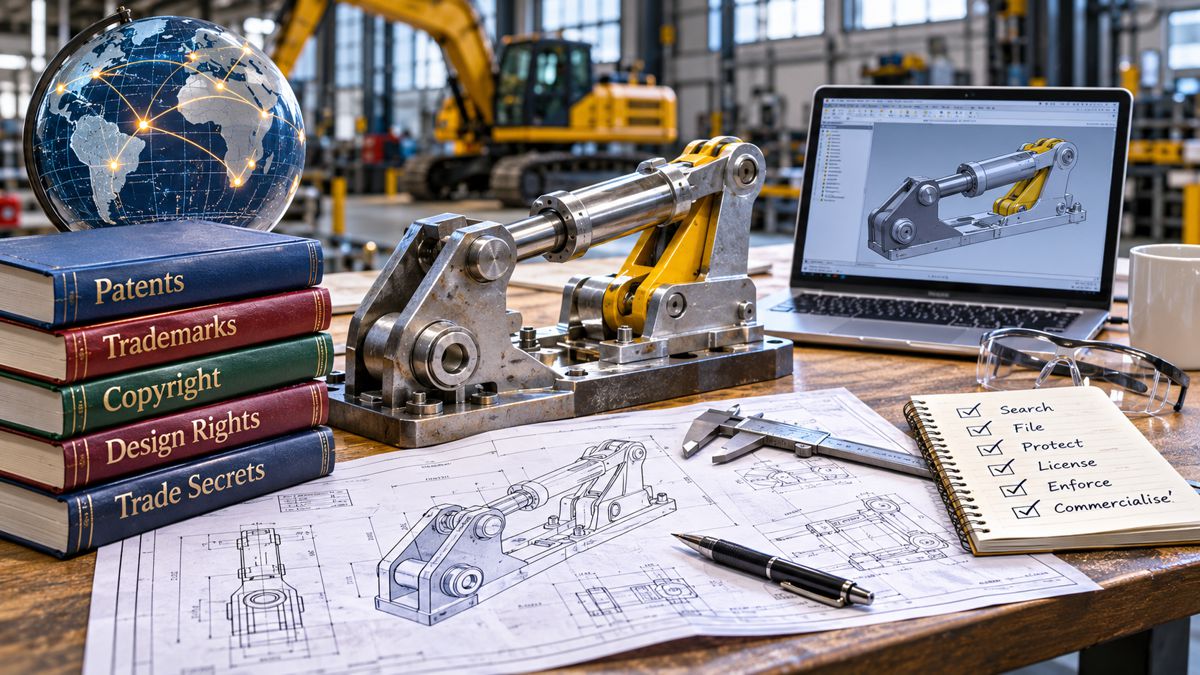
A commercial product may contain several different forms of intellectual property, each protecting a distinct aspect of its value.
A piece of construction machinery might incorporate a patented mechanism, copyrighted software, a registered trade mark and a distinctive housing protected by design rights. Its manufacturing process might also rely on confidential technical knowledge that the manufacturer chooses not to disclose.
| Protection | Principal purpose | Typical application |
|---|---|---|
| Patent | Technical inventions and processes | Mechanisms, materials, production methods |
| Registered design or US design patent | Product appearance | Equipment housings, tools, lighting |
| Trade mark | Commercial identity | Brands, logos, product names |
| Copyright | Original creative expression | Software, drawings, manuals, photographs |
| Trade secret | Confidential commercially valuable information | Manufacturing methods, formulations, calibration processes |
Registered Designs and Design Patents
Registered designs generally protect qualifying visual features of products, including shapes, configurations, patterns and decorative elements.
In the UK, registered design protection can continue for up to 25 years through successive renewals. Modern US design patents generally last 15 years from grant, although the systems differ in examination requirements, scope and enforcement.
These rights can be useful for industrial equipment manufacturers seeking to protect distinctive product appearances. They do not, however, provide the same protection for underlying technical functionality as a utility or invention patent.
The Hague System provides eligible applicants with a coordinated route for seeking industrial design protection internationally.
Trade Marks and Commercial Identity
Trade marks protect signs that distinguish one company’s products or services from those of another. Names, logos and other qualifying identifiers can become valuable as manufacturers establish reputations for reliability, safety and technical support.
A patent may eventually expire, but a registered trade mark can potentially continue through successive renewals as long as the relevant legal requirements are satisfied.
The standard USPTO trade mark application fee starts at $350 per class of goods or services. In the UK, the online filing fee for one class is currently £205, approximately $273 using the November 2026 reference rate.
The Madrid System offers a coordinated international registration procedure, although individual national or regional authorities continue to determine whether protection is available.
Copyright and Technical Documentation
Copyright generally protects qualifying original expression, including software code, technical drawings, photographs, specifications and operating manuals.
In most jurisdictions, copyright arises automatically when qualifying work is created. The Berne Convention establishes important international principles governing the protection of literary and artistic works.
The United States also offers an official copyright registration system, which can provide important legal and evidential advantages when pursuing infringement claims. The UK has no official copyright registration system, although creators can retain records and other evidence establishing when their work was produced.
Copyright generally protects the expression of an idea rather than the underlying technical principle. Copyright in an engineering drawing does not necessarily prevent another manufacturer from independently developing equipment that performs the same function.
Utility Models and Incremental Engineering
Some countries offer utility models, sometimes described as second-tier patents or petty patents. These can provide protection for certain technical improvements through procedures that may be quicker or less demanding than conventional patent examination.
Their eligibility requirements, duration and legal strength vary considerably between jurisdictions. Utility models can be particularly relevant to mechanical improvements, tools and practical equipment innovations, although they are not available everywhere.
The United States and United Kingdom do not offer equivalent general-purpose utility model systems. Inventors therefore need to understand the available forms of protection in each country rather than assuming that patent categories are internationally interchangeable.
Trade Secrets and Confidential Know-How
Some innovations may be more effectively protected by keeping technical information confidential. Manufacturing formulations, production settings, specialist calibration methods and proprietary industrial processes can retain commercial value without being publicly disclosed.
Unlike patents, trade secrets do not necessarily expire after a fixed period. However, they generally cannot prevent lawful independent development or reverse engineering, and protection depends on reasonable efforts to preserve confidentiality.
The choice between patent protection and trade secrecy often depends on whether competitors can discover the underlying technique by examining the finished product. Manufacturing processes that remain concealed within a factory may present different commercial considerations from products whose operation becomes apparent when dismantled.
Who Owns an Invention Developed at Work?
The person who develops an invention is not necessarily entitled to own the resulting patent. Employment law, contractual arrangements and the circumstances in which the invention was created can determine whether rights belong to an individual, employer or another organisation.
In the United States, inventorship is determined by contribution to the conception of the claimed invention, while ownership may depend on assignments and other legal arrangements. Employment alone does not resolve every ownership question.
The UK Patents Act 1977 contains specific provisions concerning employee inventions. Depending on the employee’s duties and the circumstances involved, rights may belong to the employer.
Section 40 also provides a mechanism through which qualifying employees can seek compensation where an invention or patent has provided an outstanding benefit to the employer and the statutory conditions are satisfied. The threshold is demanding, but it recognises that an employee’s contribution may occasionally justify compensation beyond ordinary employment arrangements.
Shanks v Unilever: When an Employee Invention Becomes Valuable
Professor Ian Shanks developed technology for blood glucose testing devices while employed by a Unilever research subsidiary in the early 1980s. Although Unilever did not manufacture the devices itself, the resulting patents generated approximately £24 million in licensing and other income.
Shanks argued that the patents had provided an outstanding benefit to his employer and that he was entitled to compensation under Section 40 of the Patents Act 1977. His claim began in 2006 and progressed through several legal proceedings before reaching the UK Supreme Court.
On 23 October 2019, the Supreme Court ruled in his favour, awarding £2 million after 13 years of litigation. The Court accepted that a fair share of the patent-related benefit was 5%, with the monetary award reflecting the passage of time.
The ruling also addressed how that benefit should be measured. Earlier decisions had placed excessive weight on Unilever’s enormous overall turnover and profits, making substantial patent income appear relatively insignificant within the wider corporation.
The Supreme Court rejected that approach, requiring an appropriate assessment of the benefit in the context of the employer’s undertaking. Its judgment provided important guidance for employee inventors, although the statutory threshold for compensation remains demanding and the length of the proceedings illustrates the difficulties that can accompany even a successful claim.
Collaborative Engineering and Ownership
Ownership becomes particularly complicated when innovations emerge through subcontracting, joint research or collaboration between inventors and manufacturers.
A construction contractor might identify a recurring problem, commission a consultant to develop a solution and work with an equipment manufacturer to produce a commercial product. Without clear agreements, uncertainty may arise over the original invention, subsequent improvements and associated documentation.
Contracts addressing intellectual property ownership, confidentiality, licensing and improvement rights should therefore be established before collaborative development creates competing expectations. These arrangements can become especially important when several businesses contribute engineering knowledge, software and manufacturing expertise to the same product.
Patent Enforcement and the Cost of Litigation
Patent protection is intended to reward technical innovation, but its practical value depends partly on the owner’s ability to enforce it.
An independent inventor might secure a patent after investing years of development work and several thousand dollars. If a larger manufacturer subsequently introduces a potentially infringing product, the inventor may face legal proceedings involving specialist lawyers, expert witnesses, technical evidence and extensive procedural costs.
The financial imbalance can be considerable. The American Intellectual Property Law Association’s 2025 Report of the Economic Survey provides an indication of the potential expenditure, with published reporting identifying the following median estimated costs for US patent infringement litigation.
| Amount at risk | Through discovery, motions and claim construction | Through trial, post-trial and appeal |
|---|---|---|
| $1 million to $10 million | $600,000 | $1 million |
| $10 million to $25 million | $1.5 million | $3 million |
Figures are median survey estimates, not fixed legal fees or forecasts for individual disputes. The full AIPLA report requires paid or member access.
A large manufacturer may have in-house lawyers, specialist litigation budgets and extensive patent portfolios. An individual inventor may possess only one patent, limited financial reserves and no reliable method of funding prolonged proceedings.
Even a legally credible case can become commercially impractical when enforcement expenses threaten to exceed the resources available to the rights holder. The difference between relatively modest patent application fees and potentially substantial litigation expenditure remains one of the system’s most significant barriers.
Sioux Steel: An Industrial Patent Dispute
Sioux Steel Company, a family-owned American equipment manufacturer established in 1918, began infringement proceedings against Prairie Land Millwright Services in 2016 over patented grain bin sweep technology.
The dispute subsequently involved both federal court litigation and challenges before the USPTO’s Patent Trial and Appeal Board. It continued for several years, requiring the manufacturer to defend its patent rights through different legal procedures.
In December 2022, a jury awarded approximately $11.8 million, including $11.4 million in lost profits and an additional reasonable royalty. The jury found willful infringement, and subsequent proceedings resulted in a permanent injunction.
The case ultimately led to a reported payment of approximately $13.8 million in 2024, including interest and costs. The outcome illustrates how damages and injunctions can both affect the commercial consequences of patent infringement.
Sioux Steel had obtained intellectual property enforcement insurance before the infringement began, helping finance covered legal expenses during the prolonged dispute. The company was an established manufacturer with commercial resources, making the case an example of how financial preparation and insurance can support enforcement rather than a typical experience of an individual inventor.
An October 2026 IPWatchdog article discussed the proceedings and was sponsored by IPSIC, an intellectual property insurance provider. The author disclosed that their company had been involved in the case.
When Litigation Becomes Commercial Leverage
Patent litigation serves a legitimate purpose when valid rights have been infringed. However, the expense of defending a case can influence commercial negotiations before a court reaches a decision.
A business facing a questionable infringement claim may decide that settlement is cheaper than proving its position in court. Conversely, an inventor with credible rights may accept an inadequate licensing agreement because pursuing litigation would be too expensive.
These pressures can distort the relationship between invention and reward. Smaller patent owners sometimes succeed against substantially larger opponents, while defendants can successfully challenge invalid or excessive claims, but unequal resources can influence which disputes reach trial and whether commercially reasonable settlements are achievable.
Patent Assertion and Non-Practising Entities
Organisations that own patents without manufacturing products are commonly described as non-practising entities, or NPEs. Some are more critically labelled patent trolls, although the two terms should not be treated as interchangeable.
Universities, independent inventors and research institutions frequently license inventions without manufacturing them, and that activity is a legitimate part of the innovation economy. Specialist licensing and enforcement companies can also provide access to financial resources that inventors would otherwise lack.
Concerns arise where weak, excessively broad or questionable claims are asserted primarily to extract settlements from businesses unwilling to finance prolonged legal proceedings.
A report, drawing on the 2025 AIPLA survey, reported that litigation involving NPEs costs approximately 35% more than disputes between operating competitors.
The comparison should be treated as an industry-reported finding rather than evidence that every NPE claim is abusive. The more fundamental concern is the potential use of litigation expense as negotiating leverage, regardless of the technical strength of the patent.
Challenging Patents in the United States
The United States provides administrative mechanisms for challenging certain granted patents through the Patent Trial and Appeal Board.
Inter partes review, or IPR, allows eligible challenges to certain patent claims based on specified prior patents or printed publications. Post-grant review, or PGR, offers a broader range of potential challenges during a limited period following patent grant.
These procedures were designed partly to provide alternatives to conventional federal court litigation, although they can still involve significant expense. The policies governing whether petitions are accepted for review have also changed substantially during 2025 and 2026.
Industry reporting indicated that institution rates fell significantly over this period, with average rates of approximately 60–70% in October 2024 declining to around 30–40% by July 2026. These are reported trends rather than predictions for individual challenges, but they show how administrative policy can affect the accessibility of patent review.
A further change was announced by the USPTO on 10 November 2026. Under arrangements taking effect on 16 November, PTAB judges will resume evaluating merits-based considerations when determining whether to institute IPR and PGR proceedings on the Director’s behalf.
The Director will continue reviewing non-merits-based considerations, including discretionary factors, under the revised procedure. The change is explained in the USPTO’s official announcement.
More restrictive institution policies may help patent owners avoid repeated challenges, including smaller inventors attempting to defend legitimate rights. However, they can also make it harder for businesses facing questionable claims to obtain administrative review.
The appropriate balance remains contested because both patent owners and accused infringers may be financially vulnerable. An efficient review mechanism must protect valid inventions while providing a realistic route for challenging rights that should not have been granted.
Patent Portfolios and Barriers to Competition
Major industrial and technology companies frequently maintain extensive patent portfolios covering products, components, processes and incremental developments.
Some patents protect valuable inventions, while others provide defensive leverage in cross-licensing negotiations or disputes with competitors. As portfolios accumulate, businesses can encounter patent thickets, where overlapping rights make it difficult to determine which licences are needed to commercialise a product.
Negotiating access to numerous patents may become prohibitively complicated for smaller manufacturers. Even where no individual patent presents an insurmountable obstacle, the combined legal and administrative burden can discourage market entry.
The system can consequently reward both technical development and the financial ability to accumulate intellectual property rights. Concerns about patent quality, excessive claim breadth and successive applications intended primarily to extend commercial exclusivity add further complexity.
Follow-on innovation is frequently legitimate and valuable, but additional patents do not necessarily represent equally significant technical advances. The challenge is to distinguish meaningful improvements from strategies that primarily increase the cost of competing.
When Published Patents Benefit Competitors
Patent applications generally become public before their commercial value has been established. Once published, the technical information can be accessed internationally, including by manufacturers operating in countries where the inventor has not obtained enforceable rights.
Competitors may be able to study the invention and develop products for territories outside the patent’s geographical coverage. They can also investigate alternative designs that avoid the claims while using knowledge gained from the published material.
Disclosure remains a central benefit of the patent system because it makes technical knowledge available for future development. Nevertheless, it creates a strategic dilemma where an inventor can afford protection in only a limited number of countries while making the underlying technology visible worldwide.
Lower-Cost Patent Enforcement and Insurance
Several mechanisms can reduce the financial barriers associated with intellectual property disputes, although none eliminates litigation risk entirely.
The UK’s Intellectual Property Enterprise Court offers specialist procedures intended to make certain disputes more proportionate. Its multi-track arrangements ordinarily limit damages to £500,000, approximately $665,500, while recoverable legal costs are subject to a general cap of £60,000, approximately $79,900, subject to applicable rules and exceptions.
These limits do not mean that a party’s actual legal expenditure cannot exceed the recoverable amount. They constrain aspects of the financial exposure and potential recovery associated with the procedure.
The UK IPO also provides a patent opinions service, allowing parties to request a non-binding assessment of infringement or validity issues.
The official fee is £250, approximately $333, making it a potentially useful preliminary step before more expensive proceedings. However, the opinion does not itself establish infringement liability or award damages, and material submitted in the process is not treated as confidential.
In the United States, the USPTO Patent Pro Bono Program helps qualifying financially under-resourced inventors obtain professional assistance with patent preparation and prosecution. That assistance does not necessarily extend to financing later infringement litigation.
Intellectual Property Insurance
Intellectual property insurance can help businesses manage legal risks that might otherwise threaten their operations. Defence policies may contribute towards covered costs when a company is accused of infringement, while certain enforcement policies can provide funding for pursuing claims against competitors.
Coverage varies considerably, including exclusions, deductibles, policy limits, qualifying conditions and the insurer’s involvement in litigation decisions. Insurance cannot turn a weak patent into a strong one, and it may be unavailable or prohibitively expensive for some businesses.
The Sioux Steel case demonstrates how insurance arrangements can support an established manufacturer through prolonged enforcement proceedings. Litigation funding and contingency-fee agreements may provide alternatives, although these introduce questions about cost, control and the distribution of any eventual recovery.
Can the Patent System Be Made Fairer?
The weaknesses of the patent system do not necessarily justify abandoning exclusive intellectual property rights. Without meaningful protection, businesses and individuals may have fewer incentives to invest in difficult or expensive research.
The challenge is to preserve those incentives while reducing the disproportionate financial risks associated with obtaining and enforcing legitimate rights. More accessible dispute resolution, specialist legal assistance, proportionate court procedures and improved patent examination could help reduce unnecessary expenditure.
International cooperation can lower duplication and improve consistency, although administrative harmonisation cannot resolve differences between national courts, legal remedies and enforcement costs.
A more effective system would allow legitimate rights to be defended without unreasonable financial exposure while making it possible to challenge weak or excessive patents through proportionate procedures. Achieving that balance would benefit inventors seeking commercial rewards and manufacturers needing confidence that their products can enter the market without unnecessary legal uncertainty.
Licensing and Commercialising an Invention
Many inventors do not want to establish their own manufacturing businesses. Their objective is to persuade an established company to develop, manufacture and distribute the technology.
Licensing provides one potential route. A manufacturer receives permission to use specified intellectual property in exchange for an upfront payment, royalties, minimum commitments or another negotiated arrangement.
This can be particularly attractive in construction equipment and industrial technology, where commercialisation may involve tooling, regulatory approvals, independent safety testing, distribution and continuing technical support.
Manufacturers will consider more than the existence of an application number. They will assess whether the invention works, whether customers will purchase it, whether protection is likely to be enforceable and whether competitors could develop alternative solutions.
Commercial agreements also need to address territorial rights, exclusivity, quality control, subsequent improvements and ownership of jointly developed technology. A manufacturer may contribute considerable expertise during prototyping and certification, creating additional intellectual property that affects the relationship with the original inventor.
A well-structured licensing agreement can help both parties share development costs and commercial opportunities. Poorly defined terms may leave the inventor with limited influence over the product’s future or create disputes over ownership of improvements developed during commercialisation.
When Not Patenting May Be the Better Decision
Not every invention justifies a patent application. A product with a short commercial lifespan might become obsolete before protection is granted, while a device that competitors can easily redesign may provide limited practical exclusivity.
Certain industrial processes may be better protected through confidential know-how than by disclosing their technical details in a patent application. Other innovators deliberately publish technical information or distribute developments through open-source arrangements, encouraging collaboration and wider adoption.
Public disclosure can help establish prior art against later patent claims covering the disclosed subject matter, but the decision must be made carefully because publication may also compromise the inventor’s own opportunities for protection.
The appropriate strategy depends on technical novelty, commercial value, available resources, target markets and the ability to enforce or exploit the resulting rights. Intellectual property expenditure should be directed towards protecting viable commercial opportunities rather than accumulating registrations without a clear business purpose.
Key Industry Questions
- Should an inventor file before approaching a manufacturer? Filing before disclosing detailed technical information is generally the safer strategy where international patent protection is contemplated. Confidentiality agreements can provide additional safeguards, but they depend on contractual enforcement and should be supported by careful disclosure management.
- Is a prototype required before applying for a patent? A working prototype is not always necessary. However, an application must sufficiently explain the invention, describe how it can be implemented and support the protection being claimed.
- Can a provisional application protect an invention internationally? A qualifying initial application may establish a priority date relevant to subsequent international filings, but it does not automatically create enforceable foreign patent rights. Appropriate national or regional applications must still be pursued within the relevant deadlines.
- Who owns an invention created during employment? Ownership depends on the jurisdiction, employment duties and contractual arrangements. Inventorship and ownership are separate legal concepts, while some countries provide limited statutory compensation mechanisms for qualifying employee inventions.
- Can an invention be licensed before a patent is granted? Yes. Licensing arrangements can concern pending applications, confidential know-how and associated intellectual property, although the value and enforceability of the agreement may depend on whether protection is ultimately granted.
- What happens if a manufacturer introduces a similar product? The patent holder must assess whether the product falls within enforceable claims and whether infringement proceedings are commercially justified. Negotiation, licensing, administrative review and litigation may be relevant depending on the circumstances.
- Is there a way to challenge infringement without full litigation? Mediation, negotiated settlements, specialist courts and certain administrative procedures can provide alternatives. Their availability differs between jurisdictions, and the merits of a dispute may still require formal determination.
- Is a patent worthwhile if enforcement would be unaffordable? A patent may still support licensing, investment or commercial negotiations, but its practical value must be assessed realistically. Insurance, litigation funding, manufacturing partnerships and alternative intellectual property strategies may influence that decision.
Strategic Takeaways
- Treat intellectual property as a commercial investment. Filing decisions should reflect market potential, technical novelty and the likely value of enforceable protection.
- Understand the complete financial commitment. Initial filing fees are only a small part of the possible costs of examination, international applications, renewals and litigation.
- Plan internationally before disclosure. Priority deadlines, national grace periods, manufacturing locations and target markets should inform early decisions.
- Use complementary protection where appropriate. Patents, trade marks, registered designs, copyright and confidential know-how can protect different aspects of the same product.
- Account for enforcement and operational risk. Licensing agreements, insurance, freedom-to-operate assessments and proportionate dispute procedures can be as important as obtaining the patent itself.
Intellectual Property as Part of the Innovation Process
The international patent system has evolved considerably since its earliest foundations. Cooperation between patent offices, regional protection arrangements and international filing procedures have reduced some of the administrative obstacles faced by inventors seeking protection across multiple countries. Patents also continue to encourage technical disclosure and provide mechanisms through which inventors and investors can recover development costs.
Yet the gap between registration and enforcement remains substantial. An individual can develop a valuable invention, obtain legitimate rights and still lack the resources needed to defend them against a determined competitor. Meanwhile, large manufacturers may require extensive legal and technical assessments simply to establish whether a new product can be introduced without infringing existing patents.
Engineering businesses should therefore consider intellectual property long before a design reaches production. Patent searches, ownership agreements, licensing arrangements and international filing decisions can influence development budgets, procurement strategies, manufacturing partnerships and product launch schedules. The strongest commercial position belongs to the business that has established how its technology will be protected, manufactured and brought to market before committing significant resources to production.
Official Resources and Further Reading
Patent Systems and International Protection
- United States Patent and Trademark Office
- USPTO Patent Fees
- USPTO Provisional Patent Applications
- UK Intellectual Property Office
- World Intellectual Property Organization
- Patent Cooperation Treaty
- European Patent Office
- Unified Patent Court
- Japan Patent Office PPH Portal
- China National Intellectual Property Administration
- India Intellectual Property Office
Copyright, Trade Marks and Designs
Patent Enforcement and Commercial Risk
- AIPLA 2025 Report of the Economic Survey
- USPTO Patent Pro Bono Program
- USPTO November 2026 PTAB Institution Announcement
- UK Intellectual Property Enterprise Court
- UK IPO Patent Opinions Service
- Shanks v Unilever, UK Supreme Court
- IPWatchdog: The True Cost of Patent Infringement Litigation
Editorial note: Financial amounts are expressed in US dollars, with UK fees converted using the indicative 11 November 2026 ECB-derived reference rate of £1 = US$1.331. Litigation figures are drawn from published reporting of the AIPLA’s 2025 Economic Survey, whose complete report requires paid or member access. Fees, procedures and legal requirements vary by jurisdiction and may change. This article provides general industry information rather than jurisdiction-specific legal advice.