Asphalt Pavement Emissions Over 250 Times Lower Than Previous Estimates
Peer-reviewed research from the University of California, Riverside has found that emissions from compacted asphalt pavements are minimal under the conditions examined, largely localised and more than 250 times lower than estimates reported in earlier, widely cited research. The findings challenge previous assumptions about the contribution of asphalt roads to urban air pollution and suggest that emissions from in-service pavements may have been substantially overstated.
Published in ACS ES&T Air, the study, Primary and Secondary Emissions from In-Service Compacted Hot Mix Asphalt Pavement, examined how volatile organic compounds are released from asphalt long after construction has finished. By accounting for pavement compaction, the limited accessibility of bituminous binder and the effects of ageing, researchers calculated lifetime emissions more than 250 times lower than an earlier estimate based on different assumptions about the availability of compounds within the material.
Asphalt production and paving operations are established sources of emissions, but the behaviour of completed roads is a separate question. Once compacted and opened to traffic, asphalt becomes a relatively dense structure of mineral aggregates and bituminous binder, exposed to sunlight, temperature fluctuations and atmospheric weathering over many years. Understanding how that material behaves is essential when estimating its contribution to urban air pollution.
Briefing
- Peer-reviewed research found that estimated lifetime emissions from compacted asphalt pavement were more than 250 times lower than an earlier published estimate.
- Outdoor measurements under Southern California summer conditions were generally indistinguishable from background air and below the study’s detection limits.
- Laboratory emissions at 60°C declined approximately 50-fold between the first and seventh days.
- The study estimated secondary organic aerosol formation of approximately 5.2 kg per day across Southern California’s South Coast Air Basin under its constant-temperature modelling scenario.
- Pavement compaction, binder ageing, temperature and ultraviolet exposure all influence emissions, making the physical condition of the asphalt central to accurate assessments.
New Measurements Challenge Earlier Emission Estimates
The research, published 7 October 2026, was conducted by scientists at the University of California, Riverside, including Huawei Li, Yanyu Zhang and David R. Cocker. Their investigation combined controlled laboratory testing, outdoor exposure experiments and atmospheric chemistry measurements to assess emissions from compacted hot mix asphalt.
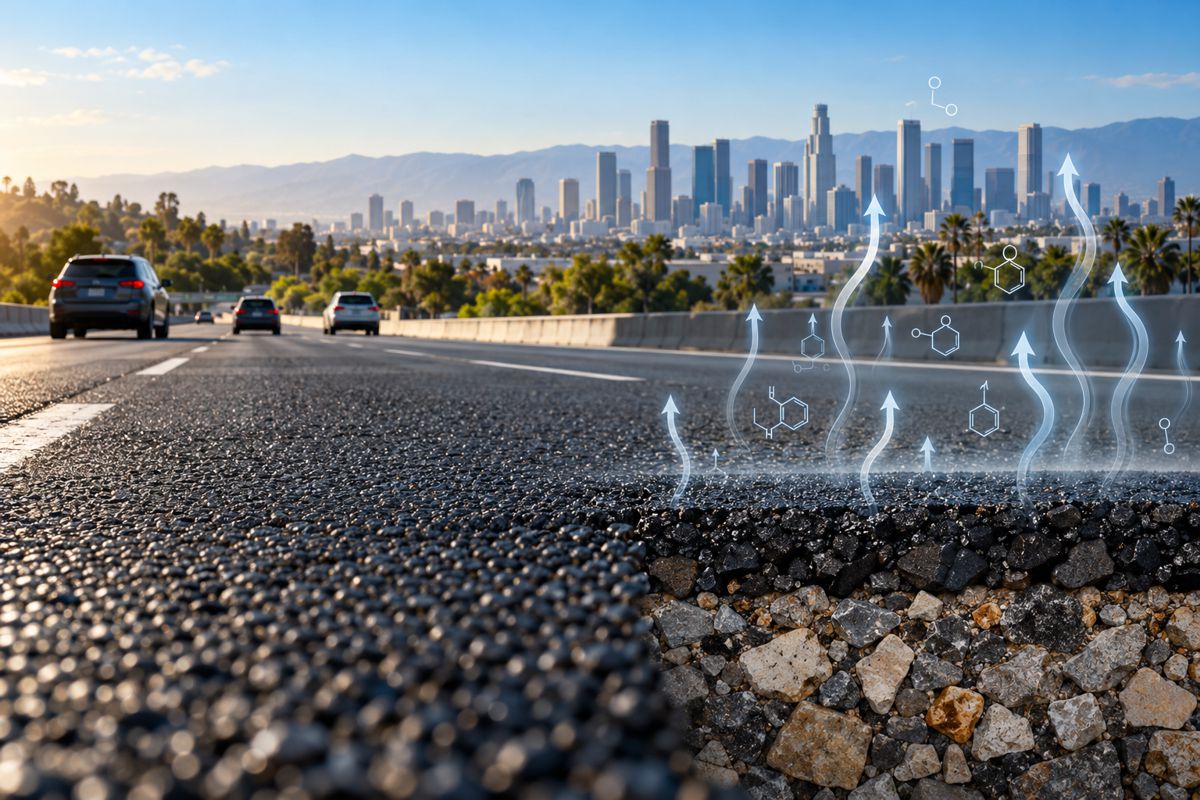
The researchers examined both primary emissions, consisting of compounds released directly from the pavement, and secondary emissions associated with chemical reactions in the atmosphere. These secondary processes can produce organic aerosol, a component of airborne particulate matter that contributes to urban air pollution.
Using compacted asphalt specimens manufactured to recognised pavement specifications, the researchers measured volatile organic compounds (VOCs) and intermediate-volatility organic compounds (IVOCs) under different environmental conditions. Their results were considerably lower than some earlier estimates, particularly when the material was exposed to temperatures representative of actual outdoor operation rather than sustained laboratory heating.
During outdoor experiments under Southern California summer conditions, measured VOC and IVOC concentrations were generally indistinguishable from background air and below the study’s detection limits. Although this does not establish that emissions were completely absent, it indicates that releases from the tested compacted asphalt were too small to be reliably distinguished from surrounding atmospheric concentrations using the experimental methods employed.
Laboratory testing at a constant 60°C produced measurable emissions, but these declined rapidly. The estimated VOC emission factor fell from approximately 528 micrograms per square metre per hour on the first day to 11 micrograms by the seventh day, a reduction of roughly 50-fold. The sustained laboratory temperature also represented a more severe exposure condition than the daily heating and cooling experienced by most roads.
Why Compacted Asphalt Behaves Differently
The physical structure of compacted asphalt is central to understanding the difference between the new findings and earlier estimates.
Hot mix asphalt contains bituminous binder distributed around mineral aggregates, with a relatively small proportion of interconnected air voids remaining after compaction. Much of the binder is enclosed within the pavement structure rather than freely exposed to the atmosphere, restricting the movement of volatile compounds from the material into the surrounding air.
Earlier experimental approaches sometimes assumed that a much larger proportion of the binder could release volatile compounds over time. When these assumptions are extended across extensive road networks and projected over decades, they can produce substantially higher estimates of cumulative emissions.
The Riverside researchers tested compacted specimens with thicknesses of 38, 76 and 115 mm, finding that thicker specimens generally sustained emissions for longer. The movement of compounds through the material was a significant constraint, while ageing progressively reduced their availability and mobility.
As bitumen ages, oxidation generally increases binder stiffness and viscosity, while the movement of volatile compounds through the asphalt matrix becomes increasingly restricted. The pavement’s internal structure therefore influences both the initial release of emissions and their decline over time.
The research also examined material recovered from a roadway in Indianapolis originally constructed in 1995, alongside adjacent concrete pavement of a similar age. These field-aged samples provided a comparison with newly prepared laboratory specimens, extending the investigation beyond freshly manufactured asphalt.
Temperature, Sunlight and Atmospheric Chemistry
Temperature influences the rate at which volatile compounds are released from asphalt, but the distinction between laboratory heating and real-world exposure proved substantial.
During outdoor experiments, ambient summer temperatures ranged from approximately 32°C to 46.1°C, while asphalt specimens approached 60°C for only limited periods. By comparison, laboratory specimens maintained continuously at 60°C experienced sustained heating that accelerated the release of detectable compounds.
The researchers concluded that actual emissions under the outdoor conditions examined were at least 20 times lower than their constant-temperature laboratory estimates. A pavement that heats during the day and cools overnight therefore cannot necessarily be represented accurately by measurements taken under continuous elevated temperatures.
Ultraviolet radiation introduced another variable. The study found that UV exposure could increase emissions by approximately two to five times under the tested conditions, indicating that sunlight can influence the chemical behaviour of asphalt even after its initial volatile constituents have diminished.
A newly constructed pavement exposed to intense sunlight may consequently behave differently from an older surface with a hardened binder and restricted internal diffusion pathways. The relative effects of temperature, ultraviolet radiation and ageing also depend on the asphalt formulation and the conditions under which it is tested.
Reassessing Asphalt’s Contribution to Urban Air Pollution
The researchers used their measurements to estimate potential emissions across Southern California’s South Coast Air Basin, an extensively urbanised region with substantial road infrastructure and established air-quality monitoring programmes.
Under a constant-temperature scenario of 60°C, the study estimated approximately 5.2 kg of secondary organic aerosol formation per day attributable to hot mix asphalt. The researchers reported that this represented less than 0.0099% of the particulate matter benchmark used in their comparison with the region’s 2022 Air Quality Management Plan.
This was a modelled regional estimate rather than a direct measurement of every road surface in the basin. It depended on the experimental emission factors, atmospheric chemistry assumptions and pavement characteristics incorporated into the calculation. Nevertheless, the estimated contribution was extremely small relative to the regional benchmark used by the researchers.
The lifetime calculations produced an even more striking comparison with earlier research.
When emissions were assumed to decline exponentially as the pavement aged, the researchers estimated a cumulative mass loss of approximately 0.00002% over 20 years. This was more than 250 times lower than an earlier published estimate that assumed a substantially greater proportion of the asphalt binder remained accessible for volatile release.
Even a deliberately conservative upper-bound calculation produced an estimated lifetime mass loss of approximately 0.00035%.
The more-than-250-fold difference concerns modelled cumulative emissions under different assumptions, rather than a universal ratio between directly measured emission rates. It nevertheless demonstrates how strongly estimates can depend on whether the compacted structure and ageing behaviour of asphalt are adequately represented.
Reconciling Different Research Findings
The new study challenges earlier estimates without establishing that every asphalt pavement produces negligible emissions under all operating conditions. Other researchers have recorded higher emission rates, including experiments involving ultraviolet radiation and aged pavement samples.
Differences in material preparation, binder chemistry, pavement porosity, exposure conditions and measurement duration can influence the results. A specimen tested for several hours under intense radiation cannot necessarily be compared directly with a compacted sample monitored over several weeks.
The Riverside researchers acknowledge previous findings indicating that ultraviolet radiation can increase emissions even from heavily aged asphalt. Surface chemistry and environmental weathering therefore remain relevant alongside the diffusion processes identified in their experiments.
Different asphalt technologies also introduce variables that require separate investigation. Hot mix asphalt, warm mix asphalt, polymer-modified binders and mixtures containing reclaimed asphalt pavement can differ in composition, production temperature and material characteristics. The findings from the tested compacted hot mix asphalt specimens cannot automatically be applied to every pavement formulation.
Nor do the results address every environmental issue associated with asphalt. Emissions from production plants, hot paving operations, construction workers’ exposure and the broader lifecycle impacts of bitumen production remain separate considerations. The investigation concentrates on chemical emissions from compacted pavement during service.
Implications for Pavement Research and Environmental Assessment
The findings have direct relevance to how emissions from road infrastructure are measured and represented in environmental assessments.
Laboratory testing that exposes unusually large quantities of binder, maintains elevated temperatures or overlooks changes in material properties over time may produce emission factors that are difficult to reconcile with actual pavement conditions. Extrapolating those results across entire road networks can magnify the difference, particularly when cumulative emissions are calculated over decades.
The Riverside study demonstrates the value of testing compacted specimens with realistic internal structures and accounting for the depletion and diffusion restrictions that develop as asphalt ages. Its outdoor experiments also provide a comparison with laboratory conditions, although measurements across additional climates, pavement ages and material formulations would be needed to establish how widely the results apply.
For asphalt producers and road authorities, the research provides evidence that emissions from completed, compacted pavement may be considerably smaller than previously suggested. It does not establish a basis for changing asphalt specifications or dismissing other environmental considerations associated with road construction.
The central finding is that estimated lifetime emissions from compacted asphalt were more than 250 times lower than those reported in earlier research, while outdoor measurements under the conditions examined were generally below detection limits. The results support a substantially smaller contribution from in-service asphalt pavements to urban air pollution than some previous estimates proposed, subject to further validation across different materials and environments.
Key Industry Questions
- How much pollution do completed asphalt roads produce? The study found that emissions from tested compacted asphalt specimens were generally below detection limits under outdoor summer conditions. Modelled contributions to regional secondary organic aerosol formation were also very small.
- Were previous estimates of asphalt pavement emissions too high? The researchers calculated lifetime emissions more than 250 times lower than an earlier published estimate. The difference was strongly influenced by assumptions about binder accessibility, compaction and ageing.
- Does asphalt continue releasing chemicals after construction? Yes. Compacted asphalt can release volatile and intermediate-volatility organic compounds during service, although the measured quantities in this study were small and declined as the material aged.
- What is secondary organic aerosol? Secondary organic aerosol consists of particulate material formed when organic compounds undergo chemical reactions in the atmosphere, rather than being emitted directly as particles.
- Does hot weather increase asphalt emissions? Yes. Higher temperatures increased emissions in laboratory experiments, although actual outdoor measurements were substantially lower than estimates based on continuous exposure at 60°C.
- How does sunlight affect asphalt emissions? Ultraviolet radiation increased emissions by approximately two to five times under the experimental conditions examined. The response may vary with binder composition, pavement age and exposure conditions.
- Why does compaction reduce emissions? Compaction limits the amount of binder directly exposed to the atmosphere and restricts the movement of volatile compounds through the pavement’s internal structure.
- Do these findings apply to warm mix and recycled asphalt? Not automatically. Different asphalt formulations and recycled material contents may influence emissions, requiring specific testing before comparable conclusions can be drawn.
- Does the research establish that asphalt is environmentally harmless? No. It addresses atmospheric emissions from compacted pavement during service, rather than the complete environmental impacts of asphalt production, construction, maintenance and disposal.
Strategic Takeaways
- Peer-reviewed research challenges earlier lifetime asphalt pavement emission estimates by a factor exceeding 250, although the comparison depends on the assumptions used in the respective calculations.
- Emissions measured from compacted asphalt under realistic outdoor conditions were generally below detection limits, supporting a limited and largely localised atmospheric contribution under the tested conditions.
- Pavement compaction and binder ageing substantially restrict the release of volatile compounds, making material structure central to credible emissions estimates.
- Laboratory measurements obtained under sustained elevated temperatures can overstate emissions relative to outdoor pavement conditions.
- Environmental assessments should distinguish emissions from completed asphalt pavements from those associated with asphalt production, paving operations and other lifecycle processes.