AI-Powered Property Inspections Move Closer to Automated Maintenance Management
SnapInspect has introduced three artificial intelligence features that allow property inspectors to document building conditions by voice, generate maintenance work orders from recorded defects and create automated workflows using ordinary language. The additions bring inspection reporting and maintenance administration closer together within a single software environment.
The new capabilities address a familiar problem in facilities management. Inspectors gather observations and photographs while moving through buildings, but turning that information into structured reports, assigning repairs and following up on outstanding defects can involve considerable administrative work. SnapInspect is seeking to reduce that burden by connecting the inspection process more directly with the maintenance activities that follow.
The technology is aimed at property managers, building inspectors and facilities teams responsible for maintaining residential, commercial and institutional buildings. Its introduction also comes as artificial intelligence becomes more widely used in property management, although the industry’s arrangements for governing that technology have been developing at a considerably slower pace.
Briefing
- SnapInspect is introducing AI-assisted inspections, automated maintenance work orders and natural-language workflows.
- Inspectors can record spoken observations and photographs, with AI processing the material into structured inspection checklists.
- Reported defects can be converted into work orders and routed using property information.
- Automated workflows can manage inspection tasks, asset records, notifications and other routine activities.
- A 2026 IREM and AppFolio survey found 58% AI adoption among respondents, but only 8% reported having a written organisational AI policy.
From Site Observations to Inspection Records
Digital inspection software has already replaced much of the paperwork traditionally associated with property assessments. Mobile checklists, photographs and electronic reports allow inspectors to record conditions on site and produce documentation without returning to the office. Completing those records still requires considerable interaction with the application, particularly when an inspection involves numerous rooms, assets or individual defects.
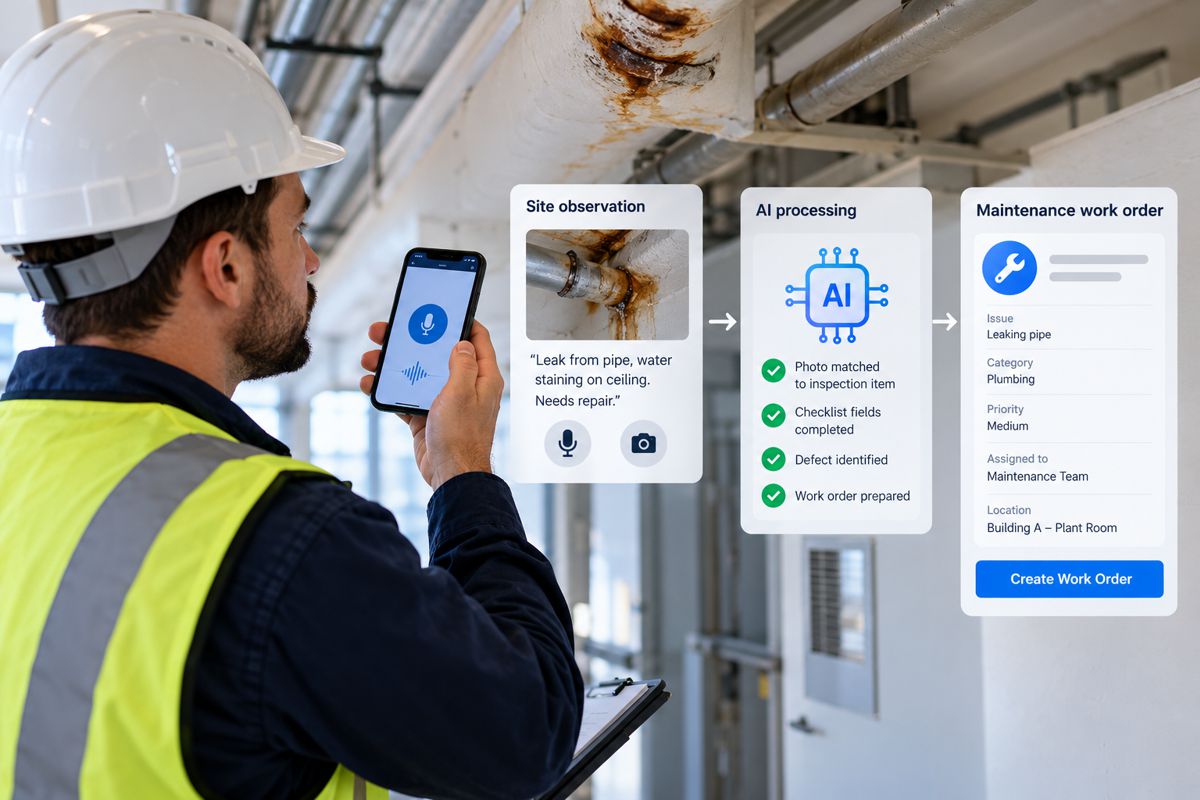
SnapInspect’s AI Inspections feature changes how that information is collected. Using the company’s mobile application on an iPhone or Android device, inspectors can describe conditions aloud while walking through a property and photographing relevant areas. Once an inspection has been signed and completed, the recordings and images are uploaded for processing, with AI matching photographs to checklist items and populating the corresponding fields.
An inspector examining a residential building might describe moisture staining around a window, damaged floor finishes or deteriorating fittings while photographing each affected area. Rather than entering those observations individually into a checklist, the inspector leaves the software to organise the recorded information into the appropriate sections.
The application also supports offline recording, with captured material uploaded when connectivity becomes available. That is a practical consideration in basements, plant rooms and other areas of larger buildings where mobile reception may be unreliable. Automated processing takes place after upload, so inspectors working without a connection will not necessarily have an immediately completed report.
SnapInspect acknowledges that the system may leave checklist items incomplete when it cannot interpret parts of a recording. Inspectors must then complete the missing information manually, while finished AI inspections carry an identifying badge to distinguish them from records produced through the conventional process.
The arrangement reduces the amount of information an inspector needs to enter manually, but the quality of the resulting report still begins with the observations made on site. A photograph may document visible cracking or water damage without establishing the underlying cause, and specialist assessments remain necessary where defects raise structural, electrical or other safety concerns.
Connecting Inspections with Maintenance Work Orders
The second feature extends the process beyond inspection reporting. AI Work Orders allows inspectors to describe a deficiency during a walkthrough and have the observation converted into a maintenance request.
The software can also analyse a photograph, identify the apparent problem, place it into a relevant category and prepare a work order containing supporting notes and details. Property profiles can then be used to direct the task towards an appropriate person or maintenance team.
In a building containing multiple mechanical and electrical systems, an inspection might identify a leaking pipe, damaged lighting and a faulty door mechanism. Each problem requires a different response, yet all three may have been recorded during the same visit. Converting those observations directly into separate maintenance instructions removes some of the administrative work between documenting a defect and arranging corrective action.
That connection is particularly relevant to organisations managing substantial property portfolios, where inspections generate numerous maintenance requests across different locations. Information that previously required copying between inspection reports, emails and maintenance systems can remain associated with the original observations.
There is nevertheless a distinction between generating a work order and managing a repair through to completion. The announcement describes the creation, categorisation and routing of maintenance tasks, but does not establish that AI independently determines repair priorities, diagnoses underlying faults or verifies completed work.
Those responsibilities remain part of the organisation’s maintenance procedures. A defect may be accurately recorded but still require a qualified technician to determine its cause, establish the appropriate response and confirm that the problem has been resolved.
SnapInspect has not provided independently verified figures for defect recognition accuracy, time saved during inspections or reductions in maintenance administration. Such results would help establish how consistently the system performs across different properties and inspection conditions.
Building Workflows Through Ordinary Language
Alongside the inspection and work-order functions, SnapInspect is expanding its ability to automate routine administrative processes through AI Workflows.
Rather than requiring users to configure every step through conventional workflow tools, the system accepts instructions written in everyday language and converts them into repeatable actions. A property manager could instruct it to create a follow-up task whenever a new inspection is recorded, or to send a notification when a particular event occurs.
Workflows can be triggered by inspections, tasks, contacts, new users, scheduled events or manual instructions. Supported actions include creating and updating inspection records, tasks and assets, sending emails and inspection requests, and activating other workflows.
Users can begin with predefined templates or test their instructions against a recent record before putting the automation into operation.
For facilities teams responsible for multiple buildings, the ability to establish common procedures across different properties could simplify routine administration. Follow-up inspections, recurring tasks and maintenance notifications can be configured to operate according to defined rules, reducing the need for staff to initiate each activity individually.
The flexibility also places greater importance on how those rules are written. An ambiguous instruction can produce an unsuitable workflow, while a mistake in a process used across an entire portfolio may be repeated many times before it is identified.
SnapInspect has included several controls to make the configuration and operation of these workflows more visible.
Oversight and Operational Controls
When a workflow is saved, the software checks its instructions and displays a diagram showing the actions it intends to perform. Workflows that fail the system’s checks are automatically disabled, and each execution is recorded in a log that allows users to examine what has taken place.
Only users with Company Manager permissions can configure workflows. The system also prevents a workflow from directly triggering itself and limits chains of connected workflows to five levels, restricting the possibility of uncontrolled sequences of automated actions.
These controls provide a degree of operational transparency, although a successful workflow execution does not necessarily mean that the resulting action was appropriate. A task might be created and assigned exactly as instructed while containing an incomplete defect description or being directed to a team without the required expertise.
Organisations adopting automated inspection and maintenance systems will therefore need to establish which activities can proceed without intervention and which require approval or review. Maintenance involving fire safety equipment, electrical installations or potentially structural defects, for example, may require procedures beyond those used for routine cosmetic repairs.
Voice recording also introduces information-management considerations. Inspections undertaken in occupied buildings may capture conversations, personal belongings or other information unrelated to the condition of the property. Access permissions, storage arrangements, retention periods and the handling of recorded material need to form part of the organisation’s wider data governance arrangements.
AI Adoption Outpaces Formal Governance
The increasing use of artificial intelligence in property management provides useful context for SnapInspect’s latest additions.
A 2026 survey of 3,662 US property management professionals conducted by the Institute of Real Estate Management (IREM) and AppFolio found that 58% of respondents were using AI, compared with 21% in 2023. Among those using the technology, 78% reported doing so daily or almost every day.
Formal governance was less widespread. Only 8% of respondents reported that their organisation had a written AI policy, while 26% said they had received formal AI training.
The figures suggest that many property management businesses are adopting AI tools before establishing comprehensive organisational procedures for their use. The survey covers US respondents rather than the international market, but it provides a useful indication of the challenges facing businesses as AI moves from drafting documents and analysing information into operational activities.
The distinction becomes more pronounced when software begins creating work orders, updating asset records and initiating communications automatically. These activities can affect maintenance schedules, staff workloads and the records used to demonstrate that building management responsibilities have been fulfilled.
SnapInspect’s permission controls, workflow diagrams and execution logs address some of the practical requirements of supervising automation. Decisions about acceptable AI use, data protection, staff training and responsibility for maintenance outcomes remain with the organisations deploying the software.
Building a More Connected Asset Management Process
Property inspections form part of a much larger maintenance and asset management process. Buildings accumulate condition records, repair histories, compliance documentation and recurring inspection requirements throughout their operational lives, often across systems that have developed independently.
Connecting observations made during an inspection with maintenance requests and subsequent asset records can reduce the administrative separation between these activities. The approach has potential applications across commercial property portfolios, public buildings, healthcare estates and transport facilities, where large numbers of assets must be inspected and maintained over many years.
The immediate appeal is relatively straightforward. Inspectors can record what they find while moving through a building, leaving software to organise the information and prepare routine administrative actions. Maintenance teams receive structured requests linked to the original observations, while managers have access to records of the processes that followed.
Whether the approach delivers measurable improvements will depend on its performance in operational use. Recognition accuracy, the quality of generated work orders, compatibility with existing maintenance systems and the time required to review AI-produced records will all influence the benefits realised by individual organisations.
SnapInspect says AI Inspections and AI Workflows are enabled individually for customer organisations, with access available on request rather than automatically across all accounts.
The introduction of these capabilities brings property inspection software further into the operational side of facilities management. The technology can take on much of the recording and administrative work, while inspectors and maintenance professionals remain responsible for the assessments and decisions that determine how buildings are maintained.
Key Industry Questions
- How does AI-assisted property inspection work? Inspectors record spoken observations and photographs using a mobile application. AI processes the material and populates relevant checklist fields, with incomplete items requiring manual attention.
- Can AI identify building defects from photographs? Image analysis can help recognise visible conditions and suggest defect categories. It cannot reliably establish every underlying cause or replace specialist engineering assessments where further investigation is required.
- Can SnapInspect create maintenance work orders automatically? Yes. Its AI Work Orders feature converts spoken deficiencies or photographed problems into structured maintenance requests that can be routed using property information.
- Does the inspection software operate without internet access? The mobile application supports offline recording. Captured material is uploaded for AI processing once connectivity is restored.
- What is natural-language workflow automation? It allows authorised users to describe routine administrative processes in everyday language. The software converts those instructions into workflows triggered by defined events or schedules.
- What controls are available for automated workflows? SnapInspect provides workflow diagrams, execution logs, permission restrictions, instruction checks and limits on chained automation. Human review remains necessary where the consequences of an incorrect action are significant.
- Can AI inspection systems replace qualified building inspectors? They can assist with documentation and administrative processing, but professional judgement remains necessary for diagnosing defects, identifying hazards and determining appropriate corrective measures.
- What should facilities managers assess before adopting AI inspection software? Relevant considerations include recognition accuracy, integration with existing maintenance systems, data protection, recording retention, inspection requirements, staff training and the ability to review or correct automated records.
Strategic Takeaways
- Connecting inspection records with maintenance requests can reduce administrative duplication. Observations recorded on site can move directly into work-order processes without repeated manual entry.
- Offline recording accommodates difficult inspection environments. Voice and photographic evidence can be captured in areas with unreliable connectivity and processed when a connection becomes available.
- Defect classification still requires reliable source information. Automated work orders depend on accurate observations, suitable photographs and clearly defined maintenance responsibilities.
- Workflow controls are becoming part of facilities management software design. Permission restrictions, execution records and visible process diagrams allow organisations to supervise automated administrative activity.
- Operational evidence will determine the commercial value. Measured reductions in inspection time, administrative effort and maintenance delays will provide a stronger basis for investment than the availability of AI features alone.