America’s Railway Future Balances Freight Strength with Passenger Investment
A new agreement between Schneider National and Norfolk Southern is bringing fresh attention to the American railway system, where freight operators are investing in intermodal terminals, double-stack routes and network capacity while passenger infrastructure continues to develop along a very different trajectory from Europe and China.
Announced on 29 October 2026, the partnership will make Norfolk Southern Schneider’s primary eastern rail provider, combining the logistics company’s container fleet, trucking operations and intermodal expertise with one of the principal freight networks in the eastern United States. The arrangement comes as the industry faces questions over consolidation, infrastructure investment, competition with road transport and the future of a railway system that has evolved around very different priorities from those found overseas.
For all the attention devoted to European high-speed trains and China’s extraordinary railway expansion, America’s railways remain formidable freight infrastructure. The country’s extensive privately operated network carries agricultural products, minerals, chemicals, industrial materials and consumer goods over distances where rail can compete effectively with road transport. Yet the same country has struggled to establish comparable passenger services across much of its territory.
The contrast reveals three distinct approaches to railway development, each shaped by geography, economic priorities, infrastructure ownership and the relationship between public investment and commercial operations.
Briefing
- Schneider National has selected Norfolk Southern as its primary eastern intermodal rail provider under a new strategic agreement.
- The US freight railway network extends approximately 135,000 route miles, or 217,000 kilometres, according to the Association of American Railroads.
- American freight rail accounts for approximately 40% of long-distance freight tonne-miles, while passenger rail remains concentrated on selected corridors.
- China ended 2025 with approximately 165,000 kilometres of operational railway, including more than 50,000 kilometres of high-speed lines.
- The proposed Union Pacific–Norfolk Southern merger could reshape American freight operations, while major passenger projects are progressing through construction and financing challenges.
A New Partnership in American Freight
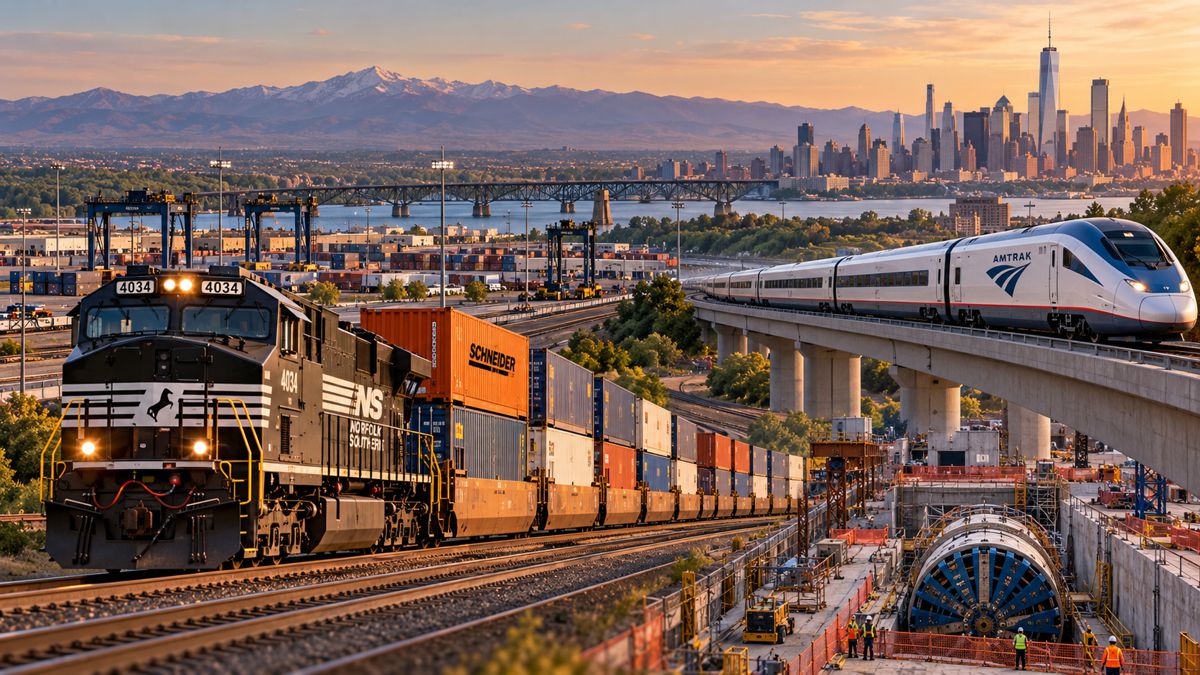
Under the agreement, Schneider will use Norfolk Southern’s eastern network to expand its domestic intermodal operations, drawing on a fleet of approximately 26,800 containers and 23,900 chassis. Schneider operates through more than 60 intermodal rail hubs across North America, with company drivers completing over 90% of its domestic drayage movements.
Intermodal transportation combines rail for the longer section of a journey with road transport for collection and delivery. Containers are transferred between trains and trucks at specialised terminals, allowing railways to handle the distance-intensive portion of a shipment while retaining the flexibility needed to reach individual customers.
The arrangement gives Schneider access to Norfolk Southern’s extensive eastern network, which connects major metropolitan markets, manufacturing centres and seaports across 22 states. Norfolk Southern reported 3% growth in intermodal volumes during the third quarter of 2026, supported by consumer demand, truck-market conditions and improvements to its operating network.
Michael Baumgardt, Executive Vice President of Intermodal and Logistics at Schneider, explained the company’s position: “Schneider’s Intermodal network is built on a strong asset-based foundation that gives customers the control, consistency and reliability they depend on,” he said. “As we transition our primary eastern rail provider to Norfolk Southern, we’ll expand access to key markets, increase network flexibility and create new opportunities to better serve our customers. It will strengthen Schneider’s competitive position and enhance the reliable service experience our customers expect.”
Norfolk Southern has already been investing in the capacity required to support additional intermodal traffic. Its programme includes a new Cincinnati–Atlanta service, double-stack clearance improvements along the East Edge route between the Midwest and New England, and terminal expansions in Ohio, Michigan, North Carolina and Illinois.
Other projects involve pavement reconstruction, improved truck access, storage facilities, lighting, maintenance areas and security systems at terminals including Atlanta, Louisville, Harrisburg, Chicago and St Louis. Terminal congestion, crane availability and truck turnaround times can be just as influential as line-haul train speeds in determining whether intermodal services are commercially attractive.
America’s Freight Railway Advantage
The American railway network has developed around the economics of transporting substantial volumes of goods over long distances.
According to the Association of American Railroads, the country’s freight railway system extends nearly 135,000 miles and includes six Class I railroads alongside approximately 615 smaller regional and short-line operators. The largest companies control the principal long-distance corridors, while smaller railways connect industrial facilities, agricultural districts, ports and distribution centres to the national system.
Freight rail accounts for approximately 40% of long-distance tonne-miles in the United States, a substantial share in a country with an extensive interstate highway system and a highly developed trucking industry. Railways are particularly competitive where large quantities of material can be consolidated into long trains, including grain, coal, aggregates, chemicals and containers.
The system is distinguished by its use of long, heavy trains, powerful diesel-electric locomotives and double-stack container operations. Carrying two containers vertically on specially designed wagons improves capacity per train, although it requires sufficient bridge and tunnel clearance, suitable loading equipment and infrastructure capable of handling the resulting train dimensions.
American freight operations also benefit from a high degree of vertical integration. Railway companies own and maintain much of the infrastructure over which they operate, making decisions about track renewal, signalling, passing loops, terminal capacity and rolling stock according to commercial requirements.
This model has supported a substantial privately funded freight network, but its priorities are necessarily influenced by the traffic available and the returns individual investments can generate. Capacity improvements on established freight corridors may offer a convincing commercial case, while infrastructure intended primarily to support wider passenger transport objectives generally requires a different funding arrangement.
Why American Passenger Rail Developed Differently
America’s passenger railway network followed a markedly different trajectory.
The expansion of private motoring, interstate highways and commercial aviation during the twentieth century gradually undermined the market for conventional intercity passenger trains. Many privately operated services disappeared, and Amtrak was established in 1971 to preserve a national passenger railway network.
Today, Amtrak remains an important transport provider, particularly in the Northeast Corridor between Washington, New York and Boston. Other services connect major cities and regions, but much of the national system operates over infrastructure owned by freight railway companies.
The Association of American Railroads reports that around 70% of the distance travelled by Amtrak trains is on freight-owned tracks. Passenger services must therefore operate alongside goods movements, often on corridors originally designed around heavy freight trains rather than frequent passenger timetables.
Despite these constraints, passenger demand has been growing. Amtrak’s 2025 financial year produced a record 34.5 million passenger journeys, an increase of 5.1% over the previous year. The operator also reported $5.5 billion in capital investment, covering major infrastructure projects, maintenance and fleet-related improvements.
The practical difficulties become apparent when considering the infrastructure itself. Many American passenger trains operate over routes where freight traffic determines much of the available capacity, while improvements to journey times can require new track, upgraded signalling, additional passing facilities or substantial reconstruction of existing alignments.
The Northeast Corridor is an important exception, with comparatively frequent passenger services and infrastructure dedicated primarily to passenger operations. Even here, however, maintaining capacity involves major investment in ageing tunnels, bridges, electrical systems and stations.
Europe’s Passenger Strength and Freight Challenges
Europe presents an almost opposite balance.
According to Eurostat, passengers made approximately 8.7 billion railway journeys across the European Union in 2024, travelling 444.5 billion passenger-kilometres. The figures reflect the importance of national passenger networks, frequent regional services and established intercity routes connecting major population centres.
High-speed rail has become a defining feature of European transport infrastructure. France, Spain, Germany and Italy have invested in dedicated high-speed corridors, while regional and conventional intercity services provide wider access to the network.
The EU’s railway system covered approximately 201,314 kilometres in 2024, with 57.6% of the network electrified. Around 40.8% had two or more parallel tracks, according to Eurostat’s infrastructure statistics.
European freight rail, however, faces considerable difficulties. Different signalling arrangements, operating rules, infrastructure priorities and national borders can complicate international services. Freight trains compete with passenger operations for capacity on busy corridors, particularly around cities and major junctions, where the scheduling requirements of frequent passenger trains can restrict the paths available to slower and heavier goods services.
The latest Eurostat freight figures show that EU rail freight activity declined by 1.8% in 2025 to 368.2 billion tonne-kilometres, continuing a downward trend despite European ambitions to move more goods from road to rail.
Some of the difficulties are structural. A shipment crossing several countries may encounter different infrastructure managers, operators, technical standards and scheduling arrangements, creating additional costs and uncertainty. European efforts to improve cross-border freight corridors and introduce more consistent signalling systems are intended to address these constraints, although progress varies across the network.
American freight operators have generally avoided some of these complications through vertically integrated operations and long-distance traffic concentrated on fewer major networks. Europe, meanwhile, has developed passenger services with a frequency and geographical coverage largely absent from the American intercity system.
China and the Scale of Railway Investment
China has pursued a third approach, combining rapid passenger railway expansion with investment in conventional freight corridors, heavy-haul operations and logistics infrastructure.
According to China’s National Railway Administration, the country ended 2025 with approximately 165,000 kilometres of operational railway, including more than 50,000 kilometres of high-speed lines. During that year alone, China brought 3,109 kilometres of new railway into operation, of which 2,862 kilometres were high-speed routes.
Railway fixed-asset investment reached 901.5 billion yuan in 2025, equivalent to approximately $128 billion at the exchange rate cited in official government reporting. China’s railways also handled approximately 4.59 billion passenger journeys and more than 5.27 billion tonnes of freight during the year.
The extent of this development becomes particularly apparent when compared with Europe’s high-speed network. China has constructed dedicated corridors across large parts of the country, connecting major metropolitan areas and regional centres while providing opportunities to release capacity on conventional lines for freight and other services.
China’s freight network carries substantial volumes of coal, minerals, industrial materials and containers. Heavy-haul corridors connect resource-producing regions with power stations, ports and industrial centres, while logistics terminals are being developed to improve transfers between rail, road and maritime transport.
Much of this expansion has been supported by centrally coordinated infrastructure planning and substantial state-backed financing. New railway lines can be developed alongside urban growth, industrial investment and regional development programmes, rather than depending entirely on the commercial return from individual services.
The scale of investment brings its own financial obligations. Construction costs, debt servicing, operating subsidies and the commercial performance of individual routes remain relevant considerations, particularly where high-speed lines serve less densely populated areas. A substantial railway network can deliver wider economic benefits without every section generating sufficient operating revenue to recover its construction costs.
China nevertheless demonstrates the construction capacity available when financing, engineering resources, land acquisition and network planning are coordinated at national scale. Its railway operator expects the network to reach approximately 180,000 kilometres by 2030, including around 60,000 kilometres of high-speed lines.
Comparing Three Railway Systems
| Indicator | United States | European Union | China |
|---|---|---|---|
| Reported railway network | Approximately 217,000 km of freight railway | 201,314 km of railway | 165,000 km of operational railway |
| Reference period | AAR industry estimate | 2024 | 2025 |
| Principal operational strength | Long-distance freight | Passenger and regional connectivity | High-speed passenger and large-scale freight |
| Passenger infrastructure | Extensive conventional routes, limited dedicated high-speed rail | Established conventional and high-speed networks | More than 50,000 km of high-speed railway |
| Electrification | Limited across freight routes | 57.6% of railway network | Extensive electric traction and high-speed electrification |
| Predominant infrastructure model | Private freight ownership | Mixed public and private arrangements | Predominantly state-led development |
Network definitions, reporting periods and infrastructure classifications vary. The American figure describes the freight railway system, while the European and Chinese figures cover wider operational networks. The totals are therefore indicative rather than directly comparable measures of capacity or performance.
The difference in electrification is particularly striking. European and Chinese railways have invested substantially in electric traction, while American freight operations continue to depend overwhelmingly on diesel-electric locomotives.
American freight trains are often exceptionally long and heavy, making locomotive performance, route availability and operational flexibility central considerations. Electrification could reduce direct emissions and reliance on diesel fuel, but installing overhead power infrastructure across extensive freight corridors would require substantial capital investment and modifications to existing clearances, bridges and electrical distribution systems.
Europe and China have different operating characteristics, including more concentrated passenger corridors and a stronger role for public infrastructure planning. Their experience offers useful technical and operational comparisons, but the economics of electrifying an American freight corridor would depend on traffic density, train weights, energy prices and the expected life of the infrastructure.
The Intermodal Opportunity
Intermodal transport remains one of the most commercially attractive areas of American railway development.
Long-distance trucking offers flexible collection and delivery, relatively straightforward scheduling and direct access to customers. Rail can provide competitive economics over longer distances when sufficient volumes are available, although the advantage depends on terminal costs, route efficiency and the additional handling involved.
Combining the two allows freight customers to take advantage of rail’s line-haul capacity while preserving the flexibility of trucks at either end.
Schneider’s agreement with Norfolk Southern reflects an effort to make that arrangement easier for customers to use. The logistics provider controls its containers, chassis and a substantial proportion of its drayage operations, reducing reliance on external contractors for some of the activities connecting rail movements with warehouses and distribution centres.
Norfolk Southern, meanwhile, is expanding terminal facilities and improving routes to accommodate additional traffic. Its double-stack clearance programme is particularly relevant because restrictions imposed by low bridges and tunnels can prevent the use of higher-capacity container trains even where the underlying railway has sufficient track capacity.
At intermodal terminals, relatively modest infrastructure changes can improve operations considerably. Additional storage space reduces congestion, better pavement supports heavy container-handling equipment, and redesigned vehicle access can shorten the time trucks spend waiting to collect or deliver containers. These improvements are closely connected to the commercial performance of the railway service itself.
There are limits to the intermodal proposition. Shorter journeys, time-sensitive shipments and irregular freight volumes may continue to favour road transport, while terminal delays or inconsistent railway schedules can erode the advantage of a lower line-haul cost. The competitive position of any particular corridor depends on the entire journey, including the road movements and handling operations at both ends.
Consolidation and the Future of the American Network
The wider future of American freight rail is also being influenced by proposals to consolidate the industry’s largest networks.
Union Pacific and Norfolk Southern are pursuing a proposed merger that would combine major western and eastern railway operations, potentially creating a coast-to-coast freight system under common ownership.
The transaction remains subject to review by the Surface Transportation Board, which accepted a revised application for consideration in May 2026 and established a procedural schedule in August. Regulatory consideration is continuing, and approval of the merger should not be assumed.
Supporters of greater integration argue that connecting railway networks could simplify long-distance movements, reduce interchange delays and improve service consistency across regional boundaries. Such advantages would depend on how the networks were combined, the investments undertaken and the operating arrangements subsequently introduced.
Competing railway operators and other interested parties have raised concerns about competition and market concentration, particularly where customers have limited alternatives for moving bulk commodities or accessing individual railway-served facilities.
The review consequently extends beyond questions of corporate ownership. Competitive routing, service reliability, customer access and the potential effects on other railroads all require consideration, particularly in a market where infrastructure ownership gives operators considerable influence over the movement of freight.
For Schneider and other intermodal providers, the immediate priority remains operational performance. Any future network consolidation may alter service arrangements, but the competitiveness of existing operations still depends on how effectively trains, terminals and trucks work together.
American Passenger Rail Investment Takes Shape
While freight investment largely concentrates on improving existing networks, several major passenger railway projects illustrate the scale of construction required to establish faster and more reliable services.
California High-Speed Rail remains the country’s most ambitious dedicated high-speed railway construction programme. Work is active across 119 miles of the Central Valley, involving substantial earthworks, viaducts, grade separations and railway structures. The California High-Speed Rail Authority reports that more than 60 structures and 80 miles of guideway have been completed.
In June 2026, the Authority approved a consortium involving Kiewit, Stacy Witbeck and Herzog to undertake the initial phase of track and systems installation, including electrified track, overhead contact equipment, train control and communications infrastructure. The planned system is designed for speeds of up to 220 mph, although completing the wider route between Northern and Southern California will require further construction, financing and programme delivery.
The project has experienced substantial cost escalation and schedule difficulties, demonstrating the complexity of acquiring land, completing environmental approvals and constructing entirely new railway infrastructure through developed areas and difficult terrain.
Brightline West offers a different approach. Its proposed high-speed railway between Southern California and Las Vegas is intended to follow the Interstate 15 corridor, connecting to regional transport services at Rancho Cucamonga. The project is being developed around a defined intercity market where rail could offer an alternative to road and air travel.
Development and field investigation work continued during 2026, although financing remains a major challenge. In October, the San Bernardino County Transportation Authority reported that Brightline West was continuing to pursue federal loan financing, while a subsequent project update confirmed that funding arrangements had not yet been finalised.
Elsewhere, the Gateway Programme in the Northeast Corridor is addressing a different infrastructure problem. The Hudson Tunnel Project involves constructing new rail tunnels between New Jersey and New York, allowing the existing century-old North River Tunnel to be rehabilitated while improving the resilience of one of America’s busiest passenger railway corridors.
The project has required extensive preparatory engineering, including utility relocation, ground stabilisation and the construction of access shafts. The first tunnel boring machine began mining in October 2026, following earlier difficulties with federal funding disbursements that had interrupted construction activity.
These projects illustrate the range of challenges facing American passenger rail. California is building a new high-speed network, Brightline West is seeking to establish a commercially viable corridor with substantial private-sector involvement, and Gateway is undertaking major underground construction to preserve and improve capacity on an existing railway.
Each requires a different combination of engineering, public investment, financing and operational planning.
Where Future Railway Investment Will Be Directed
America’s railway investment requirements differ substantially between freight and passenger operations.
For freight operators, immediate priorities include track maintenance, terminal expansion, bridge clearance, signalling, capacity improvements and the modernisation of locomotives and wagons. Increasing the number of containers moved through an existing corridor can often provide a more manageable commercial return than constructing entirely new railway lines, particularly where additional passing tracks, terminal capacity or improved loading facilities can remove operational constraints.
Technology also has a growing role in train control, automated inspection, predictive maintenance and terminal management. Trackside monitoring systems, digital asset management and better logistics information can help operators identify defects earlier and reduce disruption, while automation in container handling and terminal operations offers scope to improve throughput without corresponding increases in physical infrastructure.
Passenger rail requires a different set of choices. The Northeast Corridor needs continuing renewal of bridges, tunnels, electrical equipment and stations, while new high-speed projects must contend with land acquisition, environmental requirements, utility relocation and the costs of constructing dedicated alignments.
Europe and China provide evidence that higher-speed passenger services can become attractive alternatives to road and air travel where population density, journey times, service frequency and city-centre accessibility support sufficient demand. The United States has corridors with these characteristics, although its geography and established transport patterns make the economic case for individual routes particularly important.
The two sides of America’s railway industry will therefore continue to demand different forms of infrastructure investment. Freight operators can build on an established and highly productive network, while passenger developments must often address decades of deferred renewal or the substantial cost of constructing new infrastructure.
Building on America’s Railway Strengths
The Schneider–Norfolk Southern agreement offers a practical example of where American railway development is already heading. Rather than constructing an entirely new network, the companies are combining existing infrastructure, logistics assets and targeted investment to attract freight that might otherwise move entirely by road.
Across the country, improvements to intermodal terminals, bridge clearances, track capacity and operating systems are helping freight railways extract greater productivity from infrastructure that already supports substantial commercial traffic.
Passenger railway development presents a more complicated picture. California’s new high-speed line, the proposed Brightline West corridor and the reconstruction of infrastructure beneath the Hudson River involve very different engineering and financial challenges, but each addresses a market or network requirement that existing railway infrastructure cannot adequately satisfy.
America does not lack railway capability. Its freight system remains one of the most productive in the world, while its passenger network has considerable scope for selective modernisation and expansion. The construction priorities are already visible in the terminals, tunnels, track installations and railway structures being delivered across the country.
Key Industry Questions
- How extensive is the American freight railway network? The Association of American Railroads estimates that the network extends nearly 135,000 route miles, approximately 217,000 kilometres, including major Class I systems and smaller regional railways.
- Why is freight rail more successful than passenger rail in the United States? American freight rail benefits from long-distance bulk movements, substantial commercial volumes and infrastructure developed around goods transport. Passenger rail faces competition from roads and aviation and frequently operates over freight-owned tracks.
- How does American rail compare with China’s railway system? The United States has a highly developed long-distance freight network, while China has invested extensively in high-speed passenger rail, electrification and network expansion. The reported route lengths use different definitions and should not be treated as directly comparable.
- Why does Europe carry so many passengers by train? European railway services benefit from extensive regional networks, established intercity connections, relatively dense travel corridors and sustained public investment in passenger infrastructure.
- What is double-stack intermodal transport? It involves carrying two shipping containers vertically on specialised railway wagons. Sufficient bridge, tunnel and overhead clearance is required, together with terminals capable of handling the containers.
- What are the main obstacles to expanding American intermodal freight? Terminal handling costs, network capacity, journey-time reliability, freight density and competition from trucking can constrain growth. Efficient first-mile and last-mile road connections are also essential.
- Why has the United States not electrified more freight railway lines? The geographical scale of the network, infrastructure costs, operating requirements and the economics of diesel-electric traction have limited electrification. Individual corridors may offer different investment cases.
- Could the Union Pacific–Norfolk Southern merger change American rail freight? The proposed merger could create an integrated transcontinental railway, subject to regulatory approval. Its effects on competition, service quality and investment remain central considerations in the review.
- What are the main high-speed railway projects in the United States? California High-Speed Rail is under construction in the Central Valley, while Brightline West is developing a proposed high-speed connection between Southern California and Las Vegas. The projects have different financing structures and delivery challenges.
- Why is the Hudson Tunnel Project important? The project will provide new railway tunnels between New Jersey and New York, allowing the existing North River Tunnel to be rehabilitated and improving the resilience of the Northeast Corridor.
Strategic Takeaways
- Intermodal integration offers an established route to growth. Coordinating railway capacity, container ownership and road collection services can improve freight competitiveness without requiring entirely new long-distance corridors.
- Terminal infrastructure can deliver substantial operational benefits. Storage space, truck access, loading capacity and vehicle turnaround times directly affect the reliability and economics of intermodal services.
- International railway models address different transport requirements. American freight operations, European passenger connectivity and Chinese network expansion reflect different geographical, financial and operational conditions.
- Network consolidation raises questions of both efficiency and competition. Larger integrated railways may simplify long-distance movements, but their effect on customer access and alternative routes requires regulatory scrutiny.
- Passenger rail investment depends heavily on individual corridors. California High-Speed Rail, Brightline West and the Hudson Tunnel Project illustrate the different construction, financing and renewal requirements facing American passenger infrastructure.