Flying Cars Are Coming – But Who Will Build the Roads in the Sky?
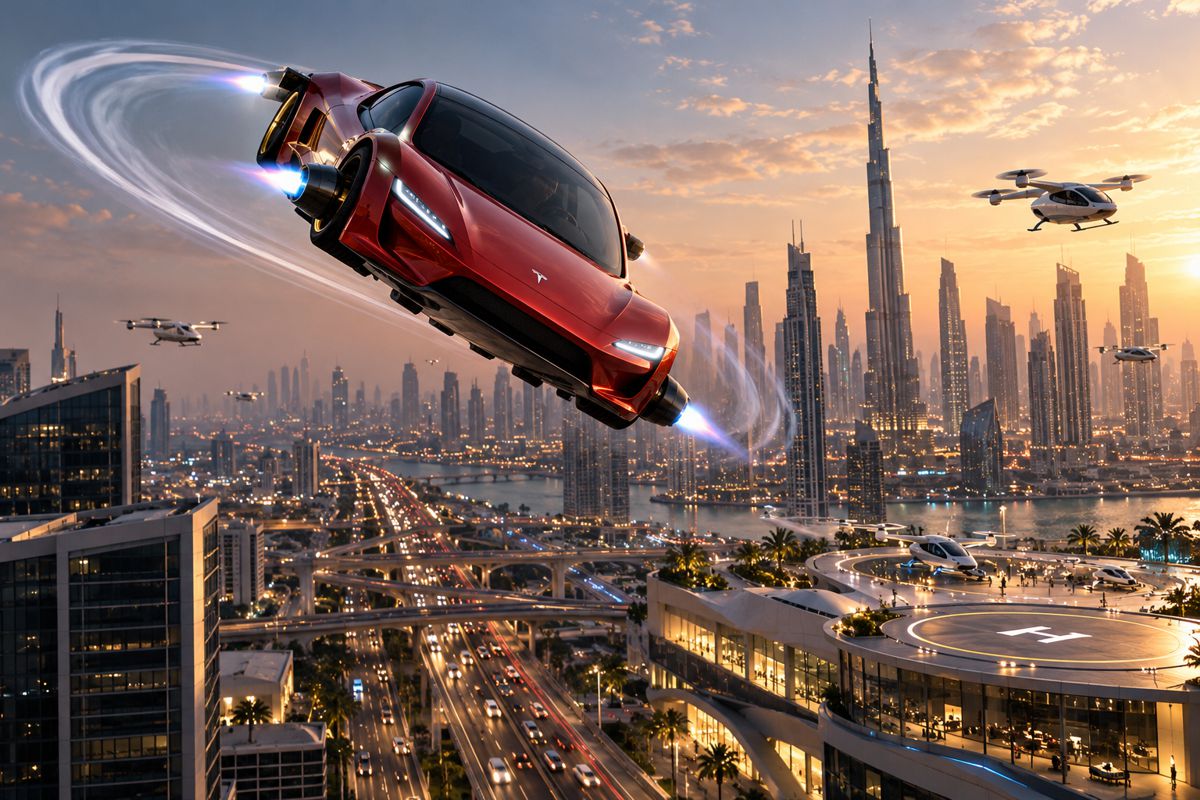
On 15 October 2026, Tesla demonstrated a new generation of Roadster at SpaceX’s test facility in McGregor, Texas, using high-pressure gas thrusters to perform manoeuvres that would once have belonged entirely to science fiction. The electric sports car reportedly drove upside down using an underbody suction system, turned in mid-air and launched itself over a line of vehicles before returning to the ground. Tesla is targeting production in 2028, with an exclusive Rocket variant intended to offer more extensive flight capabilities.
The demonstration offered a spectacular glimpse of what might become possible when automotive engineering draws on technologies developed for aerospace applications. Although brief airborne manoeuvres are very different from sustained, controlled flight, they have renewed interest in a future where the traditional boundaries between road vehicles and aircraft become increasingly blurred. The Roadster demonstration reported by Reuters also provides a timely opportunity to examine the infrastructure that more ambitious forms of personal aerial transport would require.
The attraction of the flying car has always been remarkably simple. A driver encounters congestion, activates a flight system and rises above the stationary traffic, continuing the journey without airports, timetables or lengthy diversions. It is a vision that combines the independence of private motoring with the freedom of aviation, and one that generations of engineers have attempted to make practical.
Developing a vehicle capable of leaving the ground is only part of the undertaking. If flying cars and electric air taxis become familiar features of everyday transport, they will need extensive supporting networks of landing facilities, communications systems, automated traffic management and carefully coordinated airspace. That prospect opens opportunities for infrastructure developers, civil engineers, technology companies and transport operators, with much of the investment likely to be concentrated on the ground.
Briefing
- Tesla’s October 2026 Roadster demonstration has renewed attention on the possibilities of personal aerial mobility, although rocket-assisted manoeuvres differ from sustained flight.
- Electric vertical take-off and landing aircraft, known as eVTOLs, are being developed for passenger transport, with Dubai establishing a dedicated air taxi network.
- Existing helicopter operations provide a foundation for aerial mobility, while electric propulsion and automation could improve operating economics and accessibility.
- Future networks will require vertiports, charging infrastructure, coordinated airspace and increasingly sophisticated digital traffic management.
- Aerial mobility could create substantial opportunities across construction, aviation, energy, insurance and urban transport infrastructure.
From Flying Cars to Electric Aviation
The ambition to combine motoring and aviation is considerably older than modern electric propulsion. In the late 1940s, American inventor Moulton Taylor developed the Aerocar, a roadable aircraft capable of travelling on public roads with its wings and tail assembly detached. The design demonstrated that a vehicle could function as both an automobile and an aeroplane, although converting between the two required considerably more preparation than the instantaneous transformation familiar from science fiction. Other designs followed, including the Terrafugia Transition and PAL-V Liberty, each exploring different approaches to combining road travel with flight.
Meanwhile, helicopters had already demonstrated much of the underlying concept. They could take off vertically, hover, navigate difficult terrain and land within relatively confined spaces, providing capabilities that conventional road vehicles could never match. Helicopter taxi services began operating in major cities during the twentieth century, connecting airports and urban centres long before electric vertical take-off and landing aircraft became a major focus of aerospace investment.
New York Airways operated scheduled helicopter services connecting Manhattan with the city’s airports during the 1950s, 1960s and 1970s. Modern operators continue to provide airport transfers, sightseeing flights and charter services around the world, demonstrating that urban aerial transport is already technically and commercially possible. Its limitations have largely been operational and economic, with conventional helicopters requiring substantial maintenance, trained pilots and specialist facilities, while noise and operating restrictions limit where and when they can fly.
Electric propulsion offers the prospect of improving several of these characteristics. Distributed electric motors provide precise thrust control, while aircraft designed around multiple smaller propellers can potentially reduce certain noise characteristics and mechanical maintenance requirements. Advances in batteries, power electronics, lightweight materials and flight control software are enabling configurations that would have been difficult to achieve with conventional propulsion systems.
The same technological progress that has transformed electric road vehicles is now creating new possibilities for short-distance aviation. Electric aircraft will still need to meet demanding safety and certification requirements, but improvements in operating efficiency and aircraft design could eventually make aerial transport accessible to a considerably broader market.
Dubai’s Emerging Aerial Transport Network
Dubai provides one of the clearest examples of how the next generation of urban aviation could become part of an established transport system. Through its partnership with Joby Aviation, the emirate is developing an electric air taxi network intended to connect major destinations using purpose-built vertical take-off aircraft.
Joby’s aircraft is designed to carry four passengers and a pilot, using six tilting propellers to transition between vertical lift and efficient forward flight. The company has advertised a maximum speed of approximately 200 mph and a range of up to 100 miles, although commercial performance will depend on operating conditions, certification and route requirements.
In November 2025, Joby confirmed plans for additional vertiports at Dubai Mall, Atlantis The Royal and the American University of Dubai, alongside the network’s Dubai International Airport location. The announcement followed a piloted point-to-point demonstration flight to Al Maktoum International Airport, providing an early indication of how the aircraft could operate between established destinations.
Passengers will travel to an approved terminal, board an aircraft and fly to another designated location, potentially avoiding lengthy road journeys across congested parts of the city. Concentrating operations at selected sites allows charging equipment, maintenance support and emergency services to be provided efficiently, while connections with existing roads, metro services and airports can be incorporated into the wider transport network.
The initial aircraft will carry pilots, with autonomous flight remaining a longer-term objective requiring further technical validation and regulatory approval. Dubai’s approach builds on established aviation practices while introducing a new generation of aircraft and infrastructure, providing a practical model for other cities considering similar services.
Building the Roads in the Sky
Conventional highways organise traffic through physical lanes, intersections and junctions, supported by signs, signals and increasingly sophisticated management systems. Aerial transport introduces the additional complexity of altitude, although aviation already has considerable experience coordinating movements in three dimensions. Commercial aircraft operate within structured airspace incorporating published routes, altitude assignments and established separation procedures, providing a foundation from which more intensive urban aerial networks could eventually develop.
An urban aerial mobility network might use designated altitude bands for aircraft travelling in different directions, while automated systems coordinate climbing movements, route intersections and approaches to landing facilities. Modern aircraft already employ sophisticated navigation, collision avoidance and flight management systems, and artificial intelligence offers further opportunities to predict traffic conflicts, optimise routes and respond to changing operating conditions.
The European Union Aviation Safety Agency has been developing regulatory arrangements for innovative air mobility, while the European U-space framework establishes digital traffic management requirements for certain drone operations. These systems provide useful foundations for future aerial networks, although passenger-carrying aircraft will continue to require appropriate aviation certification and operational oversight.
In the United States, the Federal Aviation Administration’s advanced air mobility programme is pursuing a gradual approach, initially integrating new aircraft with existing airports, heliports, routes and air traffic control services. Its Innovate28 implementation plan addresses aircraft certification, pilot training, ground infrastructure, electrical supply and community engagement, with initial operations expected to use predetermined schedules and pilots aboard.
As traffic density increases, automated management could become particularly valuable. Aircraft might continuously exchange information about their positions, planned routes and operating status, allowing coordinated systems to identify potential conflicts and adjust trajectories before they become dangerous. Such networks would need dependable communications, cybersecurity protections and sufficient onboard capability to manage unexpected events, including propulsion problems, navigation failures and changing weather conditions.
Aviation has spent decades developing systems for managing complex airspace. Adapting that experience to a new generation of smaller aircraft, supported by increasingly capable digital technology, offers the prospect of transport networks that could eventually accommodate far more aerial movements than today’s specialist helicopter services.
The Fifth Element and the Capacity of Urban Airspace
Luc Besson’s 1997 science-fiction film The Fifth Element presented a memorable vision of future urban transport, with flying taxis and private vehicles travelling along crowded aerial routes between towering buildings. Despite the extraordinary technology, the vehicles were still caught in traffic, an amusing but perceptive observation about the limitations of transport capacity. Moving vehicles into a third dimension increases the space available for travel, but popular destinations, busy routes and limited landing facilities could still create congestion.
An aerial network would have its own intersections, merging movements and arrival procedures, with aircraft approaching major commercial districts needing to coordinate with other flights while departures are managed to maintain safe separation. Landing facilities could become particularly important constraints, especially where passenger demand is concentrated around airports, business districts and major transport interchanges.
Consider a simplified example of a vertiport accepting one arriving aircraft every two minutes. With four passengers aboard each aircraft, that would represent a theoretical arrival capacity of 120 passengers per hour. Actual performance would depend on the number of landing pads, aircraft separation requirements, turnaround times, simultaneous departures and operating conditions, making the calculation illustrative rather than an operational benchmark.
Dubai’s infrastructure provides a more practical reference point. The Dubai International Airport vertiport has been designed around two landing and take-off areas, with published plans indicating capacity for approximately 170,000 passengers annually. The Dubai Media Office confirmed completion of the airport’s air taxi station in April 2026, demonstrating how the supporting infrastructure is beginning to take physical shape.
Conventional public transport can move substantially greater numbers of people along busy corridors, with railways and high-capacity bus services capable of carrying thousands of passengers per hour. Small aircraft are therefore more likely to complement mass transit than replace it, particularly where conventional journeys are indirect, geographical obstacles create lengthy diversions or time savings justify the additional operating costs.
The three-dimensional nature of flight nevertheless provides opportunities unavailable to road vehicles. Routes can cross rivers, bypass mountainous terrain and connect destinations without following the geometry of existing highways. As networks mature, improved scheduling, aircraft performance and additional landing facilities could increase capacity, drawing on many of the principles already used to optimise airport operations and road traffic management.
The future may indeed resemble The Fifth Element, although successful networks will be designed to manage demand before airborne traffic jams become commonplace.
The Infrastructure Beneath the Aircraft
The aircraft may attract the greatest public attention, but aerial mobility could create a substantial new market for civil engineering, electrical infrastructure and transport technology. Vertiports will require carefully designed landing and departure areas, aircraft parking facilities, charging systems, passenger access and emergency arrangements, with their configuration determined by aircraft characteristics, anticipated traffic volumes and national aviation regulations.
Site selection will be particularly important in established cities. Rooftops offer opportunities to locate terminals close to commercial districts, although structural loading, wind conditions, obstacle clearances and evacuation arrangements will need to be assessed. Ground-level facilities may provide easier construction and maintenance access but must compete with existing residential, commercial and transport uses.
Existing airports and heliports could provide useful starting points. The FAA expects initial advanced air mobility services to use much of this established infrastructure, with modifications for charging, aircraft parking and ground movements. Its published vertiport design standards are helping establish the engineering requirements for dedicated facilities, including structural loading, approach paths and electrical infrastructure.
Electricity supply introduces another dimension to infrastructure planning. Aircraft operating frequent services will need dependable charging capacity, potentially requiring new substations, upgraded distribution networks and sophisticated energy management systems. Battery storage could help manage peak demand, while coordinated charging schedules may reduce pressure on local electrical infrastructure.
Airports, railway stations, commercial centres and major transport interchanges could incorporate vertiports into their long-term development programmes, allowing passengers to transfer between aircraft, trains, buses and conventional road vehicles. The quality of those connections will influence the commercial success of aerial mobility. A ten-minute flight offers limited advantage if passengers spend another forty minutes reaching the departure terminal and travelling onwards from their destination.
Highway authorities may also become involved in planning aerial transport infrastructure. Flight paths near major roads will need to account for bridges, overhead gantries, lighting columns, power lines and emergency access, while facilities adjacent to motorways or major interchanges could provide convenient connections where aircraft movements can be accommodated safely.
Who Will Build and Own the Network?
The commercial structure of aerial mobility infrastructure is still developing, with different cities likely to adopt arrangements suited to their existing transport systems and investment environments. Airports and established transport operators are natural participants because they already manage passenger facilities, safety-critical operations and complex infrastructure, while private developers may incorporate vertiports into commercial buildings, hotels and mixed-use developments.
Dubai offers one possible model. Its Roads and Transport Authority is working with Joby Aviation and Skyports Infrastructure, combining public transport oversight with specialist aircraft operations and privately developed ground facilities. Elsewhere, airport operators might develop vertiports as extensions of their existing businesses, while infrastructure investors could finance facilities through long-term concession agreements or other commercial arrangements.
Airports, toll roads, ports and railway facilities already operate under mixtures of public ownership, private investment and concession-based management, providing established commercial models that could be adapted for aerial mobility. Vertiports might eventually generate revenue through landing charges, passenger fees, charging services and commercial property activities, with their financial performance depending on passenger demand, aircraft utilisation and development costs.
The wider network will also require investment in digital infrastructure. Communications providers, aviation technology companies and specialist software developers could participate in systems used to coordinate aircraft movements, manage traffic capacity and exchange operational information. Some services may be delivered through existing air traffic management arrangements, while others could require new commercial and regulatory structures as aircraft numbers increase.
Aviation authorities will retain essential safety and airspace oversight functions, while infrastructure owners and operators will have responsibilities for their facilities and services. For construction and infrastructure companies, the opportunities extend well beyond building landing pads, encompassing structural engineering, electrical distribution, communications, fire protection, transport integration and long-term facilities management.
Insurance, Safety and Public Confidence
Aerial mobility will create new requirements for insurers, regulators and emergency services, although the industry can draw on extensive experience from conventional aviation. Aircraft insurance already covers physical damage, passenger liability and third-party risks, with emerging aerial mobility services requiring arrangements suited to new aircraft configurations, potentially higher operating frequencies and increasingly automated flight systems.
An aircraft operating above a busy motorway or commercial district creates a different risk profile from one flying over open countryside. An incident could affect vehicles, buildings, electrical infrastructure or people on the ground, even when those affected have no connection with the aircraft itself. Aircraft hull insurance, passenger liability and third-party liability would remain important elements of commercial coverage, with responsibility for individual incidents depending on the circumstances and potentially involving aircraft operators, manufacturers, maintenance providers or other organisations.
As automation becomes more sophisticated, investigations may increasingly examine software performance, sensor reliability and the interaction between onboard systems and external traffic management services. Professional operators could benefit from standardised aircraft fleets, centralised maintenance, consistent operating procedures and comprehensive flight data, helping insurers assess risks more accurately as operational experience accumulates.
The early years of commercial deployment will be particularly important for establishing reliable safety and claims data. Insurance costs should become easier to assess as aircraft accumulate flight hours and operators demonstrate their ability to maintain safe, dependable services.
Communities have long expressed concerns about aircraft noise, flight paths and the environmental effects of aviation. Aerial mobility services operating close to residential and commercial areas will need to address similar issues, particularly as flight frequencies increase. Electric propulsion could reduce some forms of noise and eliminate direct exhaust emissions during flight, although acoustic performance will vary between aircraft designs and operating conditions. Visual intrusion, perceived safety and potential effects on privacy may also influence planning decisions.
The FAA’s advanced air mobility planning includes community engagement, noise, environmental considerations and infrastructure coordination, recognising the importance of developing services that can coexist with the places beneath them. Carefully selected routes, suitable operating hours, quieter propulsion systems and well-integrated terminals could help establish public confidence, supported by consistent safety performance and transparent regulation.
Making Aerial Transport Affordable
Electric propulsion and automation offer the prospect of reducing operating costs, although affordable aerial transport will depend on more than aircraft technology. Commercial operators must recover the cost of their aircraft, financing, maintenance, insurance, charging infrastructure and ground facilities. Initial services will also require pilots, while future autonomous operations would still need fleet supervision, maintenance personnel and operational support.
Many emerging eVTOL aircraft are designed to carry only a handful of passengers, making the cost per journey sensitive to occupancy and aircraft utilisation. A four-passenger aircraft operating with every seat occupied can distribute its costs more efficiently than one carrying a single paying passenger, while empty repositioning flights, charging delays and weather-related cancellations can affect commercial performance.
Operators will therefore have strong incentives to concentrate initially on routes with predictable demand and substantial potential time savings. Airport transfers are an obvious market, particularly in cities where road congestion makes journey times unreliable. Connections across bays, between islands or over mountainous terrain may also offer attractive applications because aircraft can travel more directly than road vehicles.
As the technology develops, larger fleets, improved batteries, more efficient aircraft and greater automation could help reduce costs. The economics may gradually move closer to those of premium ground transport, although widespread affordability remains an ambition rather than an established outcome.
Private ownership would bring many of the expenses associated with aviation, including maintenance, insurance, storage and compliance with operating requirements. Even if manufacturers eventually develop relatively affordable roadable aircraft, the ongoing costs could remain substantial. Shared aerial mobility offers a different proposition, with passengers paying for individual journeys while fleet operators manage the aircraft, maintenance and supporting infrastructure.
The development of conventional aviation provides an encouraging comparison. Air travel was once an expensive activity accessible to a relatively small proportion of the population, but advances in aircraft technology, operating efficiency, infrastructure and airline business models gradually made it available to billions of passengers. Aerial mobility may follow its own path towards broader accessibility, particularly where services offer genuine advantages over existing transport options.
From Personal Freedom to Autonomous Flight
The traditional flying-car dream places the individual driver at the centre of the experience, with a privately owned vehicle travelling along ordinary roads before taking to the air when circumstances permit. Commercial aerial mobility is developing along a more structured path, with passengers travelling between approved facilities while operators coordinate aircraft availability, departure times and flight routes.
As automation develops, increasingly sophisticated systems could manage more of those operations. A journey might eventually be booked through a smartphone, coordinated with other transport services and completed without passengers requiring any knowledge of aviation procedures. Aircraft could exchange information about their positions and intended routes, allowing automated traffic management systems to optimise movements and maintain safe separation.
Advanced onboard flight controls could reduce pilot workload and, subject to certification, eventually support fully autonomous passenger operations. The prospect is particularly attractive for short urban journeys, where traditional aviation procedures and operating costs have historically limited commercial services.
Private flying cars may develop alongside these managed networks, although owners would still need to comply with aviation regulations, airspace restrictions and requirements for safe take-off and landing. A vehicle might be capable of lifting off vertically without being permitted to depart from an ordinary public highway, where surrounding traffic, buildings, overhead structures and emergency landing options could make flight operations unsuitable.
Future travellers could nevertheless gain access to routes and destinations that are difficult to reach by road, while sophisticated automated systems manage the complexity of flying safely. The freedom offered may be different from the unrestricted personal flight imagined in science fiction, but the possibilities for more convenient and direct journeys remain considerable.
A New Layer of Transport Infrastructure
Aerial mobility could create opportunities extending far beyond premium passenger transport. Emergency medical services, disaster response, specialist logistics and access to remote communities are all potential applications, particularly where waterways, mountainous terrain or other geographical obstacles make conventional infrastructure difficult or expensive to construct. Some of these services could benefit from the same vertiports, charging facilities and traffic management systems developed for passenger operations.
For civil engineering contractors, the emerging market could involve everything from rooftop reinforcement and terminal construction to electrical infrastructure and integrated transport developments. Technology companies may find opportunities in navigation, communications, traffic management and autonomous systems, while specialist operators develop new service models.
Progress in batteries, high-performance computing, digital twins, advanced materials and increasingly capable sensors is already influencing construction machinery, commercial vehicles and infrastructure management. Aerial mobility brings many of those technologies together in an environment where precision, reliability and safety are essential.
Aviation authorities are developing certification and operational frameworks, while cities and infrastructure investors begin exploring how new services might integrate with established transport networks. The transition is unlikely to happen everywhere at once, with some locations offering stronger commercial opportunities because of geography, congestion, passenger demand or existing aviation infrastructure.
Successful projects could establish practical standards for vertiport design, operating procedures and commercial arrangements, allowing subsequent networks to develop more efficiently. The same process has shaped every major transport system, from the earliest railways to modern airports and motorways, where individual engineering achievements gradually became reliable public services through sustained investment and operational experience.
The Future Above the Motorway
Tesla’s Roadster demonstration is a reminder of how far automotive and aerospace engineering have progressed, while electric aircraft developers are pursuing a different approach, combining vertical lift with efficient forward flight to create practical passenger services. Both developments reflect an enduring ambition to expand the possibilities of personal transport, supported by advances in propulsion, materials, computing and increasingly sophisticated control systems.
The next chapter will be written as much by infrastructure engineers, urban planners and transport operators as by the companies developing the aircraft. Vertiports, digital flight corridors, charging networks and automated traffic management could eventually become familiar components of the built environment, allowing aerial mobility to develop alongside conventional roads, railways and airports.
The flying cars of The Fifth Element may still provide an entertaining warning about airborne traffic jams, but the film also captured something genuinely inspiring: a city in which movement was no longer confined to the roads beneath its buildings. The first commercial networks will be more structured and limited than that vision, initially resembling modern helicopter services with designated terminals and carefully managed routes. As aircraft technology, infrastructure and automation improve, the range of practical applications could expand considerably.
The ultimate achievement may be different from the dream of driving along a motorway and taking off whenever traffic becomes inconvenient. Aerial mobility could instead develop into a new layer of transport, connecting places more directly, opening routes across difficult terrain and giving passengers choices that previous generations could only imagine. Flying cars may eventually become remarkable machines, but building the infrastructure that allows them to operate safely, efficiently and affordably could be an equally remarkable achievement.
Key Industry Questions
- What infrastructure will flying cars need? Aerial mobility networks will require take-off and landing facilities, electrical charging infrastructure, communications systems, airspace management and emergency arrangements. Larger networks may also need dedicated flight corridors and automated traffic coordination.
- Can flying cars take off directly from public roads? Not as a general right. Aircraft operations must comply with aviation and applicable road regulations. Future roadable aircraft may have vertical take-off capabilities, but safe departure locations will still be governed by operational and regulatory requirements.
- How will artificial intelligence support flying cars? AI could assist with navigation, collision avoidance, route optimisation and traffic prediction. Fully autonomous passenger services will require extensive testing, certification and regulatory approval.
- Will flying cars eliminate road congestion? They could offer faster alternatives for selected journeys, particularly where roads are congested or geographical obstacles create long diversions. Their limited passenger capacity means they are more likely to complement mass transport than replace it.
- What is a vertiport? A vertiport is a facility designed to accommodate the take-off, landing and associated ground operations of suitable vertical-lift aircraft. Facilities may include passenger terminals, charging equipment, aircraft parking and emergency services.
- Could existing heliports support electric air taxis? Yes, subject to compatibility and regulatory requirements. Some existing heliports and airports could be adapted with charging equipment, revised operating areas and other necessary facilities.
- Will flying cars require special insurance? Aircraft operators already use aviation insurance covering aircraft damage, passenger liability and third-party risks. New aircraft designs, automation and high-frequency urban operations will require appropriate risk assessment and coverage.
- Who will pay for aerial mobility infrastructure? Investment could come from airport operators, private developers, specialist infrastructure companies, transport authorities and public-private partnerships. Commercial arrangements will vary between locations.
- Could ordinary people afford flying taxis? Early services are likely to focus on passengers willing to pay for substantial time savings. Costs could decline through greater aircraft utilisation, improved technology and automation, although the timing and extent of wider affordability remain uncertain.
- Are flying cars and electric air taxis the same thing? Not necessarily. Flying cars generally imply vehicles capable of travelling on roads as well as flying. Most current eVTOL air taxis are dedicated aircraft designed to operate between suitable aviation facilities.
Strategic Takeaways
- Aerial mobility could become a new infrastructure market, creating opportunities in civil engineering, electrical networks, transport integration and digital traffic management.
- Existing aviation infrastructure provides a practical starting point, allowing early networks to develop around airports, heliports and purpose-built vertiports.
- Automation could progressively improve network capacity and operating economics, although safety certification and system reliability will determine the pace of deployment.
- Commercial success will depend on selecting routes with genuine transport advantages, particularly airport connections, difficult terrain and journeys affected by geographical barriers.
- The greatest long-term opportunity may be integration, with aerial mobility becoming another useful component of established road, rail and aviation networks.