The Deba Bridge and the Quiet Rise of Ephemeral Engineering in Europe
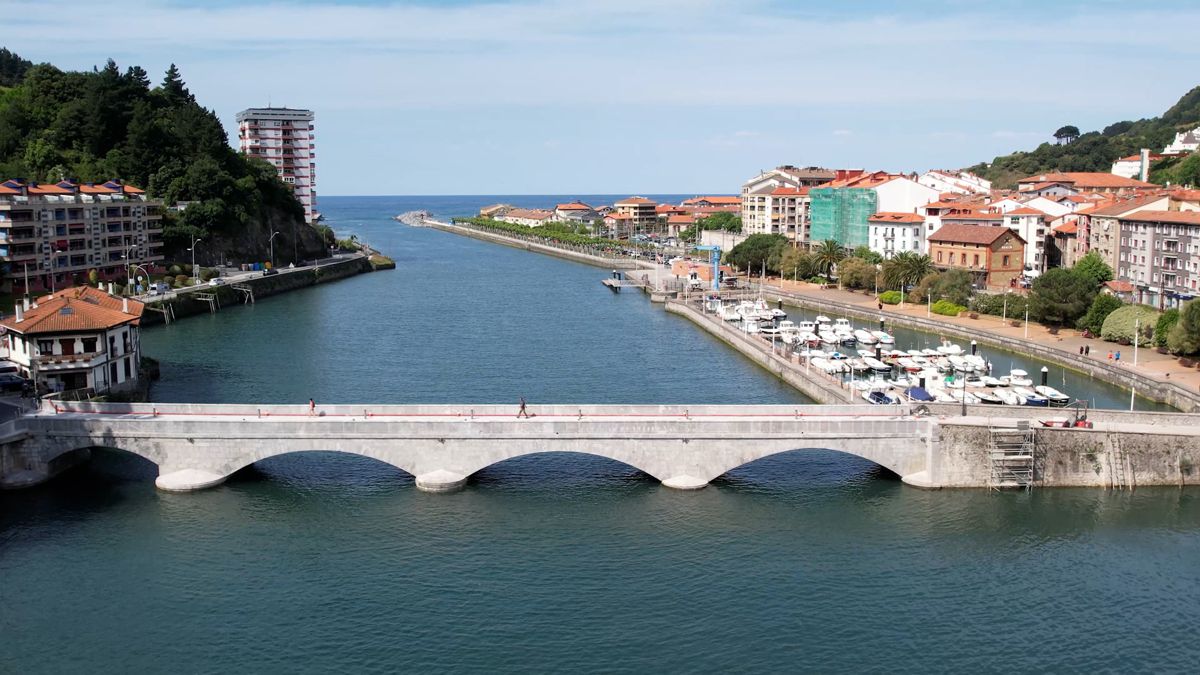
When Europa Nostra named the reconstruction of the Deba-Mutriku Bridge among its 2023 Grand Prix laureates at a ceremony in Venice that September, the citation read as a cultural honour. The commercial reading is more interesting. A nineteenth-century masonry footbridge on the Camino de Santiago, saved from collapse and rebuilt so faithfully that the intervention is barely perceptible, is not merely a conservation success. It is a working demonstration of a discipline that Europe is about to need at industrial scale, and one where technical capability, purchasing power and margin are steadily concentrating in the hands of specialist temporary-works engineers.
The timing gives the project its wider significance. Data discussed at the Eurobridge 2026 infrastructure-safety conference in Brussels put the combined built value of Europe’s bridge stock at roughly €2 trillion, with about ten per cent of structures already classified as significantly deficient and close to a third of those rated as sound not being regularly inspected at all. A large share of that stock cannot simply be demolished and replaced, because it is masonry, it is old, and much of it is protected. The Deba Bridge shows what it takes, technically and commercially, to keep such assets in service without erasing what makes them worth keeping.
Briefing
- The reconstruction of the Deba-Mutriku Bridge, a masonry arch structure completed in 1866 on the Camino de Santiago, won a 2023 European Heritage Award and was subsequently selected as one of five Europa Nostra Grand Prix laureates announced in Venice on 28 September 2023.
- The bridge nearly collapsed on 5 July 2018 when pier two settled and rotated by up to 70 centimetres after wood-boring marine bivalves consumed its timber pile foundations, causing two adjoining vaults to fail.
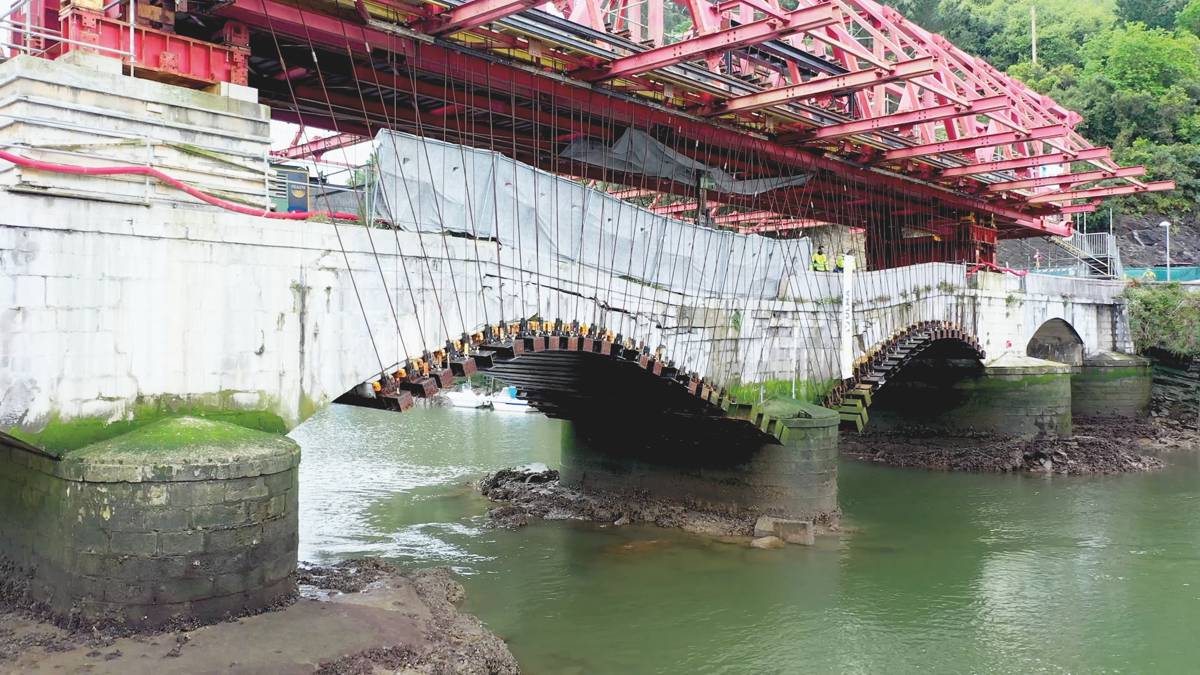
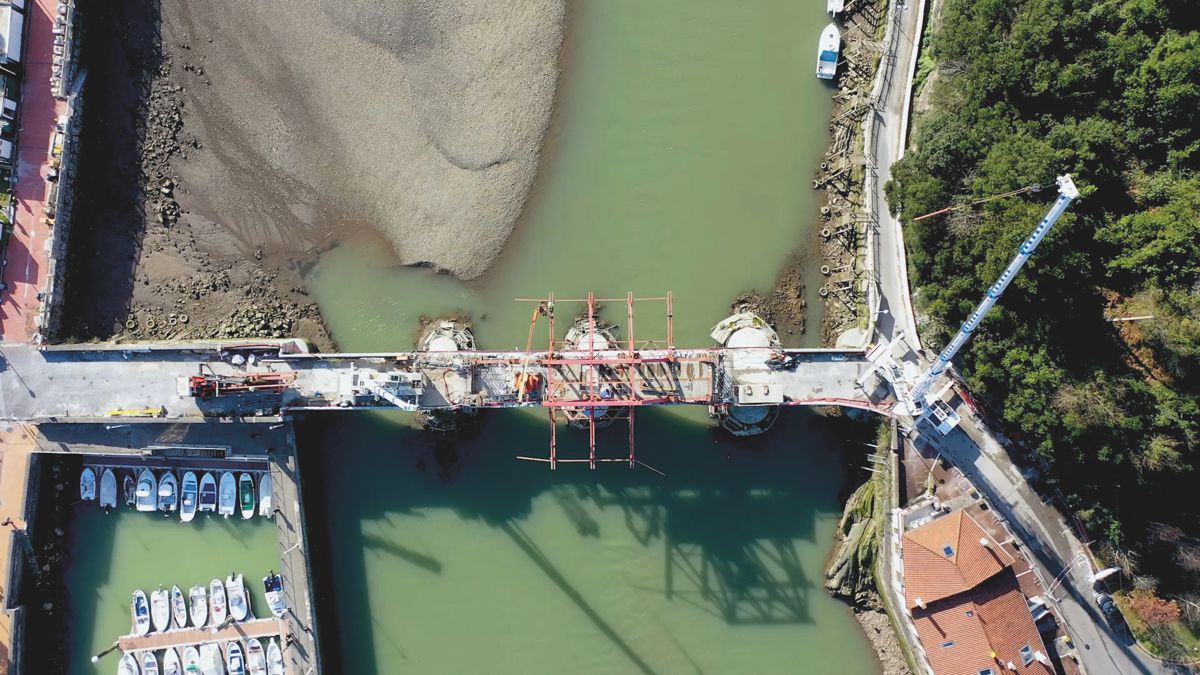
- Rather than support the structure from a tidal channel with a four-metre range and soft ground, engineers suspended almost the entire weight of the bridge from an overhead self-launching shoring system anchored on micropiled piers.
- Around 90 per cent of the original ashlar limestone was reinstated, with roughly 1,200 blocks individually catalogued and numbered so the arches could be rebuilt course by course to their original geometry.
- The project positions temporary-works engineering as a strategic competence for asset owners facing Europe’s estimated €2 trillion bridge-repair challenge, much of it involving irreplaceable heritage structures.
A €2 Trillion Bill Meets an Asset Class That Cannot Be Replaced
Europe’s bridge problem is usually framed around concrete: motorway viaducts built between the 1950s and 1980s, corroding from the inside as chlorides and carbonation attack embedded steel. That is the larger tonnage of the liability, and it drives most of the headline repair spending. What is less widely priced is the parallel stock of masonry arch bridges, which the European railways alone estimate at more than 200,000 structures and culverts, representing over half of the continent’s rail bridge inventory, the majority of them beyond a century old and carrying loads their builders never imagined. These assets have proven remarkably durable, but durability is not the same as maintainability, and the tools available for intervening on them are far more constrained than for a modern concrete deck.
The regulatory direction of travel is tightening the squeeze. A 2022 amendment secured with the backing of the European construction federation FIEC obliges member states to keep the trans-European transport network serviceable and safe across its whole life, while political pressure to raise permitted vehicle loads toward 60 tonnes runs directly against the residual capacity of older structures.
For owners of masonry and other heritage bridges, the replacement route that partly exists for concrete is often closed off by listing, by cultural value, or simply by the fact that a hand-built stone arch cannot be reproduced with a precast catalogue. That is what makes the Deba reconstruction commercially instructive. It answers a question a growing number of asset managers will face, namely how to restore full structural performance to a protected structure without destroying the authenticity that protects it.
Where the Value Sits: Temporary Works as a Commercial Discipline
The engineering that made Deba possible is what the Spanish design team called ephemeral engineering, the design of temporary structures that exist only to make a permanent intervention feasible and are removed once the work is done. It is easy to treat this as a cost line, a rental item buried in a contractor’s preliminaries. The Deba project shows why that framing understates its importance. The temporary works were not a support to the job; they were the job, the single factor that determined whether the bridge could be saved at all and whether workers would be exposed to unacceptable risk in the attempt.
That is precisely why margin and expertise are migrating toward the firms that supply these systems. The temporary works at Deba were engineered by ULMA Construction, a Basque formwork and shoring cooperative founded in 1961 in Oñati, a short distance from the bridge in the same province of Gipuzkoa, and today operating across some 80 countries as part of the wider ULMA group. Its involvement is a reminder that the specialist falsework and self-launching gantry market, long associated with new motorway and high-speed rail viaducts, maps almost perfectly onto the emerging repair and rehabilitation demand.
The same CA55 heavy-duty self-launching shoring designed to build a concrete deck can be reconfigured to hold a failing stone arch in the air, and the engineering knowledge required to do the second job safely is scarcer, and therefore more valuable, than the equipment itself.
Suspending a Bridge From the Sky
The site conditions at Deba ruled out every conventional approach. The channel beneath the bridge carries a tidal variation of around four metres, the riverbed is soft, and the provincial directive from the Gipuzkoa authority forbade working beneath the structure. Traditional shoring, which props a structure up from firm ground, was therefore impossible.
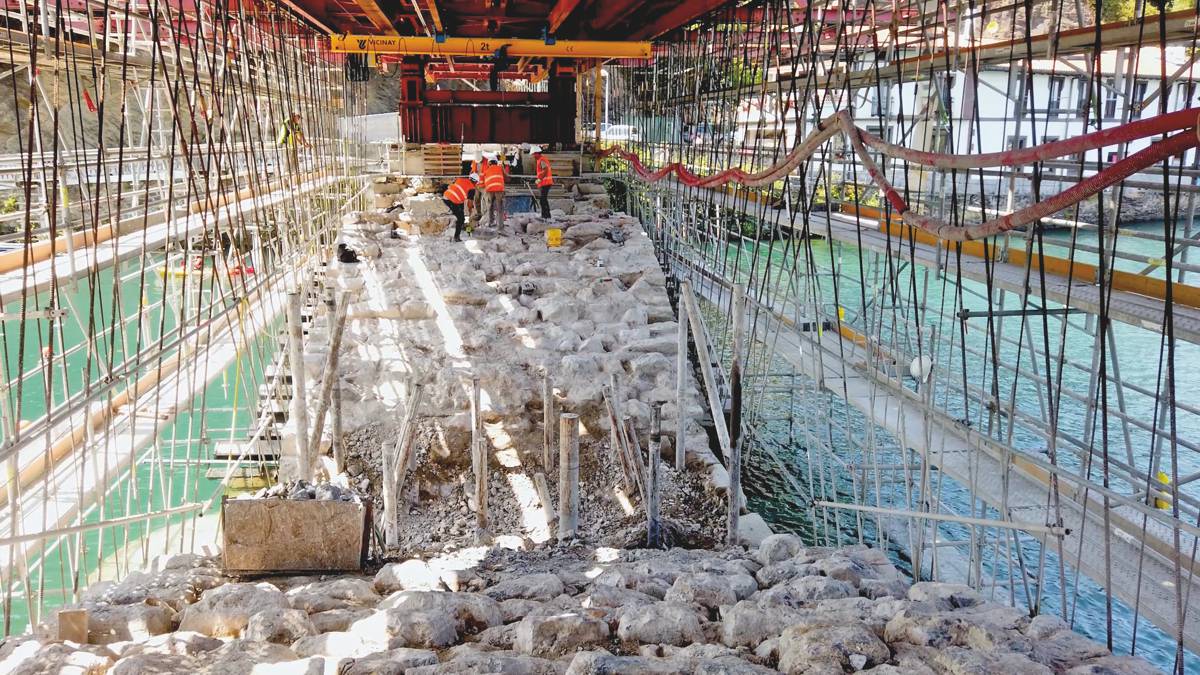
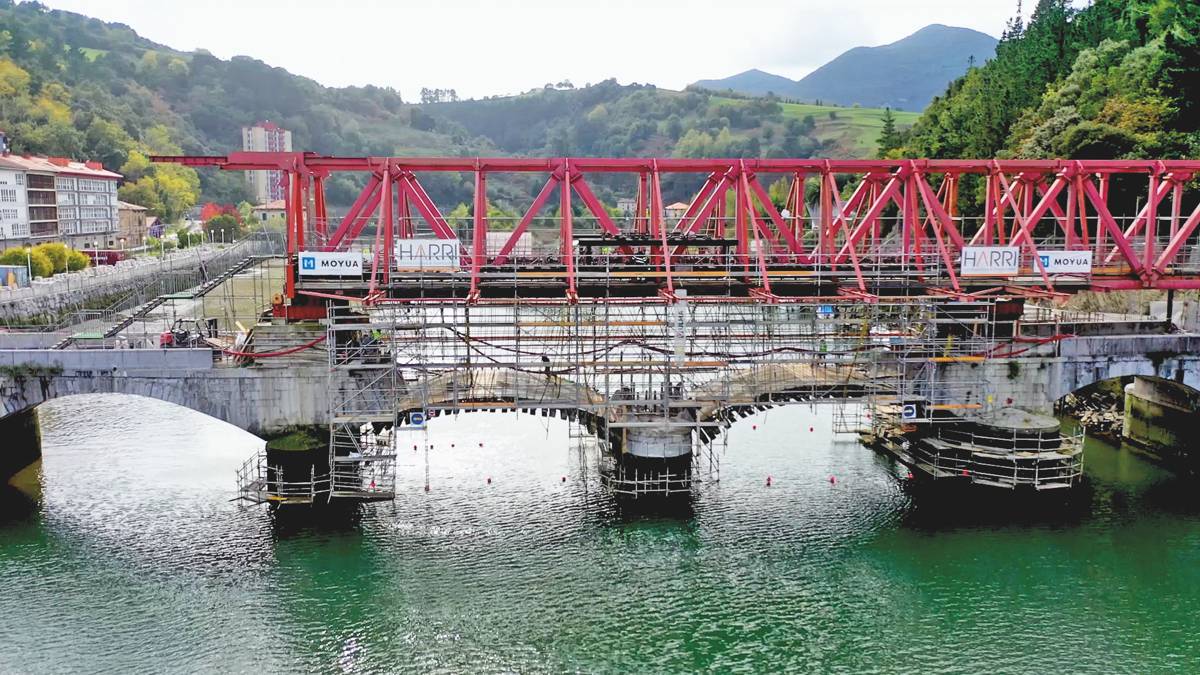
The solution inverted the usual logic of falsework by hanging the bridge from above rather than supporting it from below. Piers one and three, reinforced with micropiles to carry the additional load, became the anchor points for a high-capacity CA55 self-launching shoring installed over the deck, from which modular formwork panels were suspended on dywidag bars arranged radially to follow the line of the vaults.
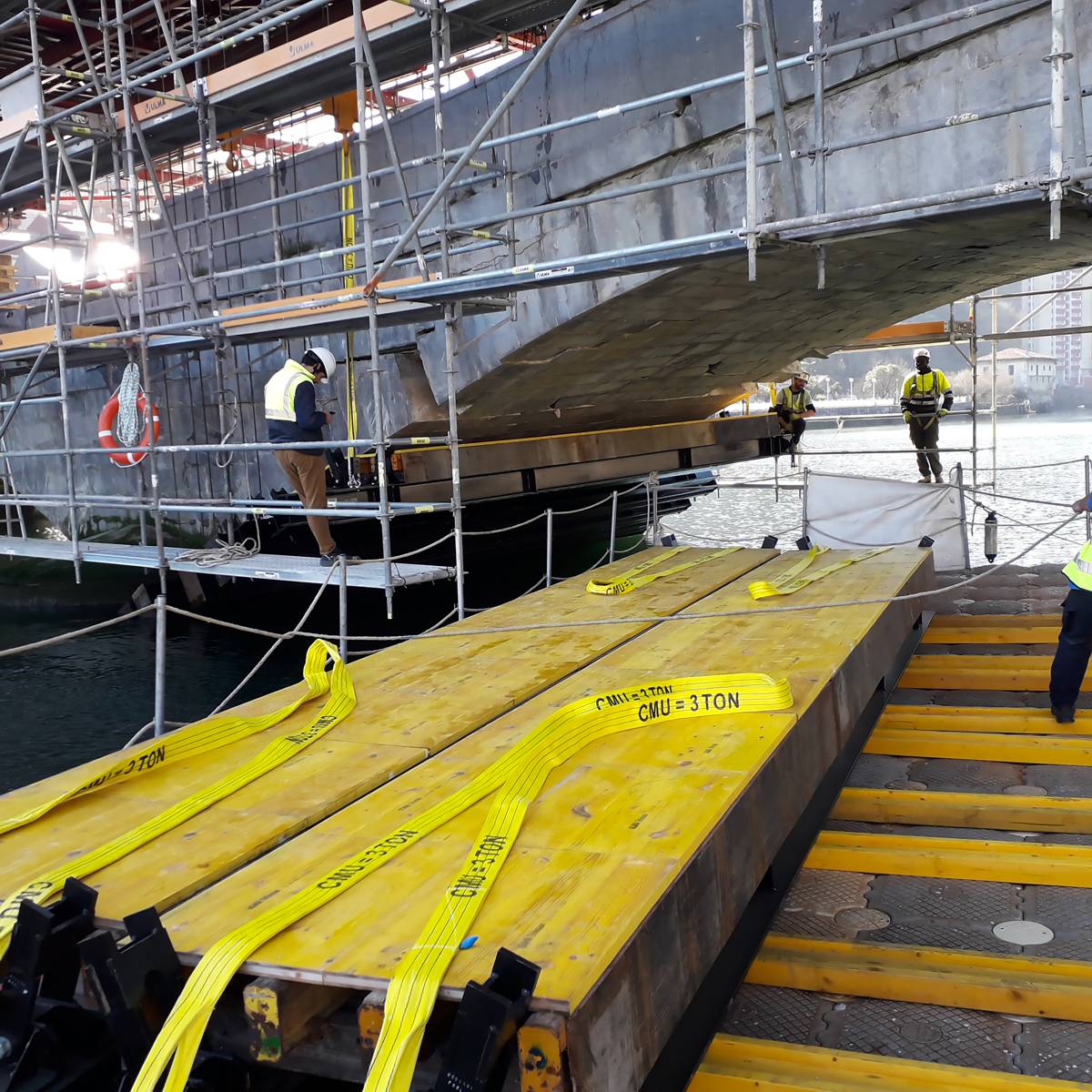
The commercial value of that approach lies in control and risk transfer. Each bar could be tensioned independently, allowing the load of the bridge to be handed over to the overhead system gradually and predictably, until almost the entire weight of the structure was suspended and the damaged vaults could be dismantled and rebuilt in safety. The formwork panels themselves were preassembled on a nearby port platform, floated into position on barges and placed with automated hoists and a purpose-built overhead crane, keeping the workforce clear of the tidal channel throughout.
A BRIO platform turned the space beneath the arches into a sheltered, near-industrial working environment. For an asset owner, this is the difference between a job that can be insured, sequenced and delivered on programme and one that cannot be attempted at all, and it explains why heritage clients increasingly buy the engineering method before they buy the contractor.
Reading the Nineteenth Century Course by Course
Restoring performance was only half the brief. The other half was authenticity, and it demanded that the team recover how the bridge had been built in the first place. Engineers from Fhecor and Injelan studied nineteenth-century construction techniques and married them to modern analysis, then approached the fabric with the discipline of an archaeological dig. Roughly 1,200 ashlar limestone blocks were dismantled under control, each individually catalogued and numbered so that it could be returned to its exact original position, and the arches were rebuilt course by course to correct the deformations the structure had accumulated over 150 years without altering its final appearance.
One detail captured the continuity of method better than any drawing. On one stone, the number 33 marked in blue by the modern team sat beside the same number inscribed in red by the bridge’s original nineteenth-century builders, confirmation that both crews had followed the same constructional logic more than a century apart. Around 90 per cent of the original material was reinstated, which matters commercially as well as culturally.
Reusing original stone reduces waste, avoids the cost and carbon of quarrying replacements, and preserves the very heritage value that justified the investment. Striking the temporary shoring was handled with matching precision, released symmetrically upstream and downstream and longitudinally by four coordinated teams to distribute the load evenly, and by November 2021 the arch was carrying its own weight again and the overhead system could be removed.
The Marine Borer Problem Nobody Priced In
The mechanism that nearly destroyed the Deba Bridge deserves closer attention than it usually receives, because it is a latent liability sitting under a great deal of estuarine and waterfront infrastructure. The bridge’s masonry piers were founded on timber piles driven into muddy, sandy ground, a wholly normal nineteenth-century detail. What undid them was biological.
Wood-boring marine bivalves, the family of molluscs commonly known as shipworms, consumed the submerged timber from the inside until the foundation lost its bearing, at which point pier two settled and rotated and the vaults above it failed. A recovered section of one of the eaten piles told the story plainly.
This is not a local curiosity. Warming coastal waters are extending the active season and geographic range of these borers, pushing them further north and later into the year, which means legacy structures that survived on timber foundations for a century may degrade faster in the decades ahead. The financial exposure is already visible elsewhere.
The Port Authority of New York and New Jersey has approved around 180 million US dollars over five years to replace or reinforce roughly 1,700 of nearly 100,000 timber support beams under its wharves as marine borers return to cleaner harbour waters. For European owners of estuarine bridges, quays and older port structures, Deba is a warning that foundation surveys of submerged timber should move up the risk register rather than being treated as a settled question.
A Template for the Repair Decade
Read together, the strands of the Deba project point to a shift in where value and competitive advantage sit in the bridge market. The award and the publicity attach to the finished stone, but the decisive assets were the engineering method, the specialist temporary works and the interdisciplinary coordination between designer, contractor and systems supplier. Europa Nostra’s jury made the point in its own terms, praising the minimal environmental impact and the knowledge transfer, and noting that the approach could help safeguard other bridges across Europe in future.
That is an unusually direct signal from a heritage body that a conservation method has become a scalable engineering template.
For the contractors and suppliers closest to that method, the commercial relationship matters as much as the hardware, a point captured by Joel de Frías, chief executive of Harri Construcciones y Mampostería, who observed that “It is a pleasure to work with ULMA, since that in addition to providing the means, they accompany you during the execution of the works”.
As Europe works through a repair backlog measured in the trillions, much of it on structures that cannot be replaced, asset owners would do well to treat temporary-works engineering not as a procurement afterthought but as one of the strategic capabilities that will decide which of their bridges survive the coming decades and at what cost.
Key Industry Questions
- Why is the Deba Bridge reconstruction commercially significant beyond its heritage value? It demonstrates a repeatable method for restoring full structural performance to a protected masonry bridge without demolishing it, at a moment when Europe faces an estimated €2 trillion bridge-repair challenge and a large share of the affected stock is old, listed or otherwise irreplaceable. The value in such projects concentrates in specialist temporary-works engineering rather than in the visible stonework. For asset owners, the project answers a practical question about how to keep culturally protected structures in service safely, which makes it a template rather than a one-off. It also signals where competitive advantage is moving within the bridge supply chain.
- What caused the bridge to fail in 2018? The masonry piers were founded on timber piles driven into soft riverbed. Wood-boring marine bivalves, commonly called shipworms, consumed the submerged timber over time until the foundations lost bearing capacity. On 5 July 2018 pier two settled and rotated by up to 70 centimetres, causing the two adjoining vaults to fail and leaving the bridge close to total collapse. The mechanism is significant because it is biological rather than the corrosion or overloading usually blamed for bridge deterioration, and because warming coastal waters are extending the range and active season of these borers, raising the risk to other timber-founded estuarine structures.
- Why did engineers suspend the bridge from above instead of propping it from below? The site made conventional shoring impossible. The tidal channel varied by around four metres, the ground was soft, and the provincial authority prohibited working beneath the structure. Supporting the bridge from firm ground was therefore not viable. Engineers instead installed a high-capacity self-launching shoring system over the deck, anchored on piers reinforced with micropiles, and suspended the bridge on radially arranged tensioned bars. This allowed almost the full weight of the structure to be transferred to the overhead system progressively and under control, so the damaged vaults could be dismantled and rebuilt without exposing the workforce to the channel below.
- What role did ULMA Construction play, and why does it matter? ULMA engineered the temporary works, including the CA55 self-launching shoring, the suspended formwork panels and the BRIO working platform. This matters because the temporary works were not an accessory to the project but the enabling factor that made the reconstruction feasible at all. ULMA is a Basque formwork and shoring cooperative founded in 1961 and active in around 80 countries, and its involvement illustrates how the specialist falsework market, long tied to new viaduct construction, now maps directly onto heritage repair demand. The scarce, high-value competence is the engineering knowledge to reconfigure such systems safely for restoration.
- How was the bridge’s original appearance preserved so precisely? Around 90 per cent of the original ashlar limestone was reinstated. Roughly 1,200 blocks were dismantled under control, individually catalogued and numbered, then returned to their exact positions as the arches were rebuilt course by course. Accumulated deformations were corrected during reassembly without changing the final appearance. The team also researched nineteenth-century construction techniques and combined them with modern analysis, an approach validated when a stone marked 33 in blue by the modern crew was found to carry the same number in red from the original builders. Reusing original material also reduced waste and avoided the cost and carbon of quarrying replacements.
- What does the project imply for owners of other timber-founded waterfront structures? It suggests that marine-borer damage to submerged timber should be treated as an active, rising risk rather than a historical one. Many nineteenth and early twentieth-century bridges, quays and port structures rely on timber piles, and warming waters are extending the reach of the molluscs that attack them. The financial exposure is already material elsewhere, with the Port Authority of New York and New Jersey committing around 180 million US dollars over five years to address borer damage to wharf timbers. European asset managers should prioritise foundation surveys of submerged timber and factor potential remediation into long-term maintenance budgets.
- Can the Deba method be scaled to larger or road-carrying bridges? The underlying principles of suspending a structure from an overhead system, transferring load progressively through independently adjustable ties, and preassembling components offsite for barge or crane placement are not limited to small footbridges. They derive from heavy-duty systems already used on major new viaducts. Scaling to larger or trafficked structures raises additional questions of load, sequencing, traffic management and cost, and each intervention remains bespoke. The significance of Deba is less that the exact solution transfers directly and more that it proves the commercial and technical viability of the approach, giving owners and engineers a credible reference point for constrained heritage interventions.
- How does this fit the wider European bridge-maintenance market? It sits at the intersection of three pressures: an ageing stock built largely between the 1950s and 1980s for concrete and much earlier for masonry, tightening obligations to maintain the trans-European transport network, and proposals to raise permitted vehicle loads against structures already near their limits. Roughly ten per cent of European bridges are considered significantly deficient and around a third of sound-rated bridges are not regularly inspected. Within that market, heritage and masonry structures form a distinct segment where replacement is often impossible, concentrating demand on restoration methods and the specialist engineering capability that Deba exemplifies.
Strategic Takeaways
- The commercial value in heritage bridge restoration concentrates in temporary-works engineering and interdisciplinary coordination rather than in the visible fabric, and asset owners who treat falsework as a procurement afterthought will misjudge both risk and cost.
- Europe’s masonry and heritage bridge stock forms a distinct segment of the estimated €2 trillion repair challenge, one where replacement is frequently impossible, sustaining long-term demand for restoration methods over demolition and rebuild.
- Marine-borer damage to submerged timber foundations is a climate-amplified and under-priced liability across estuarine and waterfront infrastructure, and foundation surveys of legacy timber should move up owners’ risk registers.
- Specialist formwork and self-launching shoring suppliers such as ULMA are positioned to capture rehabilitation demand because the systems and expertise built for new viaduct construction transfer directly to constrained repair work.
- The Europa Nostra jury’s endorsement of Deba as a safeguard for other European bridges effectively certifies a conservation approach as a scalable engineering template, giving owners and engineers a credible reference for future protected interventions.