The Quiet Return of the Server Room: Why Firms Are Spending Again to Own Their AI
Somewhere between a four-thousand-dollar box that sits beside a desk and a single rack that draws as much power as a small street, the economics of artificial intelligence have quietly turned. For three years the received wisdom held that serious AI belonged in the cloud, rented by the hour and scaled without capital outlay. In 2026 a growing number of organisations are reaching a different conclusion, and they are backing it with money. They are buying AI hardware and installing it inside their own buildings again.
The clearest snapshot of that shift arrived this week at Ai4 2026 in Las Vegas, where ASUS laid out a single continuous line of machines running from the data centre to the deskside. The display is worth reading less as a product launch than as a symptom. The interesting question is not what ASUS is selling, but why the customers have started buying, and what the answer means for anyone who builds, powers or operates physical infrastructure.
Briefing
- ASUS presented a four-tier AI hardware line-up at Ai4 2026 (4 to 6 August, The Venetian, Las Vegas) under the theme “Trusted AI, Total Flexibility”, spanning rack servers, data-centre systems and two deskside supercomputers priced from roughly four thousand dollars to several hundred thousand.
- The showcase reflects a wider 2026 reversal in which sustained, high-utilisation AI workloads are making owned hardware cheaper than rented cloud capacity over a multi-year horizon, with independent analyses placing the crossover at around 70 to 80 per cent sustained GPU utilisation.
- Four forces are driving the return of in-house compute: the utilisation maths flipping in favour of ownership, data that regulated and IP-rich firms will not send to a third-party cloud, latency that autonomous and real-time systems cannot tolerate, and a collapse in the physical size of the hardware required.
- At the top of the stack the same trend is remaking data-centre construction, now the single most powerful force in the sector, with US construction starts rising from 14.9 billion dollars in 2023 to 77.7 billion dollars in 2025 and power infrastructure accounting for 30 to 40 per cent of facility cost.
- For construction and infrastructure firms the development lands on two fronts at once, as a surge in the data-centre buildout they may design and deliver, and as newly affordable local compute for autonomous plant, site inference and engineering workloads.
The Maths That Flipped
The core of the story is unglamorous and financial. Renting a graphics processing unit from a hyperscaler is inexpensive when the workload is occasional and punishing when it runs constantly, because a rented asset costs the same whether it is busy or idle and depreciates on someone else’s balance sheet at a margin.
For the first wave of AI adoption, occasional was the norm. Teams prompted a model, waited, and moved on, and cloud rental suited that rhythm perfectly. What has changed in 2026 is the arrival of always-on autonomous agents, systems that reason and act continuously rather than answering one query at a time. Continuous work means high, sustained utilisation, and at high utilisation the arithmetic of ownership begins to win.
Independent cost analyses published through the first half of 2026 converge on a consistent threshold. Below roughly 70 per cent sustained GPU utilisation, cloud remains cheaper on total cost of ownership. Above 80 per cent, owned hardware can win over a three-year horizon when measured against standard hyperscaler pricing. Vendor-backed studies push the claim further, with one Lenovo-cited analysis arguing that on-premise configurations can reach break-even in as little as four months for genuinely high-utilisation workloads.
Those aggressive figures deserve scepticism, since the companies publishing them sell servers, but even the conservative independent numbers point the same way. A single cloud H100 at today’s reduced rates of around 2.50 dollars an hour still costs roughly 21,900 dollars a year, every year, with no asset remaining at the end.
Falling cloud prices, down about 60 per cent from their 2023 peak, have not settled the argument in the cloud’s favour. They have sharpened one half of the on-premise case instead, because cheaper rental makes the hardware that renders it look better value to own outright. The decision now turns almost entirely on how hard a given organisation intends to run its models.
What ASUS Actually Put On The Floor
Viewed through that lens, the ASUS booth reads as a map of the utilisation curve. Four platforms represent one workflow, described by the company as training in the rack, deployment at data-centre scale, and inference at the deskside.
At the enterprise end sits the ESC8000A-E13P, a four-rack-unit server built on NVIDIA’s MGX modular architecture. It carries two AMD EPYC 9005 or 9004 processors and up to eight dual-slot NVIDIA H200 or RTX PRO 6000 Blackwell Server Edition graphics cards, each drawing up to 600 watts, with up to 24 memory slots. Alongside it, the RS720A-E13-RS8G is a denser two-rack-unit machine on the DC-MHS open standard, a dual EPYC 9005 server optimised for up to three dual-slot cards. These are the systems an organisation buys when it intends to train or serve models at scale on its own premises.
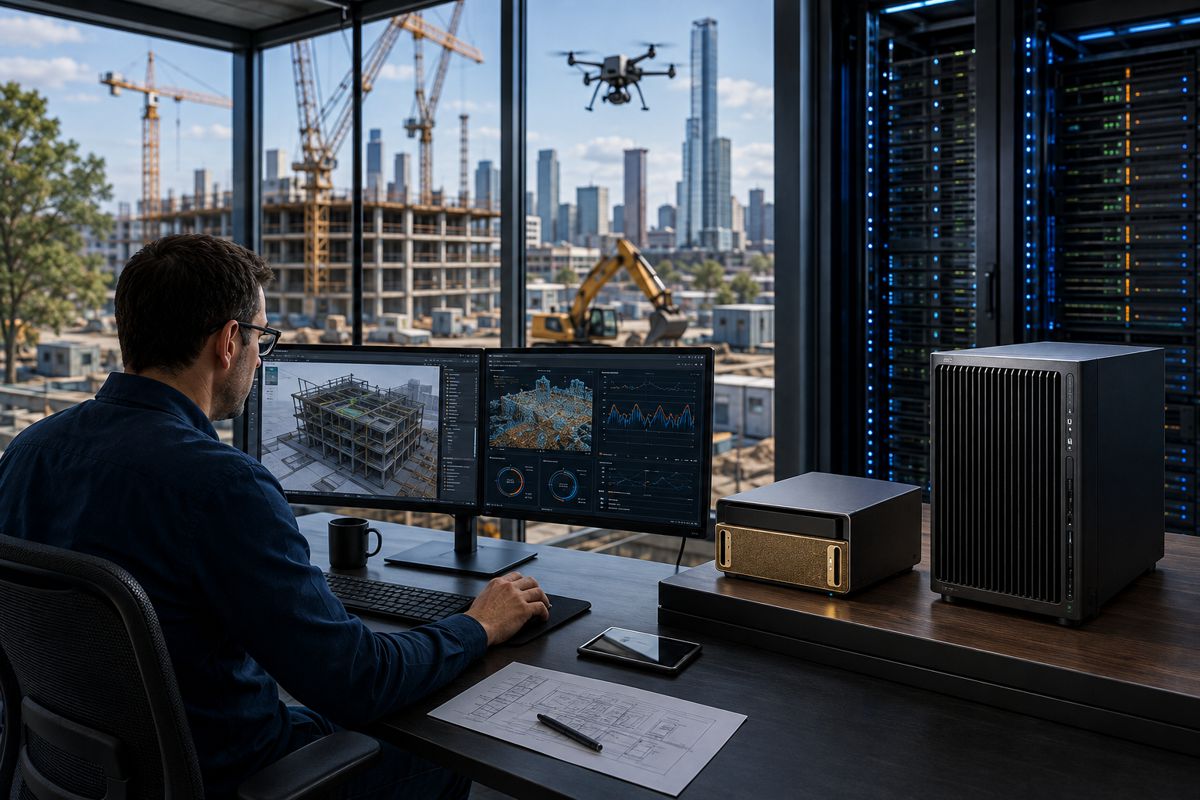
The two machines that better illustrate the shift are the smaller ones. The ASUS Ascent GX10, built on NVIDIA’s DGX Spark platform, is a compact desktop unit powered by the GB10 Grace Blackwell Superchip. It delivers up to one petaFLOP of AI performance at FP4 precision and carries 128GB of unified memory, enough to run models of up to 200 billion parameters locally. It is the on-ramp, and it costs roughly four thousand dollars. Above it sits the ExpertCenter Pro ET900N G3, built on the NVIDIA DGX Station platform and powered by the far larger GB300 Grace Blackwell Ultra Desktop Superchip, with 748GB of coherent memory and up to 20 petaFLOPS of performance, capable of running trillion-parameter models. This is a machine that until recently would have required a data centre, now sitting beside a desk.
That price spread, from a few thousand dollars to several hundred thousand, is itself part of the story. The entry point to serious local AI has become genuinely cheap, which is precisely what makes on-premise viable for mid-sized firms rather than only for hyperscalers.
The Data That Will Not Leave The Building
Cost is the loudest driver but not the only one. A second force is quieter and, for many organisations, decisive on its own. A growing number of firms will not send their data to a third-party cloud at any price.
The reasons stack up. Regulated sectors face compliance and data-sovereignty rules that make external processing awkward or prohibited. Firms sitting on valuable proprietary information, engineering designs, tender pricing, geotechnical survey data or client records, increasingly fear that material routed through a public model becomes training fuel for someone else’s system.
The concern has moved from the legal department into the boardroom, and it is the sentiment ASUS is addressing with the “Trusted” half of its “Trusted AI, Total Flexibility” theme. Running the model inside your own walls is the most direct answer available to the question of where your data goes, because the answer becomes nowhere.
For construction and engineering businesses this is not abstract. The value of a contractor’s accumulated project data, or a design firm’s detailing library, is exactly the kind of asset that ownership instincts protect. Local inference lets a firm apply large models to that material without ever exposing it, which for some organisations is worth more than the cost comparison.
Latency Is A Physical Fact
The third driver is the one that connects most directly to territory this publication already covers. Some workloads cannot tolerate the round trip to a distant cloud region, because the physics of distance imposes delay that real-time systems cannot absorb.
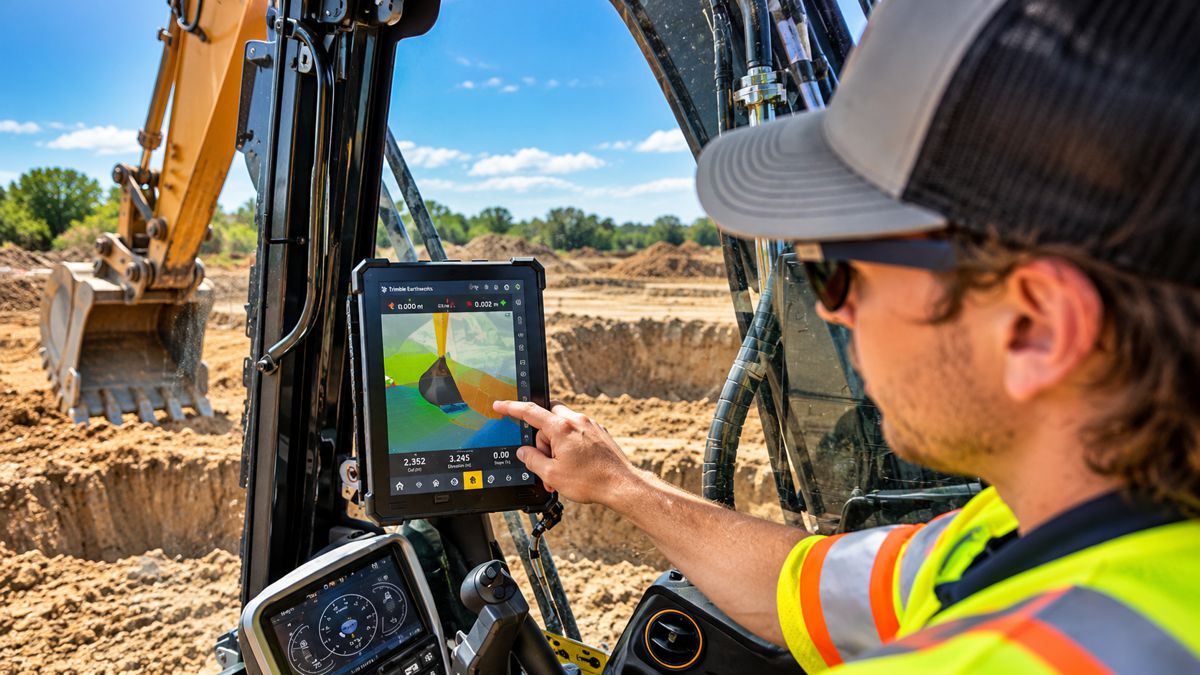
Autonomous machinery, robotics and on-site inference all fall into this category. A machine making control decisions cannot wait for a signal to travel to a data centre and back, so the compute has to sit close to the point of action. This is the logic behind edge AI, and it is why the deskside and local-inference end of the ASUS line matters beyond the office. The same argument that puts a supercomputer beside an engineer’s desk puts inference hardware on a job site, inside a survey vehicle or within a piece of autonomous plant.
ASUS frames this as building on-prem AI factories to enable always-on autonomous agents running locally, and Kaustubh Sanghani, Vice President of GPU Product Management at NVIDIA, described the underlying architectures as a flexible foundation to build and run AI across the data centre and desktop.
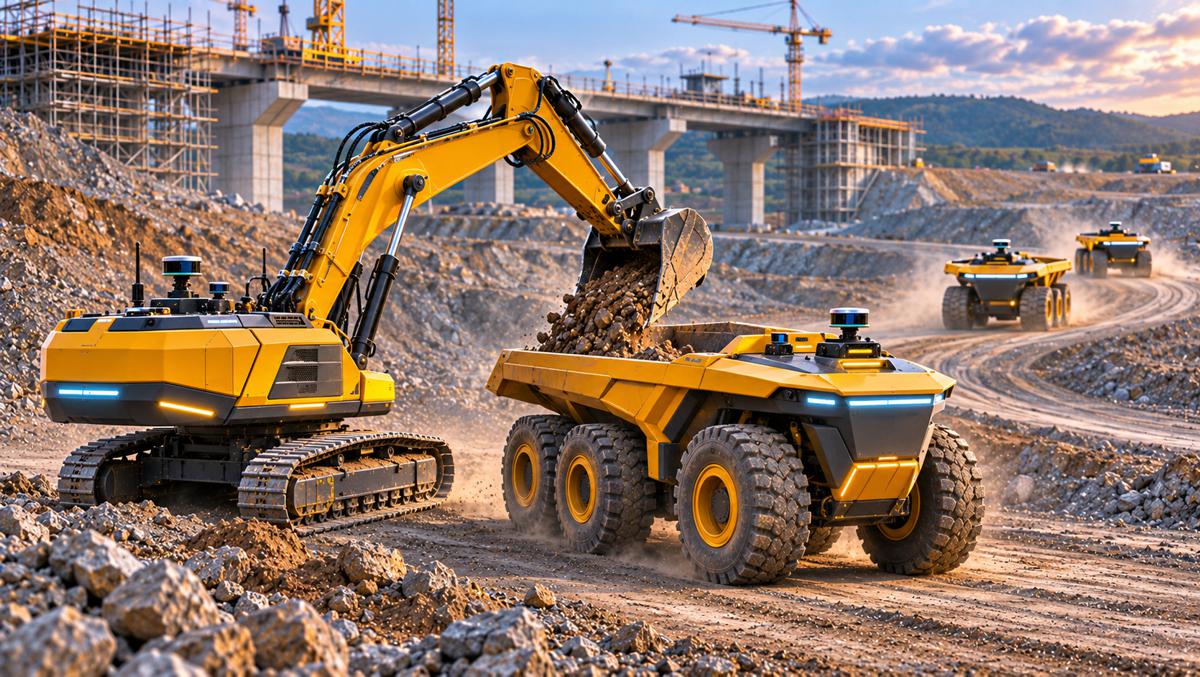
For readers following the steady advance of construction-equipment autonomy, the connection is direct. The economics that make local compute affordable are the same economics that make autonomous plant more practical to deploy, because the intelligence can now live on the machine rather than in a distant facility.
The View From The Top Of The Stack
If the deskside machines show why individual firms are repatriating compute, the top of the ASUS stack shows what that demand is doing to physical infrastructure, and this is where the story becomes unambiguously a construction one.
ASUS also builds the AI POD, a rack-scale system on NVIDIA’s Vera Rubin NVL72 platform that reaches a thermal design power of up to 227kW per rack and relies on 100 per cent liquid cooling, because traditional air cooling simply cannot shed that much heat. A single rack now draws power on the order of a small industrial unit, and that figure captures the pressure the AI buildout is placing on buildings, grids and cooling systems.
The construction numbers behind that pressure are striking. US data-centre construction starts rose from 14.9 billion dollars in 2023 to 26.9 billion in 2024 and then to 77.7 billion in 2025, a 190 per cent year-on-year increase, and 2026 has accelerated further, with spending through April running at nearly four times the prior year’s pace. Data centres have become, by several industry accounts, the single most powerful force in US construction while the broader non-residential market flattens.
Power infrastructure alone now represents 30 to 40 per cent of total facility cost, cost-per-megawatt figures for AI-optimised builds run well above conventional facilities, and construction timelines for large AI campuses frequently stretch to between 24 and 48 months because of grid interconnection queues and transmission constraints. Analysts estimate that a substantial share of planned 2026 capacity will slip to 2028 for exactly those reasons, and utilities expect to invest more than a trillion dollars in grid upgrades between 2025 and 2029 to keep pace.
Those constraints are reshaping where and how data centres get built. Power access, not the speed of pouring concrete, now decides project feasibility, and behind-the-meter generation, modular construction and liquid-cooling retrofits are moving from the margins to the mainstream. For the civil, structural and power-infrastructure firms that deliver these projects, the AI hardware on the ASUS booth is the demand signal at the far end of a very long supply chain that begins with land, substations and water.
The Room ASUS Chose
The choice of Ai4 as the venue is telling in its own right. The conference, running from 4 to 6 August at The Venetian, is positioned as North America’s largest applied-AI event, drawing a projected 12,000 attendees and built around real-world deployment rather than pure research. Its keynote line-up pairs the field’s founding figures, Geoffrey Hinton, Fei-Fei Li and Andrew Ng, with a rare joint appearance by Waymo co-chief executive Dmitri Dolgov and founder Sebastian Thrun, whose company is the clearest example anywhere of AI crossing from research into commercial deployment at scale.
For an infrastructure audience, the more relevant detail is who else is in the room. The speaker roster includes executives from Caterpillar and Ford, a reminder that the industrial and heavy-equipment sector now treats applied AI as core business rather than novelty. ASUS placed its hardware in front of exactly the buyers who are weighing the buy-versus-rent decision across manufacturing, energy and construction, which is the audience for whom the repatriation calculation is live.
Key Industry Questions
- Why are companies spending again to put AI hardware inside their own buildings? Because the shift to always-on autonomous agents has driven AI workloads to high, sustained utilisation, and at that level owning hardware becomes cheaper than renting cloud capacity over a multi-year horizon. Data-protection requirements, latency demands and a collapse in the physical size of the necessary hardware reinforce the same conclusion.
- At what point does owning beat renting? Independent 2026 analyses place the crossover at roughly 70 to 80 per cent sustained GPU utilisation over a three-year horizon measured against standard hyperscaler pricing. Below that, cloud generally wins on total cost. Vendor studies claim far faster break-even, but those figures come from hardware sellers and should be treated with caution.
- Does this mean the cloud is finished for AI? No. Cloud remains the right choice for sporadic, unpredictable or bursty workloads, and for organisations that do not want to manage hardware. The change is that a second viable path has reopened for firms with steady, heavy usage or strict data requirements, not that one model has replaced the other.
- How does any of this concern construction and infrastructure firms? On two fronts. The demand for AI compute is driving a historic data-centre construction boom that civil, structural and power-infrastructure firms are being asked to deliver, and newly affordable local compute makes AI more practical to deploy in autonomous plant, on-site inference and engineering workflows.
- What is the significance of the 227kW rack figure? It marks the point at which conventional air cooling fails and full liquid cooling becomes mandatory. A single rack drawing 227kW illustrates why the AI buildout is straining power grids and cooling systems, and why power access rather than construction speed now dictates data-centre feasibility.
Strategic Takeaways
- The buy-versus-rent decision has genuinely reopened, and it turns on utilisation. Organisations planning sustained, always-on AI workloads should model owned hardware seriously, while those with sporadic or unpredictable demand still belong in the cloud.
- Data sovereignty can override cost. For firms holding regulated or commercially sensitive data, the case for local compute may be decided before the spreadsheet is opened, and construction and engineering businesses sit squarely in that category.
- The affordability of edge inference strengthens the case for autonomous plant. The same economics that put a supercomputer beside a desk make on-machine intelligence more deployable in the field.
- The data-centre buildout is now a defining construction market, not a niche. Power infrastructure, liquid cooling, grid interconnection and modular delivery are where the constraints and the opportunities concentrate.
- Price is no longer the barrier to entry. With a capable local machine available at around four thousand dollars, the question for most firms is no longer whether they can afford to own AI compute, but whether their workload justifies it.