MIE and International Trade Council Expand Market Access Across Global Exhibitions
International exhibitions increasingly have to deliver more than floor space, visitor numbers and a few days of networking. For companies entering unfamiliar markets, particularly across Africa and the Middle East, the harder work often begins after the stand has been dismantled: identifying credible partners, reaching public-sector decision-makers, finding distributors and turning introductions into commercial relationships.
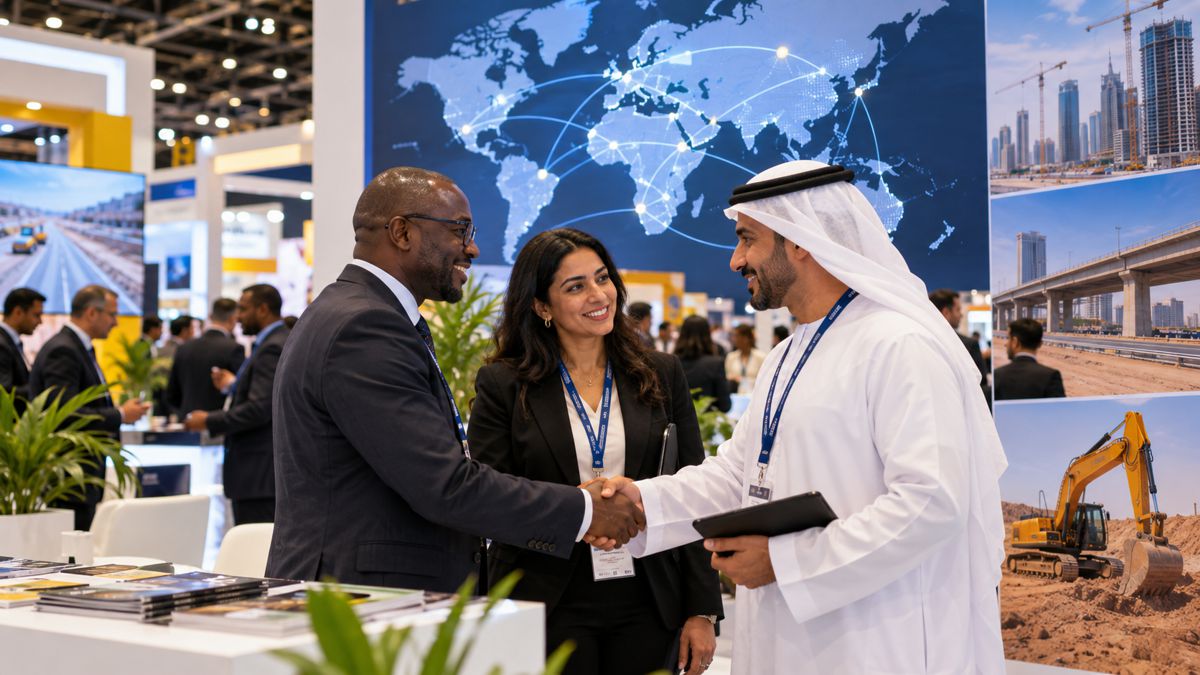
MIE Groups and the International Trade Council are extending an existing relationship across MIE’s 2026 and 2027 international exhibition portfolio, with B2B matchmaking, government engagement and market access at the centre of the arrangement. The partnership is due to operate across exhibitions and business platforms spanning Asia, the Middle East, Africa, Europe and the United States.
For construction, infrastructure, energy and mobility businesses, the interesting part is the network being built around those exhibitions. MIE already operates events covering construction, infrastructure, energy, property and electric mobility in markets including Ghana, Kenya, Morocco, Saudi Arabia and the UAE. The International Trade Council adds connections with businesses, chambers, trade bodies and government organisations across an international network.
Briefing
- MIE Groups and the International Trade Council have expanded an existing relationship across MIE’s 2026 and 2027 exhibition portfolio.
- The programme is intended to strengthen B2B matchmaking, strategic introductions and B2G engagement.
- Participating businesses may be connected with buyers, distributors, suppliers, investors and prospective commercial partners.
- MIE’s portfolio includes construction, infrastructure, energy and mobility exhibitions across several international markets.
- The partnership begins with MIE’s remaining 2026 events and is planned to continue through 2027 and beyond.
Beyond the Exhibition Floor
Trade exhibitions have always been built around bringing buyers and sellers into the same building. The difficulty is ensuring that the right people actually meet.
MIE and the International Trade Council say their collaboration will place greater emphasis on structured matchmaking, including introductions between exhibitors and potential buyers, distributors, investors, suppliers and business partners. Government representatives and public-sector organisations are also part of the network, providing another route into markets where procurement, regulation and public investment are closely connected.
There is already some operational history behind the agreement. The International Trade Council partnered with Ghana Investment & Trade Week in July 2026, alongside the launch of its Centre for Africa in Tema. The programme included trade facilitation, market-entry activity and B2B matchmaking. MIE subsequently listed the Council as an honorary supporting partner for Africa Food Show Kenya and The Hotel Expo Kenya in August.
The expanded agreement takes that relationship across a broader portfolio. For an equipment manufacturer, technology supplier or specialist contractor considering a market such as Ghana, Kenya, Morocco or Saudi Arabia, exhibition attendance can establish visibility and provide an initial concentration of potential customers. Building a lasting presence generally requires relationships extending beyond prospective buyers to local distributors, government agencies, project owners, investors and established commercial partners.
Building the International Network
MIE’s calendar provides considerable territory over which to develop the model. Its 2026 programme has included Ghana Investment and Trade Week, Africa Build Show Ghana and Kenya, Megawatt events, CTW Kenya and infrastructure-focused exhibitions in the United States. Remaining events include CTW Global in Dubai, events in Morocco and electric mobility exhibitions in Morocco, the UAE and Saudi Arabia.
The construction connection is particularly visible in Africa. Ghana Investment and Trade Week 2026 was co-located with Africa Build Show and Megawatt Africa, bringing trade, construction and energy audiences together in Accra. MIE says the 2026 Ghana event attracted more than 6,000 visitors from over 33 countries and generated more than 1,100 B2B meetings, although those figures are organiser-reported rather than independently audited.
In Kenya, China Trade Week was held alongside Africa Build Show Kenya, Africa Technology Show and Megawatt Africa at Nairobi’s Kenyatta International Convention Centre in July. Several related sectors were concentrated around the same event while structured meetings connected overseas suppliers with regional businesses and institutions.
For a roadbuilding equipment supplier, that might mean finding a distributor with an established customer base and technical support capability. A technology company may need access to an infrastructure owner or government agency, while an energy developer could be looking for investors and local partners. The exhibition provides the concentration of organisations; the quality of the introductions determines whether that concentration becomes commercially useful.
The International Trade Council describes itself as a peak-body chamber of commerce supporting businesses and governments involved in international trade and foreign direct investment. It traces its origins to 1956 and says its network encompasses more than 28,000 companies. Its role within the MIE partnership is expected to include strategic introductions, access to international business networks and support for B2B and B2G engagement.
The original announcement also refers to connecting companies with investment opportunities and strategic projects, although no specific projects or investment commitments were identified. Partnerships of this kind create opportunities for introductions rather than guarantees of contracts, investment or successful market entry. Their practical value depends on the quality of the participating organisations, the relevance of the matchmaking and the commercial follow-through once an event finishes.
The scale of the Council’s network also warrants careful wording. The supplied announcement describes more than 28,000 members across 179 countries and a wider reach exceeding 40 million companies. The Council’s current website supports the 28,000-plus figure and says its network spans more than 179 countries, although another Council-linked event site gives 176 countries. The broader description of an international network is therefore more defensible than treating an exact country count as fixed.
From Introductions to Commercial Relationships
Companies can already research suppliers, equipment and technologies online. A physical event becomes more useful when it compresses months of business development into a few days and provides access to people who may be difficult to reach remotely.
That becomes particularly relevant when companies enter markets where they have little existing representation. Finding a distributor through an internet search is straightforward. Establishing whether that distributor has the technical capability, customer relationships and local standing to represent a specialised construction equipment or infrastructure technology business requires considerably more work, and structured introductions can provide a better starting point for that due diligence.
For MIE, the International Trade Council partnership extends the proposition around its exhibitions from attendance towards market access. For the Council, MIE provides a physical network of events where its international membership and institutional relationships can meet companies seeking buyers, investment and local partners.
The harder test comes afterwards. Meetings and introductions are relatively easy to count, as are visitors through the doors of an exhibition. Distributorships established, contracts signed, investments completed and businesses still operating successfully in new markets several years later provide a more useful measure of whether those connections produced lasting commercial value.
Key Industry Questions
- What does the MIE Groups and International Trade Council partnership cover? It covers MIE’s 2026 and 2027 international exhibitions and business platforms, with cooperation expected to continue beyond 2027.
- What is the main commercial purpose of the partnership? The stated focus is market access, B2B matchmaking, strategic business introductions, investment connections and B2G engagement.
- Which sectors are relevant to construction and infrastructure businesses? MIE operates exhibitions covering construction, infrastructure, energy, property, technology and electric mobility, among other sectors.
- Which markets are covered by MIE Groups? Its portfolio extends across Africa, the Middle East, Asia, Europe and the United States, with active events in markets including Ghana, Kenya, Morocco, Saudi Arabia and the UAE.
- Does the partnership guarantee contracts or investment? No. It provides platforms for introductions, matchmaking and engagement. Commercial agreements remain dependent on the participating organisations and subsequent negotiations.
- Has the International Trade Council previously worked with MIE events? Yes. Its 2026 involvement included Ghana Investment & Trade Week and support for Africa Food Show Kenya and The Hotel Expo Kenya.
- Why are B2G connections relevant to infrastructure suppliers? Government agencies and public-sector organisations frequently influence infrastructure planning, regulation, investment and procurement, making institutional relationships important when entering new markets.
- How can exhibitors judge the value of structured matchmaking? Useful measures extend beyond the number of meetings arranged to include qualified leads, distributor agreements, procurement opportunities, investment discussions and commercial relationships that continue after the event.
Strategic Takeaways
- International exhibitions are increasingly being developed as market-entry platforms rather than standalone promotional events.
- Structured matchmaking is most useful when exhibitors are connected with commercially relevant organisations rather than simply generating more meetings.
- Combining private-sector and government participation can be particularly relevant in construction, infrastructure, energy and mobility markets.
- MIE’s presence across several African and Middle Eastern markets gives the partnership an existing network through which to operate.
- Long-term commercial outcomes provide a more meaningful measure of the partnership than attendance or meeting statistics alone.