From Manila to Singapore: 10 Infrastructure Projects to Watch Across Southeast Asia
Across Southeast Asia, some of the region’s largest infrastructure projects are overcoming geography that has always complicated movement.
The Philippines is building a 147 km commuter railway through one of the world’s largest urban regions while boring its first underground metro beneath Manila. Malaysia’s East Coast Rail Link is approaching operations after crossing the mountainous interior of the peninsula, while Penang is beginning its first modern light railway. Singapore is constructing what will become its longest fully underground MRT line, Jakarta is extending its metro beneath the historic centre of the Indonesian capital, and Vietnam is completing a new international airport while preparing a high-speed railway that would run almost the length of the country.
The engineering varies enormously. There are deep tunnels beneath congested cities, viaducts across flood-prone ground, major earthworks, bridges and marine crossings, airport runways, railway depots, stations, electrification systems and hundreds of kilometres of new alignment.
Some projects are approaching testing and operation, others are deep into heavy civil construction, and a few are still at the stage where financing, design and procurement decisions will determine how they are ultimately built.
Briefing
- The Philippines’ 147 km North-South Commuter Railway has an estimated project cost of PHP873.6 billion, with partial operations planned from December 2027.
- Malaysia’s 665 km East Coast Rail Link had reached 92.62% completion by February 2026, with the first 519 km section now moving towards commercial operation in January 2027.
- Vietnam’s first phase of Long Thanh International Airport represents investment of approximately VND109.1 trillion, around $4.6 billion, and is targeted for commercial operation during 2026.
- Singapore’s Cross Island Line will eventually extend around 67 km with 27 stations, creating the country’s longest fully underground MRT route.
- Vietnam’s planned 1,541 km North-South High-Speed Railway carries an estimated investment of $67.34 billion, with construction now targeted to begin in December 2027.
1. Metro Manila Subway, Philippines
Beneath one of Southeast Asia’s most congested metropolitan areas, the Philippines is constructing its first underground railway.
Metro Manila Subway Phase 1 will create a predominantly underground route through the capital region, connecting Quezon City with Taguig and extending to Ninoy Aquino International Airport. The programme combines deep stations, tunnel boring, depot construction, railway systems and interfaces with existing and future transport networks.
Japan is central to its financing and engineering. The project is backed by Japanese official development assistance through JICA, while major civil packages involve Japanese contractors working with Philippine partners. Government funding has continued alongside the external finance, with PHP44.17 billion released in March 2026 for the subway and North-South Commuter Railway programmes.
The construction story has accelerated during 2026. In September, a tunnel boring machine completed a 1.13 km drive between North Avenue and Quezon Avenue at a depth of around 35 metres. The PHP25.538 billion CP102 package, including a 3.1 km tunnel section and Quezon Avenue and East Avenue stations, is being delivered by the Nishimatsu Construction-DMCI joint venture.
Days earlier, construction formally began on the NAIA Terminal 3 station. Contract Package 109 is being delivered by the Taisei-DMCI joint venture, creating the direct airport connection that will eventually make the subway part of Manila’s international transport gateway.
Tunnelling is only part of the challenge. Metro Manila combines dense development, major utilities, difficult traffic management and ground conditions influenced by waterways and flooding. Stations and shafts have to be inserted into a city with little spare surface space for construction compounds, while the new railway has to connect with a transport network that is itself being rebuilt.
One of those connections will be with a much longer railway running across the metropolitan region.
2. North-South Commuter Railway, Philippines
At approximately 147 km, the North-South Commuter Railway will connect Clark and its international airport north of Manila with Calamba in Laguna to the south, passing through the capital along the way. The complete system is planned around 35 stations and represents an estimated PHP873.6 billion investment.
Financing reflects that scale. The programme combines Japanese support through JICA with substantial Asian Development Bank lending. ADB approved up to $4.3 billion for the 54.6 km South Commuter section alone, while JICA is financing railway systems and rolling stock as well as other components of the wider network.
The project is beginning to move from pure civil engineering towards railway operation. A third trainset was delivered to the Malanday Depot in September 2026 and a fourth had arrived in the Philippines. Seven are expected to be available by September 2027 for testing, commissioning and operational preparation ahead of planned partial operations in December 2027. J-TREC and Sumitomo are supplying 13 eight-car trainsets under the current programme.
The operating structure is also taking shape. ADB is supporting the operations and maintenance public-private partnership through a $700 million partial credit guarantee. The proposed concession uses availability payments, with the Department of Transportation paying the private operator against defined service standards rather than transferring passenger demand risk entirely to the concessionaire.
Civil construction, land acquisition, stations, depots, electrification, signalling and rolling stock still have to converge before the entire 147 km system becomes operational. Full operation is currently targeted for 2033, illustrating the difference between opening the first usable railway and completing a transport programme of this scale.
3. Long Thanh International Airport, Vietnam
Around 40 km east of Ho Chi Minh City, one of Southeast Asia’s largest greenfield airports is approaching its first operational milestone.
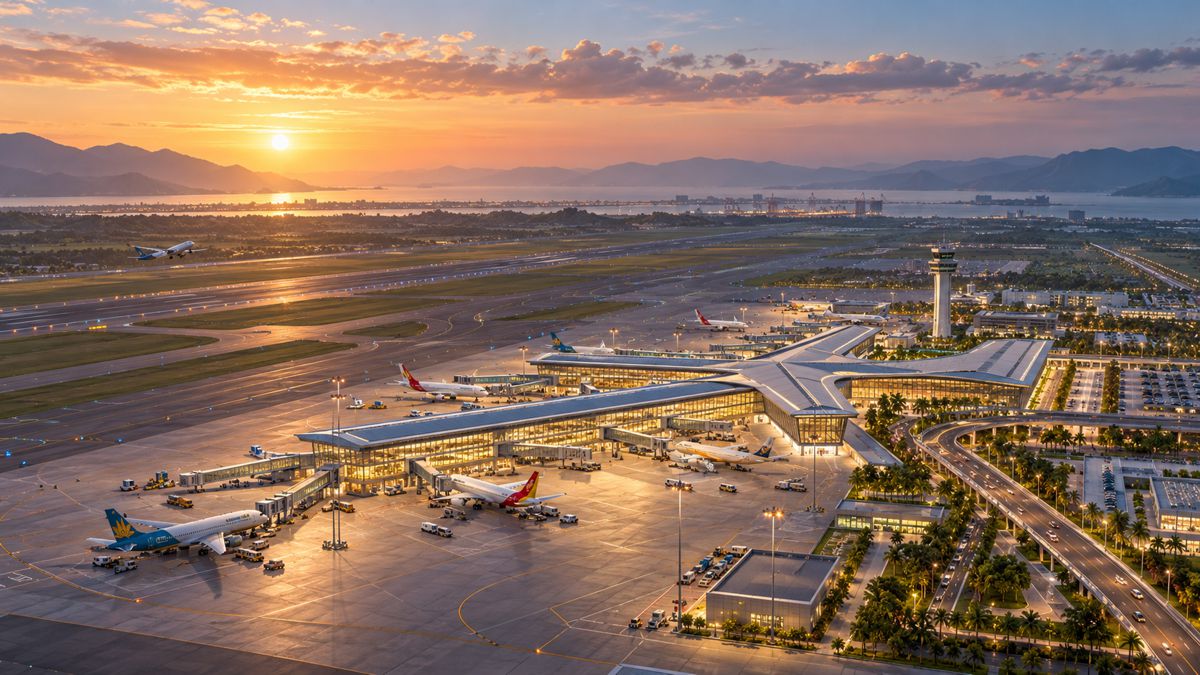
Long Thanh International Airport is ultimately planned as a 100 million-passenger-a-year hub on a site covering approximately 5,000 hectares. Phase 1 represents investment of around VND109.1 trillion, approximately $4.6 billion, and includes the first runway, passenger terminal, apron, air traffic facilities, roads, utilities, drainage and supporting infrastructure.
By May 2026, the Vietnamese authorities put overall Phase 1 progress at approximately 76%. The first runway, taxiways, aircraft apron, air traffic control facilities, fuel infrastructure and connecting transport works were among the components already completed or capable of operation, while the government continued to push towards commercial opening during 2026.
The workforce gives another indication of the construction intensity. Airports Corporation of Vietnam reported almost 9,000 workers on site in March, with contractors, supervision consultants and project management teams operating across numerous packages. Component Project 3 alone encompasses a large collection of airport facilities and supporting infrastructure.
The contractor base is correspondingly broad. Package 4.8, covering internal airport transport infrastructure and utilities and valued at VND11.066 trillion, involves CC1 and eight other members of a contractor consortium. The works include roads, technical corridors and associated infrastructure required to connect the individual airport components.
An airport of this scale cannot operate independently of the transport system around it. Long Thanh has to be connected effectively with Ho Chi Minh City, regional expressways and future rail infrastructure, making access capacity almost as consequential as the runway and terminal.
Vietnam is simultaneously preparing a transport programme several orders of magnitude longer.
4. North-South High-Speed Railway, Vietnam
Vietnam’s proposed North-South High-Speed Railway would fundamentally change the scale of railway construction in Southeast Asia.
The approved investment policy covers approximately 1,541 km between Ngoc Hoi in Hanoi and Thu Thiem in Ho Chi Minh City. The double-track, standard-gauge railway is planned for a design speed of 350 km/h, with 23 passenger stations and five freight stations. The current preliminary investment estimate is approximately $67.34 billion.
This is not yet a heavy construction programme. During 2026, the focus has been on feasibility work, technical preparation, land acquisition planning and the selection of consultants. More than 80 consulting organisations had expressed interest by May, while the government has been working through the feasibility and FEED process.
The timetable has also become clearer. Earlier government ambitions to begin work during 2026 have given way to a Ministry of Construction target of December 2027 for construction to start. The programme is intended to be substantially completed by 2035, although a project of this length and complexity will remain exposed to procurement, land, financing and technical risks throughout delivery.
The engineering may eventually prove easier to define than the commercial structure. Vietnam has to determine how technology will be procured and transferred, how domestic companies will participate, how thousands of hectares of land will be assembled and how an investment approaching $70 billion will be financed over the construction period.
That makes the railway worth watching before the first major civil contract is awarded. Surveys, geotechnical investigation, land preparation, design standards, materials strategy and procurement will shape the project long before high-speed trains appear.
Malaysia’s East Coast Rail Link provides a useful contrast: another national railway, but one now approaching the end of heavy construction.
5. East Coast Rail Link, Malaysia
The East Coast Rail Link is rapidly changing from one of Southeast Asia’s largest construction sites into an operational railway.
The 665 km electrified route connects Malaysia’s east coast with the Klang Valley and ultimately Port Klang on the west coast. Malaysia Rail Link is the project owner, while China Communications Construction Company is the principal engineering, procurement, construction and commissioning contractor.
By February 2026, overall construction had reached 92.62%. The 519 km main track between Kota Bharu and Gombak was completed ahead of schedule in March, moving that section towards testing, commissioning and commercial operation in January 2027. The final connection from Gombak to Port Klang is scheduled for completion in December 2027 and operation in January 2028.
The railway has required extensive bridges, viaducts, cuttings and tunnels to cross the mountainous spine of Peninsular Malaysia. Earlier in construction, more than 1,900 worksites were identified along the alignment, illustrating the distributed nature of delivering hundreds of kilometres of railway simultaneously.
Completion changes the engineering problem. Track, structures and stations have to become an operating railway integrated with ports, freight terminals, industrial areas and Malaysia’s existing rail network. The commercial case depends heavily on that freight function, particularly the ability to move goods between the east coast and Port Klang without the existing road or maritime detours.
6. Penang Mutiara Line, Malaysia
Penang’s Mutiara Line is at the opposite end of the construction cycle.
The Federal Government has set a RM16.8 billion budget ceiling for the project, which is being developed by MRT Mutiara, a subsidiary of MRT Corporation. The alignment is intended to connect Penang’s airport and Free Industrial Zone with George Town and eventually Penang Sentral on the mainland. Construction of the initial section began in 2025, with operations targeted for December 2031.
The first major civil contract is already substantial. A Gamuda-led SRS Consortium secured an RM8.3155 billion design-and-build package covering 23.7 km of elevated viaduct between Komtar and Silicon Island, 19 stations plus one provisional station, a depot and associated utilities and surface works. Gamuda holds 60% of SRS Consortium, alongside Loh Phoy Yen Holdings and Ideal Property Development with 20% each.
The next section extends from Macallum towards Penang Sentral. MRT Corp’s current programme envisages contractor appointment for Segment 2 in 2026 and construction beginning in January 2027, with the entire line scheduled for completion and operation in December 2031.
Penang presents a particularly constrained construction environment. Dense urban development, existing roads, utilities and industrial activity limit available working space, while extending the railway towards the mainland adds another layer of engineering and transport integration.
The project also represents something broader in Malaysia’s infrastructure programme. Large-scale urban rail investment is no longer confined to Kuala Lumpur, with Penang’s manufacturing and electronics economy creating its own demand for higher-capacity public transport.
7. Cross Island Line, Singapore
Singapore’s eighth MRT line will eventually become its longest fully underground railway.
Including its phases, Punggol extension and connection towards Changi Terminal 5, the Cross Island Line is planned to reach approximately 67 km with 27 stations. Phase 1 covers 29 km and 12 stations, Phase 2 adds approximately 15 km and six stations, the Punggol Extension another 7.3 km, and Phase 3 approximately 10 km with four underground stations.
Construction is spread across decades rather than treated as a single opening event. Phase 1 is targeted for 2030, followed by Phase 2 and the Punggol Extension in 2032. Early tunnelling is under way on Phase 2, while construction of Phase 3 is expected to begin in 2027 for opening in the late 2030s.
The machinery reflects the unusual underground conditions. On parts of Phase 1, LTA is deploying 12.6 metre diameter TBMs capable of excavating a single large tunnel containing both tracks, the largest tunnel boring machines used on an LTA railway project. Phase 2 includes twin 1.4 km bored tunnels through predominantly hard sedimentary rock beneath infrastructure including the Sungei Ulu Pandan canal, where slurry TBMs and real-time ground monitoring are being used.
Systems procurement is progressing alongside the civil works. A consortium of Siemens Mobility and Concord Corporation secured a contract worth around S$400 million for the line’s power supply system, covering design, supply, installation, testing and commissioning.
Singapore’s dense underground environment leaves little room for treating stations, tunnels and utilities independently. Existing MRT lines, roads, buildings and sensitive land uses all influence alignment and construction methodology, turning the Cross Island Line into a rolling underground engineering programme extending well into the next decade.
8. Jakarta MRT Phase 2A, Indonesia
Indonesia deserves a place on any Southeast Asian infrastructure watchlist, and one of its most interesting current projects is happening beneath the centre of Jakarta.
MRT Jakarta Phase 2A extends the existing North-South Line approximately 5.8 km from Bundaran HI to Kota. All seven new stations are underground, running through Thamrin, Monas, Harmoni, Sawah Besar, Mangga Besar and Glodok before reaching Kota. The programme is valued at around Rp25.3 trillion and is financed through Japanese-Indonesian cooperation and loan funding.
Construction was approaching 57% overall in January 2026, ahead of programme, with MRT Jakarta targeting approximately 65% by the end of the year. The first segment from Bundaran HI to Harmoni is scheduled for completion in 2027 and the second from Harmoni to Kota in 2029.
Individual packages are considerably further advanced. CP201, covering Thamrin and Monas, had passed 91% by January, while CP203 at Glodok and Kota had reached 82%. Railway systems and track work are progressing under CP205, while rolling-stock procurement and automatic fare collection form separate packages.
Shimizu-Adhi Karya Joint Venture is delivering CP201, where work around Thamrin and Monas requires extensive temporary traffic arrangements while station entrances, ventilation structures and underground works are constructed beneath one of Jakarta’s principal corridors.
Phase 2A is short compared with many projects on this list, but its engineering is concentrated. Seven underground stations, tunnelling beneath the historic urban core, utility interfaces, archaeological considerations and continuous traffic above create a different measure of complexity from a long greenfield railway.
9. Thailand-China High-Speed Railway, Thailand
Thailand is constructing the first stage of a railway intended eventually to connect Bangkok with the wider Chinese rail network through Laos.
Phase 1 extends approximately 253 km between Bangkok and Nakhon Ratchasima. The civil programme is divided into 14 contracts, of which ten are currently under construction while four remain in preparation. Railway systems, mechanical and electrical works, rolling stock and personnel training form a separate package that remains in design.
Progress varies sharply between packages, illustrating why a single percentage can be misleading on a railway of this scale. The Klang Dong-Pang Asok and Sikhio-Kut Chik sections are complete, while the Muak Lek and Lam Takhong tunnel package and the Lam Takhong-Sikhio/Kut Chik-Khok Kruat works were effectively complete by August 2026. Other packages remain much earlier in construction.
Contractors include Italian-Thai Development on the 37.45 km Contract 3-4 and an ITD-China Railway Engineering Corporation joint venture on Contract 3-1, while Thai Engineers and Industry is delivering the 26.1 km Bandai Ma-Lam Takhong section.
Attention is already moving beyond Nakhon Ratchasima. Thailand’s transport authorities are preparing the second phase towards Nong Khai on the Mekong, where the railway would connect towards Laos and the existing China-Laos Railway. The July 2026 government review explicitly linked the programme with future Thailand-Laos-China connectivity.
The physical railway is therefore only one part of the proposition. Border procedures, operating standards, railway systems and freight and passenger arrangements will ultimately determine whether separate national projects function as a useful regional corridor.
10. Funan Techo Canal, Cambodia
The most unusual project on the list is not a railway, road or airport.
Cambodia’s Funan Techo Canal is planned as a navigation route of approximately 172.5 km connecting the Mekong-Bassac river system with the Cambodian coast. The Ministry of Economy and Finance lists the project at approximately $1.156 billion, structured as a build-operate-transfer public-private partnership with Funan Techo Coastal-Inland Waterways Company Limited as the private partner.
The project moved into a more tangible construction phase in April 2026 when work formally began on Section II. That section extends 151.6 km from Prek Po on the Bassac River towards the sea in Kep, passing through Kandal, Takeo, Kampot and Kep provinces. Cambodian authorities put the Section II investment at approximately $1.17 billion and the construction period at 36 months.
The engineering combines large-scale excavation with locks, bridges, embankments, water-control structures and road crossings across predominantly low-lying terrain. Unlike a railway or expressway, the canal becomes part of the hydraulic system through which it passes, making water levels, drainage and existing channels fundamental design considerations.
Its transport case is equally unusual. Cambodia intends the canal to create a more direct inland navigation route towards its own coastline and reduce reliance on existing freight routes through neighbouring Vietnam. The project therefore combines civil engineering with questions of logistics, trade and national transport strategy.
The Mekong basin also crosses national borders, ensuring that hydrology and environmental effects will continue to attract scrutiny as construction proceeds. Those issues require evidence rather than assumption, particularly on a project whose physical effects extend beyond the movement of vessels.
Geography Drives the Investment
These ten projects occupy very different points in the infrastructure cycle. Malaysia’s East Coast Rail Link is entering testing and commissioning, Long Thanh is approaching airport operations, and trainsets are arriving for the Philippines’ North-South Commuter Railway. Metro tunnels are advancing beneath Manila, Jakarta and Singapore, while Vietnam’s high-speed railway is still being shaped through feasibility work, technical decisions and procurement preparation.
The geography explains much of the investment. Southeast Asia contains archipelagos, mountain ranges, major river systems, densely developed cities and manufacturing networks increasingly dependent on movement between countries. A 172 km canal in Cambodia, a 1,541 km railway through Vietnam and a 5.8 km metro extension beneath Jakarta look very different on an engineering drawing, but each is attempting to remove a physical constraint on movement.
Finance and delivery models are equally varied. Japanese development lending supports major railway construction in the Philippines and Indonesia. Chinese engineering capability is central to Malaysia’s ECRL and the Thailand-China railway. Singapore is funding a multi-decade underground programme through its domestic public infrastructure model, while Cambodia is using a BOT structure for the Funan Techo Canal.
The next few years will see some of these schemes begin carrying passengers and freight while others move into their most construction-intensive stages. Across Southeast Asia, connectivity is increasingly being measured in tunnels, viaducts, runways, waterways and railway tracks overcoming the geography between one economic centre and the next.

Key Industry Questions
- What is the largest project on the list by disclosed investment? Vietnam’s North-South High-Speed Railway has a preliminary investment estimate of approximately $67.34 billion, although it remains in the preconstruction and feasibility stage.
- What is the largest railway currently under construction in the Philippines? The 147 km North-South Commuter Railway has an estimated total project cost of PHP873.6 billion and will connect Clark, Metro Manila and Calamba.
- When will the North-South Commuter Railway begin operating? Partial operations are planned from December 2027, with seven trainsets expected in the Philippines by September 2027 for testing and commissioning. Full operation is currently targeted for 2033.
- How advanced is Malaysia’s East Coast Rail Link? Construction had reached 92.62% by February 2026. The 519 km Kota Bharu-Gombak track has been completed, with commercial operations scheduled from January 2027.
- When is Long Thanh International Airport expected to open? The Vietnamese government is targeting commercial operation during 2026. Phase 1 was approximately 76% complete by May.
- How large will Singapore’s Cross Island Line be? The complete programme is planned at approximately 67 km with 27 stations and will open progressively from 2030 into the late 2030s.
- How advanced is Jakarta MRT Phase 2A? Overall construction was approaching 57% in January 2026, with MRT Jakarta targeting around 65% during the year. The first section is targeted for 2027 and the full Phase 2A extension for 2029.
- Is the Vietnam North-South High-Speed Railway already under construction? No. The investment policy has been approved and feasibility and technical preparation are under way. The current government target is to begin construction in December 2027.
- What is the purpose of Cambodia’s Funan Techo Canal? The approximately 172.5 km waterway is intended to connect Cambodia’s Mekong-Bassac river system more directly with the country’s coastline and maritime transport network.
Strategic Takeaways
- Southeast Asia’s infrastructure pipeline increasingly links transport investment with industrial corridors, airports, ports and cross-border trade rather than treating individual assets in isolation.
- Rail accounts for an exceptional share of current investment, ranging from deep urban metro construction to commuter networks and national high-speed corridors.
- Japanese finance and engineering remain particularly influential in the Philippines and Indonesia, while Chinese contractors and railway technology have major roles in Malaysia and Thailand.
- Several projects are moving from civil construction towards systems integration, testing and operations, shifting demand towards signalling, power, rolling stock, maintenance and operational expertise.
- Dense cities, difficult geology, land acquisition, waterways and international borders remain capable of reshaping programmes regardless of the size of the investment behind them.
Explore the Global Infrastructure Series
This article is part of Highways.Today’s global review of 110 infrastructure projects across 11 regions, examining the major transport, energy and civil engineering projects shaping investment and construction around the world.
- Middle East & North Africa
- Southeast Asia
- Africa
- Latin America
- Europe
- North America
- Central Asia
- South Asia
- China
- East Asia
- Australia, New Zealand & the Pacific