Volkswagen Gives the ID. Buzz Cargo More Room to Work
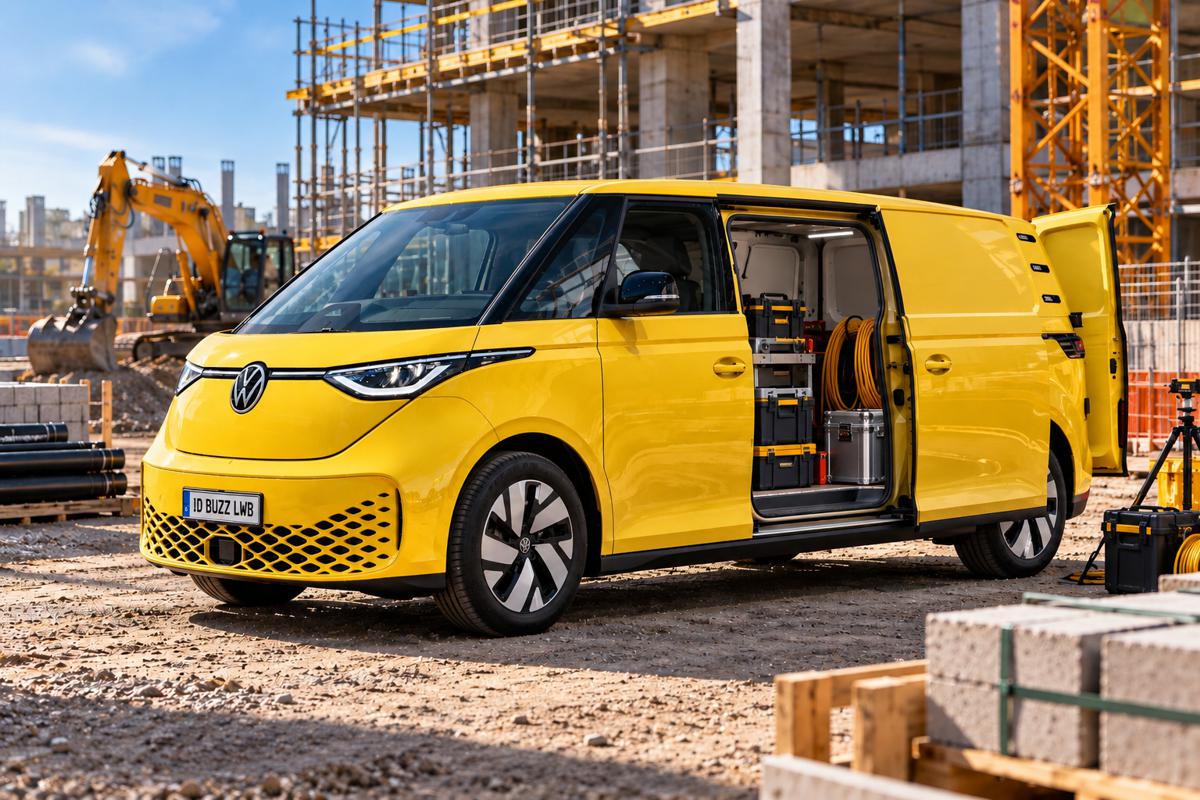
Volkswagen Commercial Vehicles is stretching the working envelope of the ID. Buzz Cargo, introducing a long-wheelbase version with 4.4 cubic metres of load space, a larger 86 kWh battery and towing capacity of up to 1,800 kg.
The additional 250 mm of load-floor length is relatively modest, but the changes around it make the new model considerably more useful as a working vehicle. A second sliding door becomes standard, the side opening is widened sufficiently to accept a Euro pallet, and Volkswagen is introducing vehicle-to-load capability that can draw power from the traction battery for tools and other electrical equipment.
Pre-sales in Germany begin with the 250 kW 4MOTION version, priced from €50,630 net, followed by the 210 kW rear-wheel-drive model from €48,490 net. Volkswagen says UK order books will open in early 2027 ahead of market introduction in the spring.
Briefing
- Load compartment volume increases from 3.9 m³ to 4.4 m³.
- Load-floor length grows by 250 mm to 2,458 mm.
- Rear-wheel-drive versions offer payloads of up to 700 kg, with 606 kg quoted for 4MOTION.
- Both versions can tow a braked trailer weighing up to 1,800 kg.
- Vehicle-to-load provides 3.0 kW continuous output, with peak power of 3.6 kW.
More Useful Space
The existing ID. Buzz Cargo occupies an unusual part of the van market. At 4,712 mm long, it combines the footprint of a relatively compact commercial vehicle with 3.9 cubic metres of load space and an electric drivetrain shared with Volkswagen’s passenger-focused ID. Buzz range.
The long-wheelbase Cargo changes those proportions. Its load floor measures 2,458 mm, compared with 2,208 mm in the current short-wheelbase model, while volume rises by 0.5 cubic metres. Width between the wheelarches remains 1,230 mm.
That still leaves the ID. Buzz Cargo below larger electric vans on outright carrying capacity. Its stronger proposition is for operations where vehicle size, access, towing and electrical capability matter alongside cargo volume.
Side access has consequently received as much attention as the extra floor area. The LWB Cargo has two sliding doors as standard, while the opening is 190 mm wider than before, allowing a Euro pallet to pass through the side door rather than being restricted to rear loading.
Payload and Towing
The larger body does not translate directly into greater payload. Volkswagen quotes a maximum of 700 kg for the rear-wheel-drive LWB Cargo and 606 kg for the 4MOTION version.
Those figures are broadly comparable with the existing ID. Buzz Cargo rather than substantially higher. Current UK specifications list payloads around 700 kg for rear-wheel-drive versions, with the additional hardware of 4MOTION reducing available payload.
Towing changes more materially. The LWB Cargo is rated to tow a braked trailer weighing up to 1,800 kg on both 8 and 12 per cent gradients.
Volkswagen currently quotes a maximum trailer load of 1,200 kg for the standard rear-wheel-drive ID. Buzz Cargo, while existing short-wheelbase 4MOTION versions can already reach 1,800 kg. The LWB therefore brings the higher towing figure across the range rather than reserving it for the all-wheel-drive model.
Larger Battery and Two Drivetrains
Volkswagen is fitting the LWB Cargo with an 86 kWh battery, compared with 79 kWh in the current standard-wheelbase Cargo.
The rear-wheel-drive version develops 210 kW, equivalent to 286 PS, while the 4MOTION model uses front and rear motors to provide all-wheel drive and combined system output of 250 kW, or 340 PS.
For fleet operators, range under load, charging behaviour, operating temperature and towing performance will matter more than headline motor output. Volkswagen has not provided a UK WLTP range figure for the LWB Cargo in the supplied launch information. The existing 79 kWh ID. Buzz Cargo is currently quoted in Britain at up to 277 miles under the official WLTP test, with real-world range varying according to payload, temperature, speed and driving conditions.
Powering Tools from the Van
One of the more useful additions is unrelated to carrying capacity. The latest ID. Buzz software introduces Vehicle-to-Load, allowing the high-voltage traction battery to supply external electrical equipment.
Volkswagen quotes continuous output of 3.0 kW and peak output of 3.6 kW through its PowerSocket adapter connected to the vehicle’s Mode 3 charging connection. Adapters will be offered with either a domestic Schuko socket or a 230 V CEE connection.
The principle is already established elsewhere in the electric commercial-vehicle market. Ford’s E-Transit, for example, offers Pro Power Onboard with up to 2.3 kW available for tools, lighting and other equipment.
For contractors, service engineers and mobile maintenance teams, stored energy that would otherwise be dedicated to propulsion can therefore replace a small generator or provide temporary power where a mains connection is unavailable. A 3 kW continuous supply will not operate every piece of construction equipment, and tool start-up loads need to be considered, but it covers a useful range of portable electrical equipment.
Driver Assistance and Recuperation
The LWB Cargo will also receive Volkswagen’s latest ID. software generation, including an updated optional Travel Assist system with traffic-light recognition. Volkswagen says the system can recognise a red signal and automatically decelerate the vehicle to a standstill, subject to the operating conditions and limitations of the assistance system.
One-pedal driving is also being introduced, allowing the accelerator to control propulsion and strong regenerative deceleration through to a standstill. On urban delivery and service routes, repeated acceleration and braking provide opportunities to recover energy while reducing reliance on the friction brakes.
A Broader Commercial Role
The longer ID. Buzz Cargo remains an unusual proposition. It does not have the carrying capacity of larger electric vans, and operators primarily concerned with maximum payload or cubic capacity have alternatives designed around those requirements. Its appeal is in combining a relatively compact vehicle with enough capacity for many service, maintenance, technical and urban logistics applications.
Pallet access through the side door improves loading flexibility, 1.8-tonne towing opens additional equipment and trailer applications, and vehicle-to-load makes the traction battery useful once the van reaches the job. The long-wheelbase ID. Buzz Cargo consequently feels less like an extended version of an electric passenger vehicle and more like a commercial vehicle whose dimensions and electrical architecture have been considered around the working day.
Key Industry Questions
- How much cargo space does the ID. Buzz Cargo LWB provide? The long-wheelbase version provides 4.4 m³, an increase of 0.5 m³ over the current standard-wheelbase Cargo.
- What is the maximum load length? The load floor is 2,458 mm long, 250 mm longer than the standard-wheelbase version.
- Can a Euro pallet pass through the side door? Yes. Volkswagen has widened the sliding-door opening by 190 mm so that a Euro pallet can pass through it.
- What is the maximum payload? Volkswagen quotes up to 700 kg for the rear-wheel-drive model and 606 kg for the 4MOTION version.
- How much can the ID. Buzz Cargo LWB tow? The quoted maximum braked trailer weight is 1,800 kg.
- What battery does the LWB Cargo use? It receives an 86 kWh battery, compared with 79 kWh in the current standard-wheelbase Cargo.
- What is Vehicle-to-Load? It allows electrical equipment to draw energy from the vehicle’s high-voltage battery. Volkswagen quotes 3.0 kW continuous output and 3.6 kW peak output.
- When will the ID. Buzz Cargo LWB reach the UK? Volkswagen plans to open UK order books in early 2027, with market introduction expected in spring 2027.
Strategic Takeaways
- The additional 0.5 m³ is useful, but improved side access makes the longer cargo compartment more operationally flexible.
- A 1,800 kg towing limit broadens the equipment and trailer applications available to rear-wheel-drive customers.
- Payload remains around 700 kg rather than increasing with the larger body.
- Vehicle-to-load gives commercial operators another use for the traction battery while the vehicle is stationary.
- The LWB model occupies a position between compact electric vans and larger high-volume panel vans rather than competing solely on capacity.