Intel and Altera Tackle Real-Time Sensor Processing for Intelligent Machines
Intel and Altera have announced plans to develop a programmable sensor-bridge architecture designed to help robots and other intelligent machines process information from multiple sensors in real time. The collaboration combines Intel’s processing hardware and software with Altera’s field-programmable gate arrays (FPGAs), addressing the engineering challenge of connecting increasingly complex sensing systems to the computers responsible for interpreting their information.
The proposed technology will initially target robotics, advanced medical equipment and aerospace and defence applications. The underlying architecture is also relevant to autonomous construction machinery and industrial vehicles, where cameras, radar, LiDAR and other sensors must operate together in difficult conditions.
As more equipment incorporates automated functions, manufacturers face increasingly demanding requirements for data transfer, synchronisation and processing. Computing performance is only part of the problem. Information must reach the processor quickly enough, and with sufficient consistency, to support reliable machine operation.
Briefing
- Intel and Altera announced a collaboration on 10 November 2026 to develop programmable, real-time sensor-bridge reference solutions.
- The architecture combines Altera FPGA technology with Intel compute, connectivity and software.
- Initial target markets include robotics, healthcare, aerospace and defence.
- Reference solutions are intended to be accessible through Intel’s Open Edge Platform SDK and an Altera SDK.
- Commercial availability, pricing, specific hardware configurations and independently verified performance benchmarks have not yet been announced.
Connecting Sensors to Intelligent Machines
Modern autonomous equipment depends on a continuous stream of information about its surroundings, position and operating condition. A machine may use cameras to recognise objects, LiDAR to measure distances, radar to detect movement and inertial sensors to track changes in orientation. Positioning systems and machine-mounted instrumentation can add further information, each using different interfaces and operating at different rates.
Bringing these inputs together requires careful coordination. A camera image and a LiDAR measurement collected at different moments may describe slightly different conditions, particularly when the machine or an object nearby is moving. The processing system must therefore account for timing differences while handling substantial quantities of information.
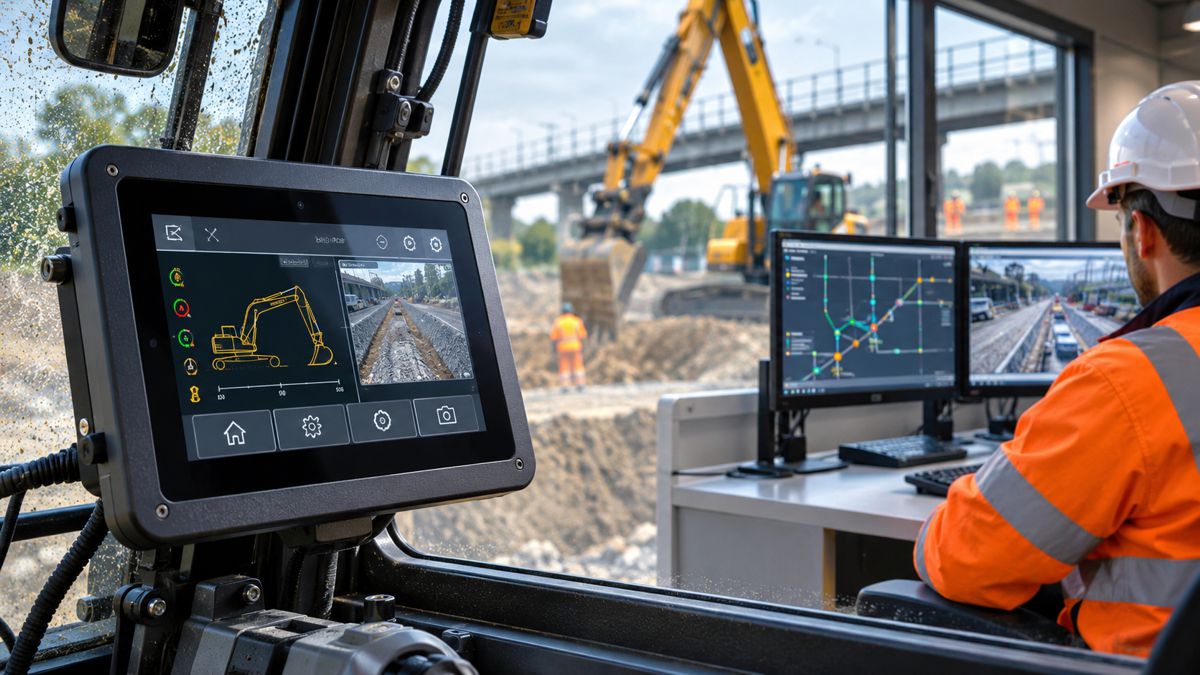
These requirements become particularly demanding when sensors are distributed around a large machine. An autonomous earthmover, for example, might carry cameras around its structure, LiDAR equipment above the cab and additional sensors monitoring its movements. Connecting those devices to a central computing system introduces practical questions about cable routing, bandwidth, electromagnetic interference and the positioning of electronic components.
Intel and Altera intend to address these challenges through modular reference designs that combine programmable hardware with a consistent computing and software environment. The proposed sensor bridge would use Altera FPGA technology to manage incoming information and deliver it to memory for processing by an Intel host processor.
The companies are also considering arrangements in which input/output hardware is physically separated from the main computing board. Such configurations allow sensor interfaces to be positioned closer to the equipment they serve, rather than requiring every connection to terminate at a central processor. The eventual benefits would depend on the interfaces supported, the equipment layout and the communications architecture selected.
The Role of Programmable Hardware
Field-programmable gate arrays operate differently from conventional central processors. Instead of executing every operation through sequential software instructions, an FPGA can be configured to perform particular functions directly through programmable digital logic. Multiple operations can run in parallel, allowing the hardware to handle high-speed interfaces and timing-sensitive tasks without relying entirely on the host processor.
This makes FPGA technology suitable for functions such as sensor aggregation, protocol conversion and preliminary data processing. Depending on the implementation, programmable logic can also assist with timestamping and coordinating incoming sensor streams before they are passed to the computing system responsible for higher-level interpretation.
Altera already addresses these requirements through its Physical AI technology portfolio, which includes programmable connectivity, sensor processing and low-latency interfaces for intelligent machines.
A conventional processor may offer substantial computing capacity, but performance can vary according to the other tasks it is executing. FPGA logic can be designed to perform particular operations with more predictable timing, an advantage where incoming information must be handled consistently.
The division of work between programmable hardware, conventional processors and AI accelerators depends on the application. FPGA development requires specialist expertise, and functions assigned to hardware must be considered alongside software maintenance, system upgrades and validation. Manufacturers also need to assess power consumption, component costs and the availability of suitable development tools.
Programmability provides flexibility during development and over the life of a product. Sensor interfaces and processing functions can be revised without necessarily replacing the entire electronics platform, although the extent of those changes depends on the FPGA’s resources and the original system design.
Applications in Construction and Autonomous Equipment
Construction sites present a demanding environment for sensor-based automation. Machinery operates around moving vehicles, personnel and materials, while dust, vibration, changing light and irregular terrain can interfere with the collection and interpretation of information.
An autonomous earthmoving machine may need to combine positioning data with images, distance measurements and information from its hydraulic and movement systems. Cameras can help identify nearby objects, while LiDAR provides spatial measurements and positioning equipment establishes the machine’s location. Those inputs must be coordinated before the control software can build a sufficiently current picture of the operating environment.
A programmable sensor bridge could form part of the electronics responsible for collecting and preparing that information. The AI models interpreting the data, navigation software and machine-control systems would remain separate elements of the overall architecture.
Similar requirements arise in robotic surveying equipment, mobile inspection platforms, automated material-handling vehicles and machinery used in quarries or industrial facilities. These systems can involve different sensor combinations even when they share a common computing platform.
Manufacturers developing several machine variants could potentially use a modular architecture to accommodate those differences without redesigning the complete computing system. A platform designed for a compact industrial robot might require fewer interfaces than one intended for a large autonomous vehicle, but some of the underlying hardware and software could remain common.
Physical installation would still require considerable engineering. Sensor locations influence cable lengths and exposure to vibration, moisture and temperature changes, while the placement of processing electronics affects cooling, maintenance access and electrical protection. Distributed input/output arrangements can offer design flexibility, although they also introduce additional communications links that must be assessed for reliability and performance.
Neither Intel nor Altera has announced a construction-specific reference design or named a machinery manufacturer participating in the collaboration. Its suitability for production equipment will depend on the specifications and demonstrated performance of the resulting hardware.
Altera’s Position in the Semiconductor Market
The collaboration follows a significant change in Altera’s ownership. In September 2025, investment firm Silver Lake completed its acquisition of a 51% interest in the company, leaving Intel with a 49% stake. The transaction established Altera as an independently operated FPGA supplier after a decade under Intel’s ownership.
The original agreement valued Altera at approximately $8.75 billion. Its independent structure allows the company to develop programmable semiconductor products and partnerships across different computing platforms while maintaining a substantial commercial relationship with Intel.
Altera has already pursued sensor-processing applications beyond Intel-based systems. Its Holoscan Sensor Bridge work, for example, addresses the movement of sensor information into NVIDIA GPU-based computing environments. That architecture is distinct from the newly announced Intel collaboration, but both address the challenge of connecting specialised sensing hardware to high-performance processing systems.
The company’s wider strategy includes robotics, industrial automation and other applications requiring flexible connectivity and programmable computing. These markets increasingly use combinations of CPUs, GPUs, AI accelerators and specialist processing hardware, with different components assigned to functions that suit their capabilities.
For Intel, the collaboration offers a route to supporting more complex edge-computing applications through complementary FPGA hardware. Altera, meanwhile, can provide programmable interfaces and processing functions alongside Intel’s established computing and software platforms.
From Reference Design to Production Equipment
Intel and Altera plan to make their reference solutions accessible through Intel’s Open Edge Platform SDK and an Altera SDK. The intention is to provide original equipment manufacturers with a starting point for developing sensor-rich systems without having to design every interface and processing function independently.
Reference designs can simplify early development by providing known hardware and software combinations. Manufacturers must still adapt those designs to their own equipment, including the selection of sensors, communications interfaces, processing hardware and operating software.
Intel’s Dan Rodriguez, corporate vice president and general manager of the company’s Edge Computing Group, described the objective: “As sensors multiply at the edge and through Physical AI systems, our customers need a simpler way to turn real-world data into timely action. Together with Altera, we aim to give OEMs a flexible foundation that simplifies integration and helps them move faster from prototype to market deployment while meeting their needs across performance, power and cost.”
The initial development areas include medical equipment with stringent timing requirements, aerospace and defence systems where size, weight and power consumption are constrained, and robotics platforms that depend on coordinated sensing and processing.
Although these applications share technical requirements, their operating environments and regulatory obligations differ considerably. Medical equipment and aerospace systems may require extensive certification, while autonomous industrial and construction machinery must satisfy the safety requirements applicable to their intended use.
A reference architecture does not establish the safety or reliability of a completed machine. Manufacturers must validate the entire system, including its sensors, communications, computing hardware, software and responses to faults or unexpected operating conditions.
The companies have not yet disclosed the specific FPGA and processor combinations, supported sensor interfaces, achievable latency figures, reference-board configurations or timetable for commercial availability. Those specifications will determine how the architecture compares with existing approaches to sensor integration.
Engineering the Next Generation of Physical AI
Artificial intelligence systems are becoming more capable of interpreting visual information and making decisions, but their performance inside a physical machine remains dependent on the quality and timing of the information supplied to them. Cameras, radar, LiDAR and other sensors must communicate with computing hardware through electronics designed for the demands of the application.
Intel and Altera are concentrating on that connection, combining programmable interfaces with established computing platforms to provide manufacturers with a more adaptable starting point for sensor integration.
The next stage will be to demonstrate the proposed architecture in working systems and establish its performance under representative conditions. Latency, bandwidth, electrical power, interface compatibility and hardware costs will all influence whether manufacturers adopt it in production equipment.
For autonomous construction machinery and industrial robotics, the practical test will come when these systems leave the development environment and operate on machines exposed to vibration, dust, temperature changes and the unpredictable movement of people and equipment.

Key Industry Questions
- What is the Intel–Altera sensor-bridge collaboration? It is a joint development programme to create modular reference solutions connecting multiple sensors to Intel computing platforms through Altera FPGA technology. The objective is to simplify real-time sensor integration.
- What is an FPGA? A field-programmable gate array is a semiconductor device whose digital logic can be configured after manufacturing. It can perform multiple hardware operations in parallel and is widely used for connectivity, signal processing and timing-sensitive applications.
- Why are FPGAs useful in autonomous machinery? They can handle multiple sensor interfaces, coordinate incoming information and perform preliminary processing with predictable timing. This complements the conventional processors and AI accelerators responsible for higher-level computing tasks.
- Could the technology be used in construction machinery? Potentially. Autonomous vehicles, robotic equipment and machine-vision systems have relevant sensing requirements, although Intel and Altera have not announced a construction-specific product or deployment under this collaboration.
- Does the sensor bridge perform artificial intelligence processing? Its principal proposed role is sensor connectivity and data processing before information reaches the host computing platform. AI inference and higher-level decision-making depend on the wider system architecture.
- Does Intel still own Altera? Intel retains a 49% stake following the sale of a controlling 51% interest to Silver Lake in September 2025.
- When will the technology become commercially available? The companies have not announced a commercial release date. The proposed reference solutions are intended to be accessible through Intel’s Open Edge Platform SDK and an Altera SDK.
- Will the architecture improve machinery safety? Predictable sensor processing can support responsive machine operation, but safety depends on the complete system design and validation. The collaboration has not yet demonstrated independently verified safety improvements or announced relevant certifications.
Strategic Takeaways
- Sensor integration remains a demanding engineering task in autonomous machinery, particularly where multiple devices operate at different rates and locations.
- FPGA technology allows manufacturers to configure high-speed interfaces and timing-sensitive processing functions around specific equipment requirements.
- Modular sensor architectures could help manufacturers develop different machine variants around common computing hardware, although integration and validation remain necessary.
- Altera’s independent operating structure supports collaboration across competing semiconductor platforms while retaining close commercial ties to Intel.
- Published latency, bandwidth, power consumption and cost figures will be essential to evaluating the proposed architecture against existing systems.