High Voltage Takes Hyundai Electric Forklifts to 18 Tonnes
An 18-tonne forklift working around a steel yard, port or precast concrete plant presents a rather different electrification problem from a warehouse truck moving pallets between racking.
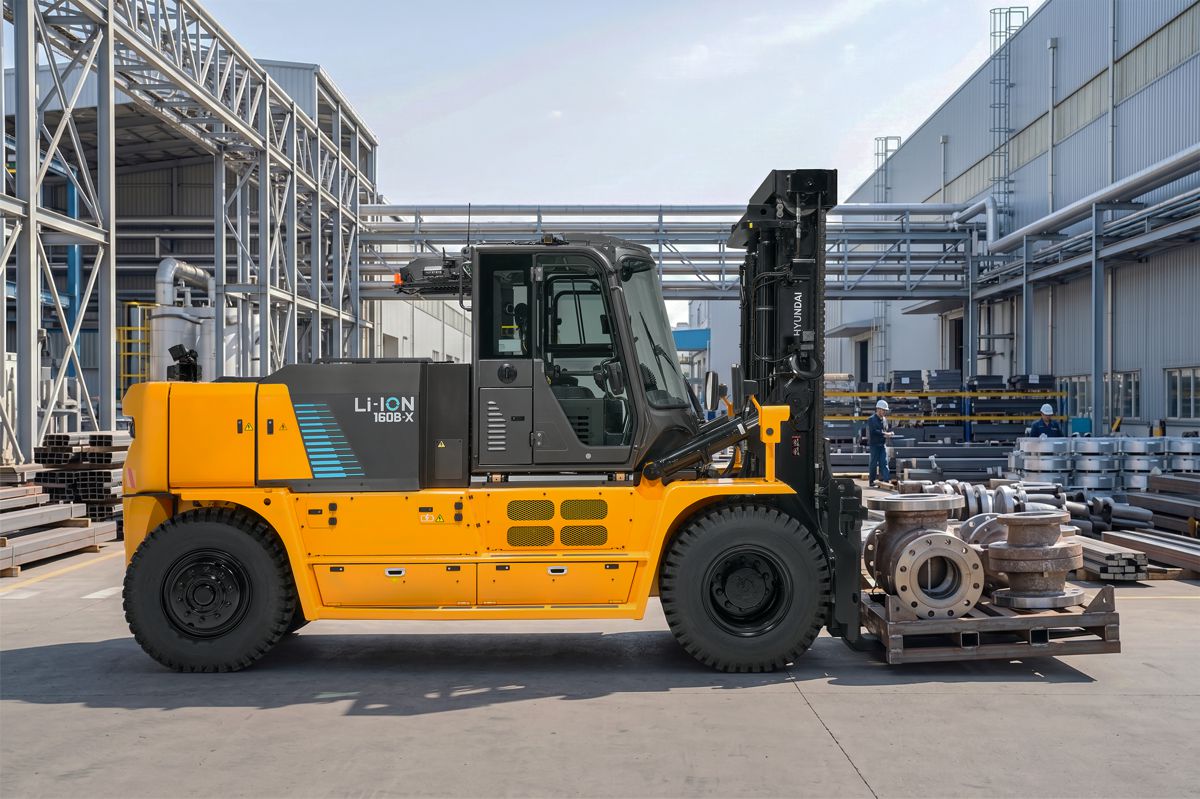
Hyundai Material Handling is now targeting precisely that territory. The completion of its B-X range extends the manufacturer’s high-voltage electric counterbalance forklifts from 4 tonnes through to 18 tonnes, with the latest 100B-X, 120B-X and 130B-X LC600 machines covering 10 to 13 tonnes and the 160B-X and 180B-X LC600 moving into the 16 to 18 tonne class.
The range began with 4 to 9 tonne machines introduced in 2025. Moving beyond those capacities requires considerably more than fitting a larger battery. Heavy industrial forklifts combine high travel loads, demanding hydraulic cycles, long operating hours and frequent outdoor use, often in places where equipment availability is more important than the technology providing the power.
Hyundai’s answer is a 618V electrical architecture for the new 10 to 18 tonne machines, backed by liquid-cooled battery thermal management, integrated heating and weather-protected electrical components. It brings battery-electric equipment into a part of the forklift market where diesel has remained particularly difficult to displace.
Briefing
- Hyundai’s B-X electric forklift range now covers rated capacities from 4 to 18 tonnes.
- Five heavier models complete the line-up: the 100B-X, 120B-X, 130B-X LC600, 160B-X and 180B-X LC600.
- The 10 to 18 tonne machines use a 618V electrical system, compared with approximately 309 to 348V for the smaller B-X models.
- Hyundai is targeting ports, timber, steel, concrete, manufacturing and other intensive industrial operations.
- The 16 and 18 tonne models offer up to 7.5 hours of operation according to Hyundai, with fast charging intended to support demanding duty cycles.
Moving Electric Power into Heavier Machines
For a given power requirement, increasing system voltage allows current to be reduced. In a heavy forklift, where travel and hydraulic systems can demand substantial power, that can reduce electrical losses and heat while easing the demands placed on cables, connectors, inverters and other components.
Hyundai uses approximately 309 to 348V systems on its 4 to 9 tonne B-X machines, while the 10 to 18 tonne models move to 618V. The architecture supports water-cooled permanent magnet motors for travel and hydraulic functions, with Hyundai claiming travel speeds, lifting speeds and gradeability comparable with equivalent diesel machines.
Operators buying heavy forklifts for steel, timber, concrete products, ports or manufacturing are unlikely to accept lower productivity simply to electrify a fleet. The machine still has to move the same loads at the required rate across the working shift.
The 160B-X and 180B-X are rated for 16,000kg and 18,000kg respectively, with Hyundai specifying lift heights from 3,010mm to 7,515mm. The company states that these models can provide up to 7.5 hours of operation, although actual runtime will depend on load, travel distance, hydraulic demand, gradients, temperature and the intensity of the application.
The 10 to 13 tonne machines have a different operating profile, with Hyundai quoting up to 12 hours of operation, again subject to application and working conditions.
Designing for Outdoor Work
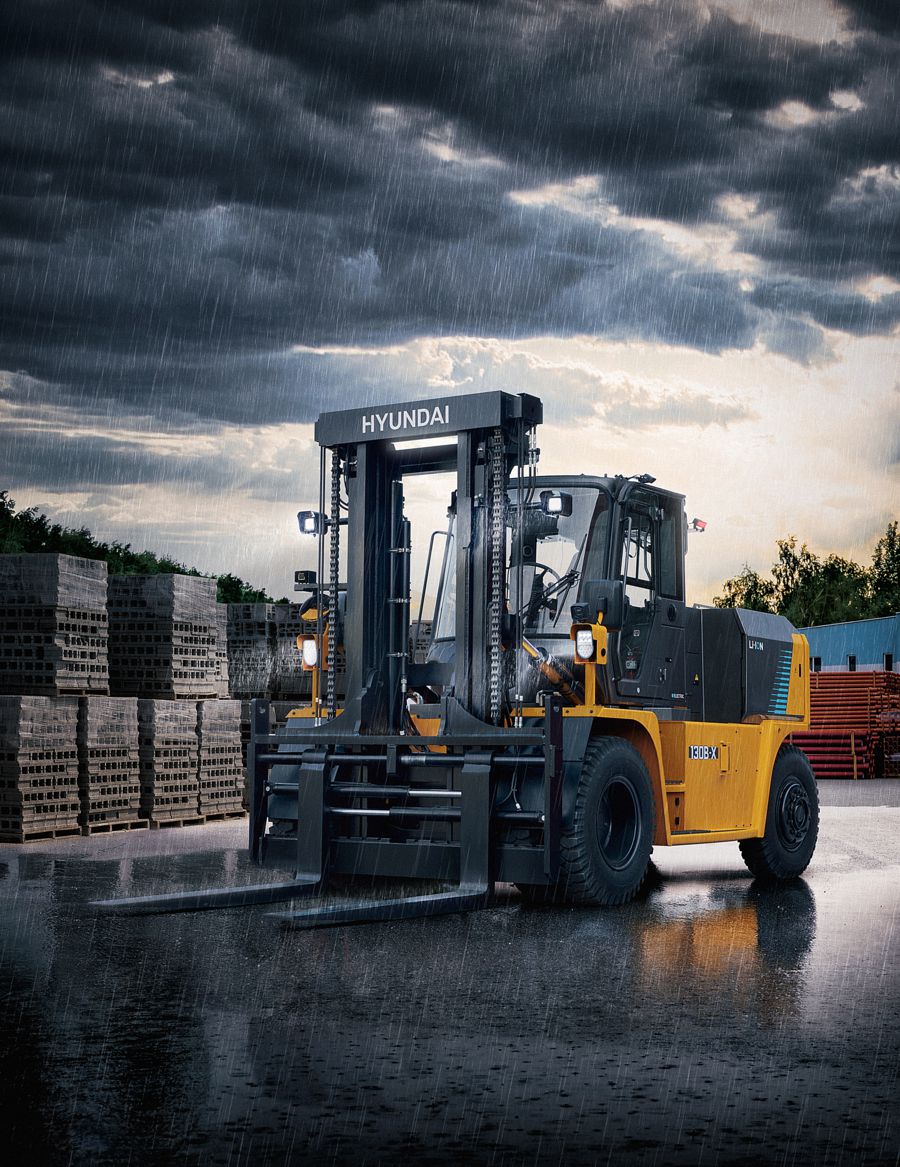
Ports, timber yards, steel plants and construction-material operations expose forklifts to water, dust, low temperatures and repeated temperature changes. Hyundai has retained established chassis and mast structures while developing dedicated electric drivetrains, control systems and battery installations around them.
Major electrical components are protected to IP67, while selected electronics reach IP69K protection. The battery system uses active liquid cooling and integrated heating to regulate operating temperature rather than relying solely on ambient airflow.
Hyundai has subjected the B-X machines to water-spray, flooding and cold-climate endurance testing. Batteries generate heat under sustained high loads and charging, while low temperatures can restrict battery performance and charging behaviour. Active heating and cooling give the control system greater ability to keep the pack within its intended operating range during year-round outdoor work.
Charging Becomes Part of Fleet Planning
The diesel forklift retains an operational advantage that is difficult to ignore: refuelling is quick and familiar. A battery-electric replacement has to be considered alongside its charging infrastructure, bringing charger capacity, electrical supply, shift patterns and available charging windows into the fleet calculation.
Fast charging and opportunity charging can reduce periods out of service, but only where sufficient electrical capacity is available. A machine capable of accepting high charging power offers little benefit if the facility cannot supply it.
A forklift returning repeatedly to a predictable operating area can be relatively straightforward to electrify because charging can be incorporated into breaks, shift changes or natural pauses in production. Operations involving almost continuous utilisation require more careful modelling of battery capacity, charging windows and fleet redundancy.
For ports, manufacturing plants and processing facilities, the assessment can extend well beyond the forklift itself. Electrical distribution equipment, transformers, charger positioning and future fleet expansion may all influence whether electrification works economically.
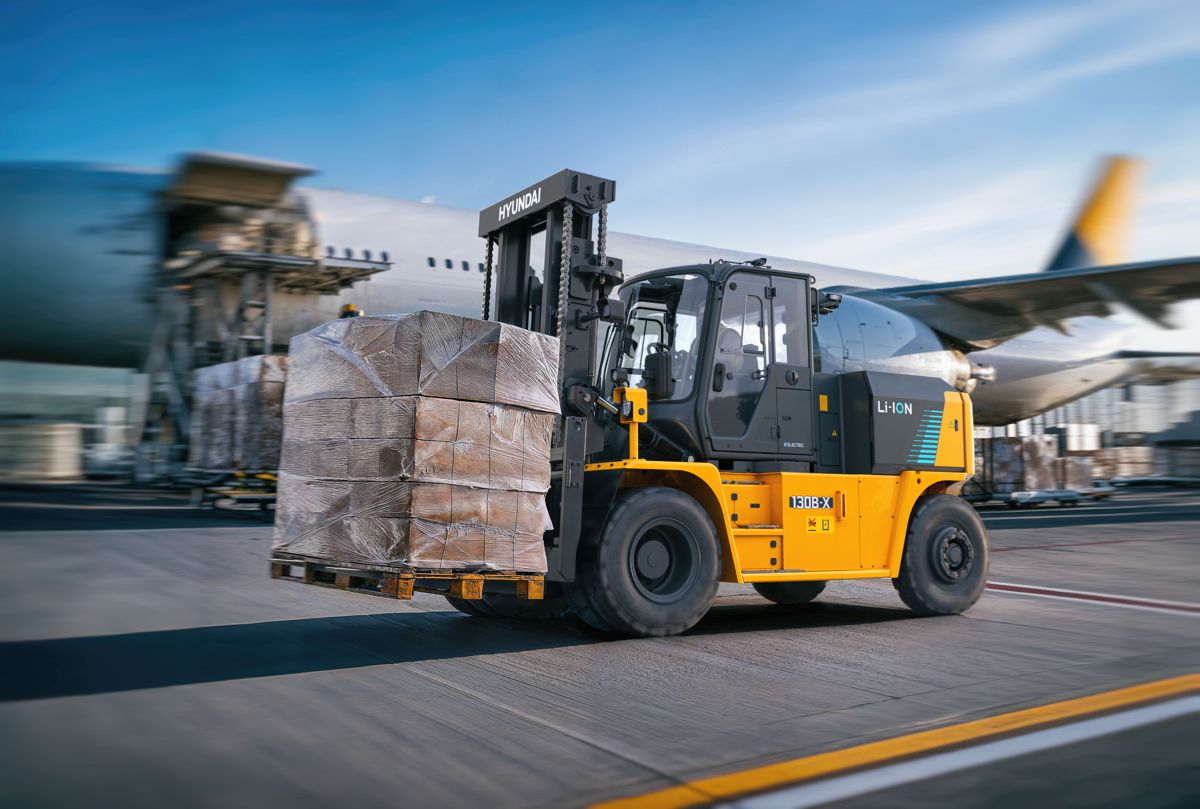
Maintenance and the Diesel Comparison
Heavy-duty electric forklifts remove the combustion engine, fuel system and associated engine servicing, but introduce high-voltage equipment requiring different maintenance procedures and technician competencies.
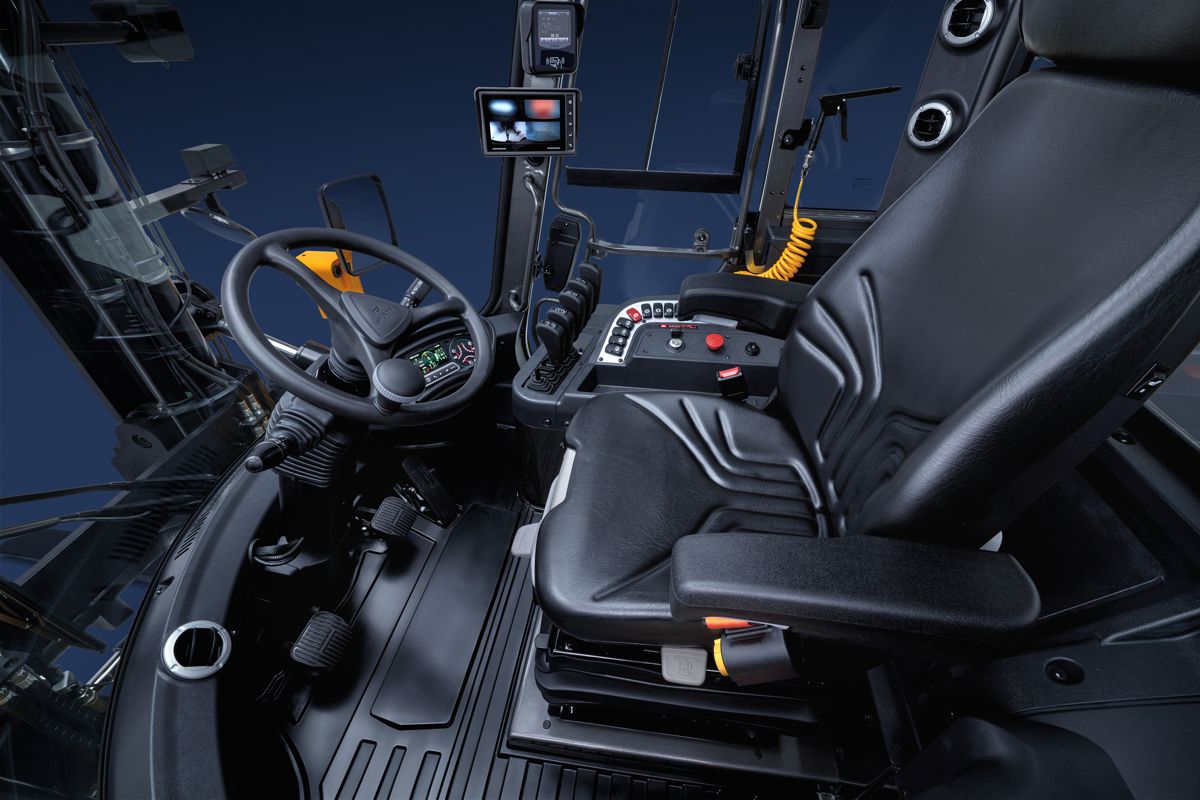
Hyundai has incorporated high-voltage isolation measures and clearly identified insulated cables into the larger B-X machines. The 160B-X and 180B-X also use a tilting cab to provide access to the powertrain, hydraulic and electrical components.
Fleet economics will depend heavily on utilisation. Fuel consumption and engine servicing can represent substantial costs for heavily worked diesel machines, giving electric alternatives more opportunity to recover the additional costs associated with batteries and charging infrastructure. Machines with light annual utilisation present a different calculation.
Electric drive also brings lower noise and vibration, particularly useful where equipment moves between indoor and outdoor areas, while the absence of tailpipe emissions removes a constraint in enclosed or partially enclosed facilities. Those advantages still have to be weighed against the working cycle, charging opportunities and electrical infrastructure available at each site.
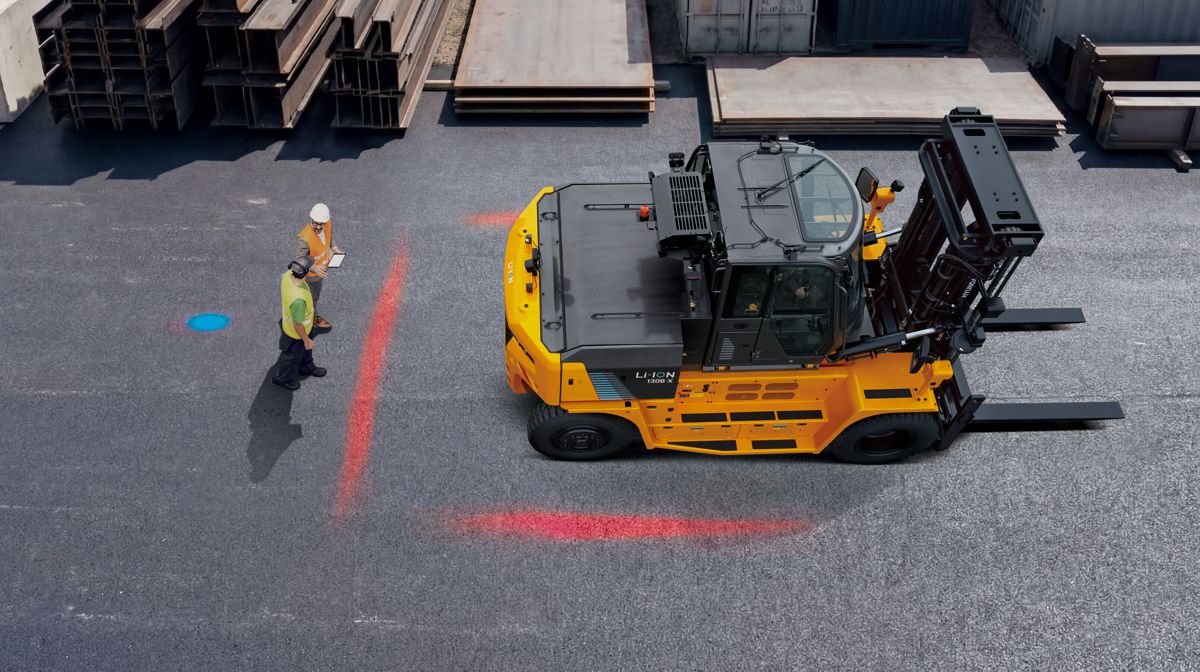
Heavy-Duty Electric Forklifts Move Outdoors
An 18-tonne electric forklift puts battery power into applications that have remained stubbornly dependent on diesel. Ports, timber yards, steel plants and construction-material operations combine heavy loads with rain, dust, gradients and long shifts, while diesel machines can be refuelled within minutes and returned to work.
Hyundai is positioning the B-X range directly against that operating model.
Raymond Galavazi, Senior Product Manager at Hyundai Material Handling Europe, said: “Completing the B-X range means that electrification is no longer limited to the lower-capacity forklift segments. Customers across a wide range of industries can now consider high-voltage electric trucks from 4-18 tonnes, also for demanding outdoor applications where high capacity and intensive operation are required.”
The machines do not make diesel obsolete. They broaden the circumstances in which operators can realistically compare the two technologies. Fleets with predictable movements, suitable charging windows and adequate electrical infrastructure can now consider battery power at capacities that until relatively recently remained firmly associated with internal-combustion equipment.
Where utilisation is continuous or charging infrastructure is constrained, diesel retains practical advantages. The interesting engineering work is increasingly taking place in the gap between the two.
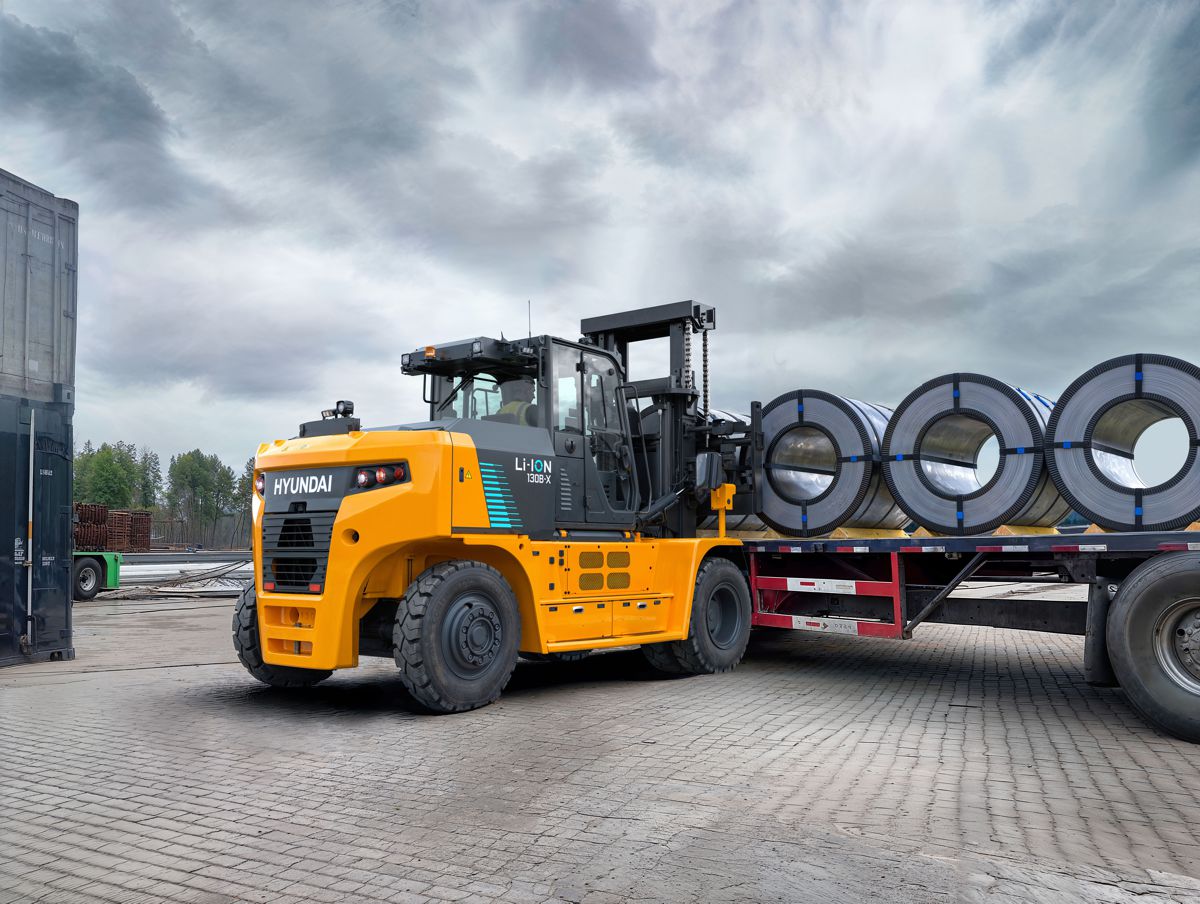
Key Industry Questions
- What capacities does Hyundai’s B-X electric forklift range cover? The completed range covers rated lifting capacities from 4 to 18 tonnes.
- What voltage do the larger B-X forklifts use? The 10 to 18 tonne models use a 618V electrical architecture. Smaller 4 to 9 tonne B-X machines use systems of approximately 309 to 348V.
- Why use a higher voltage on a heavy electric forklift? Higher voltage allows a given amount of electrical power to be delivered at lower current, reducing electrical losses and heat while making high-power drivetrains more practical.
- Where are the 16 and 18 tonne electric forklifts intended to operate? Hyundai identifies applications including ports, timber yards, steel and metal handling, concrete, paper production, manufacturing and other heavy industrial operations.
- Can the B-X forklifts operate outdoors? They have been developed for indoor and outdoor operation. Major components carry IP67 protection, with selected electronic systems protected to IP69K.
- How long can the 16 and 18 tonne machines operate? Hyundai states up to 7.5 hours for the 160B-X and 180B-X. Actual runtime will vary according to the application and operating conditions.
- Can an electric heavy-duty forklift directly replace a diesel machine? That depends on the duty cycle. Capacity and performance may be comparable, but charging windows, electrical infrastructure, utilisation and environmental conditions need to be considered.
- Does electrifying a forklift fleet require additional infrastructure? Usually. Sites may require chargers, electrical distribution upgrades and potentially additional transformer or grid capacity depending on fleet size and charging power.
Strategic Takeaways
- High-voltage architecture is allowing electric drivetrains to move into forklift capacities previously dominated by diesel.
- Heavy-duty electrification is increasingly an infrastructure decision as well as a machine-purchasing decision.
- Battery thermal management becomes more important as machines encounter sustained loads and outdoor temperature variations.
- Predictable duty cycles and charging opportunities favour electric deployment more than headline battery capacity alone.
- Diesel remains operationally attractive where utilisation is continuous, charging access is difficult or electrical infrastructure is constrained.