Braen Stone Puts New York’s Aggregate Supply Chain On The Water
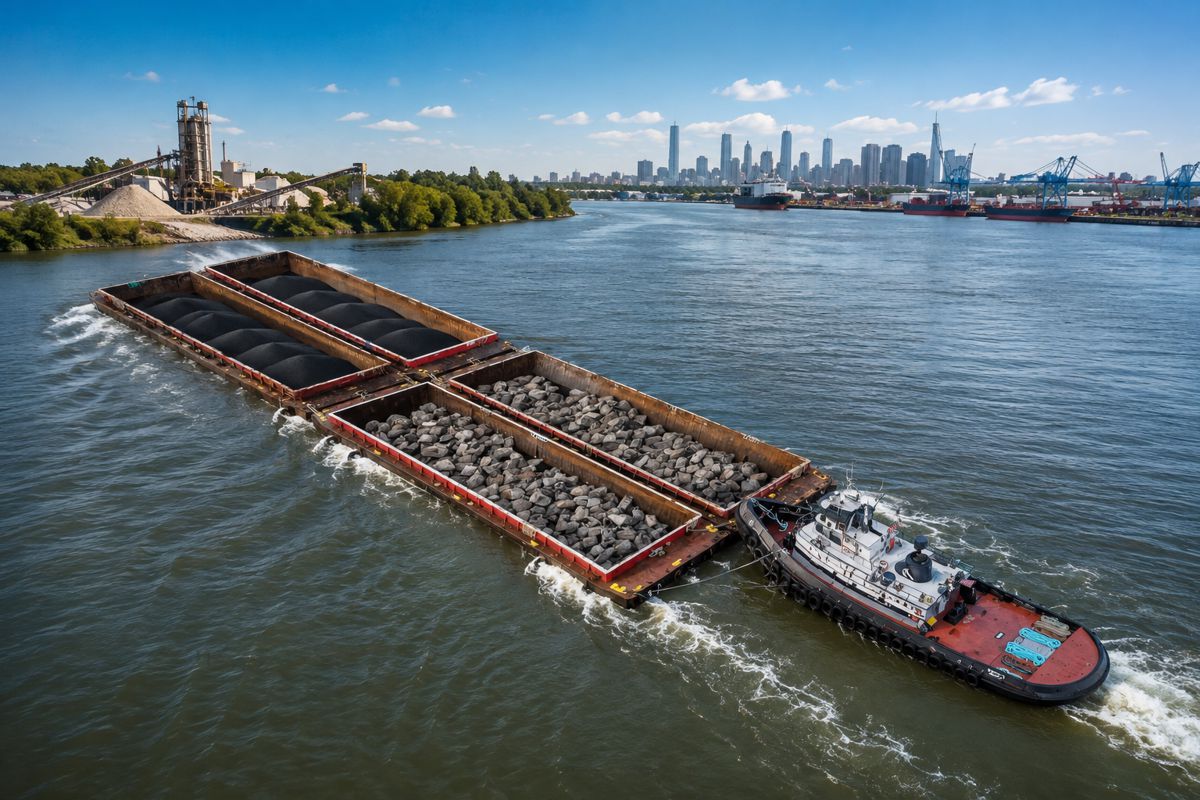
For a company that has spent 122 years moving crushed stone by road, Braen Stone’s decision to start delivering aggregates by barge across the New York and New Jersey waterways reads less like a sustainability gesture and more like a calculated answer to an economics problem that has been building for years.
The cost of moving heavy, low-value material such as stone into and around New York City has climbed steadily, pushed up by congestion, tolling and tightening restrictions on the region’s bridges and highways. When the Haledon-based producer confirmed that it had acquired six barges and begun waterborne deliveries for the first time in its history, it was effectively conceding that the truck-only model no longer suits the market it serves.
The significance sits in that admission rather than in the vessels themselves, because it signals where competitive advantage in regional materials supply is now concentrating.
The headline arithmetic explains the logic. A single barge can carry up to 2,000 tons of aggregate, against roughly 25 tons on a standard truck, so one loaded vessel removes the equivalent of around eighty truck movements from a congested road network. That ratio matters far more for aggregates than for almost any other construction input, because stone is cheap to produce and expensive to move, and transport routinely accounts for a large share of its delivered price.
In a mega-region where the roads into the five boroughs are becoming both slower and more costly to use, controlling a waterborne route is fast becoming a genuine commercial moat rather than a marketing line. Braen’s entry places a family-owned independent alongside the far larger integrated groups that have long treated marine access as a core supply asset.
Briefing
- Braen Stone has begun delivering aggregates by barge for the first time in its 122-year history, acquiring six vessels to serve the New York and New Jersey metro market and signalling interest in expanding the fleet.
- The shift is driven by the rising cost and declining reliability of road haulage into New York City, where congestion pricing, bridge restrictions and chronic congestion fall hardest on heavy trucks.
- One barge carries up to 2,000 tons against about 25 tons per truck, a modal advantage that is decisive for a low-value, high-weight commodity where transport dominates delivered cost.
- The model rests on vertical integration, linking Braen’s Whitehall granite quarry in upstate New York to a Newark dock equipped with conveyor and stevedoring capacity for transfer between water and land.
- Waterborne aggregate supply into New York Harbour is an established competitive model, used by integrated groups such as CRH-owned Tilcon and adopted at scale on the Port Authority’s $19 billion JFK redevelopment.
The Road Toll That Rewrote The Delivered Cost Of Stone
The external development that gives Braen’s announcement its wider significance is the structural change in what it now costs to run a truck into Manhattan. New York’s congestion pricing scheme, live since January 2025, charges vehicles entering the Congestion Relief Zone below 60th Street, and its design falls disproportionately on freight.
Large multi-unit trucks pay as much as $21.60 to enter during peak hours with an E-ZPass, and unlike passenger cars, which are capped at a single daily charge, trucks are billed on every entry. Those rates are scheduled to rise to $28.80 in 2028 and $36.00 in 2031, so the road premium facing anyone hauling bulk material into the city is set to widen rather than ease.
For a while the scheme’s future looked uncertain, but that question has now been settled in its favour. In March 2026 a federal judge upheld the programme in a detailed ruling that rejected the federal transportation department’s attempt to rescind approval, and the scheme raised $562 million net in its first year, exceeding the authority’s own projections.
For materials suppliers, the practical message is that the toll is permanent and escalating, and that congestion pricing sits on top of longer-standing constraints such as bridge weight limits, height and traffic restrictions and the simple unpredictability of moving oversized loads through dense traffic. Read together, these pressures do not merely add a line item to a delivery ticket, they change which transport mode makes commercial sense for the heaviest, cheapest cargo on the road.
Why Aggregates And Water Belong Together
Aggregate economics are unusually sensitive to how material is moved, which is precisely why the barge maths lands so hard. Crushed stone is dense, low in value per ton and costly to transport in bulk, and industry rules of thumb have long held that trucking is economical only within roughly fifty miles of the quarry before haulage costs begin to overwhelm the value of the load. Barge carriage sits at the opposite end of that spectrum, offering the lowest cost per ton-mile of any mainstream mode and the ability to consolidate enormous volumes into a single movement.
When a producer can substitute one 2,000-ton vessel for dozens of diesel truck runs, it compresses fuel, labour, tolls and vehicle wear into a far smaller unit cost, while sidestepping the road network that congestion pricing has made most expensive.
Scott Braen, President and Chief Operating Officer of Braen Stone Companies, framed the investment squarely around that efficiency, noting that it “allows us to move significantly larger volumes of material more efficiently—up to 2,000 tons per barge compared to just 25 tons per truck—while reducing the number of trucks on already congested roads.”
The environmental dividend is real, since removing lorries from the road cuts emissions, noise and particulates, but the more durable advantage is commercial. A supplier that can quote a delivered price insulated from Manhattan’s escalating tolls, and promise a schedule that does not depend on clearing rush-hour bridges, holds a structural edge over competitors still wedded to the road. In a market this constrained, reliability of delivery is becoming as valuable as the price of the stone itself.
Building A Supply Chain From Quarry To Waterfront
What turns a fleet of barges into a defensible business is the fixed infrastructure at either end, and this is where Braen’s recent capital spending comes into focus. The producer’s granite quarry at Whitehall in upstate New York, sitting at the head of the Champlain Canal near the Vermont border, gives it a northern source that can feed material south through the canal and Hudson River corridor toward the harbour.
At the receiving end, a Newark dock the company reports acquiring in November 2024 functions as the critical hinge between water and land, using conveyor systems and stevedoring operations to load and discharge material without the friction that usually makes intermodal transfer slow and expensive. Owning both the stone and the quayside removes the margin that would otherwise leak to third-party terminals and hauliers.
That control is the strategic point, and Braen’s own managers describe it as such. Will Hannema, the company’s Production Supervisor for Northern Quarries, said the aim is to “control more of our supply chain, improve delivery timelines, and provide a higher level of service to our customers across the NY/NJ metro area.”
Vertical integration of this kind has always been the hallmark of the strongest aggregate businesses, because it lets a producer manage cost, quality and timing from the blast face to the customer’s gate rather than surrendering those levers to the market. By assembling a quarry, a dock and a fleet under one roof, Braen is converting a transport decision into a barrier to entry that a competitor cannot easily replicate without comparable assets and comparable patience.
Following A Proven Corridor Into The Harbour
Braen is not opening an untested route so much as claiming a place on an established one, and the competitive backdrop underlines how much value sits in marine capability. Tilcon New York, part of the global CRH group, has for decades moved traprock and other crushed stone from its Hudson Valley quarries into the metropolitan market by truck, barge and rail, supplying landmark projects from Hudson Yards to the Second Avenue Subway.
The presence of a large, well-capitalised integrated player using the water so heavily is the clearest signal that waterborne supply is where scale and pricing power concentrate in this region. For a family-owned independent to build the same capability is a notable repositioning, placing Braen in a category usually reserved for companies many times its size.
The public sector has been making the same calculation on an even larger scale. The Port Authority’s $19 billion redevelopment of John F. Kennedy International Airport, the biggest airport programme in United States history, runs a dedicated construction support facility that uses barges to bring in sand, aggregate and steel and to carry debris away.
That operation is designed to eliminate more than 300,000 truck trips and around 1.5 million miles of truck travel over the life of the works, with a single barge displacing close to 200 truckloads. When the region’s most significant infrastructure client and its dominant materials supplier both treat the waterways as the sensible way to move bulk material, a mid-sized producer investing in the same logic is reading the market rather than gambling against it.
From Aggregate Runs To A Flexible Marine Asset
The early deployment of Braen’s fleet suggests the company sees its barges as a broad logistics platform rather than a single-purpose delivery tool. According to the producer, the vessels have already carried aggregates to Queens for use in asphalt production and supported infrastructure work at JFK, the very programme that has done most to normalise marine construction logistics in the region.
Those first movements matter because they demonstrate the model working against real deadlines and real customers, converting a capital commitment into demonstrated capability. A supplier can talk about barge economics indefinitely, but delivered tonnage on named projects is what persuades procurement teams to build waterborne supply into their own planning.
The company has also put the fleet to work beyond its own stone, leasing vessels to move rock salt around New York Harbour and treating the barges as an asset that can earn its keep between aggregate runs. That flexibility improves the return on what is a substantial investment, and it hints at an emerging logistics arm that could serve the wider regional market rather than Braen alone.
Owning marine capacity in a harbour where such capacity is scarce and increasingly valuable gives the producer optionality that a pure quarry business would lack. It is the difference between buying transport and owning a network, and in a constrained market the second is worth considerably more.
Where Regional Materials Supply Goes Next
The broader lesson for the construction and infrastructure sector is that policy and physical constraint are quietly redrawing the map of how materials reach the biggest markets. Congestion pricing was conceived as a transport and revenue measure, yet its most lasting effect on the construction economy may be to push heavy, low-value freight off the road and onto the water wherever geography allows.
Producers with waterfront access, upstream reserves and the appetite to invest in docks and vessels will be better placed to serve New York City at a predictable cost, while those confined to trucking will absorb a widening premium and pass it into their bids. Over time that gap is likely to shape which suppliers win the largest and most schedule-sensitive contracts.
For infrastructure owners and their contractors, the takeaway is that resilient, lower-emission supply chains are increasingly a matter of logistics design rather than aspiration. The JFK model has shown that barging can be planned into a mega-project from the outset, and Braen’s move shows that private suppliers are now building the standing capability to make that routine.
As more of the region’s capital programmes weigh congestion, emissions and reliability alongside headline price, the ability to deliver stone by water is set to become a standard question in procurement rather than an exotic one. The companies positioning for that shift today, whether integrated majors or ambitious independents, are the ones most likely to define regional materials supply through the next decade of building.
Key Industry Questions
- Why is barge transport becoming more attractive for aggregate suppliers in the New York region? Aggregate is dense, cheap per ton and costly to move, so transport can account for a large share of its delivered price. Road haulage into New York City has become both slower and more expensive because of congestion pricing, bridge restrictions and chronic traffic, and those costs fall hardest on heavy trucks. Barge carriage offers the lowest cost per ton-mile of any mainstream mode and consolidates huge volumes into single movements, with one vessel replacing dozens of truck runs. For suppliers serving the five boroughs, water access increasingly translates into a lower, more predictable delivered cost and a schedule that does not depend on clearing congested bridges and tolled zones.
- How does New York’s congestion pricing affect construction material deliveries? The scheme, live since January 2025, charges vehicles entering Manhattan below 60th Street, and its structure penalises freight disproportionately. Large trucks pay up to $21.60 per peak entry with an E-ZPass and are billed on every entry rather than once a day, with rates scheduled to climb to $28.80 in 2028 and $36.00 in 2031. A federal court upheld the programme in March 2026, confirming it as a permanent and escalating cost of moving material by road into the city centre. For bulk, low-margin cargo such as stone, that premium can meaningfully erode competitiveness, which is precisely why alternative modes such as barge have moved up the agenda for materials producers.
- How much material can a barge carry compared with a truck, and does that translate into lower costs? Braen reports that a single barge carries up to 2,000 tons of aggregate against roughly 25 tons on a standard truck, so one vessel can remove around eighty truck movements from the road. The cost benefit follows from that consolidation, compressing fuel, labour, tolls and vehicle wear into a far smaller unit cost while avoiding the most expensive parts of the road network. The advantage is largest for heavy, low-value commodities where transport dominates delivered price. On the Port Authority’s JFK works, larger barges have displaced closer to 200 truckloads each, illustrating how the ratio scales with vessel size and route.
- What role do the Whitehall quarry and Newark dock play in Braen’s waterborne model? They anchor the two ends of the supply chain. The Whitehall granite quarry in upstate New York, near the head of the Champlain Canal, provides a northern source that can feed material south toward the harbour through the canal and Hudson River corridor. The Newark dock, which the company reports acquiring in November 2024, acts as the transfer point between water and land, using conveyor and stevedoring operations to load and discharge material efficiently. Owning both the reserve and the quayside lets Braen manage cost, quality and timing across the whole route, rather than surrendering margin and control to third-party terminals and hauliers at each handover.
- Is waterborne aggregate supply new to the New York Harbour market? No. It is a long-established competitive model, and its prevalence is part of what makes Braen’s move commercially logical. Tilcon New York, part of the CRH group, has moved crushed stone into the metropolitan market by truck, barge and rail for decades, supplying major projects across the city. The Port Authority’s $19 billion JFK redevelopment runs a dedicated barge-served construction support facility to cut hundreds of thousands of truck trips. What is notable is that a mid-sized, family-owned independent is now building comparable marine capability, entering a category historically dominated by far larger integrated groups with the balance sheets to own docks, quarries and fleets.
- What does vertical integration mean for aggregate producers and their customers? Vertical integration means controlling successive stages of the supply chain, from the quarry face through transport to the point of delivery, rather than relying on external parties for each step. For a producer, it protects margin, improves scheduling and reduces exposure to third-party pricing and availability. For customers, it can mean more reliable delivery timelines and a single accountable supplier for both material and logistics. In Braen’s case, linking the Whitehall quarry, a barge fleet and the Newark dock creates a route the company controls end to end, which is both a cost advantage and a barrier that competitors cannot easily match without similar assets and long-term investment.
- How does barge transport affect emissions and sustainability credentials? Shifting bulk material from road to water removes large numbers of diesel truck movements, cutting the emissions, noise and particulates associated with hauling stone through dense neighbourhoods. The Port Authority estimates its JFK barge operation will save around 1.5 million miles of truck travel over the programme, an indication of the scale of avoided road impact when barging is planned in from the start. For suppliers, lower-carbon delivery is increasingly relevant as public and private clients weigh environmental performance in procurement. The commercial and environmental cases point the same way here, since the mode that reduces delivered cost also reduces the road burden on communities along the route.
- What are the risks or limits of relying on barge logistics for construction materials? Barging works only where navigable waterways connect source and market, so it complements rather than replaces trucking, which still handles the first and last miles to and from the quayside. The model demands significant fixed investment in vessels, docks and handling equipment, and returns depend on maintaining steady volumes to justify that outlay. Weather, tides, canal and channel conditions and dock capacity can all affect reliability, and material must still be transferred to road for final delivery. These constraints explain why marine capability has tended to sit with well-capitalised producers, and why Braen is pairing its fleet with owned quarry reserves and dedicated dock infrastructure.
Strategic Takeaways
- Congestion pricing’s most durable effect on construction may be modal, pushing heavy, low-value freight off New York’s roads and onto its waterways wherever geography allows, and widening the cost gap between water-served and road-only suppliers.
- For aggregates specifically, where transport dominates delivered price, marine access is shifting from a nice-to-have into a structural competitive advantage that shapes which producers can serve the metropolitan market profitably.
- Vertical integration from quarry to quayside is the real barrier to entry, since owning the reserve, the fleet and the dock lets a producer control cost, quality and timing in ways a road-only competitor cannot replicate quickly.
- Braen’s entry signals that ambitious independents, not only integrated majors such as CRH-owned Tilcon, can now build the waterborne capability that large public programmes like the JFK redevelopment have already normalised.
- Infrastructure owners and contractors should expect barge-based supply to become a standard procurement consideration on schedule-sensitive metropolitan projects, rewarding suppliers that invest early in docks, vessels and upstream reserves.