Bechtel Turns to Wet Processing for its Next Century of Materials Production
A quarry and materials business founded in southern Germany in 1926 is preparing for its second century with an investment that says rather more about the changing economics of aggregates than the anniversary itself.
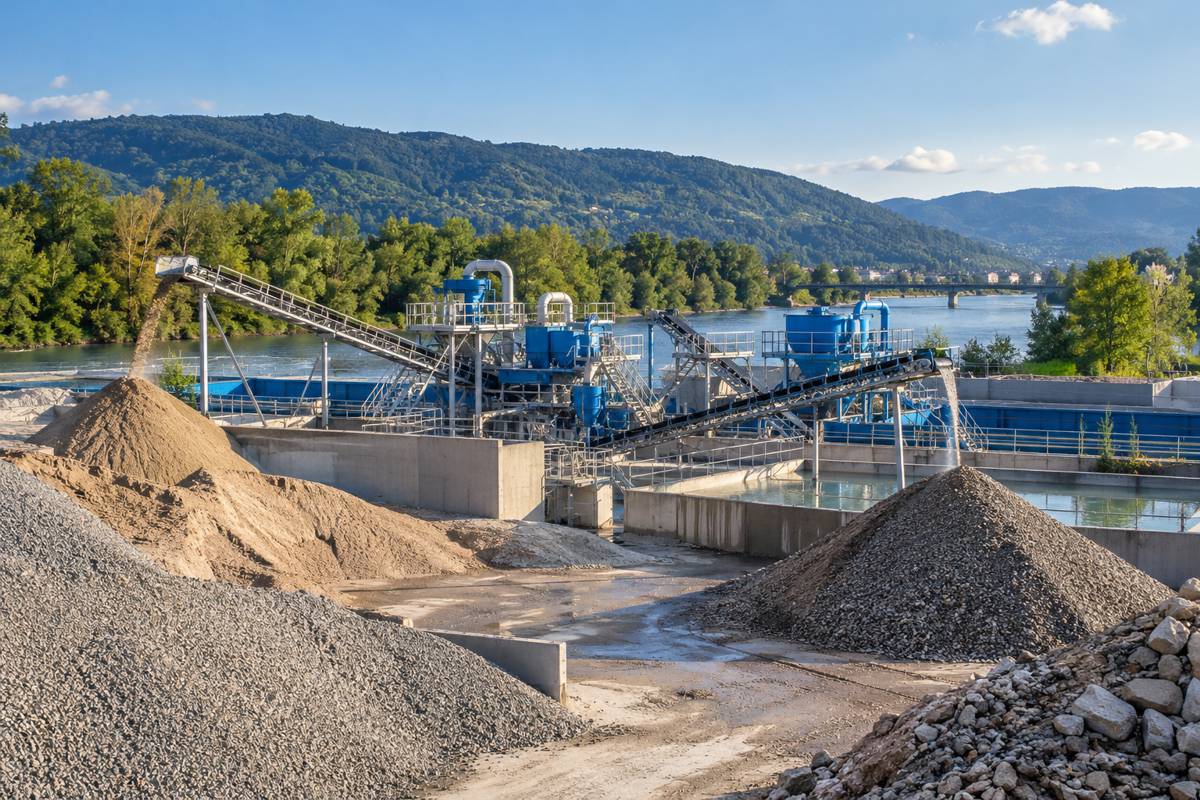
Bechtel Group is developing a new wet processing plant with CDE at its Wallbach operation in Bad Säckingen, close to the Swiss border. The installation will add washing, classification and dewatering capabilities to an operation already handling sand and gravel, excavated material and recycled concrete.
For a regional producer with roots stretching back four generations, the investment broadens the range of material that can potentially be processed into usable construction products. The distinction between quarrying and recycling is also becoming less rigid. Increasingly, the commercial question is not simply where a mineral material originated, but whether it can be separated, cleaned and classified consistently enough to meet the requirements of its next application.
Bechtel’s Wallbach investment is being designed around that problem.
Briefing
- Bechtel Group is investing in a new CDE wet processing plant at Wallbach in Bad Säckingen, Germany.
- The investment coincides with the company’s centenary, with its original Bad Säckingen operation dating from 1926.
- The plant will incorporate washing, classification and dewatering technology for different mineral material streams.
- Bechtel already produces sand and gravel and processes excavated material and concrete demolition waste.
- CDE’s involvement comes as the company expands its German presence through a new distribution agreement with Kleemann and Wirtgen Deutschland.
A Materials Business Rather Than Just a Quarry
Bechtel’s current activities provide the context for the investment. The company describes its Bad Säckingen operation as supplying sand and gravel while also accepting uncontaminated excavated soil and processing concrete demolition material into secondary construction products.
A conventional quarry has a comparatively straightforward flow of material from extraction through crushing, screening and sale. Recycling introduces considerably greater variability. Feed material can differ in particle size, moisture, fines content and contamination, while the value of the resulting product depends heavily on how effectively those fractions can be separated and controlled.
Wet processing provides another set of tools within that production chain. Rather than relying entirely on dry crushing and screening, water can be used to separate fines, remove unwanted material and classify sand and aggregate fractions. Dewatering reduces the moisture retained in the finished product, while modern installations can incorporate water recovery systems that return much of the process water to the plant.
CDE has been commissioned to develop the Wallbach system specifically around Bechtel’s operating requirements rather than supplying a generic production line. The companies have not disclosed the plant’s capacity, detailed equipment configuration, investment value or expected commissioning date, so its eventual production economics cannot yet be assessed.
The intended flexibility is nevertheless apparent. According to the project announcement, the installation is being designed to process a range of mineral material streams. At a site dealing with both primary and recovered materials, washing and classification can influence whether a marginal feed becomes a saleable product or remains a disposal problem.
Extracting More from the Material
The economics of mineral processing increasingly depend on recovery. Every tonne of excavated material or demolition aggregate that can be converted into a specification-controlled construction material potentially reduces both the volume requiring disposal and the requirement for newly extracted aggregate.
The equation is not automatic. Processing consumes energy, water and plant capacity, while recovered products still have to satisfy technical and regulatory requirements for their intended applications. Good processing does not make every waste stream valuable, but it can increase the range of streams from which useful products can realistically be recovered.
Clay, silt and fine particles that compromise a dry-screened product can be separated through washing, while multiple aggregate and sand fractions can potentially be recovered from the same incoming feed. Integrated plants can combine screening, scrubbing, cyclone separation, dewatering and water treatment, with recovered process water returned to the washing circuit.
The precise Wallbach configuration has not been announced, and it should not be assumed that Bechtel will adopt any particular combination of CDE equipment.
For Michael Bechtel, Managing Director of Bechtel Group, the investment is deliberately being viewed over a much longer horizon: “This investment is far more than the purchase of a new processing plant. It is a clear commitment to our site, our company and our long-term development. Our objective is to continue strengthening the Bechtel Group and position the business for long-term success for future generations.”
That perspective fits a capital-intensive sector in which processing plants can shape the commercial possibilities of a site for decades.
A Regional Material Loop
Bad Säckingen sits on the Rhine directly opposite Switzerland, in the Hochrhein region between the southern Black Forest and north-western Switzerland. Bechtel’s business is consequently rooted in a relatively compact regional construction economy rather than a long-distance commodity model.
Aggregates are heavy, comparatively low-value materials for which transport rapidly becomes a significant component of delivered cost. Recovering usable construction material close to the places where demolition and excavation material arises can therefore alter the economics before any environmental benefit is considered.
Bechtel’s model already combines the supply of primary aggregates with the acceptance of excavated soil and concrete demolition material. More capable processing potentially allows those flows to interact: incoming material becomes feedstock, processing separates useful fractions, and recovered products return to regional construction markets.
There are limits. Circularity in construction materials depends on material quality, specifications, regulation, customer acceptance and economics as much as processing technology. Virgin aggregate remains necessary for many applications, and recycled material cannot simply be substituted indiscriminately. More flexible processing infrastructure allows those decisions to be made material by material rather than treating recovered mineral material as a single category.
CDE Expands its Position in Germany
The Wallbach project arrives during a period of increased activity for CDE in Germany. In August 2026, CDE and Kleemann announced a sales cooperation under which specialists at Wirtgen Deutschland Vertriebs- und Service GmbH would distribute selected CDE wet processing systems in the German market from September.
The agreement covers a portfolio of sand washing, scrubbing, classification, thickening and water-recycling technologies. For CDE, the arrangement provides access to an established German sales and support network. For Kleemann, whose traditional strength is mobile crushing and screening, wet processing extends the production chain beyond size reduction and dry classification.
The Bechtel project is separate from that distribution announcement, but the timing places it within a wider push by CDE into the German aggregates and recycling market.
CDE Business Development Manager Andrew Wilson said: “We’re really looking forward to seeing the development and installation of this project. The Bechtel Group has recognised the changing needs of the market, and how sustainable processing is the best way forward to maximise not just the lifetime, but also the quality of the material.
“It’s an exciting year for the Bechtel Group as it celebrates its 100th anniversary. We’re delighted to be playing a role in helping the Bechtel Group close the loop whilst also supporting the local construction industry.”
Processing Becomes the Competitive Asset
The conventional image of an aggregates producer is defined by reserves: access to sand, gravel or rock and the equipment needed to extract it. That remains fundamental, but businesses combining quarrying and recycling increasingly have another resource available to them in the material already moving through the regional construction economy.
Excavated soils, demolition concrete and other mineral streams are generated whether a quarry operator uses them or not. Their commercial value depends on collection, regulation, transport and the ability to process inconsistent feed into predictable products. Plant capability therefore becomes part of the resource equation.
A sufficiently adaptable operation can work across primary and secondary materials, recover more usable fractions and respond to changing specifications without depending entirely on additional extraction. The economics will vary from site to site, and Bechtel has not released enough technical information to quantify those gains at Wallbach.
A company that began extracting regional mineral resources a century ago is now investing in machinery designed to obtain more usable material from each resource entering its gates. For Bechtel’s second century, the valuable asset may increasingly be not only what lies beneath the ground, but what the business can recover from the material already above it.
Key Industry Questions
- What is wet processing in aggregates production? Wet processing uses water alongside screening, classification, scrubbing and separation equipment to remove fines and unwanted material and produce controlled sand and aggregate fractions.
- Why wash recycled construction materials? Demolition and excavated materials can contain clay, silt, fines and other unwanted fractions. Washing can improve separation and help produce more consistent recovered materials, although final suitability still depends on specification and regulation.
- What will the new Bechtel plant process? Bechtel says it is being designed for a range of mineral material streams. The company has not published the detailed feed specification or final equipment configuration.
- Where is the Bechtel plant being developed? The project is at Bechtel’s Wallbach operation in Bad Säckingen, Baden-Württemberg, close to the German-Swiss border.
- How large will the plant be? No production capacity, investment value or detailed plant dimensions have yet been disclosed.
- What does Bechtel currently do with demolition material? The company says it accepts concrete demolition waste and processes it into secondary construction materials alongside its sand, gravel and excavated-material activities.
- Why is water recycling important in a wash plant? Recovering process water reduces the requirement for continuous fresh-water input and helps manage the fines and sludge generated during washing.
- What is CDE’s relationship with Kleemann in Germany? CDE and Kleemann announced a German sales cooperation in August 2026. Wirtgen Deutschland specialists are distributing a selected portfolio of CDE wet processing equipment in the country.
Strategic Takeaways
- Wet processing can broaden the range of mineral streams from which commercially usable construction products can be recovered.
- Combining primary aggregates and recycling gives regional producers more options for managing changing material availability and customer requirements.
- Plant flexibility is becoming an important asset where feed materials range from virgin sand and gravel to demolition and excavated material.
- Local recycling economics benefit from the high transport cost associated with heavy, relatively low-value mineral products.
- CDE’s Wallbach project coincides with a wider expansion of its German market presence through Kleemann and Wirtgen Deutschland.