Taming The Power Surge Behind The AI Data Centre Boom
The figures behind the artificial intelligence boom have a habit of creeping up on people. In 2023, data centres swallowed roughly 4.4 per cent of all the electricity consumed across the United States, drawing about 176 terawatt hours from the grid. By 2028, depending on how the rest of the economy fares, that share could climb to somewhere between 6.7 and 12 per cent, with annual demand rising to as much as 580 terawatt hours. Sitting behind those numbers is a construction wave unlike anything the sector has witnessed, and the grids meant to feed it are already groaning under the weight.
The Department of Energy’s Pacific Northwest National Laboratory (PNNL) has codeveloped a comprehensive guide to siting, building and maintaining the enormous buildings that house all that computing muscle. Formally titled the AI Data Center Energy Performance Framework, the resource was written alongside the National Electrical Manufacturers Association (NEMA) and ASHRAE, the body of heating, refrigeration and air-conditioning engineers.
The authors pitch it as a one-stop shop, pulling together what they reckon is the most complete body of data centre know-how yet assembled in a single place. “Policymakers, utilities and builders of data centers can find research-backed best practices in this guide for building data centers that keep energy costs low while safely maintaining operations,” said Kieren McCord, a systems engineer at PNNL and the guide’s lead author.
Briefing
- PNNL, NEMA and ASHRAE have released the AI Data Center Energy Performance Framework, a consensus guide covering siting, design, cooling, grid integration, commissioning, operations and retrofit.
- US data centres used about 4.4 per cent of national electricity in 2023, a figure that could reach 12 per cent by 2028 as AI workloads multiply.
- The framework pushes grid-interactive design, with batteries, microgrids and smart controls turning facilities from passive loads into active grid participants.
- Cooling alone eats 20 to 40 per cent of a data centre’s energy, so thermal management sits at the heart of the cost and reliability story.
- More than 50 industry partners contributed, among them NVIDIA, IBM, Carrier and Siemens, and the guide is published as a living online resource rather than a static document.
When Data Centres Become Good Grid Citizens
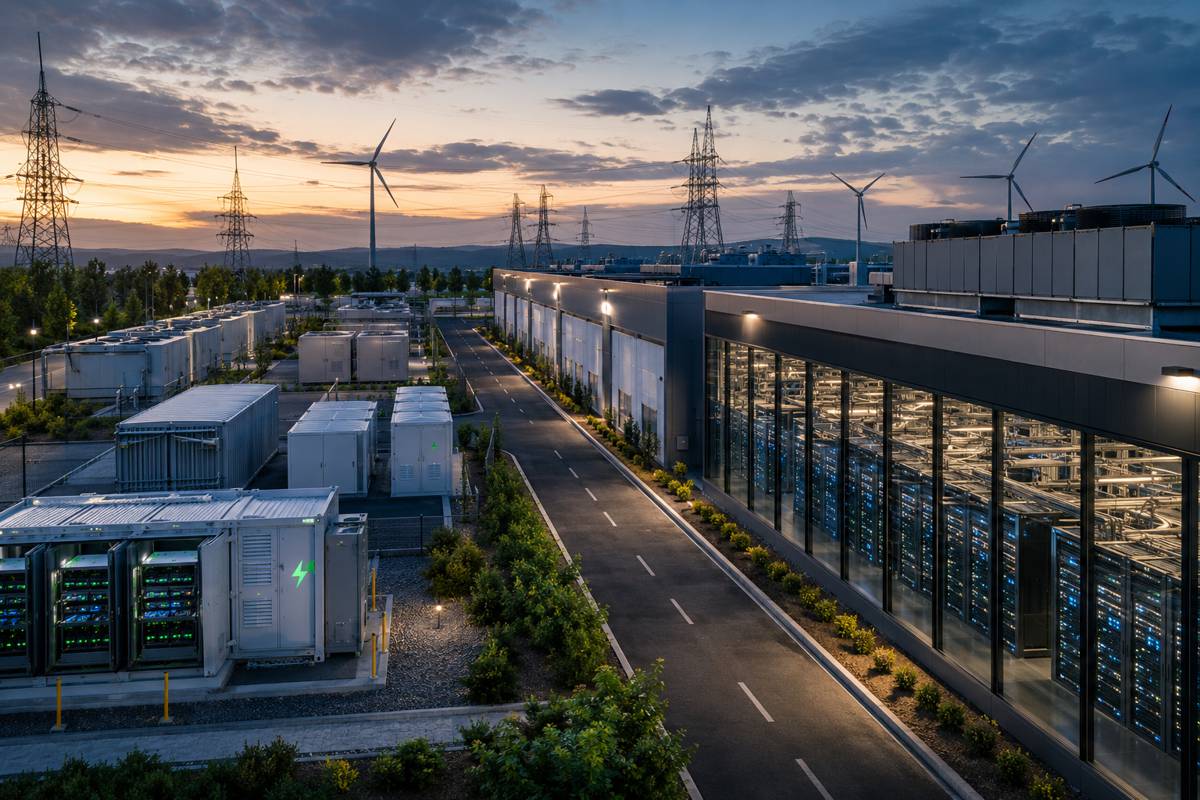
The single biggest worry hanging over the sector is not whether these buildings can be built, but whether the power network can cope once they switch on. Hyperscaler facilities, the warehouse-scale sites that can stretch to a million square feet and pack in thousands of servers, draw electricity around the clock and concentrate that hunger in a handful of locations. The strain shows up in stark ways. In July 2024, a voltage fluctuation in northern Virginia, the world’s densest data centre cluster, knocked roughly 60 facilities offline at once and left the regional grid wrestling with a sudden 1,500-megawatt surplus. Britain faces its own version of the squeeze, with Ofgem reporting that around 140 proposed projects are queueing for connections that together would demand close to 50 gigawatts of capacity.
The framework’s answer is to stop treating data centres as dumb loads and start designing them to talk back to the grid. Srinivas Katipamula, a mechanical engineer and Laboratory Fellow at PNNL who wrote the section on grid-interactive operation, frames the shift plainly. “A grid-interactive design enables a data center to actively communicate and coordinate with the electrical grid. That way, they can evolve from passive energy consumers to active participants in managing electricity usage from the electrical grid,” he said. In practice that means kit such as on-site battery banks and microgrids, which charge when demand is slack and discharge when the network tightens, say on a sweltering summer afternoon when air-conditioning load peaks. A microgrid also lets a site island itself from the wider network and keep humming if trouble strikes upstream. Smart controls add another lever, automatically dialling operations up or down in step with grid conditions.
For utilities and electrical manufacturers, that technical evolution is exactly the point. NEMA President and Chief Executive Debra Phillips argued that the laboratory’s research credentials are what the moment calls for. “PNNL brings world-class expertise on grid integration, energy efficiency, and resilience to this collaboration. Their engineering- and research-driven approach is exactly what the data center industry needs as these facilities become increasingly grid-interactive. Modern data centers are participating in demand response, integrating on-site generation and storage, and managing real-time power quality, which dramatically increases technical complexity,” she said. Steve Rosenstock, senior manager of customer technology solutions at the Edison Electric Institute, put it in blunter terms, noting that “All customers benefit from these collaborative efforts to ensure that new AI data center customers are good grid citizens.” The phrase is telling. In markets such as Ireland, where data centres already account for around a fifth of national electricity, regulators have started forcing operators to prove they can generate their own power and trim demand when the grid is stressed, shifting the burden of stability from the public purse onto private balance sheets.
The Heat Problem Nobody Can Ignore
If power supply is the headline anxiety, cooling is the running cost that quietly drains the budget. Every server is roughly the size of a laptop, and a hyperscaler stacks thousands of them in racks that run flat out, day and night, throwing off heat the whole time. McCord reaches for a familiar comparison to convey the scale of it. “It’s hard to estimate how hot the data center interior can become, but think about when your laptop feels warm on your lap. Now multiply that by an entire room of server racks,” she said. Keeping all that silicon from cooking itself swallows somewhere between 20 and 40 per cent of a facility’s total energy, which is why thermal management commands so much space in the guide.
The framework sets out several ways to shave that load, particularly when the grid is already under pressure. Some operators simply let the room run a touch warmer, much as utilities ask households to nudge their thermostats up during a heatwave. Others pre-cool the space ahead of an expected demand spike, banking the chill. “That way, during the demand time, the room and servers are still warming up from the colder temperatures so that electricity isn’t needed for cooling,” McCord explained. A handful of tech firms are going further still, engineering ways for individual chips to shed heat at the source. ASHRAE led the thermal side of the work, drawing on its long-standing Standard 90.4 for data centre energy and Standard 127 for testing the air-conditioning units that serve them, the kind of technical bedrock that rarely makes headlines but decides whether a building actually performs.
A Framework Built On Standards, Not Slogans
What lifts the guide above the usual best-practice pamphlet is its grounding in established engineering codes. NEMA folded in more than a dozen of its technical standards, covering energy storage systems, microgrids, transformers, switchgear, uninterruptible power supplies, metering, and the grounding and bonding that keeps high-density electrical rooms safe. ASHRAE contributed its data centre and mission-critical guidance, while PNNL coordinated the working group and brought federal energy-systems research to the table. The result spans the full lifecycle: planning and siting, integrated design, energy and thermal efficiency, grid-interactive and resilient design, commissioning and performance validation, operations and maintenance, and retrofit and modernisation. It even reaches into water use and the reuse of waste heat, two issues that increasingly shape where projects can win planning consent.
ASHRAE President for 2025-26 Bill McQuade said the document “translates complex technical challenges into clear, actionable strategies that help operators enhance performance, control costs and make more effective use of energy, while strengthening reliability at both the facility and grid level.” For investors weighing multi-billion-pound commitments, and for policymakers trying to keep grids stable while courting digital infrastructure, that breadth matters. The gating factor for new capacity in mature markets is rarely land or fibre any more. It is firm, low-carbon megawatts arriving at the right point on the network at the right time, and a guide that links design choices to grid outcomes speaks directly to that constraint.
Why The Whole Industry Showed Up
The collaboration is striking for who turned up. PNNL, NEMA and ASHRAE worked with more than 50 industry partners, including chipmaker NVIDIA and IBM on the technology side, and cooling and electrical heavyweights such as Carrier and Siemens. Bing Liu, director of buildings and industrial programs at PNNL, launched the lab-industry partnership a year ago and sees the breadth of participation as the point. “This guide brings together the most comprehensive industry expertise on data centers in a single resource,” he said.
Crucially, the framework is not being handed down as a finished tablet. “Rather than being frozen in time, it’s a dynamic online resource that can be updated, remain relevant and stay accessible to anyone involved in developing a data center,” Liu added. That choice acknowledges an awkward truth about this corner of infrastructure: the technology is moving faster than the rule books that govern it, with rack power densities climbing and AI workloads reshaping where and how electricity gets used. A living document stands a far better chance of keeping pace than a printed standard left to gather dust. Whether the industry actually follows the guidance, of course, is the next question, and on that the world’s increasingly stressed grids will be the judge.