Building the Invisible Jobsite
How the Connective Tissue Between Systems Became Construction’s Real Advantage
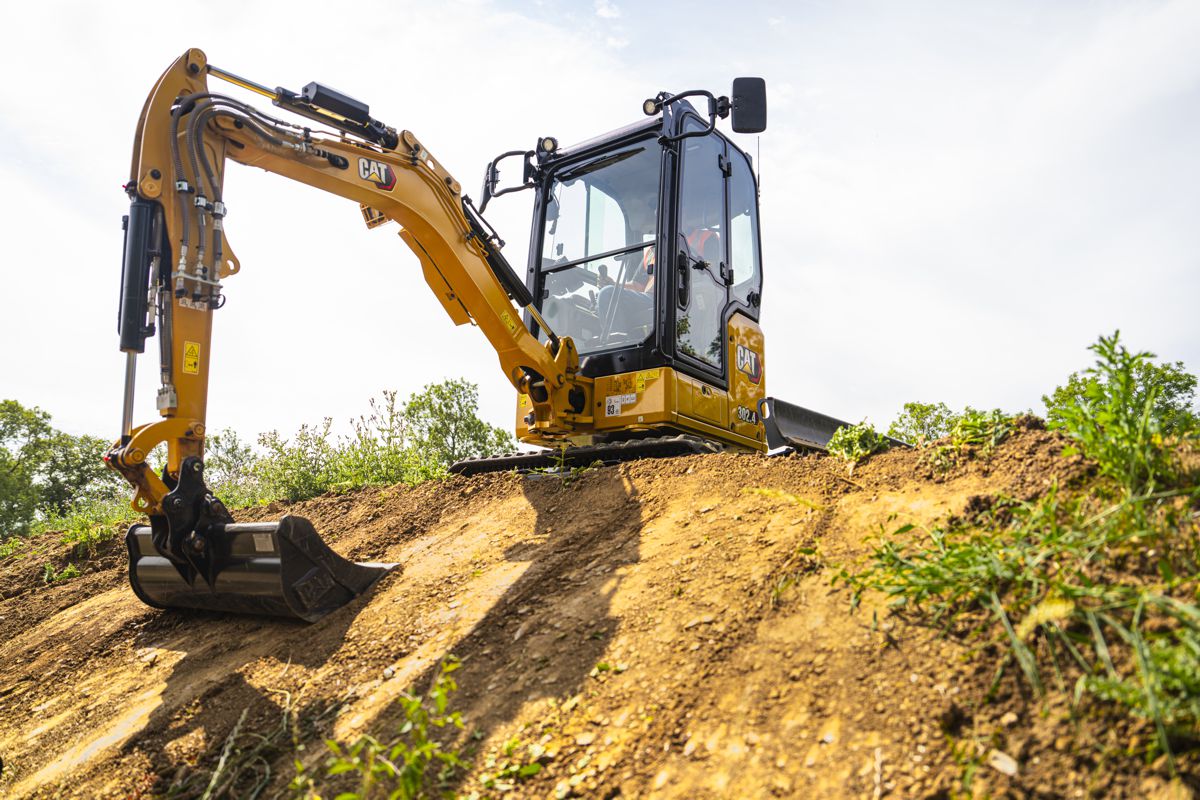
Picture a well-run construction project five years from now. A tower crane swings above a rising frame, an excavator trims a foundation, deliveries queue at the gate and crews move between work fronts with the same rhythm they follow today. Nothing about the scene announces a technological leap.
There are no humanoid robots striding between trades, no holographic overlays hanging in the air, no visible break from the site you would recognise now. The popular image of the futuristic jobsite, all gleaming automation and empty of people, largely misses what is actually arriving, because the most important change is one you cannot see from the gate.
The intelligence of that project has moved almost entirely out of sight, and that is what industry leaders should sit with. Construction has spent well over a decade buying digital tools, yet the productivity numbers have barely shifted. McKinsey puts global construction output at roughly US$15 trillion in 2025, heading towards US$22 trillion by 2040, while construction productivity grew only about 0.4 per cent a year between 2000 and 2022, against roughly 3 per cent annually in manufacturing.
The tools were rarely the constraint. The harder and more valuable problem, as KPMG’s construction research and Deloitte’s 2026 engineering and construction outlook both set out, is making isolated systems behave as scalable, integrated capabilities rather than a drawer of disconnected pilots. The real advantage lies in the connective tissue between systems rather than in any individual gadget, and that is where competitive value is quietly concentrating.
Briefing
- Global construction output is worth about US$15 trillion, according to McKinsey, but productivity has grown only around 0.4 per cent a year since 2000, so the case for integration is commercial rather than a matter of technological novelty.
- Cloud common-data environments have become the jobsite’s durable memory: on Birmingham’s Midland Metropolitan University Hospital, Balfour Beatty reported saving roughly a week on each package submission and keeping the information record intact through Carillion’s 2018 collapse.
- Connected-worker sensing has left the experimental phase, with WakeCap reporting coverage of more than 100,000 workers across 78 projects at NEOM Oxagon, figures that are vendor-reported but that point to continuous labour and safety telemetry at scale.
- Positioning now works at two scales at once: centimetre-class GNSS correction guiding machines and robots, and satellite InSAR watching whole corridors, with SatSense monitoring National Grid’s 32.5-kilometre London Power Tunnels for ground movement across 2020 to 2023.
- AI agents are commercially real for documentation and project controls, with Procore advertising more than 18 job-specific agents and over 90 connectors, but they are not yet trustworthy controllers of safety-critical physical work, and the deliberate design keeps machine safety local.
The site you can’t see
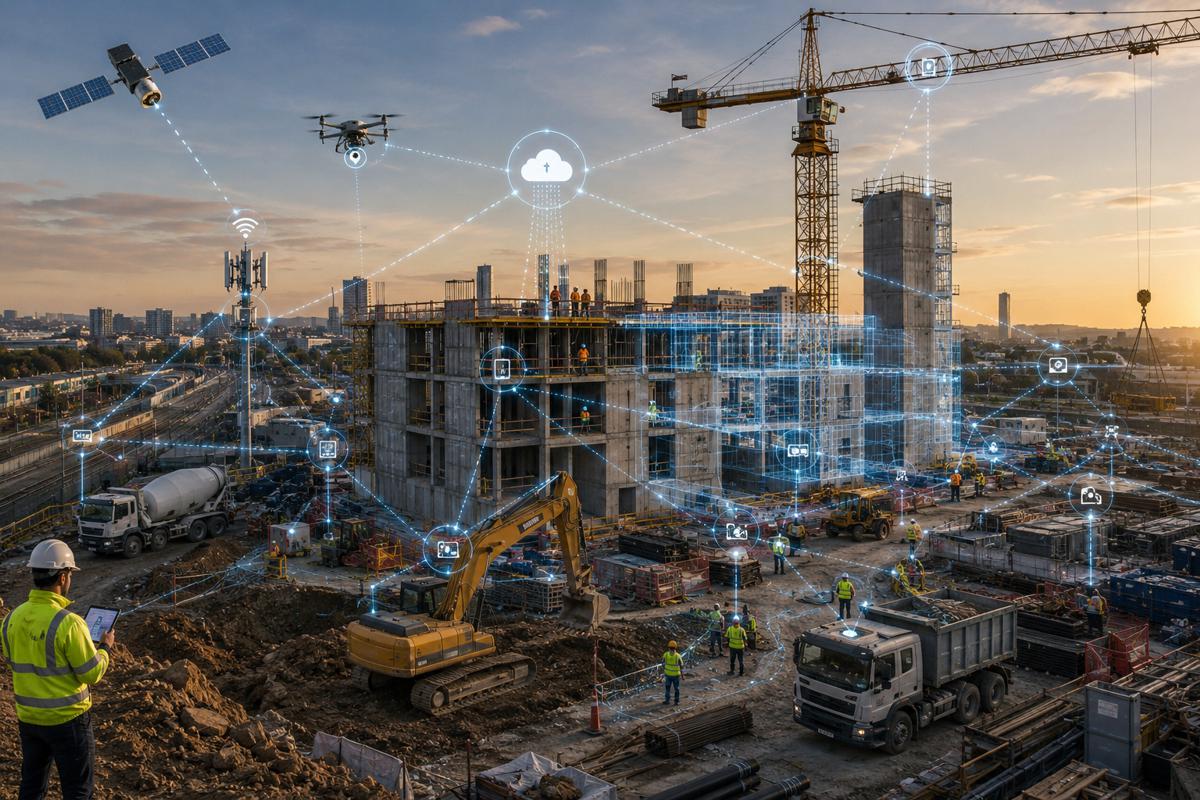
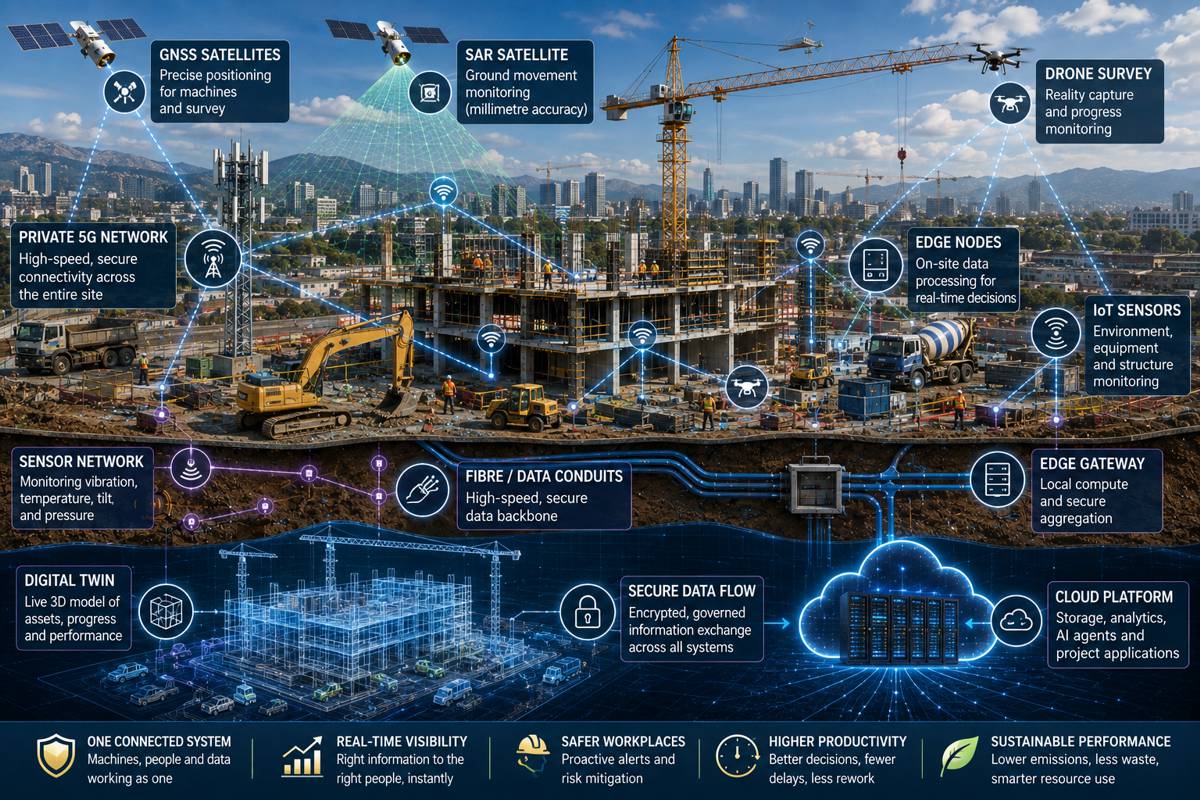
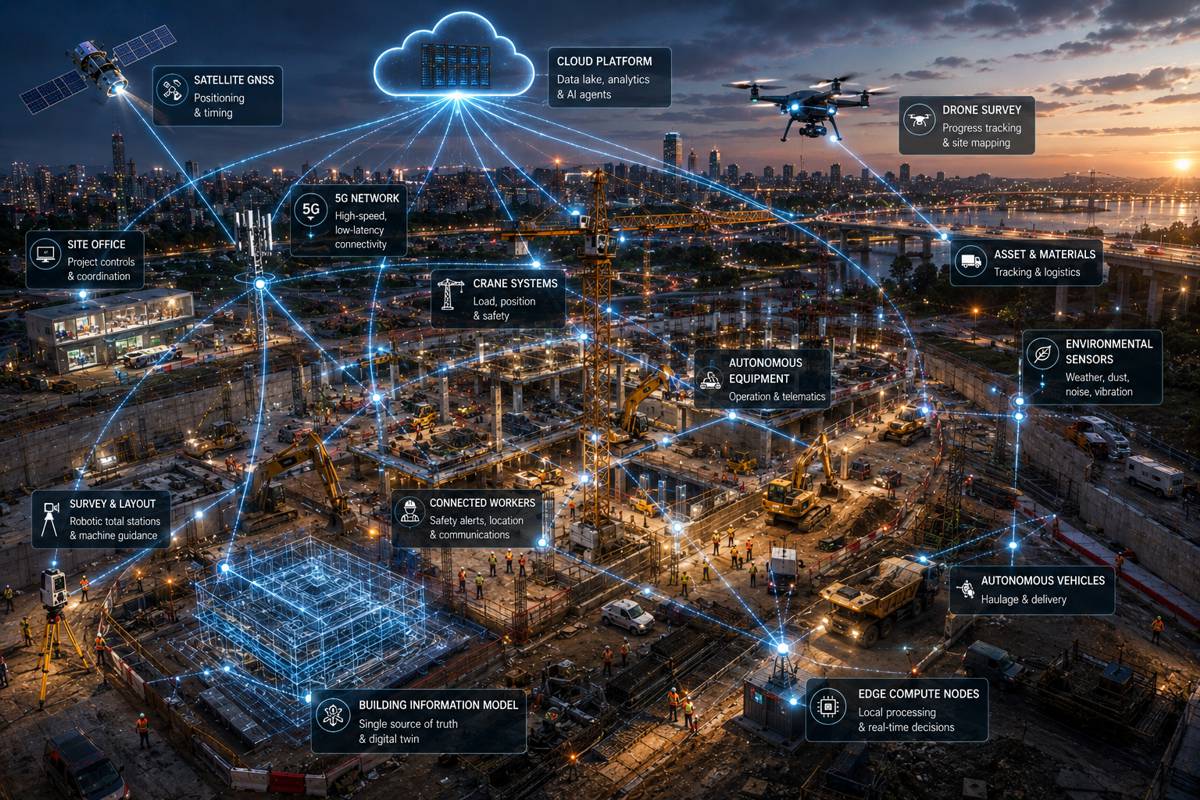
Strip away the ordinary surface and a second site appears, layered above, across and beneath the first. Overhead sit GNSS constellations feeding centimetre-accurate corrections to machines and rovers, alongside radar spacecraft watching the surrounding ground for millimetre-scale movement. Across the site runs a constant traffic of signals over private 5G, Wi-Fi, low-power radio and machine links.
Inside helmets, cameras and cabs, small computers sense conditions and decide in real time what deserves attention. Beneath the visible scene lies an information model holding every grid line, object identifier, work package and inspection, and above it all sits a cloud layer where the project’s records, analytics and increasingly its AI agents turn observations into proposed decisions.
The most useful way to read this hidden architecture is anatomically, because it behaves less like a stack of software products and more like a body. The cloud is its memory, holding the durable contractual record. Sensors are its nerves, registering what is happening across the site. Satellites give it spatial awareness, both of where each machine sits and of how the ground itself is behaving. Private 5G and its network siblings are its communications.
Edge computers are its reflexes, acting before anything needs to reach a distant server. The digital twin is its situational awareness, and AI agents are its interpretation. Robots and autonomous logistics are its muscles. Each of these is unremarkable in isolation, which is exactly why the individual-gadget framing fails. A camera without geometry produces only footage, a twin without live data is merely a better model, a robot without project context automates a single task, and an agent without governed source data simply accelerates uncertainty. Connect them correctly and each one raises the value of the others.
The nervous system
Memory comes first, because without a durable record the rest has nowhere to write. Cloud common-data environments have matured from document repositories into the authoritative business record that specialist systems publish to and field devices draw from, and the Midland Metropolitan University Hospital in Birmingham shows why that matters commercially. When Carillion entered liquidation in 2018, the project’s cloud-held information could be transferred to Balfour Beatty rather than reconstructed from fragmented local drives, and Balfour Beatty subsequently reported that access and workflow automation through Trimble Viewpoint for Projects saved approximately one week on each package submission while preserving a full auditable record through handover.
Trimble’s Hensel Phelps case describes the same pattern in normal conditions, with Trimble Connect acting as the hub feeding BIM, coordination and augmented reality on projects including Harbor-UCLA and the LAX terminal redevelopment. The cost profile is mostly operating expense, though the hidden labour sits in migration, permissions, taxonomy and training. Autodesk accordingly cautions that change management belongs inside any return calculation, and ISO 19650 governance together with vendor-neutral standards such as IFC keeps that memory portable rather than locked in.
The nerves are the sensing layer, and it has long outgrown the temperature probe. Commercial deployments now fuse badge location, worker presence, equipment telemetry, environmental monitoring, cameras and geotechnical sensors, and the scale has become serious. At NEOM Oxagon, WakeCap reports coverage of more than 100,000 workers across 78 mega-projects, a 60-percentage-point cut in ghost-worker hours and more than SAR8 billion in projected savings, while at BESIX’s 78-storey Uptown Tower in Dubai it reports a 96 per cent fall in over-reported hours and US$3.57 million of labour value unlocked. Those are vendor figures rather than independent evaluations, and they deserve that label, but the direction is unmistakable.
Sensing only becomes useful once the data carries meaning, which happens when a raw event maps to an authorised worker, a BIM location and a work package, and open models such as OGC SensorThings earn their place at exactly that point. That same richness creates an obligation, because location telemetry can slide into workforce surveillance, and the UK’s Information Commissioner’s Office is clear that monitoring needs a defined purpose, proportionality and the least intrusive method, with an impact assessment where processing is high-risk. The sensible response is architectural: perform as much safety inference as possible at the edge, retain aggregate data where individual histories are unnecessary, and keep safety monitoring explicitly separate from productivity scoring.
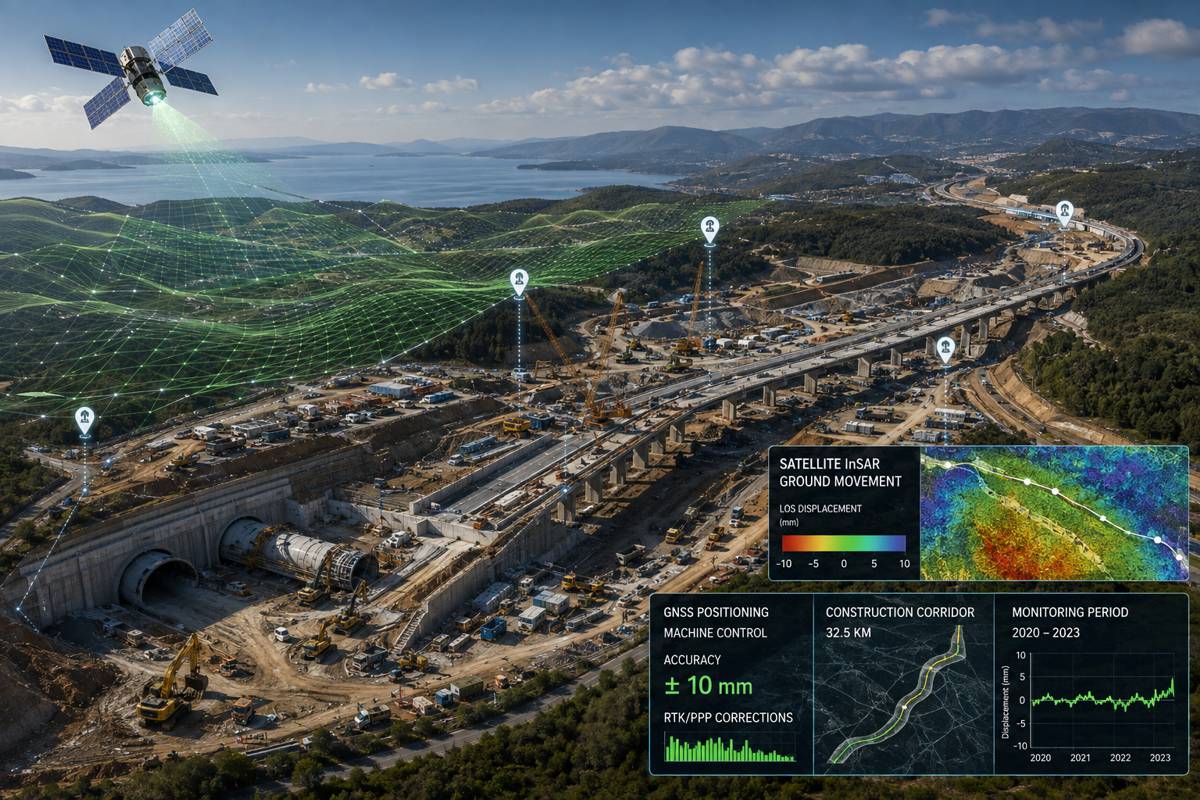
Spatial awareness arrives from orbit in two very different forms. GNSS gives receivers and machines a precise position, and mature correction services from Topcon’s Topnet Live and Leica’s HxGN SmartNet, the latter reporting more than 4,500 reference stations, let construction rovers and machines hit high accuracy for layout, earthworks and as-builts. In one Leica iCON deployment, Swissaufmass reported measurements becoming roughly 20 to 30 per cent faster, with digital capture also removing manual transcription. Earth observation operates at a scale machine control never touches.
National Grid’s London Power Tunnels used SatSense InSAR monitoring across a 32.5-kilometre corridor between 2020 and 2023, with the same technique applied on the Thames Tideway Tunnel, comparing repeated radar passes to detect ground movement at millimetre resolution and to establish a pre-construction baseline before excavation begins. One satellite layer tells a machine where it is; another tells engineers whether the ground around an entire project is shifting.
Communications are the pathways those nerves depend on, and where a site starts to resemble a temporary industrial campus, private 5G becomes credible. The strongest UK evidence remains the government-funded 5G AMC2 programme, which installed standalone private networks at BAM Nuttall’s Kergord construction project in Shetland and its Kilsyth test environment, carrying a use-case stack that reads like a catalogue of the invisible jobsite: cloud access to BAM’s digital construction workspace, live UAV video, mixed reality, a Trimble X7 scanner riding a Boston Dynamics Spot robot, and an autonomous material-delivery vehicle.
Government evaluators modelled £376,200 in remote-survey savings and £300,960 in virtual-meeting savings over a four-year scenario, though the report is candid that final benefits reporting did not capture achievement against every target, so those figures are best read as targets. Ericsson’s Newmont Cadia deployment in New South Wales demonstrates the same principle where the stakes are highest, using private 5G to run remote-controlled bulldozers building a tailings wall and keeping operators out of the danger zone. Private 5G works as the site’s temporary digital utility, letting many demanding applications share one controlled network. As the NCSC warned in August 2026, though, a private network brings its own visibility and threat-detection challenges rather than being secure simply because it is private.
The reflex layer
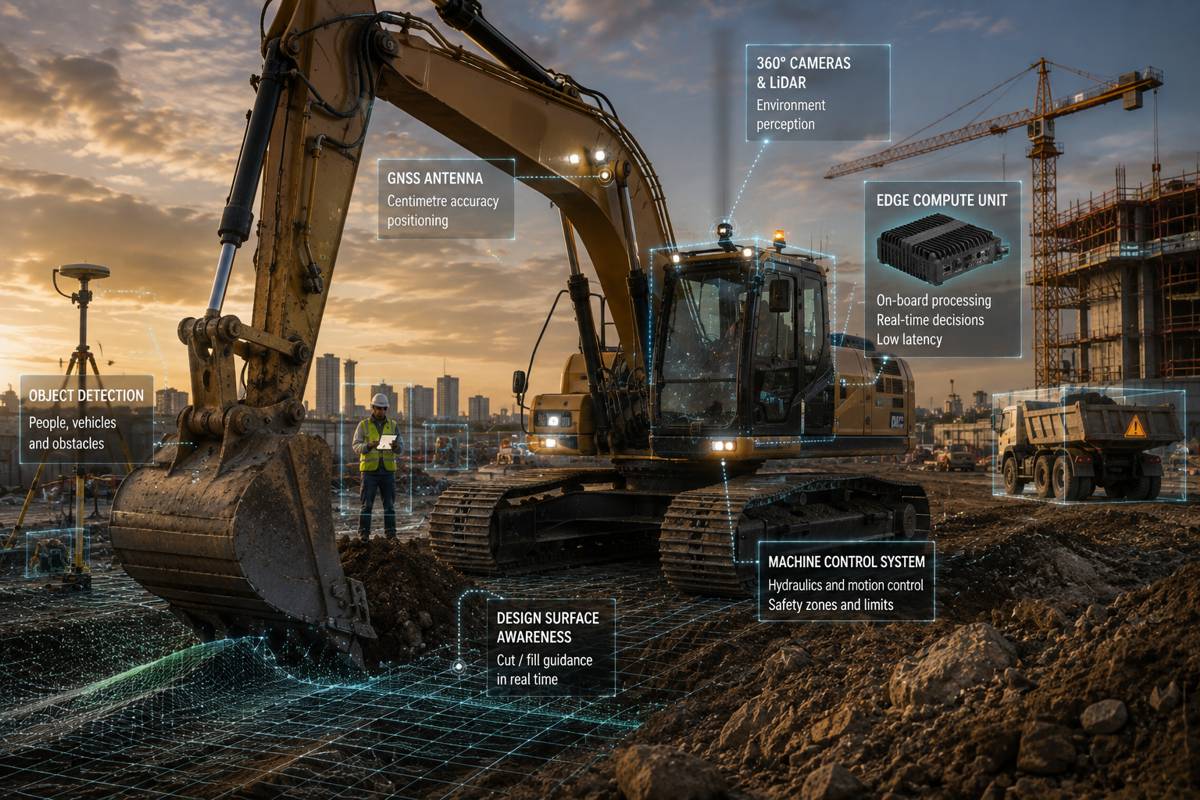
Reflexes exist because a body cannot route every decision through conscious thought, and a construction site cannot route every video frame, LiDAR point and control command to a distant cloud and wait for an answer. Edge computing takes on the tasks that are time-sensitive, bandwidth-heavy, privacy-sensitive or safety-critical, and sends the cloud only what has durable value. AWS IoT Greengrass is representative of the general-purpose pattern, running local inference and continuing to operate through intermittent connectivity, with NVIDIA Jetson providing the embedded processing for vision and autonomous machines.
A useful caution hides in the economics: AWS lists the Greengrass runtime at around US$0.16 per active core device per month, a figure that says almost nothing about total cost of ownership once the rugged compute, cameras, integration and model maintenance are counted.
The reflex has to be reliable precisely when the network is not. Built Robotics’ RPD 35 shows the construction-specific version, fusing RTK positioning, vision and onboard processing to run autonomous solar piling at up to five times conventional productivity while flagging pile refusal automatically, all without waiting on a remote server.
The governing principle is that a loss of cloud connectivity must never disable a machine’s safety state; the edge should fail safe and buffer non-critical telemetry for later synchronisation. That places real weight on some unglamorous discipline, including patch management across transient site devices, consistent model versions and physical security for hardware that can be stolen or tampered with. Handled well, it lets the higher, slower layers of the body think without the machine ever losing its reflexes.
The machine layer
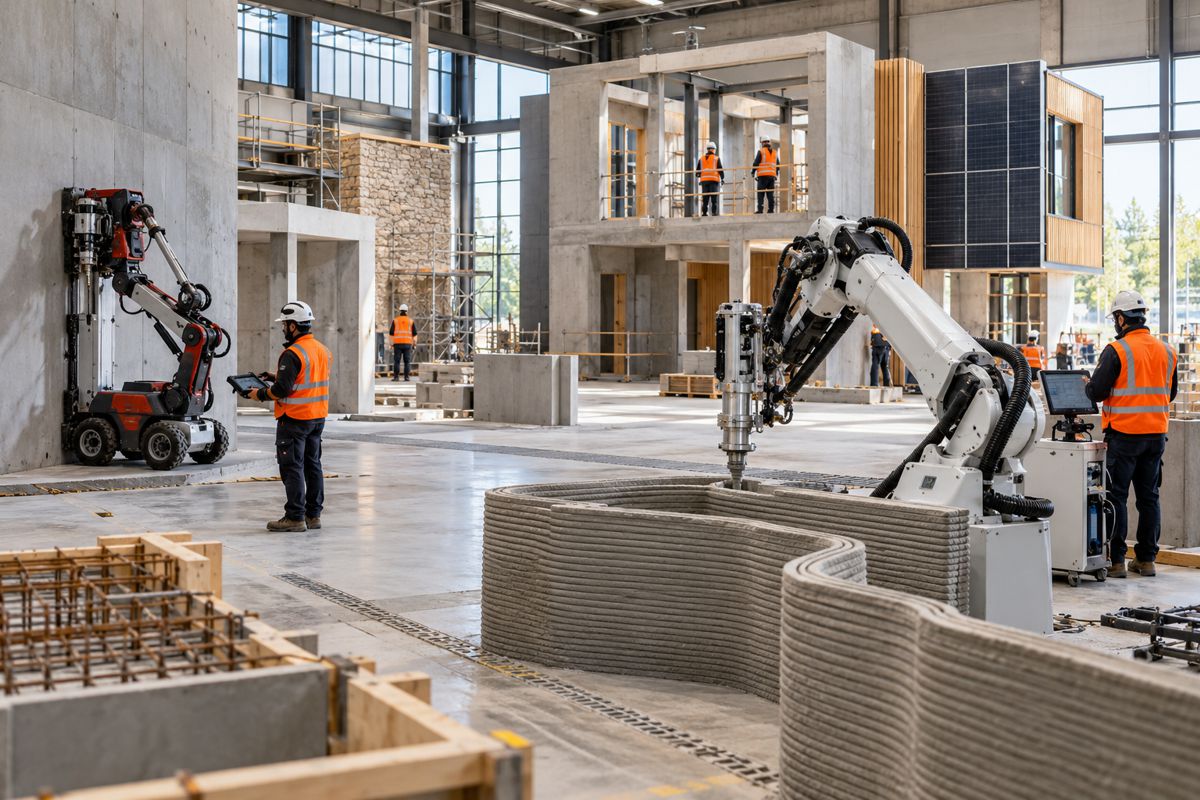
Muscles are where the invisible site finally moves something physical, and the real trend is specialisation rather than spectacle. General-purpose humanoids remain firmly pilot-stage, a point McKinsey makes plainly, while the robots earning their keep today attack a narrow task with high repetition, clear geometry and measurable labour content.
Three categories are already credible: layout robots such as Dusty Robotics’ FieldPrinter and HP SitePrint that translate BIM coordinates onto the slab; mobile capture robots such as Boston Dynamics’ Spot that carry cameras and scanners through awkward ground; and heavy autonomous machines, exemplified by Built Robotics, that automate repetitive civil and solar work. On Turner’s New Canaan Library in Connecticut, Dusty reports that one person laid out roughly 42,000 square feet in five days, and on a 70,000-square-foot Skanska medical project it reports 50 per cent faster layout that helped shave three months from the programme.
This is also where the distinction between an autonomous machine and the wider autonomous construction company becomes important: automating an individual physical task is only one part of a much larger shift towards coordinating estimating, procurement, scheduling, reporting, equipment and project controls.
The apparently simple act of marking a floor exposes the entire hidden body behind it: approved BIM, layout extraction, a coordinate system, robotic total-station or GNSS localisation, path planning, printed geometry and a digital as-built returning to the record. That dependency reveals the strategy, since HP SitePrint integrates with Leica, Topcon and Trimble total stations because robotics succeeds by plugging into surveying infrastructure rather than replacing it.
The commercial models follow suit, with HP offering SitePrint on a pay-as-you-go basis and Built pricing its piling per pile, arrangements that push utilisation risk onto the vendor and make the return easy to weigh against a manual task. Material logistics is the harder frontier, because a live site is a moving target where routes change overnight, surfaces shift with weather and pedestrians improvise.
The 2025 ADAPT autonomous forklift research showed off-road handling approaching human-level performance, and Komatsu’s Smart Quarry Autonomous brings driverless haulage into controlled quarry settings through retrofit rather than a dedicated control centre, yet geofenced repeatable routes will lead while congested in-building delivery lags. Throughout, autonomy is a safety-engineering problem before it is an AI problem, a fact now written into the EU Machinery Regulation’s explicit treatment of autonomous mobile machinery and its supervisor, and a reminder that once a compromised command can move equipment, cyber controls become physical-safety controls.
The thinking layer
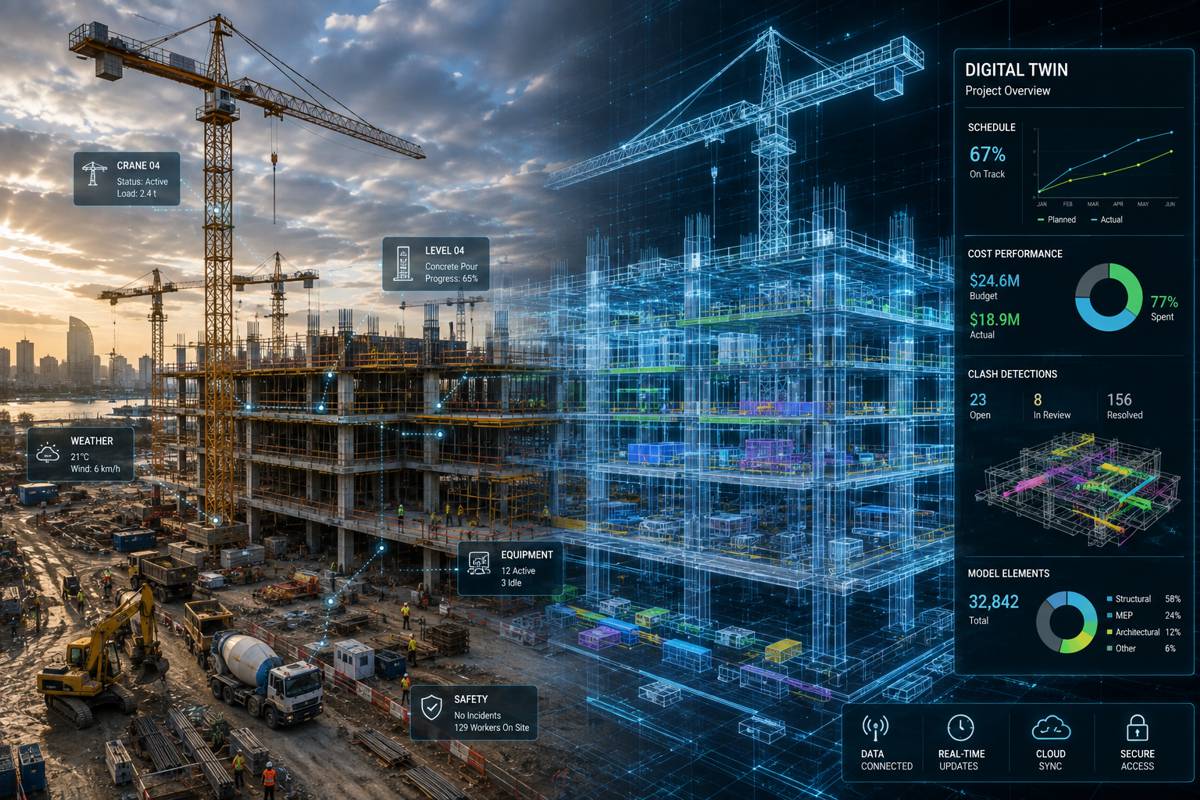
Situational awareness is the twin’s job. The most useful definition of a construction digital twin describes a maintained digital representation whose state is refreshed from the physical system and used for observation, analysis or decision-making, which is a good deal more than a very detailed 3D model. That continuous connection separates a genuine twin from a static BIM file, and Bentley’s iTwin, Autodesk’s Tandem and Hexagon’s digital-reality products are converging on it from different starting points.
The returns show up where the data is disciplined: Bentley reports that Sweco used iTwin design review to cut the cost of resolving construction errors by 25 per cent, while Autodesk’s early NEST research building in Zurich connected roughly 3,000 sensors to expose live performance data. Rendering the geometry is rarely the hard part; matching identities is, so that the same pump, column, room or work package stays recognisable across the model, the asset register, the schedule and the sensor stream. IFC 4.3, now extended into roads, rail, bridges, ports and waterways, together with OGC SensorThings and ISO 19650, matters for exactly that reason, and a twin that stops being updated decays into an expensive historical visualisation.
Interpretation is the newest and least proven faculty, and precision about its maturity is where a serious account earns its credibility. AI agents differ from earlier analytics because they can be given a goal, retrieve information across systems and take multi-step action, and the first credible targets are administrative: searching records, drafting RFIs, reviewing submittals and investigating cost or schedule anomalies.
Procore advertises more than 18 job-specific agents and over 90 connectors, with a Datagrid layer bringing data together and answers linked back to source documents, while Oracle’s addition of a Primavera Cloud MCP Server resource in August 2026 points towards agents reaching project-control tools rather than being trapped in a chat window. The candid caveat is that public, agent-specific return-on-investment evidence still trails the marketing. Mature platform reporting, such as HITT’s use of Procore real-time data, is well documented, but 2026’s newest agent functionality has not accumulated the named, controlled case studies that GNSS, cloud platforms or layout robots can show.
As capability grows and the EU AI Act tightens expectations around consequential decisions about workers, the boundary should stay firm: an agent may recommend that a work zone be stopped, but the interlock that halts dangerous machinery must remain a separate, engineered, deterministic system.
When everything connects
The architectural mistake to avoid is building nine independent technology stacks that happen to share a car park. A smarter design treats the site as a layered system in which each component has a defined latency, authority and information responsibility, and reading the connections between those layers reveals four distinct loops worth engineering deliberately. The observation loop runs physical to sensor to edge to cloud to twin, ideally sending a meaningful event and a short evidence clip rather than years of undifferentiated video.
The spatial loop runs design coordinate to GNSS or total station to machine to as-built and back to the twin, turning a digital instruction into physical work and returning it as evidence. The project-control loop runs site event to work-package and cost context to agent or planner to approved action, which is where cloud platforms and agents create value provided the identifiers line up. The autonomous loop runs mission to edge perception to deterministic control to machine, where the cloud may assign a task but should never steer the wheels packet by packet.
A single governing rule keeps this coherent: the cloud proposes and remembers, the edge interprets and reacts, and machine safety systems remain authoritative over motion. That discipline prevents a language model, a WAN outage or a cloud service from becoming a single point of physical failure. Interoperability then has to exist at several levels at once, with IFC describing the built asset, SensorThings normalising observations, ISO 19650 governing the information process and APIs moving transactions, yet none of these alone solves identity.
The project’s most valuable technical artefact may therefore be its least glamorous, namely a canonical identifier map tying asset, location, schedule activity, work package, cost code, document and sensor together. Two risks travel with all of this and belong in the design rather than in a later policy note. Integration expands the attack surface, and on an instrumented site a cyber compromise becomes a physical-safety event, so the NCSC’s warning on private-5G visibility points towards segmented identity and least privilege, meaning a concrete-temperature sensor should never hold authority to issue a robot mission. Privacy is the parallel case, where the ICO’s proportionality test is best answered by architecture that keeps individual movement data to the minimum the safety purpose requires.
The integration dividend
The economics of the invisible jobsite only make sense once technologies stop being appraised one at a time. Conventional procurement weighs each purchase against its own payback, setting a layout robot against a manual crew, a common data environment against shared drives, or a sensor network against the incidents it might prevent. That habit systematically undervalues integration, because it never counts the worth each layer adds to the others.
It also helps explain construction’s accelerating shift towards recurring revenue, as cloud platforms, connectivity, positioning services, machine intelligence and increasingly robotics move technology spending away from one-off ownership and towards subscriptions, usage-based services and outcome-based models.
Assessed alone, several of these systems look marginal. Assessed as parts of a connected body, the same systems change character, because the return on any one of them rises with every other layer it can reach.
Private 5G is the clearest illustration. A contractor would struggle to justify a private network purely for connectivity, since Wi-Fi and public cellular cover most needs at a fraction of the fixed cost. Route drone video, autonomous machine control, connected-worker safety, remote inspection, reality capture and edge processing across that same network, however, and the appraisal is no longer about connectivity at all. It becomes a question of amortising one engineered utility across six or seven high-value applications that would each be weaker on a shared public link. The BAM Nuttall trials are telling precisely because the network mattered less than the stack of things it made possible at once.
The same compounding runs through the rest of the body. A digital twin that a team must update by hand is an expensive model, whereas a twin that sensors and reality capture populate automatically becomes a live instrument worth consulting daily. Robotic layout that simply marks a floor faster is a modest saving, but robotic layout whose as-built evidence flows straight into the project record removes a downstream reconciliation nobody enjoys paying for. AI agents asked to reason across badly named, duplicated documents mostly produce confident errors, yet the same agents working over information that already shares identifiers become genuinely useful. In each case the marginal value of one investment is set by how well it connects to the others, and one plus one begins to exceed two.
There, in that compounding, sits the integration dividend, and it reframes what an owner is actually buying. The asset is less the excavator, the platform or the robot in isolation than the governed capability to make them work as a system, and that capability grows more valuable as more of the body is wired together. It also explains why the housekeeping disciplines of identifier maps, open schemas and coordinate governance pay for themselves indirectly rather than on their own line in the budget. An organisation that understands this stops asking whether a single technology clears a hurdle rate and starts asking what each addition is worth once connected to everything already on site.
Who owns the invisible jobsite?
No credible vendor owns the complete body, and that fact reorganises where advantage comes from. Autodesk, Procore, Oracle, Bentley and Trimble are strongest around project data; Topcon and Leica around spatial control; AWS and NVIDIA around computation; the telecom vendors around connectivity; and specialist firms around sensing and robotics.
The winning architecture is therefore federated, which turns interoperability from an IT preference into a contractual requirement specifying which identifiers, coordinate systems, schemas and APIs must remain exportable at handover. It also implies a build order that most sites attempt back to front, and it reads more clearly as a sequence than as a buried sentence: Govern → Standardise → Digitise → Instrument → Connect → Twin → Interpret → Automate.
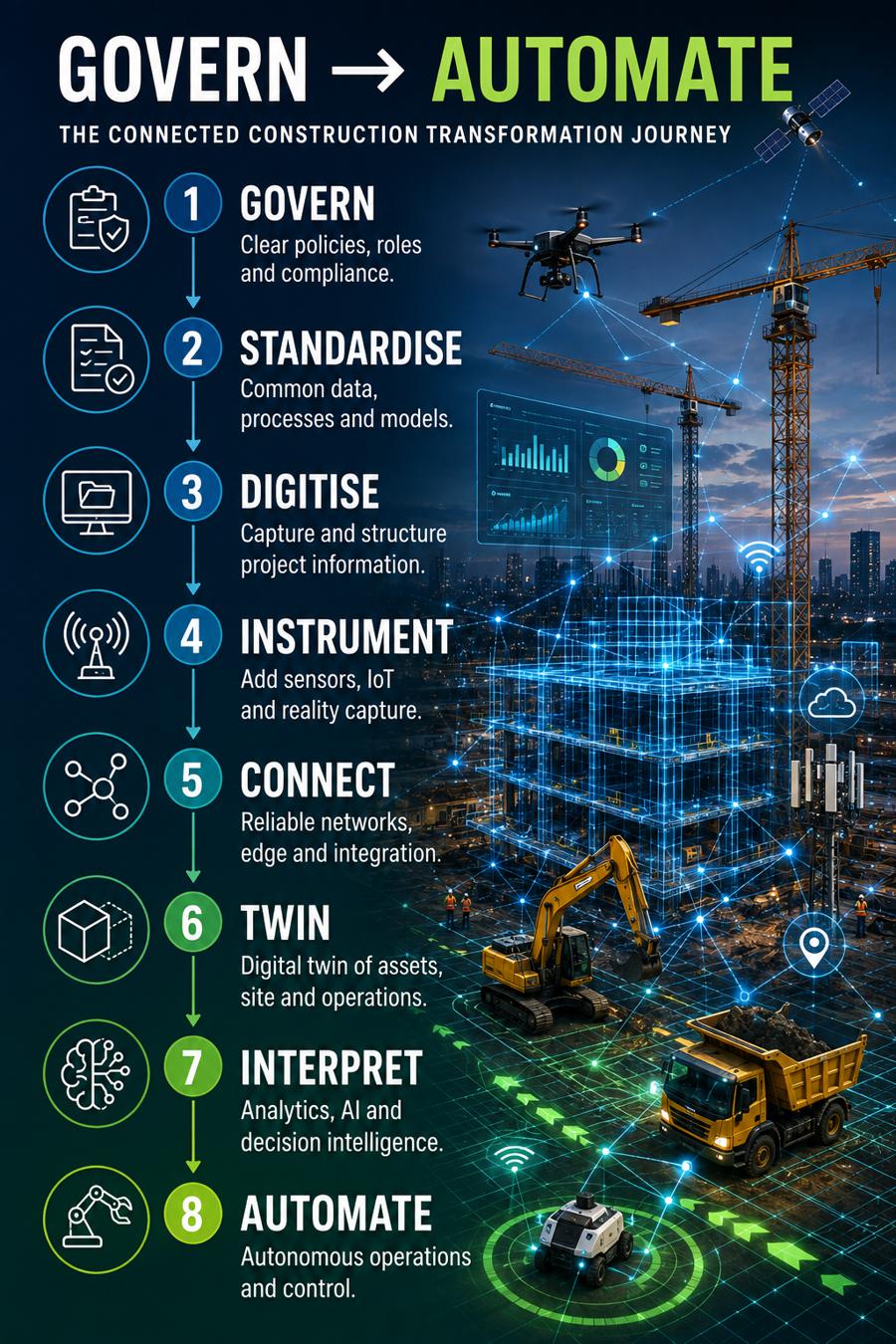
Each step in that sequence returns value on its own, so a programme that stalls halfway still leaves the project better off rather than stranded with clever kit and poor data. Buying robots before coordinate control, or agents before permissions and clean documents, inverts the order and produces expensive tools that make poor data travel faster. The discipline is what makes each investment worthwhile even when the next layer never arrives.
This is where the commercial argument sharpens into something owners and contractors can act on. Future competitive advantage in construction is likely to depend less on owning the best excavator or licensing the cleverest software than on engineering the connections between everything already on site. The excavator can be hired, the software subscribed to and the robot rented per pile, but the governed relationships between memory, nerves, spatial awareness, communications, reflexes, situational awareness, interpretation and muscle are specific to a project and its operator, and they are far harder for a competitor to copy.
There lies the quiet paradox of building the invisible jobsite: the more digitally capable a project becomes, the less of its intelligence can be seen with the naked eye, and the more the advantage belongs to the teams that wired the connections nobody ever photographs.
Key Industry Questions
- What is the “invisible jobsite”, and why won’t the smart construction site look futuristic? The invisible jobsite describes a project whose intelligence sits almost entirely out of sight, in positioning, sensing, connectivity, edge computing, cloud records, digital twins and AI agents, beneath a scene that still looks like conventional construction. The popular image of humanoid robots and holograms largely misses this, because the real change is integration rather than spectacle. Construction has accumulated digital tools for years, and the harder commercial problem is connecting them into scalable capabilities. A future site therefore behaves like a body with hidden systems working together, while the crane, excavator and crews remain recognisable. The advantage is not visible on the surface, which is precisely why it is difficult for competitors to observe and copy.
- Where should a contractor start investing if the budget is limited? The evidence points to funding the memory before the muscle. A governed common data environment, disciplined coordinate systems and consistent asset identifiers make every later investment more valuable, whereas robots or AI agents bought first tend to accelerate poor data rather than fix it. A workable order is to govern information, set spatial and identity standards, digitise high-value workflows, instrument the real bottlenecks, then add edge compute, connectivity, a live twin and agents, and finally bounded automation. This sequence has a practical virtue, since each step returns value independently, so a programme that stalls halfway still leaves the project ahead rather than stranded with unusable technology. It also mirrors how the underlying body works, because reflexes and muscle are only useful once memory and nerves are in place.
- Are connected-worker sensors legal under UK data-protection rules? They can be, though not automatically. The Information Commissioner’s Office requires employee monitoring to have a clearly defined purpose, to balance business interests against workers’ rights, and to use the least intrusive method capable of meeting that purpose, with a data-protection impact assessment for high-risk processing. Location and presence data is unusually sensitive because it can become detailed workforce surveillance. Sensible deployments perform as much safety inference as possible at the edge, retain aggregate or event-level information where individual histories are unnecessary, and keep safety monitoring explicitly separate from productivity scoring. Treating privacy as an architectural decision made before rollout, rather than a policy written afterwards, is both the compliant approach and the one most likely to retain workforce trust on large, heavily instrumented sites.
- Does an integrated smart site actually need private 5G? For most projects, no. Public cellular, Wi-Fi and low-power radio remain sufficient, and private 5G is economically selective rather than universal. It becomes attractive when a site behaves like a temporary industrial campus, with multiple autonomous machines, high-definition video, remote operation, mobile scanners and a need for engineered coverage and local security boundaries. The BAM Nuttall 5G AMC2 trials show the value clearly on remote and automation-dense work, but they also show the fixed-cost burden of early deployments. Private 5G is best understood as the site’s communications utility, enabling many demanding applications to share one controlled network, rather than as an application in itself, and it will continue to coexist with Wi-Fi and low-power networks rather than replace them.
- How mature are construction AI agents, and can they run a project? Not yet, and responsible vendors are not claiming otherwise. Agents are commercially real for documentation, search, RFIs, submittals and project-control workflows, where platforms such as Procore and Oracle are extending them into governed data and, increasingly, project-control tools. What is missing is the depth of independent, agent-specific return-on-investment evidence that already exists for GNSS, cloud platforms and layout robots. The prudent interpretation is that agents accelerate administrative and analytical work under human approval, but should not be trusted as autonomous controllers of safety-critical physical activity. The correct boundary is durable: an agent can recommend stopping a work zone, but the interlock that actually halts machinery must remain a separate, engineered, deterministic system rather than a conversational one.
- What is InSAR, and why should infrastructure owners care? InSAR, or interferometric synthetic-aperture radar, compares repeated satellite radar passes to detect ground displacement at millimetre resolution across wide areas. For infrastructure owners it offers something machine positioning cannot, namely a view of whether the ground around an entire corridor is moving, over kilometres rather than at a single point. SatSense monitored National Grid’s 32.5-kilometre London Power Tunnels between 2020 and 2023, and the same technique has been applied on the Thames Tideway Tunnel. Its particular strength is establishing a pre-construction baseline before excavation begins, which becomes valuable evidence for tunnelling, rail, utilities and settlement-sensitive urban work where the cause of later movement may be disputed. It is the site’s long-range spatial awareness, complementing the centimetre-scale positioning that guides individual machines.
- Why is autonomous logistics harder than autonomous layout or piling? Because a live construction site is a moving target in a way a warehouse never is. Access routes change overnight, temporary works appear without notice, surfaces shift with weather and delivery priorities are reshuffled, so reliable localisation cannot be assumed everywhere. Layout robots and autonomous piling succeed because their task is geometrically bounded and repetitive; material transport across a congested, evolving site is neither. Research such as the 2025 ADAPT autonomous forklift shows outdoor handling approaching human performance, and controlled environments like quarries are proving grounds for driverless haulage, but the near-term reality is geofenced logistics on repeatable routes such as solar farms, tunnelling compounds and material yards, with dynamic last-ten-metre delivery inside buildings remaining one of the hardest problems in the field.
- Is there a single platform that runs the whole invisible jobsite? No, and that is the strategic point. The strongest positions are concentrated by domain: project-data platforms such as Autodesk, Procore, Oracle, Bentley and Trimble; spatial control from Topcon and Leica; edge and AI computation from AWS and NVIDIA; connectivity from the telecom vendors; and sensing and robotics from specialists. Because value spans all of these layers and no vendor owns them all, the credible architecture is federated. That makes interoperability a procurement decision rather than an optional preference, best handled through open standards such as IFC, OGC SensorThings and ISO 19650, and through contracts that specify which identifiers, coordinate systems, schemas and APIs must remain exportable at handover. Ownership of the connections, rather than of any single product, is where durable advantage sits.
Strategic Takeaways
- The smart construction site will not look futuristic, and its intelligence hides in the connections between systems, which makes competitive advantage harder for rivals to observe and copy than any single machine or software licence.
- Investment should follow the body’s own order, memory and nerves before reflexes and muscle, funding information governance and spatial standards first so every later layer returns value and a stalled programme still leaves the project ahead.
- Vendor-reported productivity and safety figures are genuinely encouraging but are not independent evaluations, so buyers should treat them as directional and structure contracts, particularly for AI agents, around demonstrable outcomes rather than marketing claims.
- On an instrumented site, cybersecurity and machine safety converge, which makes segmented identity, least privilege and locally authoritative safety interlocks engineering controls on physical risk rather than IT housekeeping.
- Because no vendor owns the full stack, open standards such as IFC 4.3, OGC SensorThings and ISO 19650 become commercial leverage, and owners who specify exportable data and identifiers at handover protect both project continuity and their future freedom to compete.