Skyjack’s ELEVATE and the Race to Own the Connected Rental Machine
Skyjack’s latest push around its ELEVATE telematics suite, its operator-facing ELEVATE Live tool and a widening line of ACCESSORYZER safety attachments looks, at first glance, like routine product housekeeping from a well-regarded access manufacturer. Read against what the largest rental groups are now doing with data, it reads as something more consequential.
The commercial centre of gravity in access equipment is shifting away from the machine itself and towards the connected operating layer wrapped around it, a layer built from telematics, operator-level digital access, safety interlocks and integration into rental software. A scissor lift or telescopic boom is increasingly valued not only as a load-rated platform but as a node on a data network that a rental company, a main contractor and a project management system can all see into at once.
That shift matters because it changes where margin, differentiation and purchasing power sit in one of construction’s largest equipment categories. United Rentals has moved past 335,000 telematics-enabled assets, while Sunbelt Rentals reports gathering data from more than 340,000 connected pieces of equipment, and both are actively wiring that data into contractors’ own systems.
For an original equipment manufacturer such as Skyjack, the strategic question is no longer whether to fit telematics but whether to own the data relationship with the customer or cede it to the platform providers and rental groups that increasingly control the connected fleet. The individual tools Skyjack has announced are useful in their own right, yet the larger story is the industrialisation of the connected machine as a commercial asset.
Briefing
- The commercial value of access equipment is migrating from the physical machine to the connected layer around it, encompassing telematics, operator access, safety interlocks and software integration.
- Scale now sits with the rental majors: United Rentals has surpassed 335,000 telematics-enabled assets, and Sunbelt Rentals reports data from more than 340,000 connected machines generating over 80 million sensor readings a day.
- Skyjack’s ELEVATE is an OEM-designed telematics platform built on Trackunit and structured to feed rental ERP systems directly, positioning the manufacturer inside the data relationship rather than outside it.
- Interoperability standards, principally AEMP 2.0 (ISO 15143-3), and the late-February 2026 United Rentals integration with Procore are turning connected equipment data into a procurement expectation rather than a premium extra.
- Safety interlocks such as the award-winning LanyardGO and the SKYPROTECT secondary-guarding range are tightening the link between digital hardware and hardening MEWP safety standards, opening both factory-fit and aftermarket revenue.
The Data Layer Is Becoming the Product
The economics of equipment rental have always turned on utilisation, uptime and lifecycle cost, and telematics is now the instrument through which all three are measured and managed. United Rentals describes more than 85% of its applicable fleet as telematics-enabled and feeds that data into its Total Control platform, giving customers a single view of owned and rented assets across engine hours, location and utilisation.
Sunbelt’s Connected Solutions proposition rests on a comparable premise at scale, with the company stating that its connected fleet produces over 80 million sensor readings each day from more than 340,000 machines drawn from a total fleet exceeding 600,000 assets. When connectivity reaches that density, it stops being a differentiating feature and becomes the baseline infrastructure on which the rental relationship is priced and serviced.
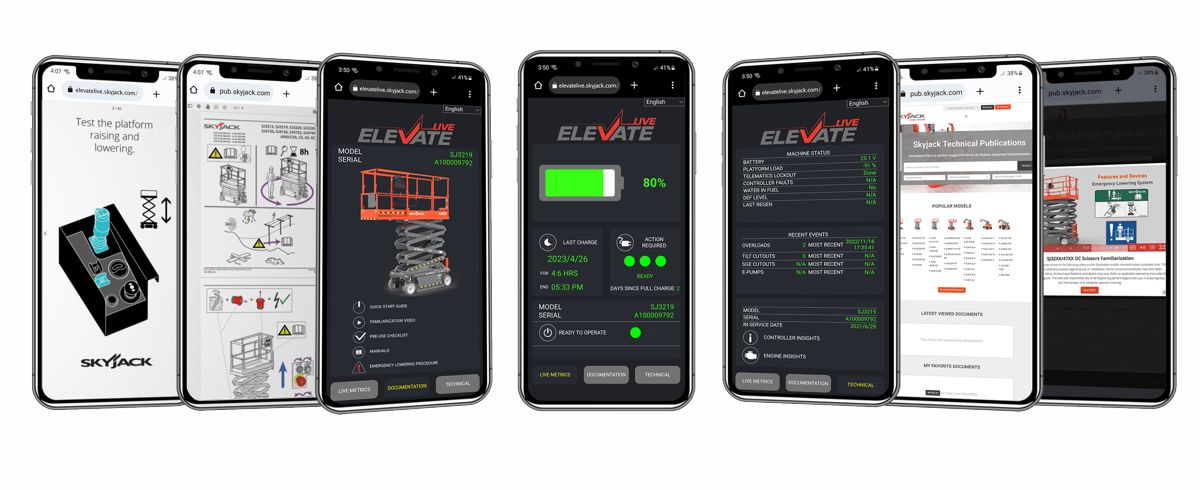
Skyjack’s contribution to this picture is the kind of machine-level data that makes utilisation meaningful rather than notional. ELEVATE captures battery health, controller area network data and what the company calls true utilisation, measured across lifting, driving, load and run time rather than simple ignition hours. That distinction carries commercial weight, because a fleet manager who can separate productive lifting from idle running can make sharper decisions on rotation, rightsizing and disposal, and can defend residual values with evidence.
The connected machine, in other words, is becoming the product that rental companies actually sell, with the steel underneath treated increasingly as the delivery mechanism for a data and service relationship.
Why Skyjack Built ELEVATE as an OEM Layer
Skyjack’s decision to design ELEVATE as a manufacturer-owned telematics platform, rather than leave connectivity to third parties, reflects a deliberate commercial stance. The system, first launched in 2018 by Linamar’s Skyjack division, is built on Trackunit, the hardware and platform layer that also underpins large parts of the wider construction and rental telematics market.
ELEVATE is structured in tiers that run from a direct link between a rental fleet and its enterprise resource planning system for maintenance and billing, through to a fuller connected-fleet management suite, with application programming interface connectivity across the packages so that live machine data can flow into a customer’s rental software. That architecture lets Skyjack sit inside the customer’s operating stack instead of alongside it.
The logic is that whoever owns the data relationship owns a durable share of the customer’s attention and, over time, of the aftermarket and replacement decision. David Swan, Skyjack’s product manager for technology and innovation, framed the original rationale in blunt terms, arguing that the only way we could see us providing our customers with true telematics value was to provide them with a solution that we, the OEM had a hand in designing.
For a manufacturer whose machines routinely operate inside mixed rental fleets, an OEM-built layer is a way of ensuring that Skyjack-specific insight, from battery management to fault diagnostics, is not flattened into generic tracking. The commercial pay-off is stickier customer relationships and a defensible position in a market where the platform providers and rental majors are competing for the same data.
Interoperability Is the Real Battleground
The counterweight to every OEM-owned layer is the contractor’s desire for one pane of glass across a fleet that no single manufacturer supplies. That tension is resolved, imperfectly, through the AEMP 2.0 telematics standard, formalised as ISO 15143-3, which defines a common schema for exchanging core machine data such as location, hours, fuel and utilisation between OEM servers and third-party systems.
Sunbelt requires its telematics partners to comply with at least the AEMP 2.0 standard, and manufacturers including Komatsu have built aggregation tools that pull ISO 15143-3 feeds from rival brands into a single dashboard. The standard does not eliminate the competitive fight over data; it simply moves the battleground from raw connectivity to the quality of insight and the ease of integration layered on top.
Nowhere is that clearer than in the move to embed rental telematics directly into construction management software. On 26 February 2026, United Rentals and Procore announced their first telematics integration, allowing shared customers to bring rental equipment data straight into Procore’s Resource Management solution and closing part of what the two companies describe as the resource gap between office planning and jobsite execution.
Tony Leopold, chief technology and strategy officer at United Rentals, said the aim was that “by integrating United Rentals telematics data into Procore, we’re extending visibility into rental equipment within a platform many of our customers already use every day.” For manufacturers such as Skyjack, the message is unambiguous: the value increasingly accrues to whoever integrates most cleanly into the software contractors already run, and standards compliance is becoming the price of entry rather than a selling point.
Putting the Machine in the Operator’s Hand
If telematics addresses the fleet manager, Skyjack’s ELEVATE Live addresses the person actually standing on the platform, and it does so in a way that quietly attacks rental companies’ cost base. Available across all Skyjack machines through a QR code that needs no app download or login, ELEVATE Live gives operators immediate access to pre-use inspection checklists, quick-start guides, familiarisation videos, emergency procedures and serial-specific machine data. Where full ELEVATE telematics is fitted, the same interface surfaces the machine’s state of health, including battery life and charge status.
The commercial effect is to move routine support out of the call centre and onto the machine, shortening phone calls, cutting site visits and reducing the labour absorbed by problems that turn out to be operator error rather than mechanical fault.
That last point is where the digital and the practical meet. A large share of rental support demand stems from misread controls, tripped circuit breakers, disconnected batteries, key-position confusion or an engaged emergency stop, faults that a remote diagnostic view or a well-designed operator screen can resolve without a technician leaving the yard.
Rodolfo Benavides, a digital product manager at Skyjack, has noted that: “we’re seeing an increase in adoption of telematics in our industry as rental companies around the world recognize it as a key operational tool. Digitising pre-use inspection and familiarisation also removes paper from the jobsite and creates an auditable record of operating time, which matters for billing accuracy, compliance and dispute resolution.” In a rental model where technician hours and truck rolls are among the largest controllable costs, tools that reduce avoidable interventions translate directly into margin.
Safety Interlocks Move from Option to Expectation
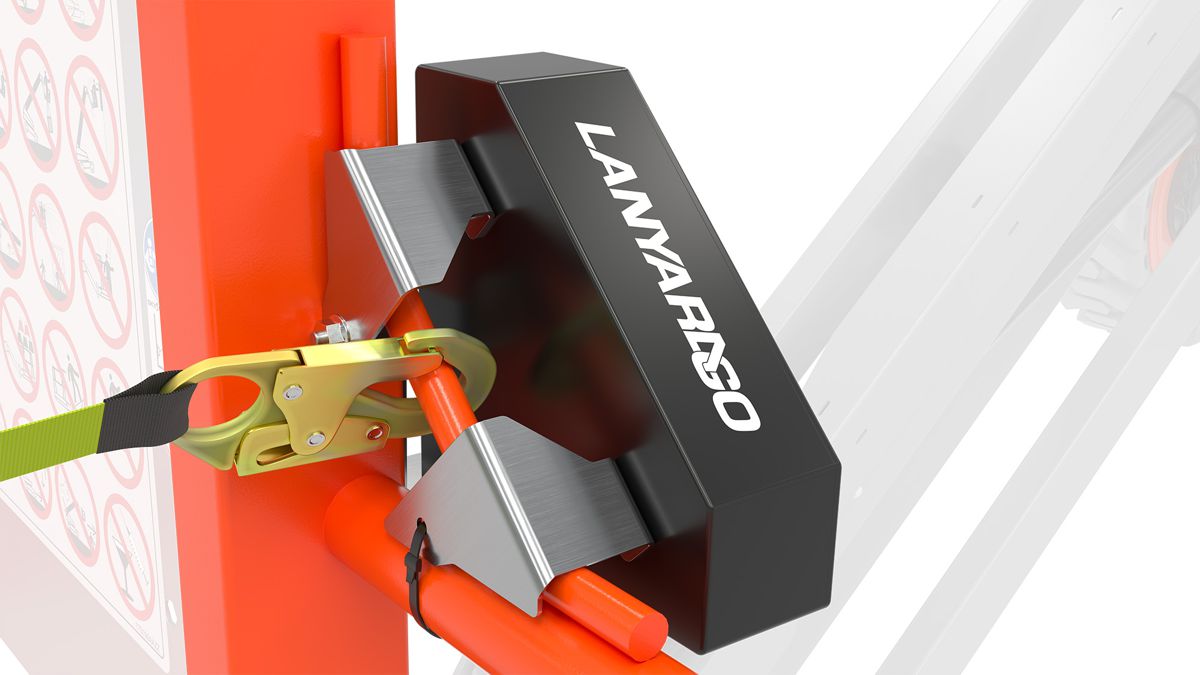
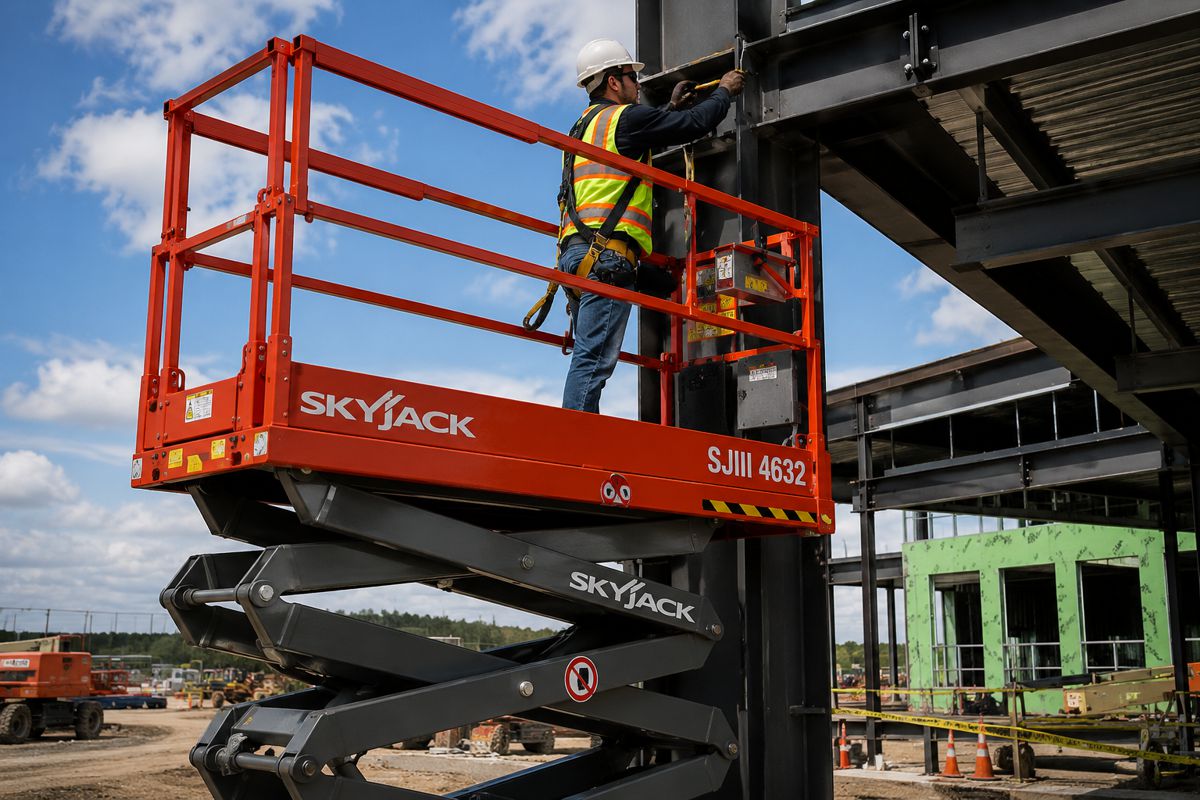
Skyjack’s ACCESSORYZER range brings the connected-machine argument into the domain where it carries the most regulatory force, namely operator safety. The award-winning LanyardGO uses a proximity sensor to detect whether an operator has clipped their harness lanyard to the platform anchor point, inhibiting lift and drive functions until the connection is made and signalling readiness through coloured LED indicators.
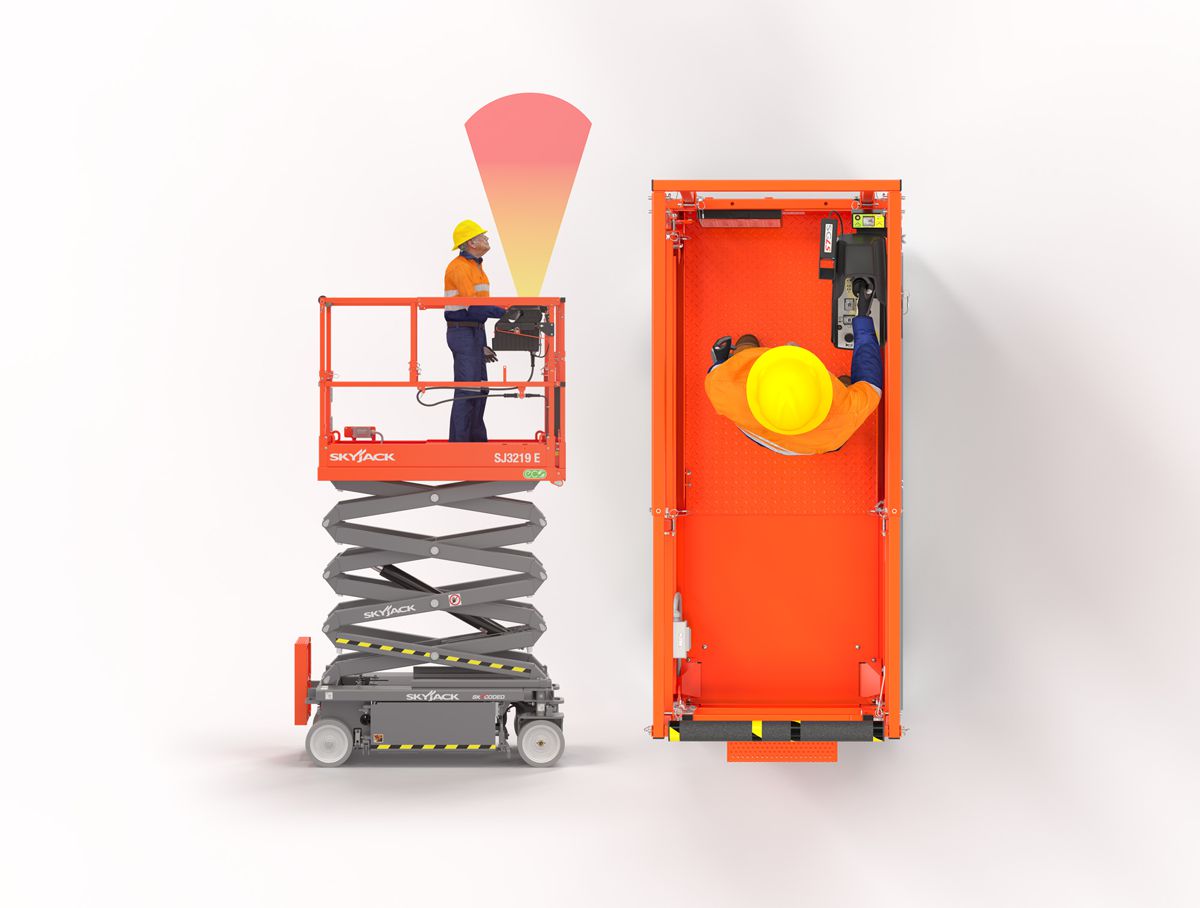
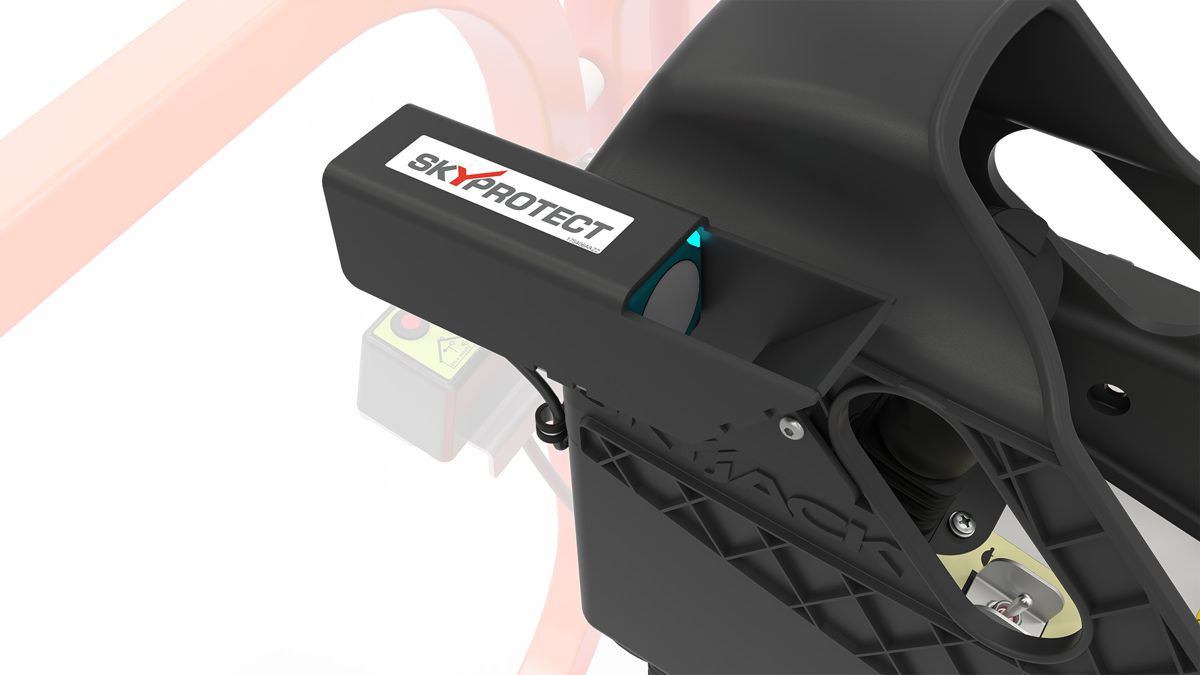
Available as a factory fit or an aftermarket retrofit, it took the 2026 Best New Product Award in the access equipment category at the Hire Industry Excellence Awards. The SKYPROTECT and SKYPROTECT+ options extend the theme to secondary guarding on scissor lifts, using a control-box-mounted ultrasonic sensor to warn of overhead collision hazards within an adjustable zone and to trigger a stop, with SKYPROTECT+ adding a secondary enable switch for lifting and reverse driving.
These are not incremental gadgets, and the safety data explains why. The IPAF Global Safety Report 2025 records that falls from the platform and entrapment remain among the leading causes of serious injury and death in powered access, even as reported falls from the platform fell by 44% and related fatalities by 39% in 2024. IPAF guidance now points to secondary guarding becoming available on 3a-type mobile vertical machines such as scissor lifts, where SKYPROTECT is aimed, having previously been concentrated on booms.
With MEWP standards including ANSI A92 and CSA B354 tightening expectations around risk assessment and secondary guarding, interlocks that enforce lanyard use or flag crush hazards are shifting from optional extras towards specification requirements on higher-risk sites. The commercial consequence is twofold: safety hardware becomes a rental differentiator, and the aftermarket retrofit route opens a revenue stream on machines already in the field.
The Rental Economics of Connection
Taken together, telematics, operator access and safety interlocks reframe what a rental transaction actually is. The traditional model hired out a machine for a period and settled up on return, with utilisation inferred and condition assessed by eye. The connected model turns the hire into a monitored service in which utilisation is measured precisely, maintenance is scheduled predictively, safety compliance is evidenced and equipment life is extended through better treatment and earlier fault detection.
Skyjack has been explicit that ELEVATE is designed to streamline existing rental business models rather than to build a new one, which is a shrewd read of a customer base that wants efficiency gains without wholesale disruption to how it operates.
For infrastructure and construction clients, the implications reach beyond the rental desk. Precise utilisation and condition data feed into total-cost-of-ownership calculations, sustainability reporting and the residual-value assumptions that underpin fleet financing, all areas under growing scrutiny as contractors face pressure on both cost and carbon.
The same data supports the wider drift towards outcome-based and recurring-revenue equipment models, where owners and rental firms monetise availability and performance rather than simple possession. As connectivity becomes standard, the competitive question for rental companies is less about who holds the most iron and more about who converts machine data into reliability, safety assurance and lower whole-life cost for the customer.
Where the Value Settles Next
For industry leaders, the practical takeaways are becoming concrete. Procurement teams specifying access equipment should treat telematics capability, standards compliance and integration into their chosen project software as core requirements rather than negotiable extras, because the operational and safety data now materially affects cost, compliance and dispute exposure.
Fleet owners and rental operators should regard clean integration into contractors’ systems, whether Procore, an ERP or a mixed-fleet dashboard built on AEMP 2.0, as a competitive necessity, since the United Rentals and Sunbelt playbooks show where the market expects connectivity to sit. Manufacturers face the sharper strategic choice of whether to build and defend an owned data layer, as Skyjack has done with ELEVATE, or to compete on insight and integration atop shared platforms and standards.
Investors and analysts watching the sector should track two things in particular: the ownership of the platform layer, where Trackunit, ZTR and the rental majors’ in-house systems are contesting a valuable position, and the pace at which safety interlocks migrate from options to specifications as MEWP standards tighten.
Skyjack’s announcements are a useful marker precisely because they are not exceptional; they are one capable OEM keeping step with a market in which the connected operating layer, not the machine alone, is where commercial value is concentrating. The companies that prosper over the next cycle will be those that own or integrate most credibly into that layer, and that treat data, operator access and safety enforcement as parts of the product rather than accessories bolted to it.
Key Industry Questions
- What does it mean that value is shifting from the machine to the connected layer in equipment rental? It means the commercial worth of an access machine increasingly reflects the data, software and safety systems attached to it, not just its lifting capacity or build quality. Rental companies price and service hires around measured utilisation, predictive maintenance and compliance evidence, all of which depend on telematics and operator-facing tools. For buyers, two mechanically similar machines can differ sharply in value depending on how well their data integrates into fleet and project systems. The practical result is that connectivity, standards compliance and software integration are becoming decisive purchasing criteria, while the physical platform is treated as the delivery mechanism for an ongoing data and service relationship rather than the whole of the offer.
- How significant are the United Rentals and Sunbelt telematics figures? They signal that connectivity has reached the scale where it functions as baseline infrastructure rather than a premium feature. United Rentals has surpassed 335,000 telematics-enabled assets and describes more than 85% of applicable equipment as connected, while Sunbelt reports data from over 340,000 machines producing more than 80 million sensor readings a day from a total fleet exceeding 600,000 assets. Numbers of that magnitude mean the rental majors can build service, pricing and safety propositions around continuous machine data across whole regions. For manufacturers and smaller rental firms, the implication is that customers will increasingly expect the same visibility as standard, and that competing without a credible connectivity offer becomes progressively harder.
- Why would an OEM such as Skyjack build its own telematics platform rather than use a third party? Owning the telematics layer lets a manufacturer keep the data relationship with the customer, preserve machine-specific insight and secure a durable position in the aftermarket and replacement cycle. ELEVATE is built on Trackunit but designed by Skyjack so that battery management, fault diagnostics and true-utilisation metrics reflect the specifics of its machines rather than being flattened into generic tracking. It also feeds rental ERP systems directly through API connectivity, embedding Skyjack inside the customer’s operating stack. The commercial reasoning is that data ownership creates stickier relationships and defends against platform providers and rental groups competing for the same information, though it must still interoperate with mixed-fleet systems to remain useful to buyers.
- What is AEMP 2.0 or ISO 15143-3 and why does it matter for procurement? AEMP 2.0, formalised as ISO 15143-3, is a data-exchange standard that defines a common format for sharing core machine information such as location, hours, fuel and utilisation between manufacturer servers and third-party systems. It matters because contractors run mixed fleets and want a single view rather than a separate login for every brand. Sunbelt requires its telematics partners to meet at least AEMP 2.0, and manufacturers including Komatsu aggregate rival brands’ data through the standard. For procurement, specifying compliance ensures rented and owned equipment data can flow into fleet dashboards and project software without bespoke integration, reducing cost and friction while keeping options open across suppliers.
- How does the United Rentals integration with Procore change the picture? It moves rental telematics directly into the construction management software contractors already use, rather than keeping it in a separate rental portal. Announced on 26 February 2026, the integration brings United Rentals equipment data into Procore’s Resource Management solution, giving a unified view of equipment, labour and materials and supporting data-driven planning. The strategic significance is that value increasingly accrues to whoever integrates most cleanly into contractors’ existing workflows, closing the gap between office planning and jobsite execution. For manufacturers and rental firms, it raises the bar from simply collecting machine data to delivering it usefully inside the systems where project decisions are actually made.
- Are safety interlocks like LanyardGO and SKYPROTECT becoming mandatory? They are not universally mandated, but they are moving from optional extras towards specification requirements on higher-risk sites as MEWP standards tighten. IPAF data continues to identify falls from the platform and entrapment among the leading causes of serious injury and death, and guidance now supports secondary guarding on scissor lifts as well as booms. Standards including ANSI A92 and CSA B354 emphasise risk assessment and appropriate guarding, which pushes contractors to specify machines with these features where hazards are identified. LanyardGO enforces lanyard use by inhibiting machine functions until the harness is clipped, and SKYPROTECT flags overhead crush risks, making both attractive as compliance-supporting differentiators and as aftermarket retrofits.
- How do connected tools affect rental company costs and margins? They reduce some of the largest controllable costs in the rental model, principally technician hours, truck rolls and unproductive support. Operator-facing tools such as ELEVATE Live resolve common issues like tripped breakers, disconnected batteries or an engaged emergency stop without dispatching a technician, while remote diagnostics identify operator error before it becomes a callout. Digitised inspections and operating records improve billing accuracy and reduce paperwork and disputes. Precise utilisation data supports better fleet rotation, rightsizing and disposal timing, protecting residual values. Collectively these effects lower the cost of serving each hire and strengthen the case for connectivity as a margin tool rather than a discretionary technology expense.
- What should contractors and infrastructure owners do differently now? They should treat equipment data as part of the deliverable and build it into procurement and project planning. That means specifying telematics capability and AEMP 2.0 or ISO 15143-3 compliance, confirming that rental data can flow into their chosen project software, and factoring safety-interlock availability into machine selection where risk assessments identify entrapment or fall hazards. Owners running larger fleets should evaluate mixed-fleet platforms that consolidate owned and rented assets into one view. The broader aim is to convert connectivity into measurable gains in utilisation, uptime, safety assurance and whole-life cost, rather than accepting telematics as a passive feature that generates data nobody acts upon.
Strategic Takeaways
- The competitive frontier in access equipment has moved from the machine to the connected operating layer around it, so procurement, fleet strategy and investment analysis should weigh data ownership and software integration alongside mechanical specification.
- Connectivity at the scale of United Rentals and Sunbelt has become baseline infrastructure, meaning any rental proposition without credible telematics and clean system integration will face growing commercial disadvantage.
- Interoperability standards and software integrations, from AEMP 2.0 to the United Rentals–Procore link, are turning connected equipment data into a procurement expectation, making standards compliance a condition of market access rather than a premium.
- Safety interlocks such as LanyardGO and SKYPROTECT are tightening the link between digital hardware and hardening MEWP standards, creating both a specification-led sales driver and an aftermarket retrofit revenue stream on the installed base.
- The durable value over the next cycle will accrue to whoever owns or integrates most credibly into the data layer, so manufacturers, rental operators and platform providers should treat telematics, operator access and safety enforcement as core product rather than accessories.