Vermeer and Interlune to Industrialise the Lunar Construction Supply Chain
The most revealing thing about the expanded partnership between Interlune and Vermeer is not that a lunar excavator exists. It is that a mainstream industrial-equipment manufacturer, with nearly eight decades of terrestrial earthmoving behind it, now treats the Moon as a serviceable jobsite rather than a research curiosity.
The two companies have moved their collaboration from a single full-scale prototype, unveiled in May 2025, towards what both describe as repeatable, scalable systems, with a mission-ready lunar site-preparation tool targeted for 2028. That shift, from one-off demonstrator to production intent, is the point at which speculative space hardware starts to resemble a supply chain.
For the construction and heavy-equipment sector, this matters because it signals where a genuinely new category of demand is forming. NASA has consolidated its lunar ambitions into a funded Moon Base programme whose middle phase explicitly calls for site-preparation rovers, logistics transfer vehicles and regolith handling.
That programme turns autonomous excavation and surface stabilisation into procurement line items rather than concept art, and it rewards precisely the industrial disciplines that terrestrial equipment builders already own: reliability engineering, wear management, drivetrain durability and autonomy at scale. The Vermeer expansion is best read as an early marker of which competencies will capture value as off-world construction moves from proposal to contract.
Briefing
- The expanded Interlune and Vermeer agreement shifts a one-off lunar excavator prototype towards repeatable, scalable systems, with a mission-ready site-preparation tool targeted for delivery by 2028 and integration onto a lunar rover.
- The tool will be demonstrated first on Earth and then on the Moon to validate its ability to prepare and stabilise the surface, aligning the venture with NASA’s funded Moon Base programme.
- NASA’s Moon Base programme envisages Phase Two site-preparation and logistics rovers, regolith manipulation and the processing of lunar soil into building materials, creating a defined demand signal for industrial-grade surface equipment.
- Vermeer, founded in 1948, contributes reliability and failure-mode engineering, while Caterpillar and Komatsu are pursuing parallel lunar programmes, evidence that the earthmoving majors treat off-world construction as a strategic field rather than a novelty.
- Interlune’s commercial case rests on helium-3, underpinned by a $6.9 million NASA resource-development contract and nearly $500 million in binding purchase agreements, giving the resource-extraction side of the story unusual financial substance.
From Prototype to Production, and Why That Distinction Matters
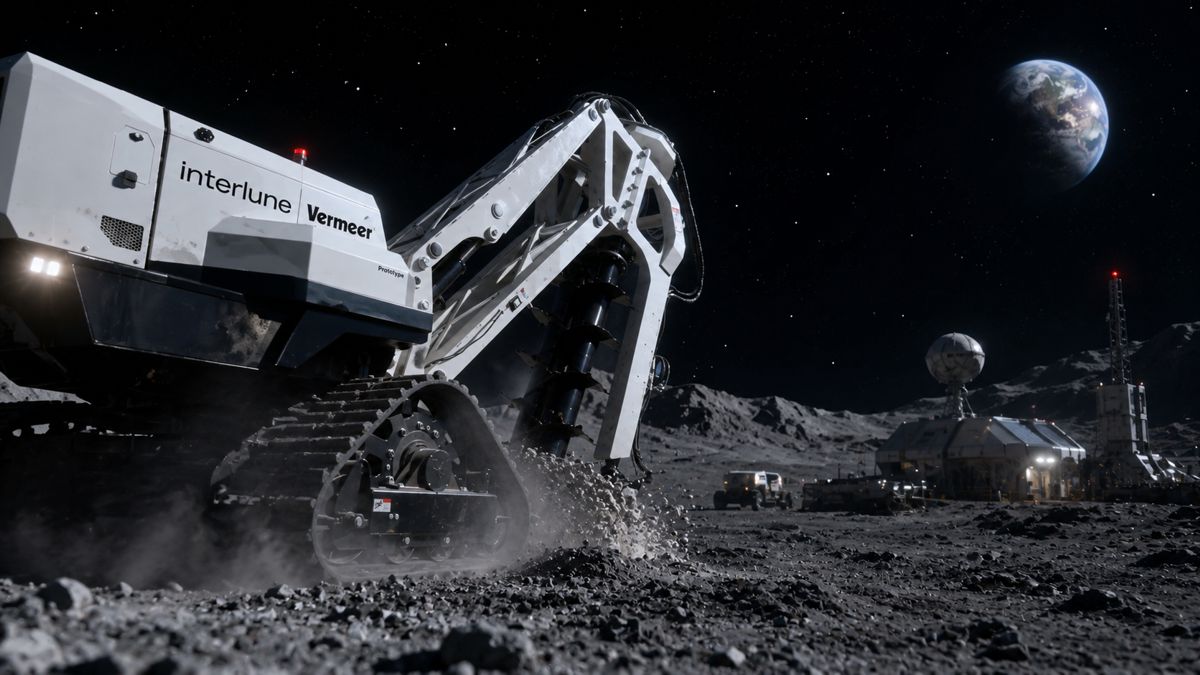
The original Interlune and Vermeer prototype was a continuous trencher-type excavator engineered to ingest roughly 100 tonnes of lunar regolith an hour, separating helium-3 through a cryogenic process and depositing spent soil behind the machine as it advances. That in itself was an engineering statement, but a single prototype proves feasibility rather than manufacturability.
The expanded agreement is aimed at the harder commercial problem, namely building systems that can be reproduced, maintained and relied upon across repeated missions. Interlune co-founder and chief executive Rob Meyerson framed the shift plainly, saying: “Reliable, autonomous mobility and heavy-duty excavation are the backbones of any permanent settlement on the Moon. By working with Vermeer, we are moving from developing prototypes to repeatable, scalable systems that will help build the Moon Base and enable the harvesting of lunar resources to power the future.”
Vermeer’s contribution is the part of this story that should interest anyone who buys, specifies or finances industrial machinery. The company brings the accumulated knowledge of how heavy digging equipment actually behaves and fails on real jobsites, where bearings seize, hydraulic seals degrade and cutting teeth wear at uneven rates depending on ground conditions.
That knowledge is far harder to acquire than a novel mechanism, and it is exactly what turns a working prototype into a dependable asset. Vermeer president and chief executive Jason Andringa, who also sits on the Interlune Advisory Board, set the ambition in similar terms: “For nearly 80 years, Vermeer has built a legacy by solving complex civil engineering challenges on Earth, and we are now ready to apply that expertise to the most demanding job site in history: the Moon. We are fully committed to working with Interlune, NASA, and others to deliver the essential infrastructure required for the Moon Base.”
NASA’s Funded Moon Base Programme Supplies the Demand
None of this would carry commercial weight without a customer, and the customer has recently become far more concrete. NASA has restructured its lunar effort into a phased Moon Base programme with named contractors, target launch windows and a multi-billion-dollar budget, moving the agency’s plans from aspiration towards manifest.
The programme’s second phase, running from the end of the decade, is where surface construction enters the picture in earnest, envisaging landing and habitation site-preparation rover demonstrations, power-cable deployment rovers, initial logistics transfer rovers and regolith-manipulation capabilities. NASA has also signalled that in-situ resource utilisation will scale during this phase, with regolith processed into building materials for on-site construction rather than shipped from Earth at ruinous cost.
That programme architecture is what converts a resource-extraction venture into a potential infrastructure supplier. When an agency writes site preparation, surface stabilisation and regolith handling into its forward plan, it creates addressable demand for machines that dig, grade, compact and haul, which is the core competence of the terrestrial earthmoving industry.
NASA underlined the direction of travel in May 2026 by awarding Interlune a firm-fixed-price contract worth $6.9 million over eighteen months, a Small Business Innovation Research Phase III project under the agency’s Space Technology Mission Directorate to develop a payload suite that measures and extracts helium-3 and hydrogen from regolith. The payload is designed to fly on a commercial robotic lander in 2028, the same horizon as the Vermeer site-preparation tool, and NASA has stated that the resulting work could inform the construction of the Artemis Moon Base itself.
Why Earthmoving Expertise Travels So Well
The strategic logic behind the partnership rests on a transfer that is easy to underestimate. Lunar operations demand autonomy, extreme reliability and tolerance of an abrasive, low-gravity, vacuum environment with fourteen-day cycles of light and dark. Those are unfamiliar conditions, yet the underlying engineering problems, keeping a machine cutting accurately, managing wear, sustaining uptime without a technician on hand, are the problems the heavy-equipment sector has spent decades solving in mines, quarries and pipeline corridors.
A vacuum jobsite raises the stakes on durability and remote operation, but it does not invent a new discipline so much as intensify an existing one. That is why a trenching and industrial-equipment specialist can credibly position itself alongside a space-systems firm.
Autonomy is where the transfer is clearest and where commercial value concentrates. Remote and autonomous operation is not a lunar novelty; it is a mature terrestrial capability that the earthmoving majors have been refining in production for years, and the Moon simply removes the option of a human in the cab. The reliability standards required off-world also feed back to Earth, since machinery engineered to run unattended through a lunar night, with minimal maintenance access, embodies design margins that raise the bar for terrestrial autonomous equipment.
For infrastructure owners and equipment buyers, the more important signal is directional. The competencies being validated on the Moon, autonomy, predictive maintenance, sealed drivetrains and wear-tolerant cutting systems, are the same competencies that increasingly determine total cost of ownership on a conventional site.
The Widening Heavy-Equipment Contest Above the Atmosphere
Vermeer is not moving into an empty field, and the presence of established competitors is the strongest evidence that this is a genuine market rather than a public-relations exercise. Caterpillar has been working with NASA on lunar excavation and construction concepts since the mid-2000s, drawing on an autonomy heritage that stretches back to autonomous mining trucks in the 1980s and today runs the world’s largest fleet of autonomous haul trucks.
NASA has leaned on Caterpillar’s proprietary simulation technology to help develop its own robotic In-Situ Pilot Excavator, a machine intended to build essential lunar infrastructure. That an agency is borrowing an equipment manufacturer’s digital tooling to design its own hardware says a great deal about where the relevant expertise resides.
Komatsu has taken a parallel route from the other side of the Pacific, selected in 2021 to join a Japanese government programme promoting autonomous construction technologies for space, and subsequently bringing in lunar exploration firm iSpace to advise its development of a lunar excavator built around high-precision digital-twin simulation.
Beyond the majors, Astroport Space Technologies and Venturi Astrolab have demonstrated a rover-mounted excavator attachment on Earth, using a quick-attach system that lets a single carrier vehicle swap implements much as a terrestrial skid-steer does. Taken together, these efforts describe a competitive landscape in which the recognisable names of terrestrial earthmoving, and a cohort of specialist newcomers, are jockeying to define the equipment standards for surface construction beyond Earth. The prize is not a single contract but a position in a category that does not yet have incumbents.
Helium-3 and the Business Model That Funds the Machines
The financial engine beneath Interlune’s infrastructure ambitions is resource extraction, and specifically helium-3, a rare isotope deposited in lunar soil by billions of years of solar wind and valued for potential applications in nuclear fusion, quantum computing and medical imaging. This is the element that gives the venture a revenue story independent of construction contracts, and it is unusually well developed for an early-stage space company.
Interlune reports nearly $500 million in binding purchase agreements for helium-3, including from a United States government customer, alongside the $6.9 million NASA resource-development contract and earlier research awards from NASA and the National Science Foundation. The company has framed its logic explicitly, intending revenue from selling helium-3 on Earth to fund the further development of harvesting technologies and of critical lunar infrastructure, including construction and site preparation.
That self-funding structure is what makes the infrastructure play credible rather than aspirational. A pure construction-services venture on the Moon would depend entirely on agency budgets and mission cadence, both of which carry political and schedule risk. By anchoring the business in a saleable commodity with existing demand on Earth, Interlune gives itself a reason to build, operate and iterate heavy machinery on the lunar surface regardless of how quickly habitat construction proceeds.
The excavator that harvests helium-3 is, in engineering terms, close kin to the machine that prepares a landing pad or stabilises a foundation, so investment in one advances the other. For Vermeer, that dual-use quality lowers the risk of committing manufacturing expertise to a market whose timelines remain uncertain.
What This Means for the Construction Supply Chain on Earth
The near-term commercial reality should be stated with proportion. There is no lunar construction market generating revenue today, delivery targets sit at the end of the decade, and every projected timeline depends on launch cadence, agency funding and hardware that has yet to operate in its intended environment.
What has changed is not the arrival of off-world revenue but the hardening of a credible pathway towards it, backed by a funded government programme, binding commercial agreements and the participation of manufacturers with real production capability. For an industry that has watched space ambitions come and go, the combination of named contracts, named contractors and dual-use economics is a meaningfully firmer footing than previous cycles offered.
The strategic implication for construction and infrastructure leaders is to treat lunar equipment development as a live extension of the autonomous and reliability engineering already reshaping terrestrial sites, rather than as a separate space story. The disciplines being pressure-tested for the Moon, unattended operation, predictive maintenance, sealed and wear-tolerant systems, and machines that swap implements without a crew, are the same capabilities that will differentiate equipment on Earth over the coming decade.
Suppliers, financiers and infrastructure owners who understand that overlap will be better placed to read where value is migrating, both above the atmosphere and on the jobsites that pay the bills today. The Moon, in that sense, is becoming a proving ground for the industrial competencies that terrestrial construction is already learning to prize.
Key Industry Questions
- Why does a lunar excavation partnership matter to the terrestrial construction industry? Because it signals where a new category of high-value demand is forming and which competencies will capture it. NASA’s funded Moon Base programme has written site preparation, regolith handling and logistics into its plans, creating addressable demand for machines that dig, grade and haul. The disciplines that win off-world contracts, autonomy, reliability engineering, wear management and unattended operation, are the same ones increasingly determining total cost of ownership on Earth. Established earthmoving manufacturers are positioning early. For construction leaders, the partnership is a leading indicator of where industrial value is migrating rather than a distant space curiosity, and it validates continued investment in autonomous and predictive-maintenance capability across conventional fleets.
- What exactly will Interlune and Vermeer deliver by 2028? The two companies plan to develop, test and deliver a mission-ready lunar site-preparation tool by 2028, integrated with a lunar rover. The tool is intended to prepare and stabilise the lunar surface for sustained operations, and it will be demonstrated first on Earth and then on the Moon to validate performance. This builds on the full-scale excavator prototype unveiled in May 2025, a continuous trencher designed to process around 100 tonnes of regolith an hour. The 2028 target aligns with NASA’s Moon Base programme and with Interlune’s separate NASA-funded resource payload, which is also slated for a 2028 launch on a commercial robotic lander.
- How does NASA’s Moon Base programme create commercial demand for construction equipment? NASA has consolidated its lunar effort into a phased, funded programme with named contractors and target launch windows. Its second phase envisages landing and habitation site-preparation rover demonstrations, power-cable deployment rovers, initial logistics transfer rovers and regolith-manipulation capabilities, and it anticipates processing lunar soil into building materials on site. Writing these tasks into a forward plan converts surface construction from concept into procurement, generating demand for machines that excavate, grade, compact and transport material. That demand rewards manufacturers with proven autonomy and durability engineering. The programme therefore functions as an anchor customer, giving commercial ventures a credible reason to build and iterate heavy machinery for the lunar surface.
- Which heavy-equipment manufacturers are competing in lunar construction? Vermeer, through its partnership with Interlune, is one of several established names active in the field. Caterpillar has collaborated with NASA on lunar excavation concepts since the mid-2000s and its simulation technology underpins NASA’s own robotic In-Situ Pilot Excavator. Komatsu was selected in 2021 for a Japanese government autonomous-construction programme and later partnered with lunar firm iSpace on a digital-twin-based excavator. Newer specialists such as Astroport Space Technologies and Venturi Astrolab have demonstrated rover-mounted excavator attachments. The presence of the earthmoving majors alongside focused newcomers indicates a genuine competitive market forming around off-world surface construction rather than a single isolated venture.
- What is helium-3 and why does it underpin Interlune’s business model? Helium-3 is a rare isotope deposited in lunar regolith by solar wind over billions of years, valued for potential use in nuclear fusion, quantum computing and medical imaging. It gives Interlune a revenue stream independent of construction contracts, which is unusual for an early-stage space company. Interlune reports nearly $500 million in binding purchase agreements for helium-3, including from a United States government customer, alongside a $6.9 million NASA resource-development contract. The company intends to use Earth-based helium-3 sales to fund further harvesting technology and lunar infrastructure. Because the harvesting excavator is engineering kin to a site-preparation machine, resource revenue and construction capability advance together.
- What engineering challenges make lunar equipment different from terrestrial machines? Lunar machinery must operate autonomously in a vacuum, under low gravity, across abrasive regolith and through fourteen-day cycles of extreme light and dark, all without on-site maintenance. These conditions raise the demands on durability, thermal management, dust tolerance and remote operation to levels beyond typical terrestrial requirements. The underlying disciplines, however, are familiar to the heavy-equipment sector: managing wear, sustaining uptime, cutting accurately and running unattended. That is why manufacturers with deep experience in mining and industrial earthmoving are credible partners. The Moon intensifies existing engineering problems rather than inventing entirely new ones, which is precisely what allows terrestrial expertise to transfer.
- Could lunar equipment development benefit construction on Earth? Yes, and the feedback is likely to be significant. Machinery engineered to run unattended through a lunar night, with minimal maintenance access, embodies reliability margins and autonomy standards that exceed most terrestrial requirements. Advances in predictive maintenance, sealed and wear-tolerant drivetrains, dust management and fully autonomous operation developed for the Moon can migrate back to conventional jobsites, where the same capabilities increasingly govern total cost of ownership. Simulation and digital-twin tooling refined for lunar conditions also sharpens terrestrial product development. The relationship is bidirectional, since the earthmoving majors are applying decades of terrestrial autonomy to space while lunar demands push their engineering standards higher.
- What are the main risks to the lunar construction supply chain thesis? The principal risks are timing, funding and unproven hardware. No lunar construction market generates revenue today, delivery targets sit at the end of the decade, and every projection depends on launch cadence, sustained agency budgets and equipment that has yet to operate in its intended environment. Government programmes carry political and schedule risk, and commercial helium-3 demand, while contracted, remains partly tied to technologies such as fusion that are still maturing. Interlune’s dual revenue and infrastructure model mitigates some of this exposure, but investors and suppliers should treat the sector as an early-stage opportunity with a credible pathway rather than a near-term market with assured returns.
Strategic Takeaways
- The Interlune and Vermeer expansion marks the point at which off-world construction shifts from prototype demonstration towards production intent, giving the earthmoving sector an early read on where a genuinely new category of demand is forming.
- NASA’s funded Moon Base programme, with site preparation, regolith handling and logistics written into its second phase, acts as an anchor customer that converts lunar surface construction from concept into procurement.
- Value in lunar equipment concentrates around competencies the heavy-equipment majors already own, namely autonomy, reliability engineering and wear management, which is why Caterpillar, Komatsu and Vermeer are all positioning rather than deferring.
- Interlune’s helium-3 revenue model, backed by nearly $500 million in binding agreements and a $6.9 million NASA contract, de-risks its infrastructure ambitions by funding heavy-machinery development from a saleable commodity rather than construction contracts alone.
- Infrastructure owners and equipment buyers should treat lunar development as a live extension of terrestrial autonomous and predictive-maintenance engineering, since the standards being validated off-world will increasingly differentiate machinery and total cost of ownership on Earth.