The Bataan Cavite Interlink Bridge Could Rewire Luzon
For years, getting from the industrial belt of Bataan to the factory towns of Cavite has meant a long, grinding detour through the most congested stretch of road in the Philippines. The two provinces sit almost within sight of each other across Manila Bay, yet a journey between them can swallow the better part of a working day once Metro Manila’s traffic gets involved.
That awkward geography is exactly what the Bataan Cavite Interlink Bridge is built to fix, and it’s why the scheme has become one of the most closely watched infrastructure bets in Southeast Asia.
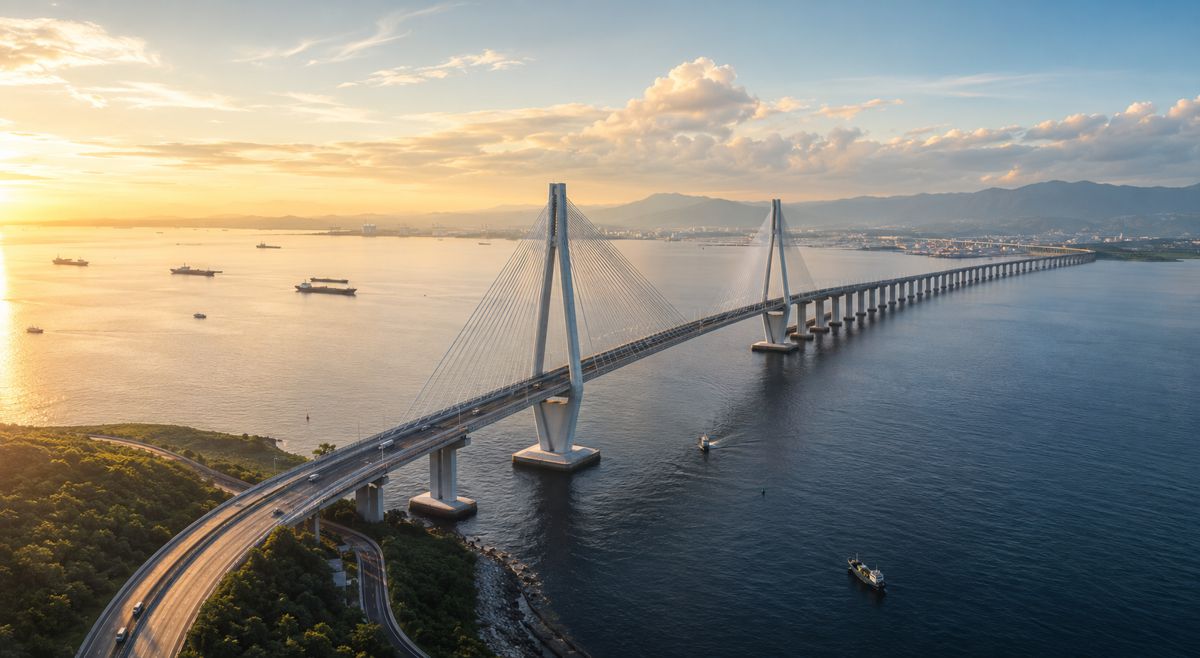
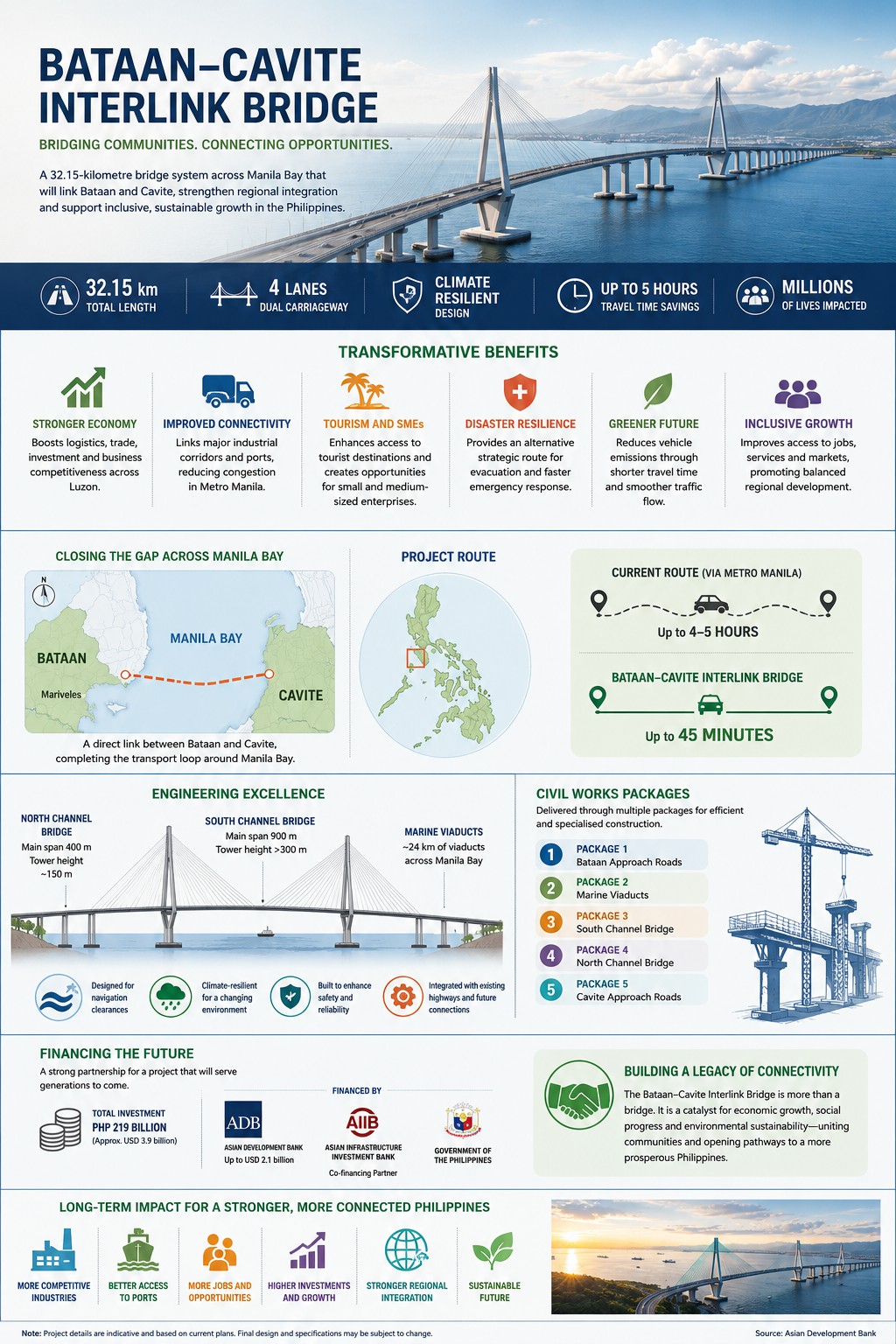
Stretching 32.15 kilometres across the mouth of Manila Bay, the crossing is one of the largest marine bridge projects ever attempted in the region, and it would rank among the longest sea-spanning bridges anywhere once it opens. It sits at the top of the Marcos administration’s Build Better More programme, and it carries the kind of price tag, close to US$3.9 billion, that tends to concentrate minds in finance ministries and boardrooms alike. As of mid-2026 the project is still in early implementation rather than full construction, with land-based packages moving first while bidding for the major marine works draws to a close.
What makes it worth watching isn’t only the engineering, though there’s plenty of that to admire. The bridge would finally close the road loop around Manila Bay, stitching together regions that already generate the lion’s share of national output. For contractors, lenders and policymakers, that mix of scale, multilateral money and real economic stakes is hard to look past.
Briefing
- The 32.15 km Bataan Cavite Interlink Bridge will give Mariveles in Bataan a direct fixed link to Naic in Cavite, removing the long detour through Metro Manila
- Total cost sits near US$3.9 billion, funded by the Asian Development Bank, the Asian Infrastructure Investment Bank and the Philippine government under a multi-tranche structure
- The design pairs roughly 24 km of marine viaducts with two cable-stayed navigation bridges of 900 and 400 metres
- Travel time between the two provinces is expected to fall from around five hours to under an hour, trimming an estimated 79,000 tonnes of CO2 a year
- The three regions it serves account for close to 60% of Philippine GDP, making it as much an economic project as a transport one
Closing A Gap That Has Held Luzon Back
Infrastructure tends to reveal its worth most plainly when it’s missing, and the Bataan to Cavite link is a textbook case. Despite facing each other across the bay, the two provinces remain poorly joined on the ground, with existing trips forced through the capital’s clogged arteries and stretching to roughly five hours in bad conditions. Manufacturers absorb longer delivery windows, hauliers swallow higher fuel and labour bills, and workers lose hours they’ll never get back. The provinces sit close on a map but feel commercially distant.
The bridge tackles that head on by carving a direct route between Central Luzon and the CALABARZON growth belt, letting freight and commuters skip Metro Manila altogether. It’s the piece that finally closes the transport loop around Manila Bay, and the economic logic behind it is unusually strong. The National Capital Region, Central Luzon and CALABARZON together account for close to 60% of the country’s gross domestic product, so a single crossing that better connects all three isn’t a minor convenience.
The Department of Public Works and Highways has pointed to an economic rate of return north of 25%, a figure that helps explain why the project has held its place near the front of the national pipeline through several budget cycles.
Following The Money Behind The Bridge
Projects on this scale live or die on their financing, and the Bataan Cavite Interlink Bridge has been built around a layered multilateral structure rather than a single cheque. The ADB came in as lead cofinancier, approving up to US$2.1 billion through a multi-tranche facility, with the first tranche set at US$650 million and the opening loan agreement signed back in December 2023.
The Beijing-based AIIB sits alongside it with up to US$1.14 billion, part of which the ADB administers, while the Philippine government covers the balance of roughly US$664 million. That spread of risk across two development banks and the national treasury is what gives a fifteen-year build the financial staying power it needs.
The procurement picture has sharpened over the past year, and it’s drawn serious international interest. The works have been split into multiple packages across approach roads, viaducts and the specialist navigation bridges, with the land-based sections leading the way to reduce execution risk. Late in 2025 the DPWH bids and awards committee recommended the roughly PHP 3.07 billion Package 2 contract to a consortium led by China Wu Yi, working with Jinan Urban Construction Group and local firm CM Pancho Construction, after it scored highest on combined technical and price terms.
Several of the early packages have attracted bids from foreign contractors, mostly Chinese, which says a good deal about how the global construction market views a marquee marine project in a fast-growing economy.
Engineering At A Scale The Region Rarely Attempts
Mega projects grab headlines through sheer size, but their long-term value rests on decisions made long before the first pile goes in. The crossing rolls several structural typologies into one alignment: around 24 kilometres of marine viaducts marching across the bay, two cable-stayed navigation bridges, and eight kilometres of approach roads tying into the existing network.
On the Bataan side a trumpet interchange links the bridge to the Roman Highway near Mariveles, while a U-turn facility near Corregidor Island leaves the door open for a future connection to the historic outcrop. The design work has been led by engineering firm TYLin, part of the Sidara group, drawing on staff across its global offices.
The two main spans show the ambition involved. The South Channel Bridge carries a 900-metre main span with a generous 72-metre navigational clearance to keep Manila Bay’s deeper shipping lanes open, while the North Channel Bridge runs a 400-metre span over its own channel. The marine structures stand in water reaching some 50 metres deep, which is part of why the team has leaned on heavy-lift cranes and longer viaduct spans to cut the number of foundations sunk into the seabed.
One note of caution on the figures doing the rounds: some early summaries describe towers topping 300 metres, but verified project documents put the North Channel towers at around 142 metres, with the 300-metre figure referring to the width of the shipping lane rather than tower height. It’s a small distinction that matters for anyone modelling the build.
Ports, Freight And Industrial Muscle
Road schemes rarely stand alone, and this one’s commercial weight comes largely from its relationship with the ports and factories clustered around the bay. Bataan keeps developing as an industrial and logistics base, anchored by energy assets, manufacturing and the freeport zone around Mariveles, while Cavite’s growth corridor pulls in export-oriented production.
A fixed link gives both provinces a credible path to position their seaports as serious international gateways rather than secondary players in Metro Manila’s shadow. ADB vice-president Scott Morris framed the upside plainly when the financing was approved, saying the project would transform the economic landscape of central Luzon, unlock the full potential of Bataan and Cavite for trade, manufacturing, and industrial output, and boost their tourism.
For logistics operators, route flexibility carries hard cash value. Networks with no alternative are brittle, and a second strategic corridor around the bay lets hauliers cut their dependence on the capital’s chokepoints while opening cleaner north to south distribution patterns. Construction materials, agricultural produce, imported cargo and finished goods all stand to move with less friction. That thinking sits comfortably with a wider regional shift, as Asian economies increasingly build in transport redundancy instead of betting everything on a single urban bottleneck.
Building For A Rougher Climate
Infrastructure delivered today faces a different operating environment than projects signed off two decades ago, and the bridge has been framed as climate-resilient from the outset. In a country that sits squarely in the typhoon belt, that’s not a marketing flourish but a design constraint. Sea level rise, stronger storms and coastal exposure all feed into how the structure has been engineered to keep working when conditions turn nasty, and official planning leans on it as an alternative corridor for emergency response and evacuation if existing roads are cut.
There’s a carbon dividend bundled in too. By stripping out the long detours and the idling that comes with congestion, the crossing is expected to lower national greenhouse gas emissions by roughly 79,000 tonnes of CO2 equivalent a year. Shorter distances and smoother freight flows do the heavy lifting there, the unglamorous arithmetic of fewer vehicle kilometres and less stop-start traffic. For a transport project, cutting emissions while adding capacity is a rare and welcome pairing.
The Tourism And Enterprise Dividend
The benefits that don’t show up in a bridge rendering are often the ones that decide whether a project earns its keep. A tourist centre and supporting facilities are planned for the Bataan approach, pitched at visitors to the peninsula and the wartime landmark of Corregidor, and the easier access could broaden the appeal of destinations that have long been a slog to reach. Tourism boards on both shores have plenty to gain from a crossing that turns a half-day trek into a short drive.
Small and medium enterprises may ultimately feel the strongest pull. Lower transport costs widen the catchment for goods, deepen the available labour pool and hand businesses more predictable delivery schedules. Firms that were effectively walled off from customers by hours of congestion suddenly find them within reach. Those gains are diffuse and hard to photograph, but they tend to compound quietly over the life of an asset like this.
A New Map For Luzon
Every generation builds a handful of projects that quietly reset how an economy moves, and the Bataan Cavite Interlink Bridge looks set to be one of them. Its real value lies less in span length or headline cost than in connectivity, redundancy and the chance to spread economic activity more evenly across one of the region’s busiest corners. Morris caught that ambition when he described the finished bridge as a platform for reimagining a more vibrant, resilient, and dynamic greater Manila Bay area.
A dose of realism is still in order. Timelines have slipped before, with construction once pencilled for 2024 and completion targets drifting between 2027 and the early 2030s depending on who’s counting, so delivery risk is genuine on a build of this complexity. If it lands close to plan, though, the crossing won’t just shave hours off a miserable journey. It could redraw the working geography of Luzon itself.