BuiltWorlds Global Innovators Highlight Companies Shaping the Future
The construction and infrastructure sector has never faced greater pressure to evolve. Governments are investing heavily in transport, energy and urban development. Contractors are grappling with labour shortages, sustainability targets and rising project complexity. At the same time, artificial intelligence, automation, digital twins, robotics and advanced materials are moving from pilot projects into mainstream deployment.
For many organisations innovation has become a prerequisite for long-term survival. Digital transformation is now influencing every stage of the asset lifecycle, from concept design and procurement through construction, operations and maintenance. The companies able to integrate technology effectively are increasingly setting the pace for the rest of the industry.
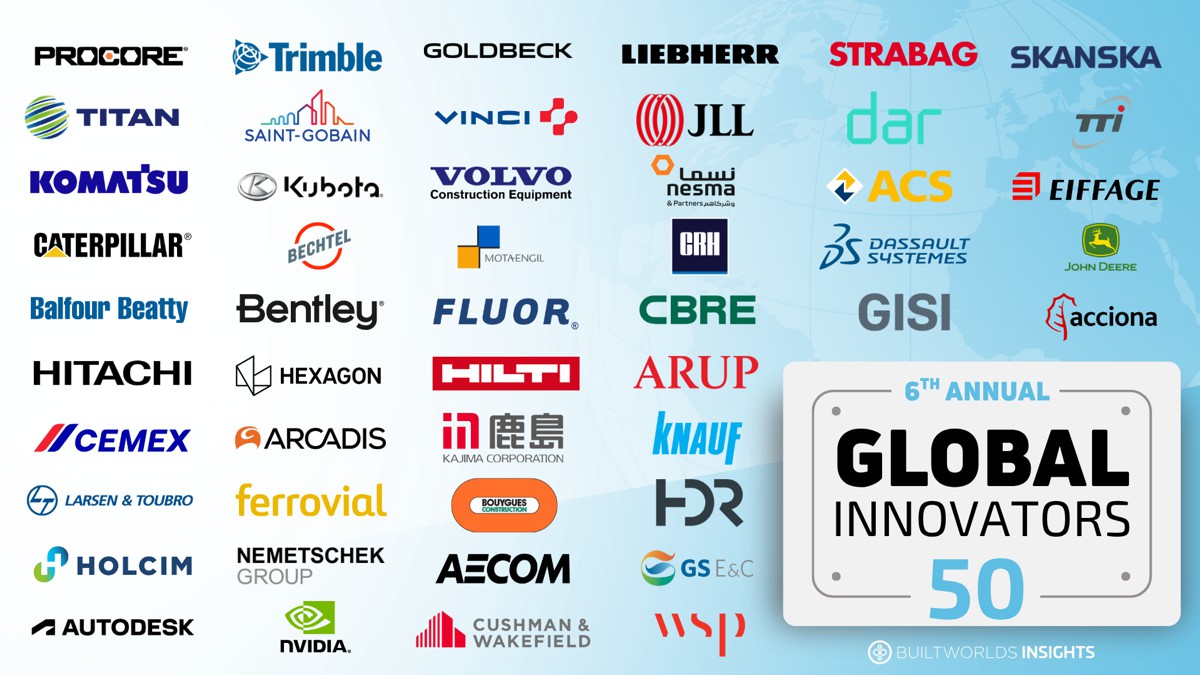
BuiltWorlds’ sixth annual Global Innovators Top 50 awards provide a snapshot of which organisations are currently leading that transformation. The programme recognises major global players that are not only investing in innovation internally, but also influencing broader industry adoption through acquisitions, venture initiatives, digital programmes and technology deployment across large-scale projects.
Briefing
- BuiltWorlds has announced its sixth annual Global Innovators Top 50 awards recognising leaders in built environment innovation.
- Honoured organisations collectively generate more than $1.1 trillion in annual revenue and employ over 2.4 million people globally.
- Artificial intelligence, automation, digital twins, sustainability technologies and strategic acquisitions are recurring themes across the list.
- Construction, engineering, materials, infrastructure, equipment, real estate and software sectors are all represented.
- The awards highlight how digital transformation is increasingly shaping investment decisions, project delivery methods and long-term infrastructure performance.
Innovation Becomes a Core Business Strategy
The built environment has historically been criticised for its slow adoption of new technologies. Productivity growth has often lagged behind sectors such as manufacturing and logistics, while fragmented supply chains and project-based delivery models have complicated innovation efforts.
That picture is beginning to change. Research from organisations including the World Economic Forum and McKinsey & Company has repeatedly highlighted how digital technologies can significantly improve productivity, project certainty and sustainability outcomes. Digital twins, AI-assisted design, automated equipment and connected asset management systems are increasingly becoming part of standard industry practice rather than experimental initiatives.
BuiltWorlds’ selection criteria reflect this shift. To qualify, organisations must operate internationally, generate more than $500 million in annual revenue, employ over 1,000 people and demonstrate meaningful innovation initiatives ranging from venture investment programmes and accelerator schemes to internal incubators and strategic technology acquisitions.
As Audrey Lynch, Director of Research at BuiltWorlds, explained: “This year’s honorees are an exceptional group of companies, representing the very best of our industry’s efforts to improve the way we build and operate structures and infrastructure. Look at Skanska’s reduction in scope 1 and 2 emissions, the number of digitalization and sustainability projects Strabag is leading, or Kajima’s deployment of its A4CSEL automated construction system at the Naruse Dam project in Japan’s Akita Prefecture. These are the organizations helping define what it is to be innovative in 2026.”
Engineering Giants Expand Through Technology and Scale
Several of the world’s largest engineering consultancies feature prominently among the recognised innovators, illustrating how digital capabilities are increasingly becoming central to engineering competitiveness.
AECOM continues expanding AI integration across design and project delivery workflows while maintaining leadership positions in transportation, water and building sectors. Meanwhile, WSP reshaped the North American engineering landscape through major acquisitions including TRC Companies and Ricardo, significantly expanding expertise in energy transition, environmental services and power infrastructure.
Arup has pursued innovation through climate resilience software development and venture studio initiatives targeting data centre sustainability challenges. The company’s continued investment in digital twin applications reflects a broader trend across engineering consultancies seeking to connect physical infrastructure with real-time operational intelligence.
Across the sector, engineering firms are increasingly becoming technology integrators as much as traditional consultants. Their role now extends beyond design into software deployment, data analytics, predictive maintenance and asset optimisation.
Sustainability Moves from Ambition to Delivery
Environmental performance remains one of the strongest drivers of innovation throughout the industry.
Several recognised organisations demonstrated measurable progress rather than simply announcing sustainability targets. Skanska reported a 65 per cent reduction in Scope 1 and Scope 2 emissions compared with 2015 levels while maintaining strong commercial performance.
In the materials sector, manufacturers are pursuing significant investments aimed at reducing embodied carbon and supporting circular construction models. Holcim increased construction demolition recycling activity while expanding lower-carbon product portfolios. CRH strengthened its position in supplementary cementitious materials through major acquisitions designed to support lower-carbon concrete production.
Meanwhile, Knauf achieved an industry milestone by eliminating formaldehyde across its fiberglass insulation portfolio through alternative binder technologies. Such developments demonstrate how sustainability innovation increasingly extends beyond energy efficiency into materials science and manufacturing processes.
Artificial Intelligence Reshapes Construction Technology
Perhaps the most visible trend throughout the Global Innovators list is the growing influence of artificial intelligence.
Software providers are embedding AI capabilities into virtually every stage of project delivery. Bentley Systems expanded its infrastructure AI initiatives through new digital engineering tools and strategic acquisitions focused on aerial data capture and asset analytics.
Autodesk strengthened field data integration capabilities through acquisition activity, while Procore moved into agentic AI technologies designed to automate project workflows and decision support.
The emergence of AI-driven construction management platforms reflects wider industry demand for improved productivity and reduced project risk. Rather than replacing human expertise, most implementations focus on enhancing decision-making, identifying potential issues earlier and automating repetitive administrative processes.
At the infrastructure scale, AI is increasingly being linked with digital twins, enabling operators to simulate asset performance, optimise maintenance schedules and improve operational resilience.
Equipment Manufacturers Accelerate Automation
Automation has become a defining competitive battleground among equipment manufacturers.
Komatsu achieved a notable milestone by commissioning its 1,000th autonomous ultra-class haul truck, highlighting how mining automation continues moving toward mainstream adoption.
John Deere showcased an extensive portfolio of autonomous and electrified machines at CONEXPO, while Kubota commercialised autonomous agricultural equipment and introduced adaptable robotic platforms aimed at addressing labour shortages.
At the same time, electrification remains a major focus. Liebherr delivered its first battery-electric mobile crane for real-world testing, while numerous manufacturers continue investing in alternative powertrains and hybrid systems.
The convergence of automation, electrification and connectivity suggests future equipment fleets will increasingly function as intelligent, software-defined assets rather than standalone machines.
Data Centres Drive a New Infrastructure Boom
Another recurring theme throughout the awards is the extraordinary growth of data centre infrastructure.
Engineering firms, contractors, real estate advisers and technology providers are all positioning themselves around the demands created by artificial intelligence and cloud computing expansion.
ACS Group has outlined ambitious data centre investment plans, while Larsen & Toubro is developing large-scale AI-ready facilities in India.
Commercial real estate firms are also responding. JLL forecasts a multi-trillion-dollar global investment cycle in data centre development through the end of the decade. Cushman & Wakefield has introduced analytical tools specifically designed to assess how AI adoption influences property demand and infrastructure requirements.
The sector increasingly sits at the intersection of energy, digital infrastructure, construction and real estate. As AI workloads expand, demand for power generation, cooling systems and advanced facility design continues to accelerate.
Mergers and Acquisitions Become Innovation Accelerators
A striking feature of this year’s innovators is the scale of merger and acquisition activity. Across engineering, software, construction and materials sectors, organisations are using acquisitions to accelerate technological capabilities rather than relying solely on internal development.
Examples include WSP’s acquisition of TRC Companies, Nemetschek’s purchase of HCSS, Autodesk’s acquisition of Rhumbix, Procore’s acquisition of Datagrid and numerous strategic transactions completed by CRH, Saint-Gobain and Holcim.
This pattern suggests innovation is increasingly being pursued through ecosystem building. Companies are assembling portfolios of complementary technologies, specialised expertise and digital capabilities that would take years to develop organically.
As competition intensifies, strategic acquisitions appear likely to remain a defining characteristic of the industry’s evolution.
Defining the Next Chapter of the Built Environment
The Global Innovators Top 50 illustrates a construction and infrastructure sector that is changing more rapidly than at any point in recent memory.
Artificial intelligence is becoming embedded within project workflows. Autonomous equipment is moving from demonstration sites to commercial deployment. Sustainability initiatives are producing measurable operational results. Data centres are creating entirely new infrastructure demand patterns, while digital twins and advanced analytics are redefining how assets are designed and managed.
Collectively, the recognised organisations employ more than 2.4 million people and generate over $1.1 trillion in annual revenue. Their decisions influence projects, procurement strategies and technology adoption across virtually every region of the world.
For construction professionals, investors and policymakers, the message is straightforward. Innovation is no longer a specialist activity taking place on the margins of the industry. It has become a central driver of competitiveness, resilience and growth. The companies recognised by BuiltWorlds provide a useful indication of where the built environment is heading next and which technologies are likely to shape the infrastructure landscape for years to come.