Decoding Bitumen Specifications Around the World
Why 60/70 in One Country Isn’t Always the Same in Another
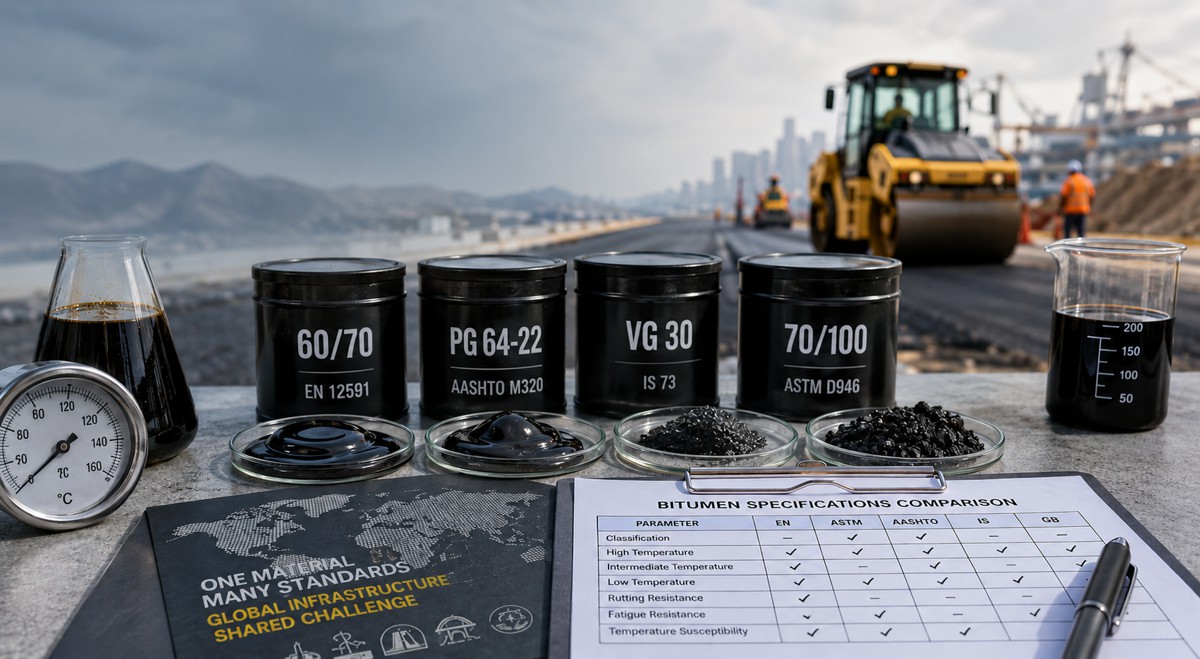
Bitumen specifications look deceptively simple until money is on the line. Globally, bitumen consumption was about 120 million tonnes in 2022, with most of it going into paving and roofing, and Europe alone accounting for roughly 17 per cent of that market, or about 20.5 million tonnes a year. In the asphalt mix itself, the binder is only a small share of total tonnage, yet US federal highway officials note that it is the more costly component than aggregate, which is why binder decisions carry outsized commercial weight in pavement contracts. Put bluntly, a short line in a specification can steer years of performance, maintenance cost, warranty exposure and political grief.
The policy angle is just as sharp. As the World Bank puts it: “Inadequate road infrastructure retards economic growth potential”, because poor roads drag on exports, jobs, business development, health and education access. That observation usually lands in discussions about whether roads should be paved at all, but it applies just as neatly to how roads are paved. If the binder is mis-specified, or badly translated from one grading system to another, the risk doesn’t sit in a laboratory notebook. It shows up later as rutting under heavy freight, brittleness in cooler seasons, mix-design rework, procurement claims and early intervention budgets.
Here is where the confusion starts. In Europe, a buyer looking for an EN-standard 60/70 paving bitumen will not find one in EN 12591. The standard lists grades such as 50/70 and 70/100, not 60/70, and it splits mandatory properties from further regional requirements such as penetration index, Fraass breaking point and viscosity. India, meanwhile, moved away from penetration grading and grades paving bitumen by viscosity under IS 73. The US and many agencies influenced by Superpave use performance grades tied to pavement temperatures, and AASHTO M 332 adds traffic loading through MSCR designations. So the familiar 60/70 label is often only the beginning of the story, not the answer.
That matters because bitumen behaviour is not only shaped by the grade name stamped on a delivery note. IndianOil states that stiffness depends on temperature, crude source and refining route, while Eurobitume notes that different refining and blending methods are used specifically to produce different characteristics. On paper, two binders may sit in adjacent or supposedly equivalent grade families. In service, they may behave rather differently once ageing, traffic speed, axle load, storage temperature, transport conditions and modifier content enter the frame. That is the real reason engineers, buyers and contractors keep tripping over specification differences from one market to the next.

Briefing
- A 60/70 label can sit inside very different specification envelopes, and Europe’s EN 12591 does not even include a standard 60/70 paving grade, instead listing 50/70 and 70/100 among its common paving grades.
- India’s IS 73 grades paving bitumen by viscosity at 60°C and links grade selection to seven-day average maximum air temperature, while IndianOil says VG-30 may be used in lieu of 60/70 penetration grade in practice.
- AASHTO M 320 grades binders by maximum and minimum pavement temperatures, and AASHTO M 332 goes further by incorporating MSCR-based traffic loading classes.
- Gulf and African procurement often mix systems, with examples ranging from Qatar’s PG-based layered approach to Kenyan tenders that require 60/70 but also invoke ORN 19 and Superpave guidance.
- Quality assurance is not a paperwork exercise. BIS prescribes lot sampling rules, while agencies such as FDOT require terminal-specific approval, laboratory evidence, QC plans and state verification testing before binders are accepted for projects.
The Standards Landscape
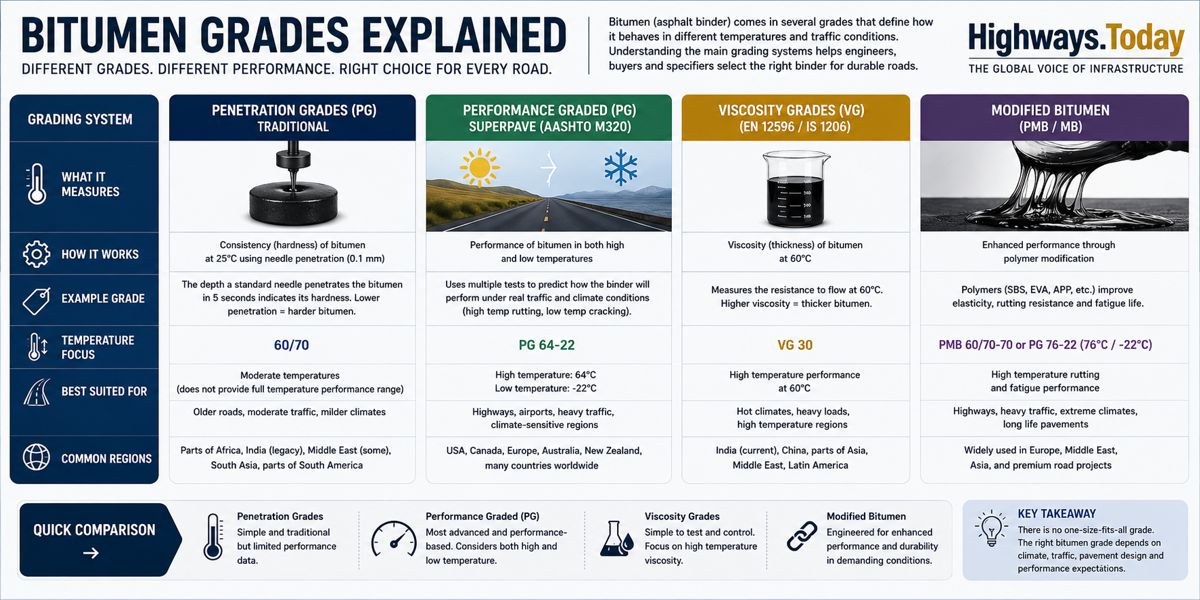
There are, broadly speaking, three big grading families in play. The first is penetration grading, where the headline number comes from how far a standard needle penetrates the binder at 25°C under standard load and time. ASTM D946 is the best-known US penetration standard and currently lists grades 40-50, 60-70, 85-100, 120-150 and 200-300. The second family is viscosity grading, represented in the US by ASTM D3381 and AASHTO M 226, and in India by IS 73, where absolute viscosity at 60°C takes centre stage. The third is performance grading under Superpave, where AASHTO M 320 links the binder to maximum seven-day pavement design temperature and minimum pavement temperature, while AASHTO M 332 adds MSCR-based traffic classes for standard, heavy, very heavy and extremely heavy loading.
Europe sits in a slightly different lane. Eurobitume explains that current European product standards still rely on empirical test methods in product specifications, while performance-related tests are used at national level and are expected to become more significant in future standards. EN 12591 governs paving grade bitumens, EN 13924 covers hard paving grades, and EN 14023 covers polymer modified bitumens. Crucially, EN 12591 separates universal requirements from regional ones. Table 1A contains properties that apply to all listed paving grades, while Table 1B contains properties tied to regional or regulatory needs, including penetration index, Fraass breaking point and viscosity, with “NR” permitted where no local requirement applies. Even inside one harmonised European family, then, the buyer still has to read the fine print.
That is a far cry from simply ordering “road bitumen”. It also explains why the terminology alone can mislead international teams. Eurobitume notes that “asphalt binder” and “asphalt cement” are terms commonly used in the US and some other countries for bitumen, and ASTM’s active standards list shows that penetration, viscosity, PG and MSCR-based specifications all remain live in parallel. A contract manager moving between Europe, the Gulf, India and East Africa is therefore not moving between dialects of the same standard. They are moving between different philosophies of material qualification.
| System Family | Core Basis | Typical Designation | Main Standards in Use | What the Label Really Signals |
|---|---|---|---|---|
| Penetration grading | Needle penetration at 25°C | 60/70, 40/50, 85/100 | ASTM D946; many project and regional specs | A consistency band, but not necessarily the same supporting limits on ageing, softening point or ductility |
| Viscosity grading | Rheology at 60°C and workability at 135°C | VG-30, AC-20 | ASTM D3381, AASHTO M 226, IS 73 | Better control of high-temperature consistency than penetration alone |
| Performance grading | Pavement temperature window | PG 64-22, PG 76-10 | AASHTO M 320 | Climate-based performance envelope linked to rutting, fatigue and thermal cracking tests |
| Performance grading with traffic loading | Pavement temperature plus MSCR traffic class | PG 76-10H, PG 76-10V | AASHTO M 332, ASTM D8239 | Climate and traffic severity, especially for rutting control and modified binders |
| European harmonised paving grades | Empirical product standard plus optional regional clauses | 50/70, 70/100 | EN 12591 | A harmonised family with mandatory and region-specific property layers |
| European special grades | Hard or polymer modified paving grades | 10/20, 25/55-55, 45/80-65 | EN 13924, EN 14023 | Specialised use cases where straight one-line comparisons become even weaker |
Table sources include ASTM product pages and active standard listings, AASHTO specification pages and previews, BIS IS 73, and Eurobitume’s technical and standards material.
FHWA’s own shorthand for PG captures the logic: “The aim of the Superpave PG system and asphalt binder specifications is to ensure acceptable performance”. That sentence sounds almost mundane, but it marks the dividing line between older consistency-led systems and the pavement-performance mindset that now shapes many high-traffic networks.
When Similar Grades Stop Matching
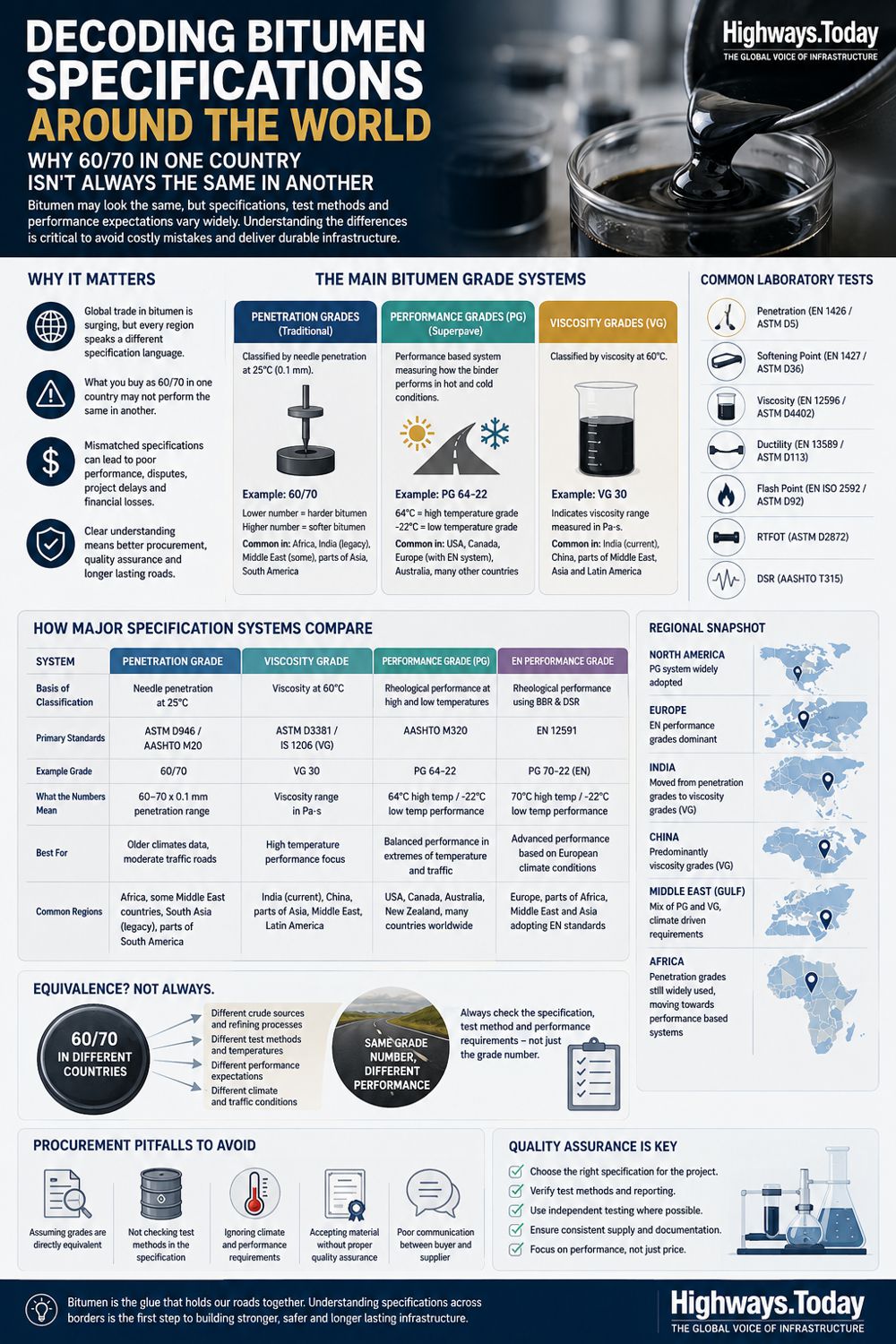
The headline example, and the one that keeps catching buyers out, is the supposedly universal 60/70 grade. Under ASTM D946, 60-70 is a recognised penetration grade. In EN 12591, it is not. The nearest common European grade in the usual paving range is 50/70, with a penetration band of 50 to 70 and a softening point of 46 to 54°C. A Kenyan tender using 60/70 under ORN 19 and ASTM tests, by contrast, summarises 60/70 with a softening point range of 46 to 56°C, flash point at least 232°C, solubility of at least 99 per cent and retained penetration after TFOT of at least 54 per cent. The numbers look close enough to tempt casual substitution. They are not identical, and the ageing and supplementary property framework differs again once Europe’s optional Table 1B requirements are added.
India is another good reminder that familiar shorthand can conceal a full change of logic. BIS states that India shifted from penetration to viscosity grading because variability at high temperatures could be better addressed through viscosity-graded specifications. IS 73:2013 links grade choice to seven-day average maximum air temperature, with VG10 for below 30°C and VG40 for above 45°C. For VG30, the standard specifies absolute viscosity of 2400 to 3600 poises at 60°C, minimum kinematic viscosity of 350 cSt at 135°C, minimum softening point of 47°C and minimum penetration of 45. IndianOil still tells customers that VG-30 can be used in lieu of old 60/70 penetration grade, which is commercially useful advice, but the standard itself is not a penetration standard any longer.
China adds another layer. The Ministry of Transport’s JTG framework governs highway design and construction, and JTG F40 remains the reference construction specification repeatedly cited in Chinese asphalt research and technical literature. Recent published studies show how slippery cross-system equivalence can be: one paper describes a 70# base asphalt satisfying JTG F40-2004 as a PG 64-22 material, while another reports a 70# virgin asphalt with the same broad 60 to 80 penetration band as meeting PG 70-16. In other words, the same nominal Chinese 70# family is not guaranteed to map to one single Superpave grade once full rheological characterisation is done. That is exactly the sort of trap that turns a tidy spreadsheet equivalence into a site problem.
The Gulf and wider Middle East make the point even more vividly. Research reviewed in an Oman performance-grade study reports 60/70 penetration grade being equivalent to PG 64-16 in Jordan, Iraq and Kuwait, while a Pakistan study found commonly used 60/70 corresponding to PG 58-22 and PG 64-22. The same review notes that bitumens produced in the Arab Gulf area could sustain a maximum pavement temperature of 64°C, while temperature zoning showed that more than half the area experienced maximum pavement temperatures of 76°C, leading to a recommendation for modification.
Qatar’s Ashghal then shows how agencies react in practice: its expressway guidance requires PG76-10 polymer modified binder in the top two asphalt layers and treats the remaining asphalt as PG58-16, explicitly noting that as conventional 60/70 penetration material. One label, several climates, and a very different engineering response depending on where the road sits.
| Market or System | Nominally Similar Binder | Key Requirement Snapshot | Practical Catch |
|---|---|---|---|
| EN 12591 Europe | 50/70 | Penetration 50-70; softening point 46-54; retained penetration after ageing at least 50 per cent | Optional regional clauses may add penetration index, Fraass breaking point and viscosity requirements |
| ASTM-style penetration procurement | 60/70 | 60-70 band under D946 family; project specs often add softening, flash, solubility and TFOT rules | The grade name does not describe the full project acceptance envelope |
| India IS 73 | VG-30 | Viscosity 2400-3600 poises at 60°C; minimum softening point 47°C; minimum penetration 45 | Often treated commercially as a 60/70 substitute, but the governing standard is viscosity-led |
| China JTG practice | 70# or A-70 | Typical technical requirements reported as penetration 60-80, softening point at least 46°C, ductility at 15°C at least 100 cm | Published studies have characterised 70# as PG 64-22 in one case and PG 70-16 in another |
| Qatar expressway practice | PG58-16 lower layers and PG76-10 PMB upper layers | PG approach tied to climate and traffic | “60/70” can survive only in lower layers while surface and intermediate courses move to PMB |
| East African hybrid tendering | 60/70 with ORN 19 and Superpave references | 60/70 may be required for binder, while mix design and guidance draw from tropical manuals and SHRP | Procurement language often mixes legacy and modern specification frameworks |
These comparisons draw on EN 12591, Indian BIS and IndianOil material, published Chinese and Middle Eastern research, Qatar’s Ashghal specification guidance, and Kenyan tender documents.
None of this is accidental. Bitumen properties depend on crude source, refining and blending methods as well as the standard itself. That is why a tidy headline grade should be treated as a signpost rather than a guarantee. Contractors who buy on the signpost alone often find out, rather late in the day, that the actual material envelope was sitting in the annexes all along.
The Tests Tenders and Traps
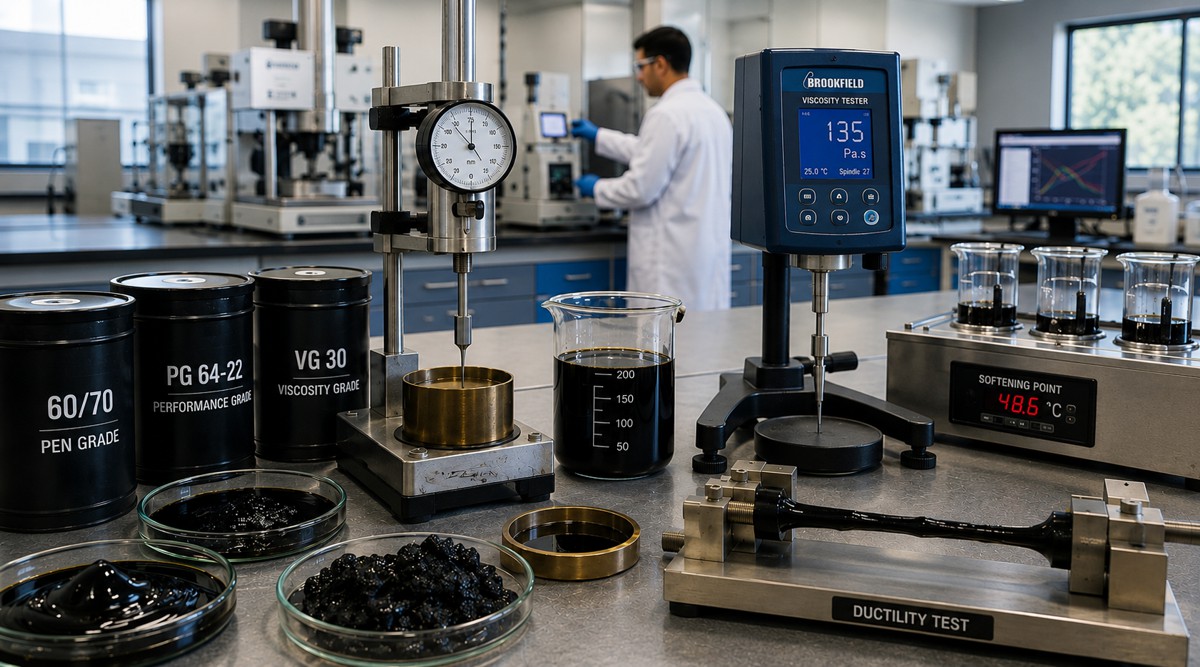
The technical mismatch begins in the laboratory. Europe’s standard toolkit still leans on empirical tests such as softening point, needle penetration, Fraass breaking point and elastic recovery. Eurobitume notes that the ring-and-ball softening point test has been used for more than a century, while the needle penetration test has been used for decades to characterise behaviour at intermediate temperatures. Those tests are not pointless. They are fast, familiar and embedded in procurement worldwide. They simply do not tell the whole story when traffic, modifiers, ageing and climate get more severe.
Superpave was built to address exactly that gap. FHWA explains that AASHTO M 320 uses DSR, BBR and direct tension procedures to control rutting, fatigue cracking and low-temperature thermal cracking through climate-linked grading, while the MSCR procedure was developed because the older G*/sinδ parameter did not accurately capture the rutting resistance of polymer modified binders at realistic strain levels. FHWA’s wording is refreshingly direct: “A single MSCR test can provide information on both performance and formulation of the asphalt binder.” That has big procurement consequences because it means the testing framework itself can distinguish between a nominally similar neat binder and a modified binder that will behave very differently under slow heavy traffic.
| Laboratory Test | Common Standard References | What It Indicates | Where Buyers Get Misled |
|---|---|---|---|
| Penetration | EN 1426, ASTM D5, IS 1203 | Consistency at 25°C | Same penetration band does not ensure same viscosity, ageing or polymer response |
| Softening point | EN 1427, ASTM D36, IS 1205 | Behaviour at elevated service temperatures | Often treated as a heat score, though it is only one part of a broader performance picture |
| Viscosity at 60°C and 135°C | EN 12596 and EN 12595; AASHTO T 316; IS 1206 | High-temperature consistency and mixing workability | Directly comparable only if the same test basis and thresholds are specified |
| TFOT or RTFOT | EN 12607-1; AASHTO T 240 | Short-term ageing during mixing and transport | Not all standards use the same ageing framework or acceptance limits |
| PAV | EN 14769; AASHTO R 28 | Long-term oxidative ageing | Essential in PG systems, absent from many traditional purchase descriptions |
| DSR | EN 14770; AASHTO T 315 | Viscoelastic response linked to rutting and fatigue indicators | A binder can pass empirical tests and still behave badly in rheological testing |
| BBR | EN 14771; AASHTO T 313 | Low-temperature creep stiffness and relaxation | Critical for cold-region or night-time thermal performance |
| MSCR | EN 16659; AASHTO T 350 | Permanent deformation susceptibility and elastic recovery under stress | Particularly valuable for modified binders and heavy traffic exposure |
Table sources are Eurobitume technical guidance, FHWA training and technical briefs, and AASHTO specification materials.
The procurement trap is that many contracts still splice old and new systems together. Kenya provides a textbook example. A current KeNHA technical specification calls for 60/70 penetration grade bitumen for asphalt concrete, says it must meet ORN 19 requirements, and at the same time refers to SHRP Superpave recommendations and requires the contractor to provide the Engineer with both ORN 19 and the Asphalt Superpave Manual.
Qatar does something different but equally telling, using explicit PG requirements in high-demand expressway layers while retaining a conventional lower-base binder logic. South Africa’s road specifications recognise penetration grade, performance grade and various modified binder classes side by side, and SABITA notes that South Africa is transitioning from penetration grading toward the SATS 3208 PG framework.
Uganda’s older road specifications allowed 60/70, 40/50 or performance grade asphalt depending on the special specification, while its 2026 general specifications now explicitly provide for PG bitumen in the binder menu. There is no single African procurement standard here, only a patchwork of road authority choices.
Here’s the rub. FHWA warns that QA risks rise when design mixes change at plant scale, when different tests are used in construction than in design, and when reclaimed materials enter the system. SABITA adds that quality assurance for imported bitumen is far more challenging, and potentially costly, than for local production.
The Oman review on PG implementation in the Middle East points to another obstacle: many countries have been slow to adopt PG not because climate does not matter, but because of limited testing devices and limited understanding of the system’s benefits. In other words, some markets keep writing empirical grades because that is what their laboratories, supply chains and institutions are currently built to handle.
Specification as Infrastructure Strategy
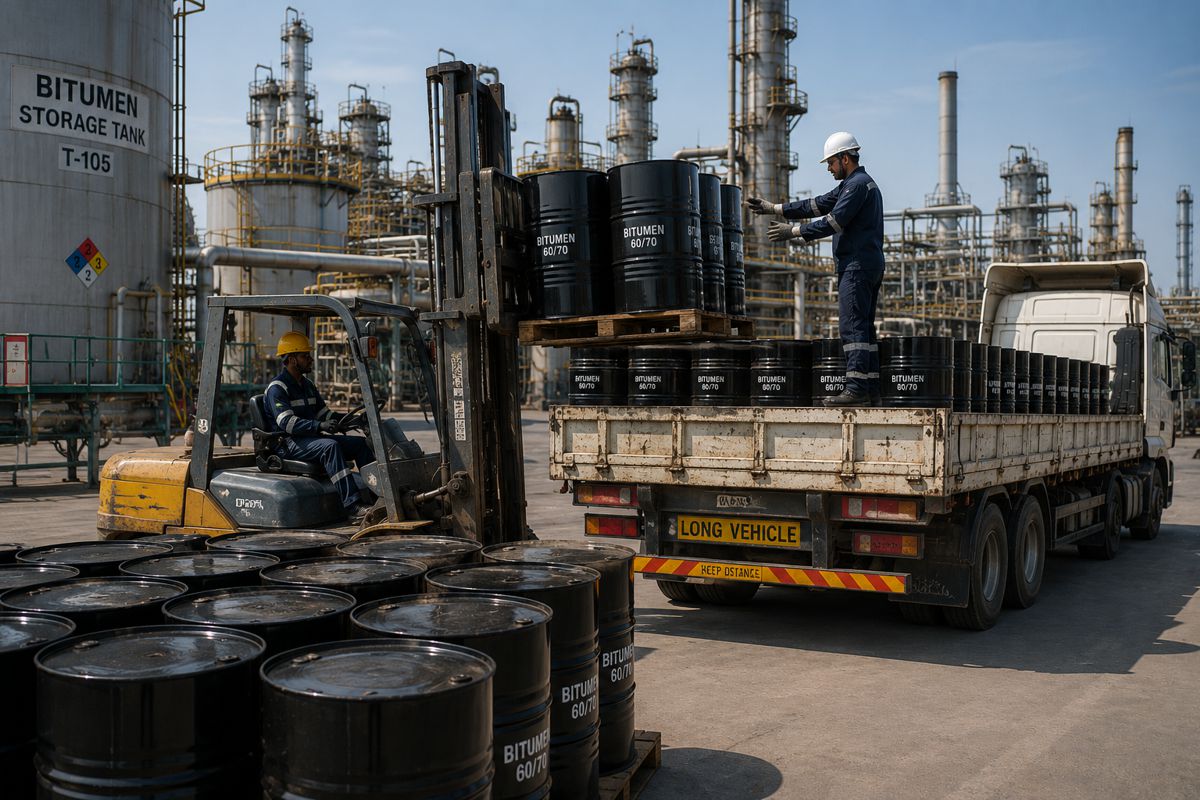
All of this turns binder specification into a governance issue as much as a materials issue. India’s IS 73 does not just define grade properties, it prescribes lot sampling scales ranging from three containers in small lots to ten in very large ones, and it requires specific tests on individual and composite samples.
Florida’s state materials manual goes further, requiring terminal-specific approval, specification compliance results from the supplier’s laboratory or an independent laboratory, a state verification sample, and a terminal QC plan before a PG binder is accepted for department projects. Those are not clerical details. They are examples of how serious agencies convert a binder description into a controlled supply system.
A mature specification also watches what happens after dispatch. South Africa’s national road specifications allow an engineer to order a spot test if overheating is suspected and permit rejection if the recovered binder exceeds the relevant n-heptane-xylene threshold. SABITA’s import guide stresses that imported bitumen quality control is difficult precisely because conformity is not secured at the point of purchase alone. Storage, blending stability, transport temperature, re-heating and sampling discipline all matter, especially where imported or modified products move through terminals before they ever reach the asphalt plant.
For buyers, then, the practical answer is not to hunt for a universal conversion chart and hope for the best. It is to specify the entire engineering envelope. In practice, that means naming the governing standard and edition, defining the relevant test methods, stating the ageing protocol, declaring whether modifiers are permitted or required, aligning the binder with pavement climate and traffic assumptions, and setting out the sampling and acceptance regime.
Where Europe’s EN system is used, the purchaser also needs to state whether regional clauses such as penetration index, Fraass or viscosity apply. Where PG is used, the purchaser must ensure the local laboratory ecosystem can actually verify DSR, BBR, PAV and MSCR requirements. That is a procurement discipline issue, not just a laboratory one.
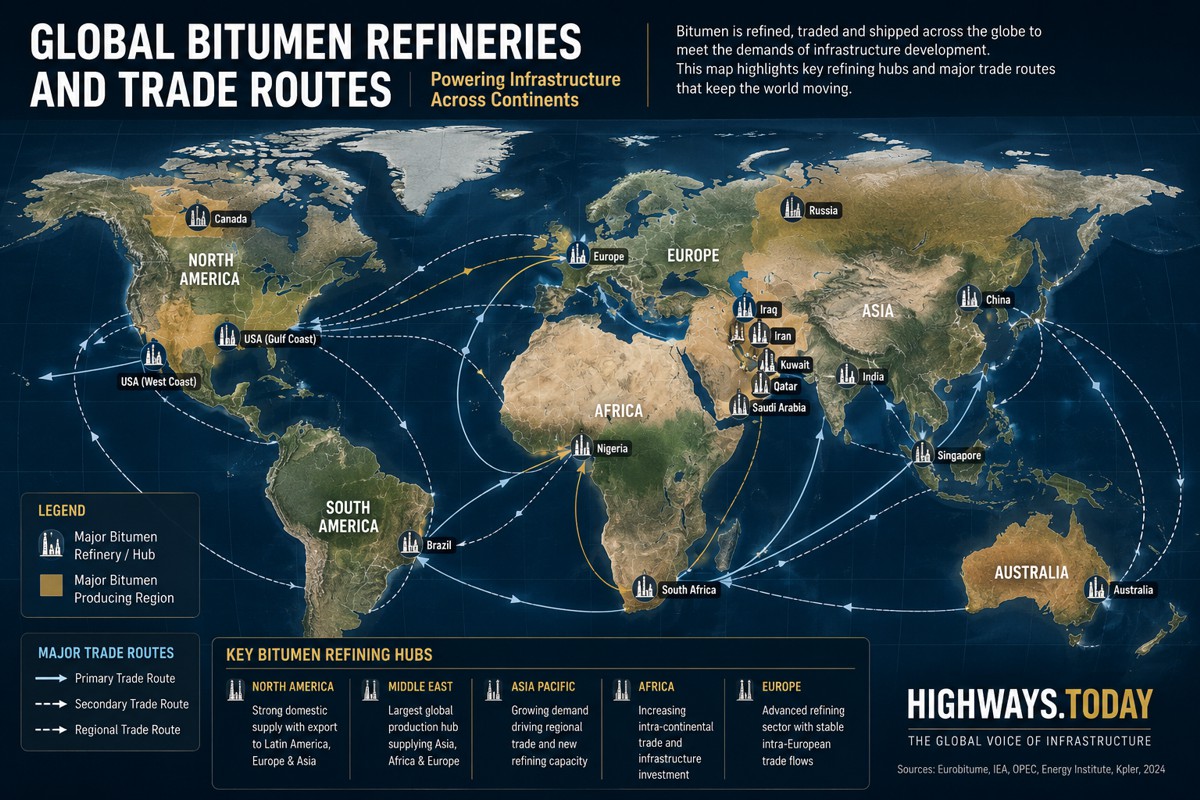
The global construction market is unlikely to settle on one binder language any time soon. Europe is still empirical at product-standard level, India remains viscosity-led, the US performance framework keeps evolving, China sits within the JTG family, Gulf agencies increasingly layer PG thinking onto very hot climates, and African road authorities operate through a live mix of imported standards, project amendments and donor-influenced practice.
So the right takeaway is not that one system is universally superior. It is that a grade name on its own is too thin a basis for serious buying. In international road construction, 60/70 is not a specification. It is the start of a conversation that has to end in named tests, quantified limits and credible quality assurance.
Further Reading and Industry References
- Eurobitume Technical Resources: Strong overview of European binder classifications, testing methods, EN standards and technical background.
- Eurobitume Global Bitumen Industry Perspective Report: Useful for market context, terminology and how specifications evolved globally.
- ASTM D946 Standard Specification for Penetration Graded Asphalt Binder: Core reference for traditional penetration grade systems including 60/70.
- ASTM D3381 Standard Specification for Viscosity Graded Asphalt Binder: Reference point for viscosity-based binder classification.
- AASHTO M320 Performance Graded Asphalt Binder: Essential reading for understanding Superpave and performance grading.
- Federal Highway Administration Superpave Performance Testing Guide: One of the best practical explanations of PG grading and performance testing.
- Bureau of Indian Standards IS 73 Paving Bitumen Specification: Explains India’s move from penetration grades toward viscosity grading.
- IndianOil Bitumen Technical Guide: Helpful real-world interpretation of VG grades and application guidance.
- Qatar Ashghal Pavement Design Guidelines: Good example of how Gulf countries apply PG systems in high-temperature environments.
- SABITA Bitumen Import Guide: Excellent practical reading on procurement, imports and quality assurance.
- Ministry of Transport China Highway Asphalt Standards Archive: Useful for readers wanting to understand the Chinese specification framework.
- Asphalt Institute Guidance on MSCR and Performance Grading: Strong supporting material for the article’s sections on advanced binder testing.