Abu Dhabi Launches Middle East’s First Adaptive Ramp Metering Network
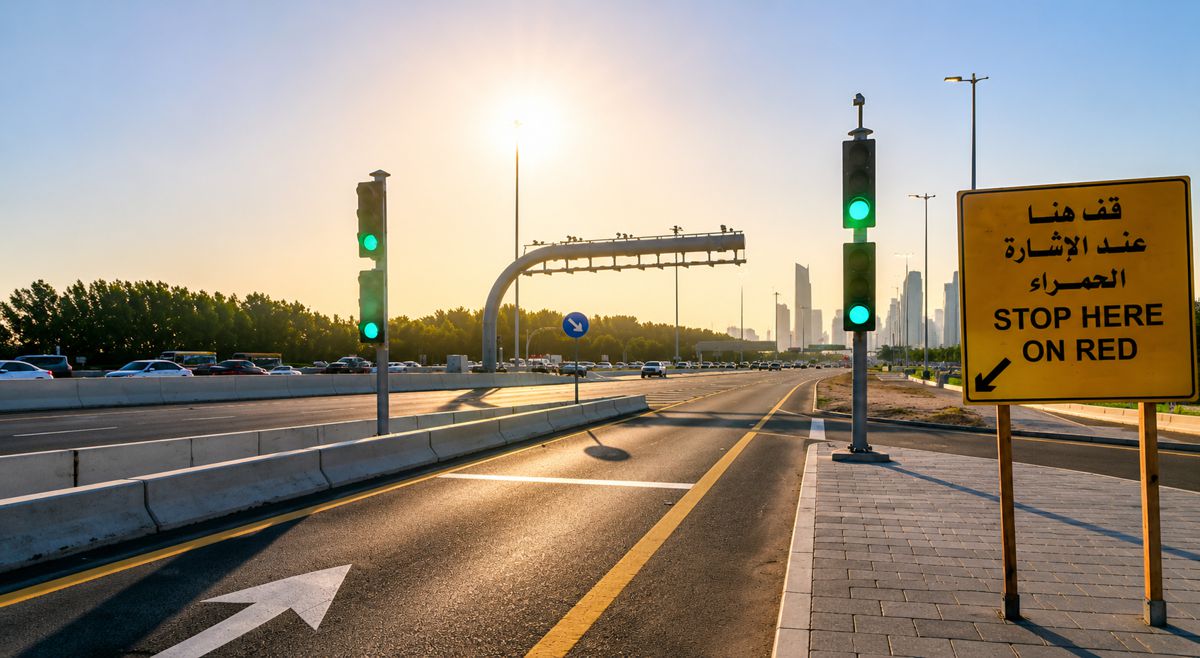
Abu Dhabi has taken a significant step in the evolution of intelligent transport systems with the deployment of the Middle East’s first adaptive ramp metering scheme on Sheikh Zayed bin Sultan Street. The project, delivered by Umovity in partnership with Tatweer and supported by ST Engineering, marks a notable shift in how rapidly growing cities in the United Arab Emirates and across the Gulf region are approaching congestion management, network efficiency and sustainable urban mobility.
Rather than relying on traditional traffic expansion projects alone, Abu Dhabi’s transport authorities are increasingly investing in digital infrastructure capable of extracting greater efficiency from existing road networks. That matters because urban congestion has become one of the defining economic and environmental challenges facing modern cities. According to research from the World Bank and International Transport Forum, traffic congestion can reduce urban economic productivity by billions annually through lost time, fuel wastage and supply chain inefficiencies. In fast-growing metropolitan regions such as Abu Dhabi, Riyadh and Dubai, managing traffic flow intelligently is rapidly becoming as important as building new highways.
Installed on one of Abu Dhabi’s busiest arterial corridors, the adaptive ramp metering system regulates vehicle entry onto the highway using live traffic conditions gathered from radar, video detection and embedded roadway sensors. Instead of allowing unrestricted surges of vehicles onto the motorway during peak demand, the system dynamically adjusts signal timings at on-ramps to smooth traffic flow before bottlenecks begin to form. The result is reduced stop-start congestion, more reliable travel times and lower vehicle emissions.
The deployment also reflects a broader transition underway across the Gulf Cooperation Council region, where governments are accelerating investments in smart city technologies, AI-enabled mobility systems and integrated digital infrastructure as part of wider economic diversification programmes. Abu Dhabi’s Integrated Transport Centre has already established itself as one of the region’s more advanced transport authorities in terms of data-driven traffic operations, and this project strengthens that position considerably.
Briefing
- Abu Dhabi has deployed the Middle East’s first adaptive ramp metering system on Sheikh Zayed bin Sultan Street
- The project combines technologies from Umovity, Tatweer and ST Engineering
- Real-time traffic monitoring allows dynamic regulation of vehicles entering the motorway network
- Estimated annual savings from reduced congestion delays are projected at approximately $2.6 million
- The system is designed for future integration with Abu Dhabi’s Intelligent Transport Central Platform and wider smart mobility strategy
Digital Traffic Control Moves Into the Spotlight
Ramp metering itself is hardly a new concept. Cities across North America, Europe and parts of Asia have been using controlled motorway entry systems for decades. However, the Abu Dhabi deployment is significant because it introduces adaptive ramp metering to the Middle East at a time when Gulf cities are dealing with rapidly increasing mobility demand, population growth and pressure on urban transport infrastructure.
Traditional fixed-time traffic control systems often struggle to respond effectively to sudden shifts in traffic demand. Adaptive systems, on the other hand, constantly analyse traffic density, queue lengths and speeds before making real-time operational adjustments. In practice, that means traffic entering the motorway network can be controlled with considerably greater precision.
For Sheikh Zayed bin Sultan Street, one of the capital’s most heavily trafficked corridors, that operational flexibility could have a substantial impact. Congestion on urban motorways creates a cascading effect across wider city networks, disrupting freight movements, commuter reliability and emergency response efficiency. By smoothing motorway inflows before saturation occurs, adaptive ramp metering helps stabilise overall network performance.
Transport authorities worldwide have increasingly recognised that congestion mitigation is no longer simply an engineering problem solved by adding lanes. In many mature urban environments, physical expansion options are limited, prohibitively expensive or environmentally difficult to justify. Intelligent traffic systems offer a comparatively faster and lower-cost alternative capable of improving network performance using data, automation and predictive analytics.
Integrating Multiple Technologies Into One Mobility Ecosystem
One of the more important aspects of the Abu Dhabi project lies in the level of systems integration behind the deployment. The solution combines field-proven traffic control hardware from Econolite with broader traffic management software capabilities delivered through ST Engineering’s TransCore TransSuite platform.
The deployment includes Econolite’s Cobalt controllers and EOS controller software for local real-time control. Meanwhile, the TransSuite platform provides centralised coordination, operational monitoring and network-level management functionality. Tatweer oversaw local engineering design, integration, commissioning and coordination with Abu Dhabi’s Integrated Transport Centre.
That integration matters because isolated smart traffic systems rarely deliver maximum value. Modern urban mobility strategies increasingly depend on interoperability between multiple platforms, including traffic control systems, predictive modelling software, incident management platforms, public transport operations and connected vehicle infrastructure.
The project was specifically designed to align with Abu Dhabi’s Intelligent Transport Central Platform, known as ITCP. The broader ITCP initiative integrates AI, predictive monitoring, network management and operational coordination into a unified transport environment intended to support more proactive traffic operations across the emirate.
Importantly, the deployment also sits within an existing technology ecosystem where software solutions from PTV Group are already widely used for traffic modelling, simulation and network prediction. That creates a scalable pathway for future network expansion without requiring wholesale replacement of existing systems.
Sustainability Benefits Extend Beyond Traffic Flow
Although congestion reduction is often framed primarily in terms of commuter frustration and travel reliability, the environmental implications are increasingly difficult to ignore. Stop-start traffic significantly increases fuel consumption and tailpipe emissions, particularly in high-temperature urban environments where vehicles spend extended periods idling.
According to the International Energy Agency, urban transport remains one of the largest contributors to energy-related emissions globally. Technologies capable of improving traffic efficiency without major construction activity therefore carry growing strategic importance for governments pursuing carbon reduction targets.
For Abu Dhabi, the environmental component aligns closely with broader national sustainability ambitions under the UAE’s long-term climate and economic diversification strategies. Smoother traffic flow can reduce unnecessary acceleration and braking cycles, lowering fuel burn and improving overall network efficiency.
There is also a financial dimension. The project estimates annual savings of up to $2.6 million in delay-related costs. While that figure represents direct congestion impacts, secondary economic benefits could extend further through improved logistics reliability, reduced commercial vehicle downtime and more predictable journey planning for businesses operating across the city.
In practical terms, intelligent traffic management systems are increasingly being viewed as economic infrastructure rather than simply transport technology. Efficient movement of goods, workers and services directly affects urban competitiveness, investor confidence and long-term productivity.
Delivering a Complex ITS Project in Six Months
Another notable aspect of the deployment is the delivery timeframe. The complete system was reportedly delivered within six months, including engineering, integration, deployment and commissioning activities.
That relatively rapid implementation highlights one of the major advantages of intelligent transport systems compared with conventional highway expansion projects. Digital traffic infrastructure can often be deployed incrementally, scaled progressively and integrated into existing road networks without years of major civil construction.
For rapidly urbanising cities facing immediate congestion pressures, that flexibility can prove highly attractive. Rather than waiting for large-scale road widening programmes or entirely new corridors, transport authorities can target operational bottlenecks with technology-led interventions capable of delivering measurable improvements relatively quickly.
Tatweer’s role in local delivery also reflects a wider shift taking place across the Middle East’s smart infrastructure sector. International technology providers increasingly depend on strong regional partners capable of managing local engineering requirements, stakeholder coordination and deployment logistics within complex regulatory environments.
That local execution capability often determines whether advanced mobility technologies succeed operationally or remain isolated pilot projects.
Intelligent Transport Systems Become Core Urban Infrastructure
Across the global transport sector, intelligent transport systems are steadily evolving from optional enhancements into core infrastructure components. The emergence of connected vehicles, autonomous mobility technologies and AI-driven traffic management is reshaping how cities think about transport operations.
Markets across Asia, the Middle East and Europe are investing heavily in digital mobility infrastructure designed to improve operational efficiency while supporting wider smart city ambitions. Analysts at MarketsandMarkets estimate the global intelligent transportation systems sector will continue expanding strongly through the decade as governments prioritise urban mobility modernisation.
For Gulf states in particular, intelligent mobility projects increasingly serve multiple objectives simultaneously. They improve urban efficiency, support sustainability targets, reinforce economic diversification goals and position regional cities as global technology leaders.
Abu Dhabi’s adaptive ramp metering project therefore represents more than a local traffic management upgrade. It signals how digital traffic operations are becoming embedded within broader urban planning and infrastructure strategies across the region.
Setting the Pace for Smarter Urban Mobility
The success of the Sheikh Zayed bin Sultan Street deployment will likely attract close attention from transport authorities elsewhere in the Gulf and wider Middle East. Cities facing mounting congestion pressures are searching for solutions that balance operational effectiveness, environmental performance and long-term scalability.
Adaptive ramp metering may not attract the same public attention as autonomous vehicles or futuristic transport concepts, yet its practical impact on everyday mobility can be substantial. Sometimes the most effective smart city technologies are the ones commuters barely notice because traffic simply moves more smoothly.
Nicholas Ghia, CEO of Umovity Software, stated that: “This project demonstrates the real strength of Umovity – combining Econolite’s field-proven traffic control technologies with a broader ecosystem of advanced traffic management and analytics capabilities. By delivering a solution that integrates seamlessly into Abu Dhabi’s existing mobility platform, we are enabling measurable impact – reducing congestion, improving travel reliability, and creating long-term value for the city. This is exactly the kind of collaborative, future-ready approach needed to scale intelligent transport systems.”
Dr. Atef Garib, Tatweer CEO, commented: “This deployment marks a significant milestone in Abu Dhabi’s journey toward intelligent, data-driven mobility. By combining world-class technology with deep regional execution expertise, we have delivered a solution that not only tackles today’s congestion challenges on one of our busiest corridors but also lays the foundation for the emirate’s long-term smart mobility ambitions. Our partnership with Umovity, and close alignment with local stakeholders, demonstrates what is possible when global innovation meets strong local delivery capability.”
As urban populations continue growing and transport networks come under increasing pressure, projects like this offer a glimpse of how cities may manage future mobility demands. Not through endless road expansion alone, but through increasingly intelligent, connected and adaptive transport infrastructure operating quietly behind the scenes.