Tennant Unveils X16 Robotic Sweeper for Modern Warehousing
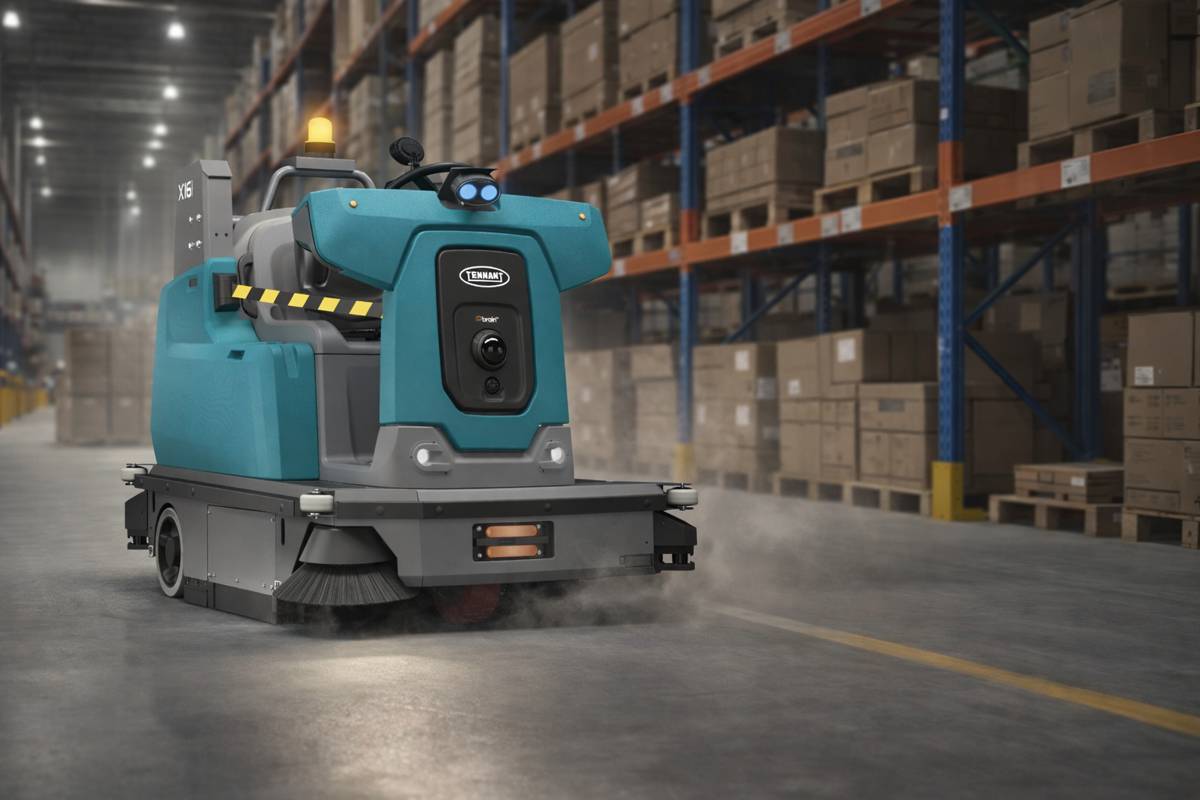
Automation has steadily reshaped industrial operations over the past decade, but one area often left behind has been large-scale floor maintenance. That’s beginning to change. Tennant Company has introduced the X16 SWEEP, positioning it as a fully autonomous robotic sweeper built specifically for the demands of warehouses, logistics hubs and light manufacturing environments.
For infrastructure operators and industrial asset owners, floor cleanliness is not merely cosmetic. Dust, debris and material residue can directly impact safety, equipment longevity and operational efficiency. Forklifts lose traction, sensors misread environments, and production lines suffer from contamination risks. As facilities grow in size and complexity, maintaining consistent cleaning coverage has become a logistical challenge that manual processes struggle to keep up with.
The arrival of purpose-built autonomous sweepers signals a shift in how industrial facilities approach maintenance. Rather than relying on intermittent manual cleaning cycles, operators are moving towards continuous, data-driven cleaning systems that integrate into wider automation strategies. The X16 SWEEP reflects that transition, offering repeatable performance designed to align with modern, high-throughput environments.
Briefing
- Tennant launches X16 SWEEP, an autonomous sweeper for warehouses, logistics and light industrial environments
- Built on Brain Corp’s BrainOS platform with AI-driven navigation and adaptive cleaning
- Supports continuous operations with autonomous charging and workflow-aware automation
- Designed to handle dust-heavy environments with specialised containment and sensor protection
- Marks the first product from Tennant’s newly formed autonomous robotics division
Automation Becomes Operational Infrastructure
Across global logistics and manufacturing, automation is no longer a pilot initiative or innovation project. It’s becoming foundational infrastructure. Warehousing giants, e-commerce operators and industrial manufacturers are investing heavily in robotics, AI-driven logistics systems and digital twins to optimise throughput and reduce operational risk.
Cleaning, historically treated as a secondary task, is now being drawn into that ecosystem. Facilities that operate around the clock can’t afford downtime for manual sweeping or inconsistent maintenance routines. In high-density environments, even minor debris can disrupt automated guided vehicles, robotic picking systems and sensor-based navigation platforms.
That’s where autonomous cleaning systems are gaining traction. By embedding cleaning into the same operational rhythm as production and logistics, facilities can maintain consistent conditions without interrupting workflows. The X16 SWEEP enters this space with a design tailored to dynamic, obstacle-rich environments rather than controlled or static settings.
Tennant’s move reflects a broader industry pattern. According to the International Federation of Robotics, the adoption of service robots in logistics and industrial environments continues to grow year-on-year, driven by labour shortages, rising costs and the need for predictable performance. Cleaning robots are increasingly part of that mix, particularly in large-scale facilities where manual labour is difficult to scale.
Building a Dedicated Robotics Capability
Earlier in the year, Tennant formalised its ambitions in automation by establishing a dedicated robotics organisation. Rather than treating robotics as an extension of existing product lines, the company has created an integrated structure spanning engineering, production, commercial strategy and customer support.
This approach matters. Autonomous systems are not simply hardware products. They require ongoing software updates, fleet management, deployment support and integration with existing operational systems. By consolidating these capabilities, Tennant is positioning itself to deliver not just machines, but complete autonomous cleaning solutions.
The X16 SWEEP is the first product to emerge from this structure, serving as both a commercial offering and a signal of intent. It demonstrates that Tennant is investing in long-term capability rather than incremental upgrades to traditional equipment.
For infrastructure stakeholders, that distinction is important. Procurement decisions are increasingly based on lifecycle performance, integration capability and scalability. A fragmented approach to robotics can lead to deployment challenges, while integrated platforms are better suited to enterprise-scale adoption.
AI Driven Cleaning for Dynamic Environments
At the core of the X16 SWEEP is the BrainOS autonomy platform developed by Brain Corp. This system provides the machine with visual intelligence, navigation capabilities and workflow awareness, enabling it to operate in environments where layouts and conditions change frequently.
Unlike pre-programmed cleaning machines that follow fixed routes, the X16 SWEEP uses AI-driven path planning to adapt in real time. Its SelfPath technology dynamically generates and refines cleaning routes, allowing the machine to respond to obstacles, shifting inventory layouts and varying levels of debris.
This level of adaptability is essential in industrial settings. Warehouses rarely maintain static configurations. Pallets move, aisles shift, and temporary obstructions are common. A machine that cannot adapt risks becoming inefficient or requiring constant human intervention.
By contrast, systems that can interpret their surroundings and adjust behaviour accordingly offer a more resilient solution. They reduce the need for manual oversight and maintain consistent performance even as conditions change. Over time, this can translate into measurable gains in productivity and operational reliability.
Engineering for Dust Heavy Industrial Conditions
One of the defining challenges in industrial cleaning is dust management. Fine particulate matter not only affects air quality but can also interfere with sensors and mechanical components. For autonomous systems, this presents a unique problem, as sensor reliability is critical to navigation and safety.
The X16 SWEEP addresses this through its DustShield system, which is designed to contain debris during operation and prevent dust from reaching sensitive components such as LiDAR sensors. Maintaining sensor clarity is essential for consistent navigation, particularly in environments where airborne particles are common.
This design consideration highlights an important aspect of industrial robotics. It’s not enough to adapt consumer or commercial technologies for industrial use. Equipment must be engineered specifically for harsh conditions, where dust, vibration and heavy usage are part of daily operations.
By focusing on these factors, Tennant is aligning the X16 SWEEP with the realities of industrial environments rather than idealised conditions. That alignment is likely to be a key factor in adoption, as operators prioritise reliability over novelty.
Supporting Continuous and Multi Shift Operations
Industrial facilities rarely operate on a single shift. Many run continuously, with cleaning requirements that extend across day and night cycles. Interruptions for maintenance or manual intervention can disrupt workflows and reduce overall efficiency.
To address this, the X16 SWEEP includes features aimed at supporting continuous operation. Its Smart-Sense hopper system provides real-time feedback on debris capacity, helping operators avoid unnecessary downtime. Meanwhile, the optional autonomous charging dock enables the machine to recharge between cleaning cycles without human involvement.
These capabilities move cleaning closer to a fully automated process. Rather than scheduling cleaning around operational downtime, facilities can integrate it into ongoing workflows. The result is a more consistent baseline of cleanliness, which in turn supports safer and more efficient operations.
From an infrastructure perspective, this aligns with broader trends towards predictive maintenance and continuous monitoring. Just as sensors track equipment performance in real time, autonomous cleaning systems can maintain environmental conditions without interruption.
Industry Perspective and Market Direction
The comments accompanying the launch reflect a broader shift in how industrial operators view automation. “Industrial customers are making more deliberate investments in automation as a core operational necessity,” said Pat Schottler, Senior Vice President, Robotics at Tennant Company. “We launched Tennant Company Robotics with a focus on advancing cleaning automation for those environments. The X16 SWEEP is the first of many products we’re bringing to market through Tennant Company Robotics, giving facilities a faster path to reliable autonomous cleaning that can keep pace with changing industrial conditions.”
That emphasis on necessity rather than experimentation is telling. Automation is no longer optional in many sectors. Labour shortages, cost pressures and the need for consistent performance are pushing operators towards technologies that can deliver predictable outcomes.
From the technology provider side, collaboration is also becoming more important. “Industrial leaders want enterprise-grade autonomy that’s easy to roll out, dependable day after day, and built for the realities of their busy spaces,” said Mark Garczewski, Chief Product Officer at Brain Corp. “We’re proud to accelerate Tennant’s vision for solving real customer problems at scale. By pairing Tennant’s industrial-grade design with the BrainOS® autonomy platform, the X16 SWEEP is the latest way we are helping enterprises deploy AI in the real world for more productive and reliable operations.”
This partnership model, combining hardware expertise with specialised AI platforms, is becoming increasingly common in industrial robotics. It allows companies to focus on their strengths while delivering integrated solutions that meet complex operational requirements.
A Practical Step Towards Autonomous Facilities
The introduction of the X16 SWEEP does not represent a radical leap in technology. Instead, it reflects a steady, pragmatic evolution of industrial operations. By addressing a specific operational need with a targeted autonomous solution, Tennant is contributing to a broader shift towards fully integrated, automated facilities.
For construction professionals, infrastructure planners and investors, the implications extend beyond cleaning. Autonomous systems are gradually embedding themselves into every aspect of industrial operations, from material handling to maintenance. Each incremental step builds towards a more connected, efficient and resilient operational model.
In that context, the X16 SWEEP can be seen as part of a larger transformation. It brings autonomous capability to an area that has traditionally relied on manual labour, aligning it with the wider automation ecosystem. As adoption grows, such systems are likely to become standard components of modern industrial infrastructure.